Pearson Edexcel · A-Level · Economics B
Course version: 9EB0 · Version from Sept 2015
D) Branding and differentiation in global markets
Full specification wording
Responding to global demand: d) Branding and differentiation in global markets
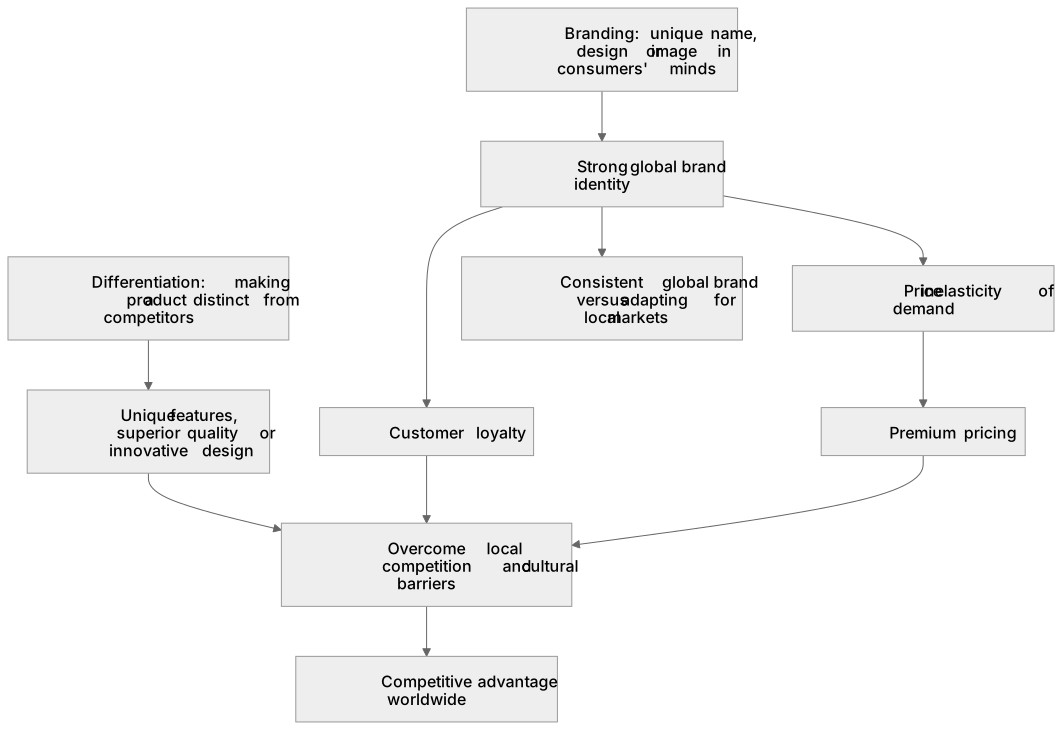
Branding in global markets involves creating a strong, recognisable identity that resonates across different countries, building customer loyalty and allowing for premium pricing.
Checked against the Pearson Edexcel 9EB0 specification (opens in a new tab) on .
- Point 4 of 4
- 2 key terms
Study notes
From the checked teaching notes for this specification point.
The idea
Branding in global markets involves creating a strong, recognisable identity that resonates across different countries, building customer loyalty and allowing for premium pricing. Differentiation is the process of distinguishing a product or service from competitors, which can be achieved through unique features, superior quality, or innovative design. In global markets, effective branding and differentiation help firms overcome local competition and cultural barriers.
For example: A technology company might differentiate its smartphones through a proprietary operating system and sleek design, while maintaining a consistent global brand image that conveys innovation and reliability, thus securing a competitive advantage worldwide.
What earns the marks
- Definition of branding as creating a unique name, design, or image for a product in the consumers' mind.
- Explanation of product differentiation as making a product distinct from competitors' offerings.
- Analysis of how strong global branding can lead to price inelasticity of demand and enable premium pricing.
- Evaluation of the costs and benefits of maintaining a consistent global brand versus adapting the brand for local markets.
Common mistakes and how to put them right
Treating branding and differentiation as the exact same concept.
Put it right: Branding is about the identity and perception of the business or product, while differentiation refers to the specific features that make the product unique.
Assuming global branding is cost-free.
Put it right: Building and maintaining a global brand requires significant investment in marketing and quality control.
Ignoring the impact of local culture on brand perception.
Put it right: A brand name or logo that is successful in one country may have negative connotations in another, requiring adaptation.
Exam tips
- Use real-world examples of global brands to illustrate how differentiation creates a competitive advantage.
- Discuss how effective branding can reduce the need for price competition in global markets.
- Evaluate the extent to which a firm can maintain a standardised global brand while still differentiating its products locally.
Try the lesson
The start of the Responding to global demand: d) Branding and differentiation in global markets lesson, made from checked teaching notes for this specification point.
Have a go first
What is the primary purpose of product differentiation in a global market?
Listen
Branding in global markets involves creating a strong, recognisable identity that resonates across different countries, building customer loyalty and allowing for premium pricing. Differentiation is the process of distinguishing a product or service from competitors, which can be achieved through unique features, superior quality, or innovative design. In global markets, effective branding and differentiation help firms overcome local competition and cultural barriers. For example, a technology company might differentiate its smartphones through a proprietary operating system and sleek design, while maintaining a consistent global brand image that conveys innovation and reliability, thus securing a competitive advantage worldwide. A strong answer earns marks for these points. Definition of branding as creating a unique name, design, or image for a product in the consumers' mind. Explanation of product differentiation as making a product distinct from competitors' offerings. Analysis of how strong global branding can lead to price inelasticity of demand and enable premium pricing. Evaluation of the costs and benefits of maintaining a consistent global brand versus adapting the brand for local markets. A common slip: Treating branding and differentiation as the exact same concept. Instead, Branding is about the identity and perception of the business or product, while differentiation refers to the specific features that make the product unique. Exam tip: Use real-world examples of global brands to illustrate how differentiation creates a competitive advantage.
See it
Key words
Say what each word means before you turn the card.
Branding
Try answering aloud or in your head before turning the card.
Product differentiation
Try answering aloud or in your head before turning the card.
See every definition
- Branding
- Creating a unique name, design, or image for a product in the consumers' mind.
- Product differentiation
- Making a product distinct from competitors' offerings through unique features, superior quality, or innovative design.
Label the diagram
Some boxes have lost their names. Pick the right name for each number.
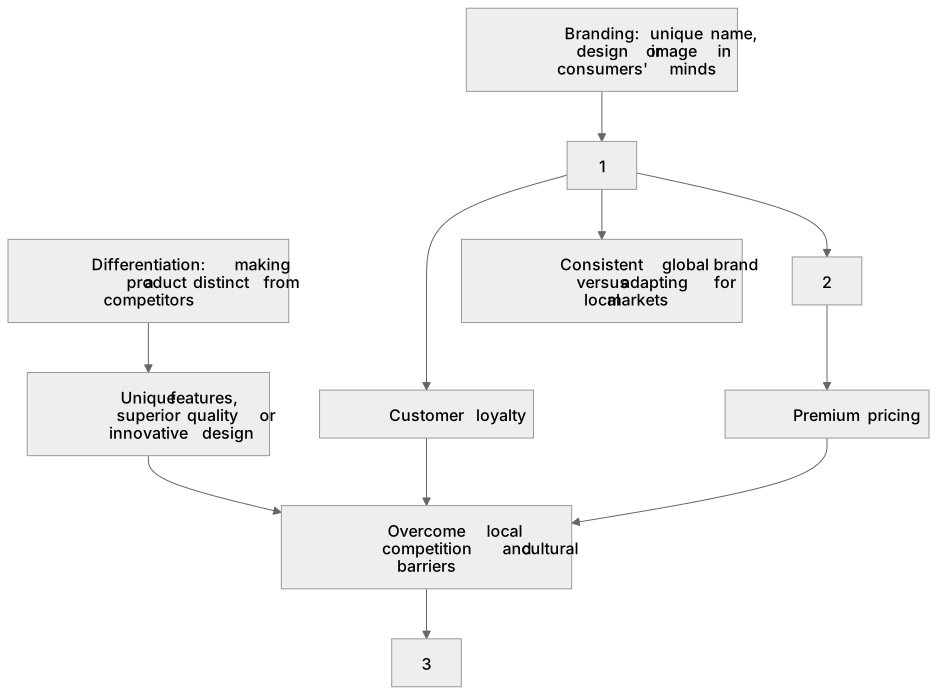
1Box 1
2Box 2
3Box 3
There is more to this lesson
The full lesson goes on to check your understanding and help you earn the marks. Create a free account to carry on, with your progress saved.
A week of Premium from your first lesson · Then the free plan continues · No card, no charge
Test your understanding of Responding to global demand: d) Branding and differentiation in global markets
Active recall beats re-reading. Take an instant quiz now to test what you’ve learned and lock it into long-term memory.
A week of Premium from your first lesson · Then the free plan continues · No card, no charge