Pearson Edexcel · A-Level · Economics B
Course version: 9EB0 · Version from Sept 2015
Revenue and costs: c) Calculation of percentage change
Percentage change is a fundamental mathematical skill in economics, used to compare the relative size of a change in a variable over time or between two scenarios.
Checked against the Pearson Edexcel 9EB0 specification (opens in a new tab) on .
- Point 3 of 3
Study notes
From the checked teaching notes for this specification point.
The idea
Percentage change is a fundamental mathematical skill in economics, used to compare the relative size of a change in a variable over time or between two scenarios. The formula is ((New Value - Original Value) / Original Value) × 100. For example, if a firm's total revenue increases from £50,000 to £60,000, the percentage change is ((60,000 - 50,000) / 50,000) × 100 = (10,000 / 50,000) × 100 = 20%. A positive result indicates an increase, while a negative result indicates a decrease. It is crucial to always divide by the original (or old) value, not the new value. This calculation is frequently applied to revenue, fixed costs, variable costs, and total costs to analyse business performance and make informed decisions.
What earns the marks
- Identify the original value and the new value from the given data.
- Calculate the absolute change by subtracting the original value from the new value.
- Divide the absolute change by the original value.
- Multiply the result by 100 to express it as a percentage.
- State the final answer with the correct sign (positive for increase, negative for decrease) and percentage symbol.
Common mistakes and how to put them right
Dividing by the new value instead of the original value.
Put it right: Ensure the denominator is the starting figure.
Forgetting to multiply by 100.
Put it right: Multiply the decimal by 100 to convert it to a percentage.
Ignoring negative signs when a value decreases.
Put it right: A decrease must be represented as a negative percentage or explicitly stated as a percentage fall.
Exam tips
- Always double-check which year or figure is the 'original' base year before calculating.
- Write down the formula and your working out, as credit may be awarded for the correct method even if the final answer is wrong.
- Pay attention to the units in the data (e.g. thousands or millions) to avoid place value errors in your absolute change calculation.
Try the lesson
The start of the Revenue and costs: c) Calculation of percentage change lesson, made from checked teaching notes for this specification point.
Have a go first
A retailer's weekly sales revenue increases from £40,000 to £48,000. What is the percentage change in sales revenue?
Listen
Percentage change is a fundamental mathematical skill in economics, used to compare the relative size of a change in a variable over time or between two scenarios. The formula is ((New Value - Original Value) / Original Value) × 100. For example, if a firm's total revenue increases from £50,000 to £60,000, the percentage change is ((60,000 - 50,000) / 50,000) × 100 = (10,000 / 50,000) × 100 = 20%. A positive result indicates an increase, while a negative result indicates a decrease. It is crucial to always divide by the original (or old) value, not the new value. This calculation is frequently applied to revenue, fixed costs, variable costs, and total costs to analyse business performance and make informed decisions. A strong answer earns marks for these points. Identify the original value and the new value from the given data. Calculate the absolute change by subtracting the original value from the new value. Divide the absolute change by the original value. Multiply the result by 100 to express it as a percentage. A common slip: Dividing by the new value instead of the original value. Instead, ensure the denominator is the starting figure. Exam tip: Always double-check which year or figure is the 'original' base year before calculating.
See it
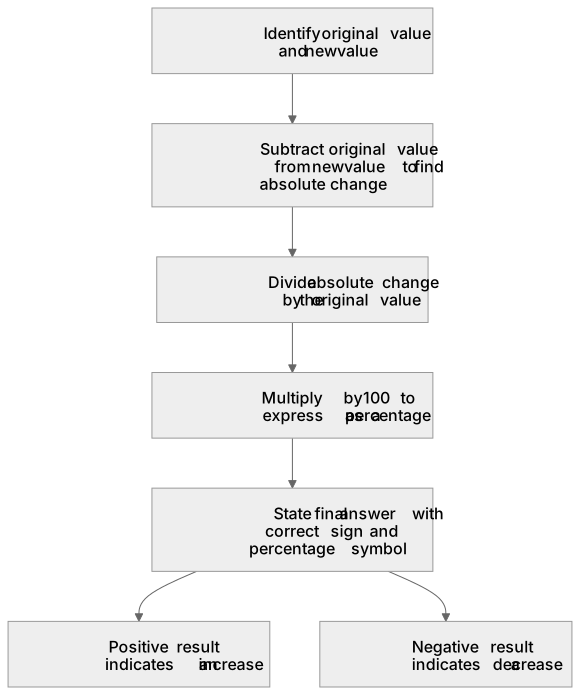
Label the diagram
Some boxes have lost their names. Pick the right name for each number.
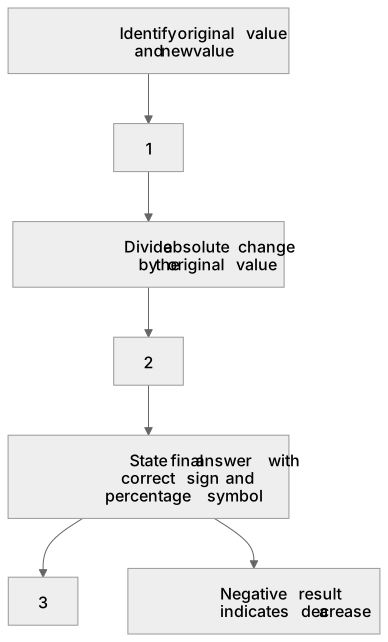
1Box 1
2Box 2
3Box 3
There is more to this lesson
The full lesson goes on to check your understanding and help you earn the marks. Create a free account to carry on, with your progress saved.
A week of Premium from your first lesson · Then the free plan continues · No card, no charge
Test your understanding of Revenue and costs: c) Calculation of percentage change
Active recall beats re-reading. Take an instant quiz now to test what you’ve learned and lock it into long-term memory.
A week of Premium from your first lesson · Then the free plan continues · No card, no charge