Pearson Edexcel · A-Level · Economics B
Course version: 9EB0 · Version from Sept 2015
Risks and uncertainty: a) The difference between risk and uncertainty
Full specification wording
Risks and uncertainty: a) The difference between risk and uncertainty
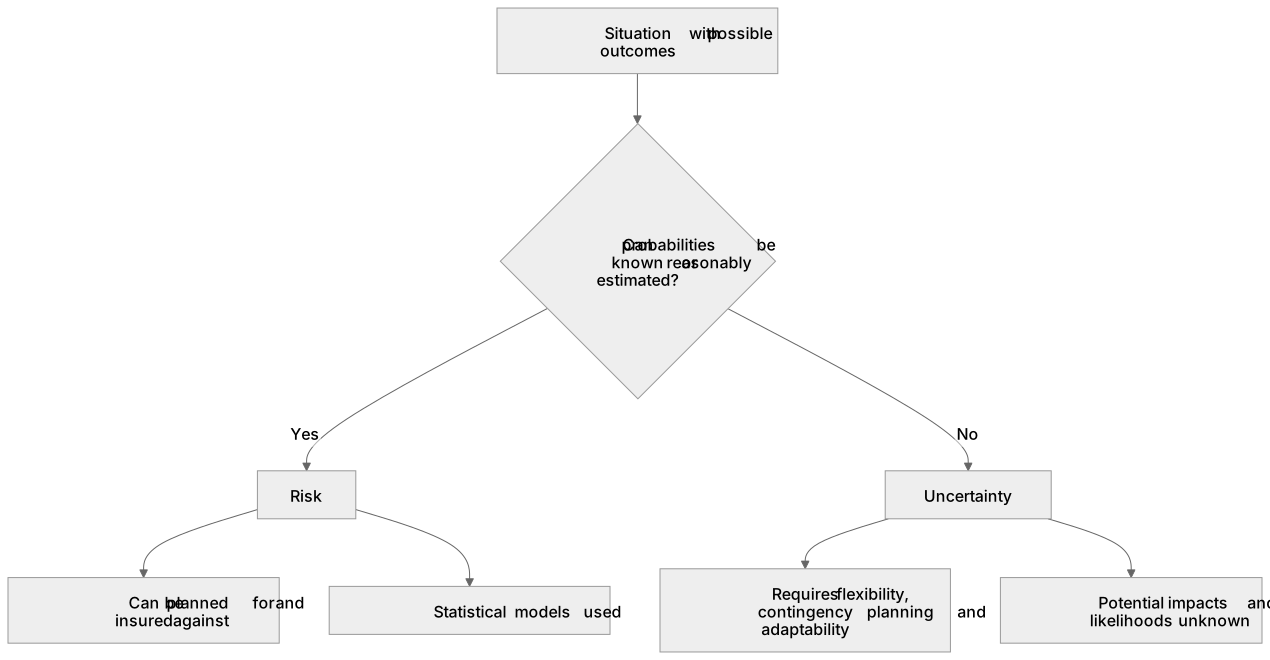
Risk refers to situations where the probabilities of different outcomes are known or can be reasonably estimated based on historical data.
Checked against the Pearson Edexcel 9EB0 specification (opens in a new tab) on .
- Point 1 of 4
- 3 key terms
Study notes
From the checked teaching notes for this specification point.
The idea
Risk refers to situations where the probabilities of different outcomes are known or can be reasonably estimated based on historical data. For example, an insurance company can calculate the risk of a car accident occurring for a specific demographic. Uncertainty, however, describes situations where the probabilities of outcomes cannot be quantified or predicted because the events are unprecedented or highly complex. A sudden global pandemic or a completely new technological disruption represents uncertainty. Businesses can plan for and insure against risk, but uncertainty requires flexibility, contingency planning, and adaptability, as the potential impacts and their likelihoods are unknown.
What earns the marks
- Define risk as a situation with quantifiable probabilities of various outcomes.
- Define uncertainty as a situation where outcomes and their probabilities cannot be quantified.
- Explain that risks can often be insured against or mitigated using statistical models.
- Explain that uncertainty requires strategic flexibility and contingency planning rather than precise calculation.
Common mistakes and how to put them right
Using risk and uncertainty interchangeably.
Put it right: Clearly distinguish that risk involves known probabilities, whereas uncertainty involves unknown probabilities.
Stating that businesses cannot prepare for uncertainty.
Put it right: Businesses can prepare for uncertainty through contingency planning and maintaining liquidity, even if they cannot insure against it.
Assuming all negative events are risks.
Put it right: Negative events with unquantifiable probabilities, like a sudden natural disaster in a non-prone area, are uncertainties.
Exam tips
- When evaluating business decisions, explicitly state whether the business is facing a quantifiable risk or an unquantifiable uncertainty.
- Use examples like insurance premiums to illustrate risk, and unprecedented market shocks to illustrate uncertainty.
- Consider how a business's attitude to risk affects its strategic choices in uncertain environments.
Try the lesson
The start of the Risks and uncertainty: a) The difference between risk and uncertainty lesson, made from checked teaching notes for this specification point.
Have a go first
In the context of business decision-making, which of the following best describes the fundamental difference between risk and uncertainty?
Listen
Risk refers to situations where the probabilities of different outcomes are known or can be reasonably estimated based on historical data. For example, an insurance company can calculate the risk of a car accident occurring for a specific demographic. Uncertainty, however, describes situations where the probabilities of outcomes cannot be quantified or predicted because the events are unprecedented or highly complex. A sudden global pandemic or a completely new technological disruption represents uncertainty. Businesses can plan for and insure against risk, but uncertainty requires flexibility, contingency planning, and adaptability, as the potential impacts and their likelihoods are unknown. A strong answer earns marks for these points. Define risk as a situation with quantifiable probabilities of various outcomes. Define uncertainty as a situation where outcomes and their probabilities cannot be quantified. Explain that risks can often be insured against or mitigated using statistical models. Explain that uncertainty requires strategic flexibility and contingency planning rather than precise calculation. A common slip: Using risk and uncertainty interchangeably. Instead, Clearly distinguish that risk involves known probabilities, whereas uncertainty involves unknown probabilities. Exam tip: When evaluating business decisions, explicitly state whether the business is facing a quantifiable risk or an unquantifiable uncertainty.
See it
Key words
Say what each word means before you turn the card.
Risk
Try answering aloud or in your head before turning the card.
Uncertainty
Try answering aloud or in your head before turning the card.
Contingency planning
Try answering aloud or in your head before turning the card.
See every definition
- Risk
- A situation where the probabilities of different outcomes are known or can be reasonably estimated based on historical data.
- Uncertainty
- A situation where the probabilities of outcomes cannot be quantified or predicted because the events are unprecedented or highly complex.
- Contingency planning
- A form of preparation that businesses can use to respond to uncertainty, alongside flexibility and adaptability, as potential impacts and their likelihoods are unknown.
There is more to this lesson
The full lesson goes on to check your understanding and help you earn the marks. Create a free account to carry on, with your progress saved.
A week of Premium from your first lesson · Then the free plan continues · No card, no charge
Test your understanding of Risks and uncertainty: a) The difference between risk and uncertainty
Active recall beats re-reading. Take an instant quiz now to test what you’ve learned and lock it into long-term memory.
A week of Premium from your first lesson · Then the free plan continues · No card, no charge