Pearson Edexcel · A-Level · Economics B
Course version: 9EB0 · Version from Sept 2015
Risks and uncertainty: c) Exchange rate risk and forward markets
Full specification wording
Risks and uncertainty: c) Exchange rate risk and forward markets
Exchange rate risk occurs when a business engages in international trade and faces potential financial losses due to adverse currency fluctuations between the time a contract is agreed and when…
Checked against the Pearson Edexcel 9EB0 specification (opens in a new tab) on .
- Point 3 of 4
- 3 key terms
Study notes
From the checked teaching notes for this specification point.
The idea
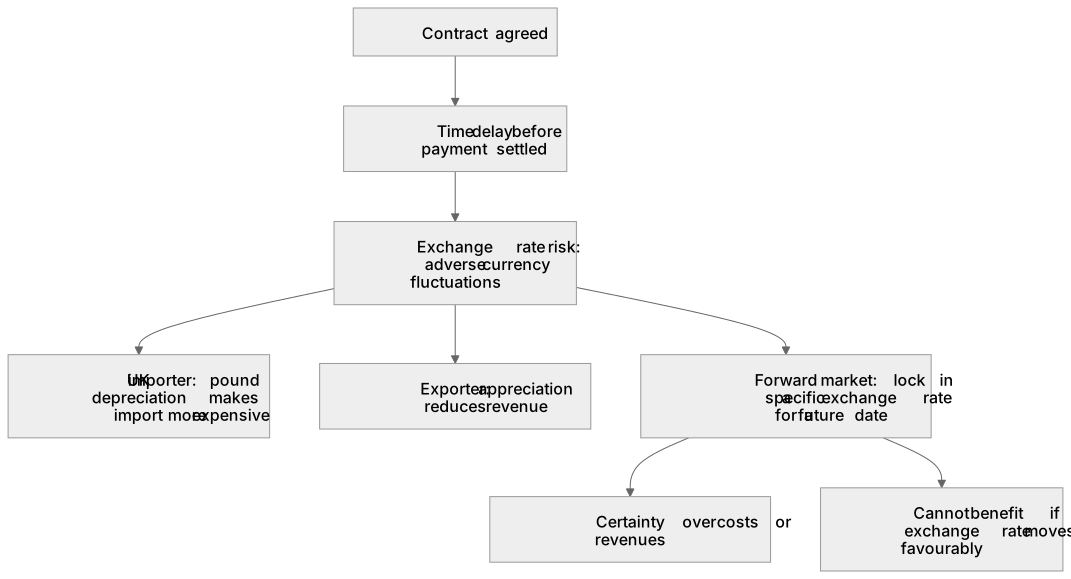
Exchange rate risk occurs when a business engages in international trade and faces potential financial losses due to adverse currency fluctuations between the time a contract is agreed and when payment is settled. For example, a UK importer agreeing to pay $100,000 in three months risks the pound depreciating, making the import more expensive in sterling. To mitigate this uncertainty, businesses use forward markets. A forward contract allows a firm to lock in a specific exchange rate for a future date, providing certainty over costs or revenues. While this eliminates the downside risk of adverse currency movements, it also means the business cannot benefit if the exchange rate moves in their favour.
What earns the marks
- Define exchange rate risk as the financial uncertainty arising from currency fluctuations during international transactions.
- Explain how a depreciation of the domestic currency increases costs for importers and an appreciation reduces revenue for exporters.
- Identify forward markets as financial markets where contracts are made to buy or sell currencies at a fixed rate on a specified future date.
- Evaluate the use of forward contracts as a hedging strategy that provides cost certainty but incurs fees and removes potential windfall gains.
Common mistakes and how to put them right
Believing forward contracts guarantee the best possible exchange rate.
Put it right: Forward contracts guarantee a fixed rate for certainty, not necessarily the most favourable rate if the market moves beneficially.
Confusing exchange rate risk with interest rate risk.
Put it right: Exchange rate risk relates to currency value fluctuations in international trade, whereas interest rate risk affects borrowing costs.
Assuming only exporters face exchange rate risk.
Put it right: Both importers and exporters face exchange rate risk, as currency movements can adversely affect costs and revenues respectively.
Exam tips
- Always link exchange rate risk to the time delay between agreeing a contract and the actual payment date.
- Use a numerical example in written answers to demonstrate how a forward contract protects a profit margin.
- Remember to weigh the cost of purchasing a forward contract against the financial protection it provides when evaluating risk management.
Try the lesson
The start of the Risks and uncertainty: c) Exchange rate risk and forward markets lesson, made from checked teaching notes for this specification point.
Have a go first
Which of the following best describes exchange rate risk for a business?
Listen
Exchange rate risk occurs when a business engages in international trade and faces potential financial losses due to adverse currency fluctuations between the time a contract is agreed and when payment is settled. For example, a UK importer agreeing to pay $100,000 in three months risks the pound depreciating, making the import more expensive in sterling. To mitigate this uncertainty, businesses use forward markets. A forward contract allows a firm to lock in a specific exchange rate for a future date, providing certainty over costs or revenues. While this eliminates the downside risk of adverse currency movements, it also means the business cannot benefit if the exchange rate moves in their favour. A strong answer earns marks for these points. Define exchange rate risk as the financial uncertainty arising from currency fluctuations during international transactions. Explain how a depreciation of the domestic currency increases costs for importers and an appreciation reduces revenue for exporters. Identify forward markets as financial markets where contracts are made to buy or sell currencies at a fixed rate on a specified future date. Evaluate the use of forward contracts as a hedging strategy that provides cost certainty but incurs fees and removes potential windfall gains. A common slip: Believing forward contracts guarantee the best possible exchange rate. Instead, Forward contracts guarantee a fixed rate for certainty, not necessarily the most favourable rate if the market moves beneficially. Exam tip: Always link exchange rate risk to the time delay between agreeing a contract and the actual payment date.
See it
Key words
Say what each word means before you turn the card.
Exchange rate risk
Try answering aloud or in your head before turning the card.
Forward markets
Try answering aloud or in your head before turning the card.
Forward contract
Try answering aloud or in your head before turning the card.
See every definition
- Exchange rate risk
- Financial uncertainty arising from currency fluctuations during international transactions, where a business faces potential financial losses between the time a contract is agreed and when payment is settled.
- Forward markets
- Financial markets where contracts are made to buy or sell currencies at a fixed rate on a specified future date.
- Forward contract
- An agreement that allows a firm to lock in a specific exchange rate for a future date, providing certainty over costs or revenues.
Label the diagram
Some boxes have lost their names. Pick the right name for each number.
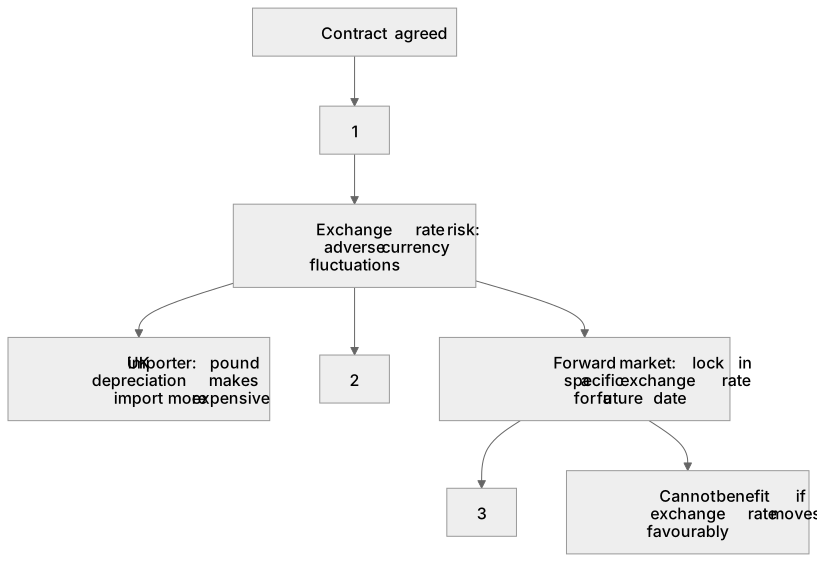
1Box 1
2Box 2
3Box 3
There is more to this lesson
The full lesson goes on to check your understanding and help you earn the marks. Create a free account to carry on, with your progress saved.
A week of Premium from your first lesson · Then the free plan continues · No card, no charge
Test your understanding of Risks and uncertainty: c) Exchange rate risk and forward markets
Active recall beats re-reading. Take an instant quiz now to test what you’ve learned and lock it into long-term memory.
A week of Premium from your first lesson · Then the free plan continues · No card, no charge