Pearson Edexcel · A-Level · Economics B
Course version: 9EB0 · Version from Sept 2015
A) Creative destruction (organising factors of production to create and…
Full specification wording
Role of an entrepreneur in the economy: a) Creative destruction (organising factors of production to create and set up an enterprise)
Creative destruction describes the process where new innovations and entrepreneurial activities replace outdated technologies and business models.
Checked against the Pearson Edexcel 9EB0 specification (opens in a new tab) on .
- Point 1 of 3
- 4 key terms
Study notes
From the checked teaching notes for this specification point.
The idea
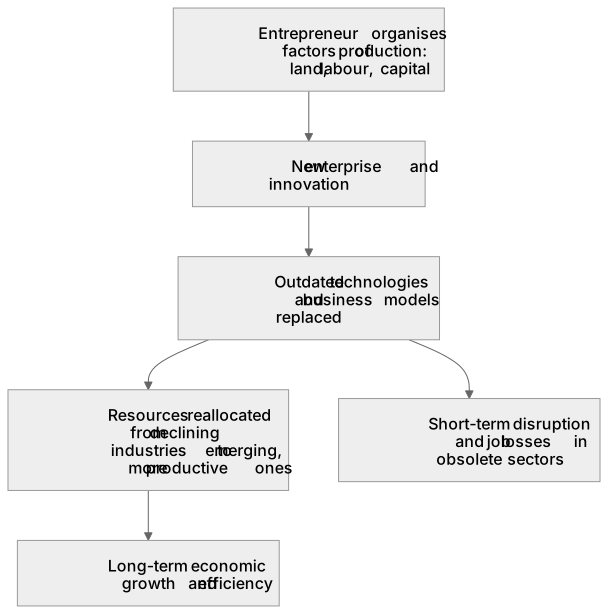
Creative destruction describes the process where new innovations and entrepreneurial activities replace outdated technologies and business models. Entrepreneurs play a crucial role by organising factors of production, such as land, labour and capital, to create and set up new enterprises. For example, the rise of digital streaming services organised software engineers and server infrastructure to deliver media, effectively destroying the traditional video rental market. This continuous cycle drives economic growth and efficiency, as resources are reallocated from declining industries to emerging, more productive ones, despite causing short-term disruption and job losses in obsolete sectors.
What earns the marks
- Definition of creative destruction as the dismantling of established practices to make way for innovation.
- Explanation of the entrepreneur's role in organising factors of production (land, labour, capital) to establish new enterprises.
- Recognition that creative destruction leads to the reallocation of scarce resources to more efficient uses.
- Understanding the dual impact: long-term economic growth versus short-term structural unemployment in declining industries.
Common mistakes and how to put them right
Viewing creative destruction purely as a negative force due to job losses.
Put it right: It is a vital driver of long-term economic growth, innovation, and improved living standards, despite short-term disruptions.
Forgetting to link the concept to the factors of production.
Put it right: Explain how entrepreneurs combine land, labour, and capital in novel ways to create new enterprises.
Confusing creative destruction with simple business failure.
Put it right: Creative destruction specifically involves failure driven by new, superior innovations replacing older methods.
Exam tips
- When discussing creative destruction, explicitly mention the four factors of production and how the entrepreneur organises them.
- Balance your analysis by acknowledging both the benefits, such as innovation and efficiency, and the costs, such as structural unemployment and business closures.
- Use clear historical or contemporary examples, such as digital photography replacing film, to demonstrate the concept in action.
Try the lesson
The start of the Role of an entrepreneur in the economy: a) Creative destruction (organising factors of production to create and set up an enterprise) lesson, made from checked teaching notes for this specification point.
Have a go first
When an entrepreneur introduces a revolutionary smartphone that makes older mobile phones and standalone digital cameras obsolete, they are demonstrating which specific economic process?
Listen
Creative destruction describes the process where new innovations and entrepreneurial activities replace outdated technologies and business models. Entrepreneurs play a crucial role by organising factors of production, such as land, labour and capital, to create and set up new enterprises. For example, the rise of digital streaming services organised software engineers and server infrastructure to deliver media, effectively destroying the traditional video rental market. This continuous cycle drives economic growth and efficiency, as resources are reallocated from declining industries to emerging, more productive ones, despite causing short-term disruption and job losses in obsolete sectors. A strong answer earns marks for these points. Definition of creative destruction as the dismantling of established practices to make way for innovation. Explanation of the entrepreneur's role in organising factors of production (land, labour, capital) to establish new enterprises. Recognition that creative destruction leads to the reallocation of scarce resources to more efficient uses. Understanding the dual impact: long-term economic growth versus short-term structural unemployment in declining industries. A common slip: Viewing creative destruction purely as a negative force due to job losses. Instead, It is a vital driver of long-term economic growth, innovation, and improved living standards, despite short-term disruptions. Exam tip: When discussing creative destruction, explicitly mention the four factors of production and how the entrepreneur organises them.
See it
Key words
Say what each word means before you turn the card.
Creative destruction
Try answering aloud or in your head before turning the card.
Entrepreneurship
Try answering aloud or in your head before turning the card.
Resource allocation
Try answering aloud or in your head before turning the card.
Economic growth
Try answering aloud or in your head before turning the card.
See every definition
- Creative destruction
- The process where new innovations and entrepreneurial activities replace outdated technologies and business models.
- Entrepreneurship
- Organising factors of production to create and set up an enterprise.
- Resource allocation
- The reallocation of scarce resources from declining industries to emerging, more productive ones.
- Economic growth
- A long-term outcome driven by the continuous cycle of innovation and efficiency, despite short-term disruption.
Label the diagram
Some boxes have lost their names. Pick the right name for each number.
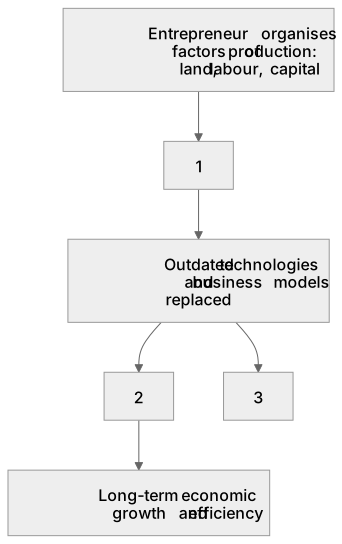
1Box 1
2Box 2
3Box 3
There is more to this lesson
The full lesson goes on to check your understanding and help you earn the marks. Create a free account to carry on, with your progress saved.
A week of Premium from your first lesson · Then the free plan continues · No card, no charge
Test your understanding of Role of an entrepreneur in the economy: a) Creative destruction (organising factors of production to create and set up an enterprise)
Active recall beats re-reading. Take an instant quiz now to test what you’ve learned and lock it into long-term memory.
A week of Premium from your first lesson · Then the free plan continues · No card, no charge