Pearson Edexcel · A-Level · Economics B
Course version: 9EB0 · Version from Sept 2015
A) Stakeholders (economic agents)
Full specification wording
Stakeholders (economic agents) and their objectives: a) Stakeholders (economic agents)
Stakeholders, or economic agents, are individuals, groups, or organisations that have a direct interest in the activities and performance of a business.
Checked against the Pearson Edexcel 9EB0 specification (opens in a new tab) on .
- Point 1 of 4
- 4 key terms
Study notes
From the checked teaching notes for this specification point.
The idea
Stakeholders, or economic agents, are individuals, groups, or organisations that have a direct interest in the activities and performance of a business. Internal stakeholders include employees, managers, and shareholders, who typically seek job security, high wages, and dividends. External stakeholders encompass customers, suppliers, the local community, and the government. Customers desire high-quality goods at low prices, while suppliers want prompt payment and regular orders. The government focuses on tax revenue and legal compliance. Understanding these agents is vital because their objectives often conflict; for example, shareholders wanting higher dividends might clash with employees demanding wage increases.
What earns the marks
- Define stakeholders (economic agents) as any group or individual with an interest in a business's operations.
- Distinguish between internal stakeholders (e.g., employees, shareholders) and external stakeholders (e.g., government, suppliers).
- Identify the specific objectives of different economic agents, such as customers seeking value for money or the government seeking tax revenue.
- Analyse potential conflicts of interest between different stakeholders, such as shareholders versus employees.
Common mistakes and how to put them right
Confusing stakeholders with shareholders.
Put it right: Shareholders own part of the business, whereas stakeholders include anyone affected by the business, such as the local community.
Assuming all stakeholders have the same objectives.
Put it right: Recognise that economic agents often have competing goals, leading to trade-offs in business decision-making.
Forgetting that the government is an economic agent.
Put it right: Include the government as a key external stakeholder interested in taxation, employment, and regulation.
Exam tips
- Always identify which specific stakeholder group is affected when analysing a business decision or economic policy.
- Use the concept of opportunity cost to explain why satisfying one economic agent might disadvantage another.
- When discussing stakeholder conflict, provide a concrete example, such as a firm cutting costs by using cheaper, more polluting materials, which pleases shareholders but harms the local community.
Try the lesson
The start of the Stakeholders (economic agents) and their objectives: a) Stakeholders (economic agents) lesson, made from checked teaching notes for this specification point.
Have a go first
Which of the following best describes a stakeholder in a business context?
Listen
Stakeholders, or economic agents, are individuals, groups, or organisations that have a direct interest in the activities and performance of a business. Internal stakeholders include employees, managers, and shareholders, who typically seek job security, high wages, and dividends. External stakeholders encompass customers, suppliers, the local community, and the government. Customers desire high-quality goods at low prices, while suppliers want prompt payment and regular orders. The government focuses on tax revenue and legal compliance. Understanding these agents is vital because their objectives often conflict; for example, shareholders wanting higher dividends might clash with employees demanding wage increases. A strong answer earns marks for these points. Define stakeholders (economic agents) as any group or individual with an interest in a business's operations. Distinguish between internal stakeholders (e.g., employees, shareholders) and external stakeholders (e.g., government, suppliers). Identify the specific objectives of different economic agents, such as customers seeking value for money or the government seeking tax revenue. Analyse potential conflicts of interest between different stakeholders, such as shareholders versus employees. A common slip: Confusing stakeholders with shareholders. Instead, shareholders own part of the business, whereas stakeholders include anyone affected by the business, such as the local community. Exam tip: Always identify which specific stakeholder group is affected when analysing a business decision or economic policy.
See it
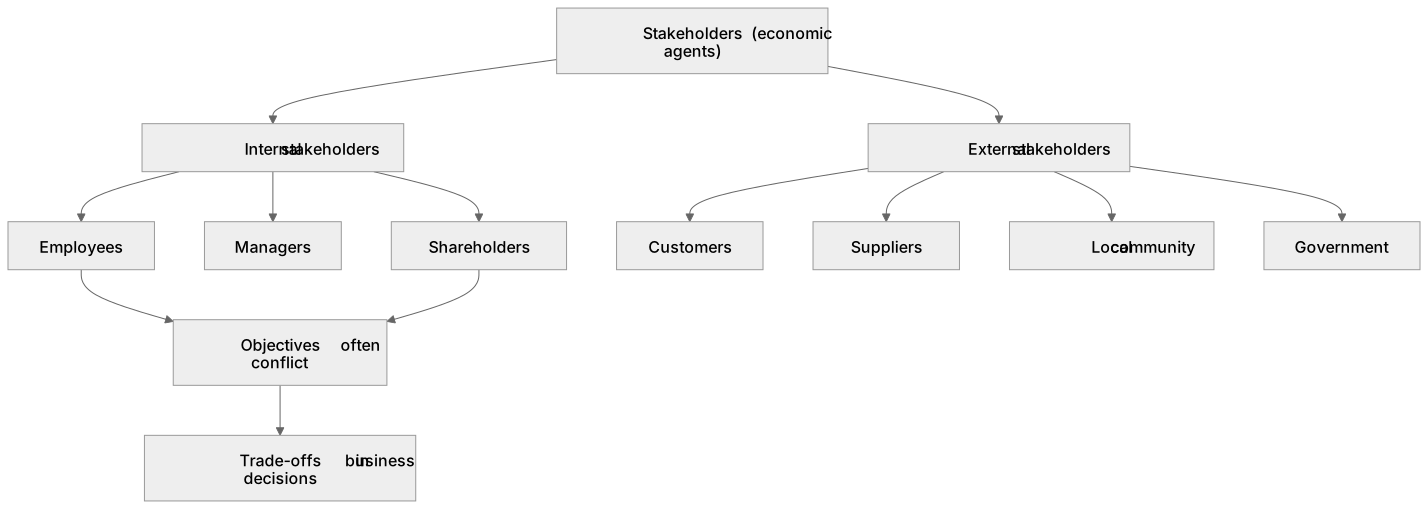
Key words
Say what each word means before you turn the card.
Stakeholders (economic agents)
Try answering aloud or in your head before turning the card.
Internal stakeholders
Try answering aloud or in your head before turning the card.
External stakeholders
Try answering aloud or in your head before turning the card.
Stakeholder conflict
Try answering aloud or in your head before turning the card.
See every definition
- Stakeholders (economic agents)
- Individuals, groups, or organisations that have a direct interest in the activities and performance of a business.
- Internal stakeholders
- Those within the business, including employees, managers, and shareholders, who typically seek job security, high wages, and dividends.
- External stakeholders
- Those outside the business, encompassing customers, suppliers, the local community, and the government.
- Stakeholder conflict
- A situation where the objectives of economic agents clash, such as shareholders wanting higher dividends while employees demand wage increases.
Label the diagram
Some boxes have lost their names. Pick the right name for each number.
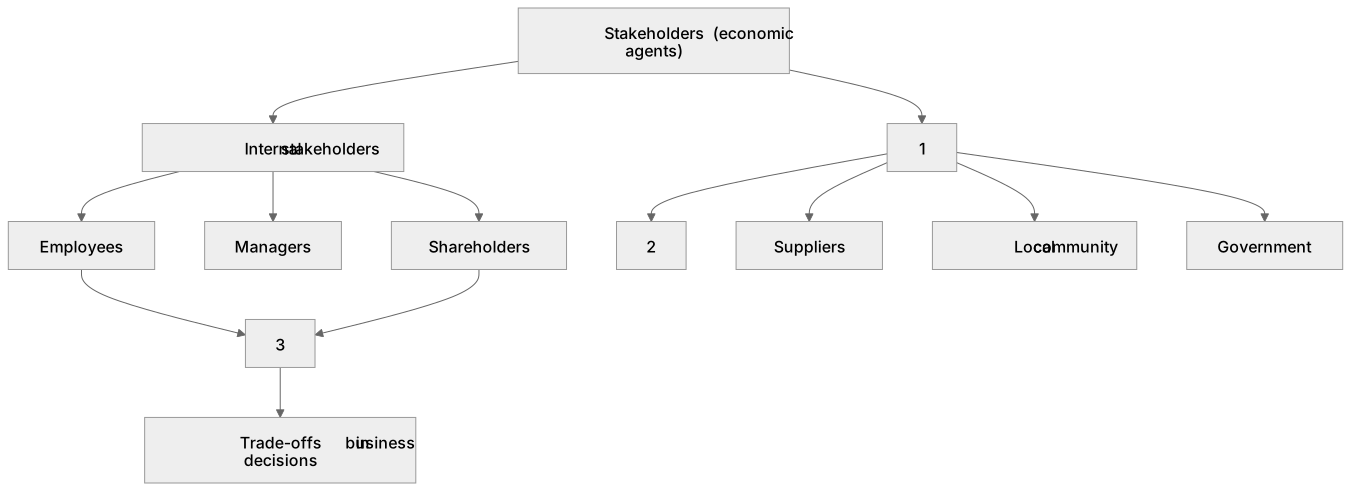
1Box 1
2Box 2
3Box 3
There is more to this lesson
The full lesson goes on to check your understanding and help you earn the marks. Create a free account to carry on, with your progress saved.
A week of Premium from your first lesson · Then the free plan continues · No card, no charge
Test your understanding of Stakeholders (economic agents) and their objectives: a) Stakeholders (economic agents)
Active recall beats re-reading. Take an instant quiz now to test what you’ve learned and lock it into long-term memory.
A week of Premium from your first lesson · Then the free plan continues · No card, no charge