Pearson Edexcel · A-Level · Economics B
Course version: 9EB0 · Version from Sept 2015
D) Corporate social responsibility
Full specification wording
Stakeholders (economic agents) and their objectives: d) Corporate social responsibility
Corporate social responsibility (CSR) refers to a business's commitment to manage its operations ethically and sustainably, considering its impact on various stakeholders beyond just shareholders.
Checked against the Pearson Edexcel 9EB0 specification (opens in a new tab) on .
- Point 4 of 4
Study notes
From the checked teaching notes for this specification point.
The idea
Corporate social responsibility (CSR) refers to a business's commitment to manage its operations ethically and sustainably, considering its impact on various stakeholders beyond just shareholders. This involves integrating social, environmental, and ethical concerns into business operations. For example, a clothing retailer might ensure its supply chain uses fair trade cotton and pays living wages, reducing environmental damage and improving worker welfare. While CSR can increase costs in the short term, it often aligns with long-term stakeholder objectives by enhancing brand reputation, attracting ethically minded consumers, and improving employee retention, thereby balancing profit motives with societal benefits.
What earns the marks
- Definition of CSR as a business approach that contributes to sustainable development by delivering economic, social, and environmental benefits.
- Identification of how CSR affects different stakeholders, such as employees, local communities, and the environment.
- Recognition of the trade-off between short-term profit maximisation and long-term CSR investments.
- Understanding that CSR can lead to competitive advantage through improved brand loyalty and corporate reputation.
Common mistakes and how to put them right
Assuming CSR is only about environmental sustainability.
Put it right: CSR encompasses social and ethical responsibilities too, such as fair labour practices and community engagement.
Believing CSR always reduces long-term profitability.
Put it right: While it may increase short-term costs, effective CSR often boosts long-term profitability through enhanced reputation and customer loyalty.
Confusing CSR with legal compliance.
Put it right: CSR involves voluntary actions that go beyond minimum legal requirements to benefit society.
Exam tips
- Always link CSR initiatives to specific stakeholder objectives, such as employees seeking better working conditions or local communities wanting reduced pollution.
- Use real-world examples of businesses implementing CSR to illustrate the potential benefits and drawbacks.
- Consider the opportunity cost of CSR investments when evaluating a firm's strategic decisions.
Try the lesson
The start of the Stakeholders (economic agents) and their objectives: d) Corporate social responsibility lesson, made from checked teaching notes for this specification point.
Have a go first
A multinational corporation adopts a policy to reduce its carbon emissions to net-zero and invest in local community education programmes. Which specific business objective is this corporation primarily pursuing?
Listen
Corporate social responsibility (CSR) refers to a business's commitment to manage its operations ethically and sustainably, considering its impact on various stakeholders beyond just shareholders. This involves integrating social, environmental, and ethical concerns into business operations. For example, a clothing retailer might ensure its supply chain uses fair trade cotton and pays living wages, reducing environmental damage and improving worker welfare. While CSR can increase costs in the short term, it often aligns with long-term stakeholder objectives by enhancing brand reputation, attracting ethically minded consumers, and improving employee retention, thereby balancing profit motives with societal benefits. A strong answer earns marks for these points. Definition of CSR as a business approach that contributes to sustainable development by delivering economic, social, and environmental benefits. Identification of how CSR affects different stakeholders, such as employees, local communities, and the environment. Recognition of the trade-off between short-term profit maximisation and long-term CSR investments. Understanding that CSR can lead to competitive advantage through improved brand loyalty and corporate reputation. A common slip: Assuming CSR is only about environmental sustainability. Instead, CSR encompasses social and ethical responsibilities too, such as fair labour practices and community engagement. Exam tip: Always link CSR initiatives to specific stakeholder objectives, such as employees seeking better working conditions or local communities wanting reduced pollution.
See it
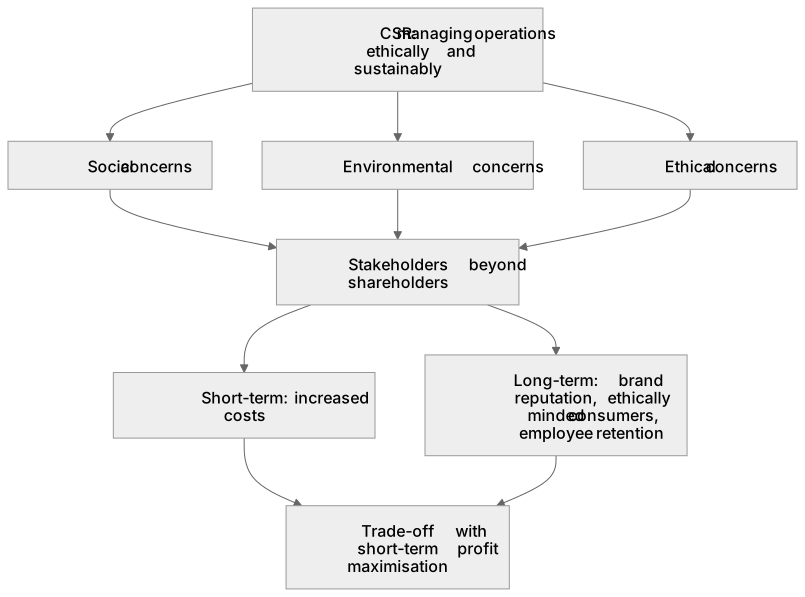
Label the diagram
Some boxes have lost their names. Pick the right name for each number.
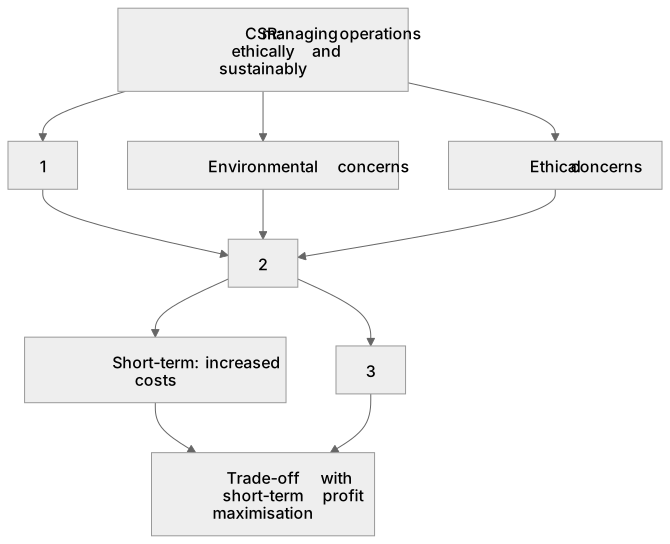
1Box 1
2Box 2
3Box 3
There is more to this lesson
The full lesson goes on to check your understanding and help you earn the marks. Create a free account to carry on, with your progress saved.
A week of Premium from your first lesson · Then the free plan continues · No card, no charge
Test your understanding of Stakeholders (economic agents) and their objectives: d) Corporate social responsibility
Active recall beats re-reading. Take an instant quiz now to test what you’ve learned and lock it into long-term memory.
A week of Premium from your first lesson · Then the free plan continues · No card, no charge