Pearson Edexcel · A-Level · Economics B
Course version: 9EB0 · Version from Sept 2015
The AD/AS model: e) The multiplier effect
The multiplier effect occurs when an initial injection into the circular flow of income leads to a proportionately larger final increase in real national income.
Checked against the Pearson Edexcel 9EB0 specification (opens in a new tab) on .
- Point 5 of 5
Study notes
From the checked teaching notes for this specification point.
The idea
The multiplier effect occurs when an initial injection into the circular flow of income leads to a proportionately larger final increase in real national income. For example, if the government spends £100 million on infrastructure, construction workers receive this as income. They then spend a portion of it in local businesses, generating further income for shop owners, who in turn spend their earnings. The size of the multiplier depends on the marginal propensity to consume (MPC) and the rate of leakages (saving, taxation, and imports). A higher MPC results in a larger multiplier effect, shifting the aggregate demand (AD) curve further to the right than the initial injection.
What earns the marks
- Define the multiplier effect as the ratio of the final change in income to the initial change in injection.
- Identify the formula for the multiplier, such as 1 / (1 - MPC) or 1 / MPW (where MPW is the marginal propensity to withdraw).
- Explain how an initial injection (investment, government spending, or exports) stimulates further rounds of spending.
- Illustrate the multiplier effect on an AD/AS diagram by showing an initial shift in AD followed by a secondary shift.
Common mistakes and how to put them right
Confusing the multiplier effect with the accelerator effect.
Put it right: The multiplier relates to how injections affect national income, whereas the accelerator relates to how changes in national income affect investment.
Assuming the multiplier is always a positive whole number.
Put it right: It can be a fraction if leakages are extremely high, and it can also operate in reverse (a negative multiplier) when injections fall.
Forgetting that the final impact on real GDP depends on the shape of the AS curve.
Put it right: If the economy is at full capacity, the multiplier effect will largely result in inflation rather than increased real output.
Exam tips
- Always state the formula for the multiplier when explaining its impact on the economy.
- Use a step-by-step example of income being spent and re-spent to demonstrate your understanding of the transmission mechanism.
- Evaluate the effectiveness of the multiplier by referencing the current state of the economy, such as the level of spare capacity.
Try the lesson
The start of the The AD/AS model: e) The multiplier effect lesson, made from checked teaching notes for this specification point.
Have a go first
A government decides to build a new railway, injecting £2 billion into the economy. This initial spending generates additional income for construction workers, who then spend a proportion of their earnings in local businesses, leading to a total increase in aggregate demand of £5 billion. Which economic concept is demonstrated by this process?
Listen
The multiplier effect occurs when an initial injection into the circular flow of income leads to a proportionately larger final increase in real national income. For example, if the government spends £100 million on infrastructure, construction workers receive this as income. They then spend a portion of it in local businesses, generating further income for shop owners, who in turn spend their earnings. The size of the multiplier depends on the marginal propensity to consume (MPC) and the rate of leakages (saving, taxation, and imports). A higher MPC results in a larger multiplier effect, shifting the aggregate demand (AD) curve further to the right than the initial injection. A strong answer earns marks for these points. Define the multiplier effect as the ratio of the final change in income to the initial change in injection. Identify the formula for the multiplier, such as 1 / (1 - MPC) or 1 / MPW (where MPW is the marginal propensity to withdraw). Explain how an initial injection (investment, government spending, or exports) stimulates further rounds of spending. Illustrate the multiplier effect on an AD/AS diagram by showing an initial shift in AD followed by a secondary shift. A common slip: Confusing the multiplier effect with the accelerator effect. Instead, The multiplier relates to how injections affect national income, whereas the accelerator relates to how changes in national income affect investment. Exam tip: Always state the formula for the multiplier when explaining its impact on the economy.
See it
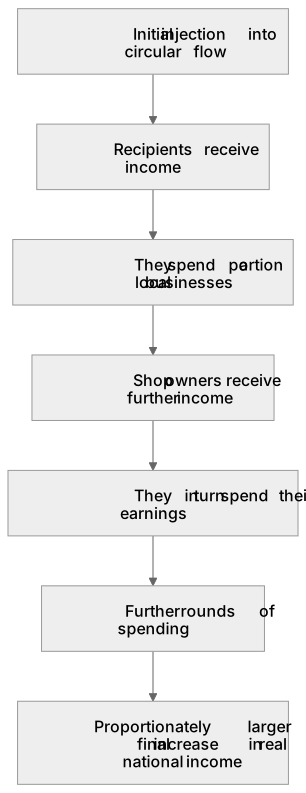
Put it in order
Put these steps in the order they happen.
- 1. Proportionately larger final increase in real national income
- 2. Further rounds of spending
- 3. They spend a portion in local businesses
- 4. They in turn spend their earnings
- 5. Initial injection into circular flow
- 6. Recipients receive income
- 7. Shop owners receive further income
Label the diagram
Some boxes have lost their names. Pick the right name for each number.
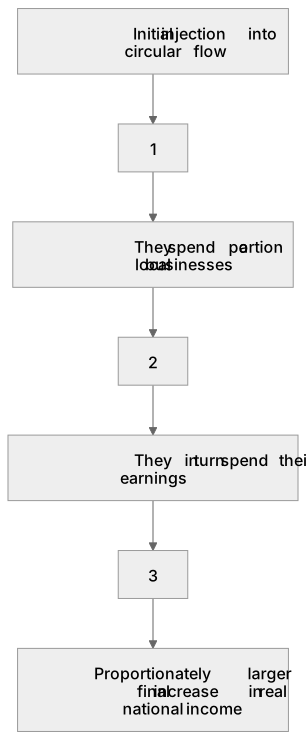
1Box 1
2Box 2
3Box 3
There is more to this lesson
The full lesson goes on to check your understanding and help you earn the marks. Create a free account to carry on, with your progress saved.
A week of Premium from your first lesson · Then the free plan continues · No card, no charge
Test your understanding of The AD/AS model: e) The multiplier effect
Active recall beats re-reading. Take an instant quiz now to test what you’ve learned and lock it into long-term memory.
A week of Premium from your first lesson · Then the free plan continues · No card, no charge