Pearson Edexcel · A-Level · Economics B
Course version: 9EB0 · Version from Sept 2015
B) Impact of MNCs on the national economy: o economic growth o FDI flows o…
Full specification wording
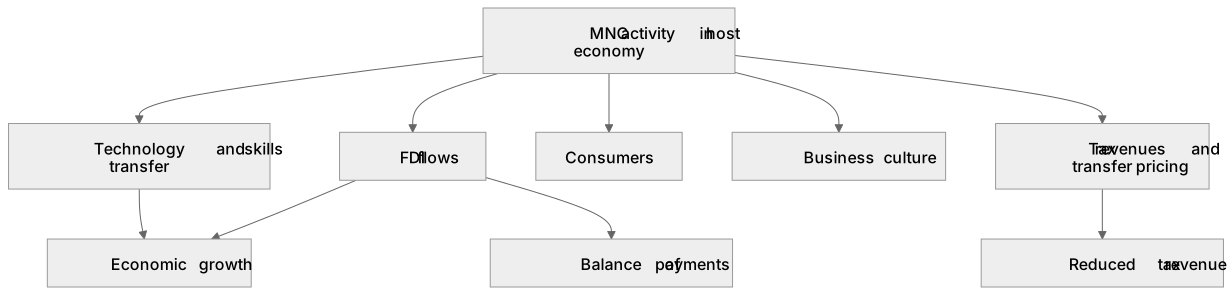
The impact of multinational corporations (MNCs): b) Impact of MNCs on the national economy: o economic growth o FDI flows o balance of payments o technology and skills transfer o consumers o business culture o tax revenues and transfer pricing
Multinational corporations (MNCs) significantly impact host national economies.
Checked against the Pearson Edexcel 9EB0 specification (opens in a new tab) on .
- Point 2 of 2
- 3 key terms
Study notes
From the checked teaching notes for this specification point.
The idea
Multinational corporations (MNCs) significantly impact host national economies. They stimulate economic growth through foreign direct investment (FDI) flows, creating jobs and boosting aggregate demand. MNCs affect the balance of payments; initial FDI improves the financial account, while exports improve the current account, though profit repatriation worsens it. They facilitate technology and skills transfer, enhancing local human capital. Consumers benefit from greater choice and lower prices. MNCs can alter local business culture by introducing new management practices. However, they may reduce host country tax revenues through transfer pricing, artificially shifting profits to low-tax jurisdictions by manipulating internal component prices.
What earns the marks
- FDI by MNCs injects capital into the host economy, creating employment and generating a positive multiplier effect on economic growth.
- The initial inward FDI improves the host country's financial account, while subsequent exports of manufactured goods improve the current account.
- MNCs can introduce advanced technology and modern management practices, which transfer to local workers and improve overall productivity.
- Transfer pricing allows MNCs to manipulate internal prices to declare profits in low-tax jurisdictions, reducing the tax revenue collected by the host nation.
Common mistakes and how to put them right
Assuming FDI only affects the current account.
Put it right: Initial FDI flows are recorded in the financial account, while resulting profits and exports affect the current account.
Believing transfer pricing always benefits the host country.
Put it right: Transfer pricing is often used to shift profits out of the host country to reduce tax liabilities.
Stating that MNCs always improve local business culture.
Put it right: MNCs can sometimes impose incompatible foreign working practices that clash with local business culture.
Exam tips
- When evaluating the impact of MNCs, contrast the short-term benefits of FDI with the long-term costs of profit repatriation.
- Use transfer pricing as a key analytical point when discussing why host governments might struggle to increase tax revenues despite MNC presence.
- Consider the impact on consumers in terms of both price and choice, but balance this against the potential monopoly power of large MNCs.
Try the lesson
The start of the The impact of multinational corporations (MNCs): b) Impact of MNCs on the national economy: o economic growth o FDI flows o balance of payments o technology and skills transfer o consumers o business culture o tax revenues and transfer pricing lesson, made from checked teaching notes for this specification point.
Have a go first
How does the practice of transfer pricing by a multinational corporation (MNC) typically affect the tax revenues of a host country with relatively high corporation tax rates?
Listen
Multinational corporations (MNCs) significantly impact host national economies. They stimulate economic growth through foreign direct investment (FDI) flows, creating jobs and boosting aggregate demand. MNCs affect the balance of payments; initial FDI improves the financial account, while exports improve the current account, though profit repatriation worsens it. They facilitate technology and skills transfer, enhancing local human capital. Consumers benefit from greater choice and lower prices. MNCs can alter local business culture by introducing new management practices. However, they may reduce host country tax revenues through transfer pricing, artificially shifting profits to low-tax jurisdictions by manipulating internal component prices. A strong answer earns marks for these points. FDI by MNCs injects capital into the host economy, creating employment and generating a positive multiplier effect on economic growth. The initial inward FDI improves the host country's financial account, while subsequent exports of manufactured goods improve the current account. MNCs can introduce advanced technology and modern management practices, which transfer to local workers and improve overall productivity. Transfer pricing allows MNCs to manipulate internal prices to declare profits in low-tax jurisdictions, reducing the tax revenue collected by the host nation. A common slip: Assuming FDI only affects the current account. Instead, initial FDI flows are recorded in the financial account, while resulting profits and exports affect the current account. Exam tip: When evaluating the impact of MNCs, contrast the short-term benefits of FDI with the long-term costs of profit repatriation.
See it
Key words
Say what each word means before you turn the card.
Foreign direct investment
Try answering aloud or in your head before turning the card.
Economic growth
Try answering aloud or in your head before turning the card.
Balance of payments
Try answering aloud or in your head before turning the card.
See every definition
- Foreign direct investment
- Capital injected into the host economy by MNCs, creating employment and generating a positive multiplier effect on economic growth.
- Economic growth
- Stimulated by MNCs through foreign direct investment flows, creating jobs and boosting aggregate demand.
- Balance of payments
- Affected by MNCs, as initial FDI improves the financial account while exports improve the current account, though profit repatriation worsens it.
Label the diagram
Some boxes have lost their names. Pick the right name for each number.
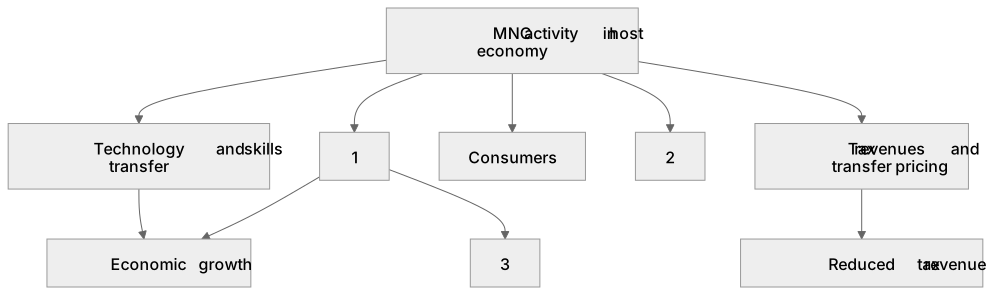
1Box 1
2Box 2
3Box 3
There is more to this lesson
The full lesson goes on to check your understanding and help you earn the marks. Create a free account to carry on, with your progress saved.
A week of Premium from your first lesson · Then the free plan continues · No card, no charge
Test your understanding of The impact of multinational corporations (MNCs): b) Impact of MNCs on the national economy: o economic growth o FDI flows o balance of payments o technology and skills transfer o consumers o business culture o tax revenues and transfer pricing
Active recall beats re-reading. Take an instant quiz now to test what you’ve learned and lock it into long-term memory.
A week of Premium from your first lesson · Then the free plan continues · No card, no charge