Pearson Edexcel · A-Level · Economics B
Course version: 9EB0 · Version from Sept 2015
A) The role of the Monetary Policy Committee in setting the official…
Full specification wording
The role of the central bank: a) The role of the Monetary Policy Committee in setting the official interest (base) rate
The Monetary Policy Committee (MPC) of the Bank of England is responsible for setting the official interest rate, also known as the base rate.
Checked against the Pearson Edexcel 9EB0 specification (opens in a new tab) on .
- Point 1 of 4
- 3 key terms
Study notes
From the checked teaching notes for this specification point.
The idea
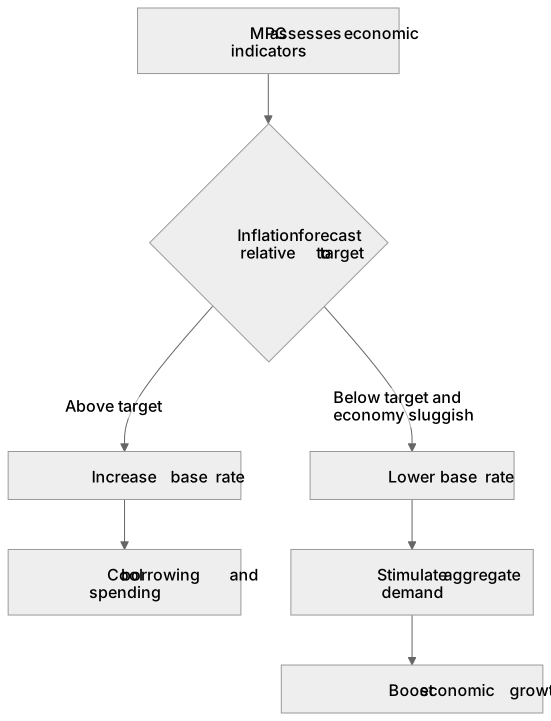
The Monetary Policy Committee (MPC) of the Bank of England is responsible for setting the official interest rate, also known as the base rate. Its primary objective is to meet the government's inflation target, currently 2% as measured by the Consumer Prices Index (CPI). The MPC meets regularly to assess economic indicators such as GDP growth, unemployment, and wage inflation. If inflation is forecast to rise above target, the MPC may increase the base rate to cool borrowing and spending. Conversely, if the economy is sluggish and inflation is below target, they might lower the rate to stimulate aggregate demand.
For example: A reduction in the base rate lowers mortgage costs, increasing consumers' discretionary income and encouraging consumption to boost economic growth.
What earns the marks
- Identifies the MPC as the body within the Bank of England that sets the official base rate.
- States that the primary objective of the MPC is to achieve the government's inflation target.
- Explains that raising the base rate is a contractionary measure used to reduce inflationary pressures.
- Explains that lowering the base rate is an expansionary measure used to stimulate aggregate demand and economic growth.
Common mistakes and how to put them right
Stating that the government sets the base rate.
Put it right: The Bank of England has been independent in setting monetary policy since 1997.
Confusing the base rate with commercial interest rates.
Put it right: The base rate influences commercial rates, but banks set their own rates for consumers and businesses.
Assuming the MPC's primary goal is economic growth.
Put it right: Its primary mandate is price stability through inflation targeting, with growth as a secondary objective.
Exam tips
- Always specify the current inflation target when discussing the MPC's objectives.
- Trace the transmission mechanism of monetary policy step-by-step, from a change in the base rate to its effect on aggregate demand.
- Consider the time lags involved in monetary policy; changes in the base rate can take up to two years to fully impact the economy.
Try the lesson
The start of the The role of the central bank: a) The role of the Monetary Policy Committee in setting the official interest (base) rate lesson, made from checked teaching notes for this specification point.
Have a go first
What is the primary objective of the Monetary Policy Committee (MPC) when setting the official interest (base) rate in the UK?
Listen
The Monetary Policy Committee (MPC) of the Bank of England is responsible for setting the official interest rate, also known as the base rate. Its primary objective is to meet the government's inflation target, currently 2% as measured by the Consumer Prices Index (CPI). The MPC meets regularly to assess economic indicators such as GDP growth, unemployment, and wage inflation. If inflation is forecast to rise above target, the MPC may increase the base rate to cool borrowing and spending. Conversely, if the economy is sluggish and inflation is below target, they might lower the rate to stimulate aggregate demand. For example, a reduction in the base rate lowers mortgage costs, increasing consumers' discretionary income and encouraging consumption to boost economic growth. A strong answer earns marks for these points. Identifies the MPC as the body within the Bank of England that sets the official base rate. States that the primary objective of the MPC is to achieve the government's inflation target. Explains that raising the base rate is a contractionary measure used to reduce inflationary pressures. Explains that lowering the base rate is an expansionary measure used to stimulate aggregate demand and economic growth. Exam tip: Always specify the current inflation target when discussing the MPC's objectives.
See it
Key words
Say what each word means before you turn the card.
Monetary Policy Committee
Try answering aloud or in your head before turning the card.
Inflation targeting
Try answering aloud or in your head before turning the card.
Base rate
Try answering aloud or in your head before turning the card.
See every definition
- Monetary Policy Committee
- The body within the Bank of England that is responsible for setting the official interest rate, also known as the base rate.
- Inflation targeting
- The primary objective of meeting the government's inflation target, currently 2% as measured by the Consumer Prices Index.
- Base rate
- The official interest rate set by the Monetary Policy Committee, which influences commercial rates but is not the same as them.
There is more to this lesson
The full lesson goes on to check your understanding and help you earn the marks. Create a free account to carry on, with your progress saved.
A week of Premium from your first lesson · Then the free plan continues · No card, no charge
Test your understanding of The role of the central bank: a) The role of the Monetary Policy Committee in setting the official interest (base) rate
Active recall beats re-reading. Take an instant quiz now to test what you’ve learned and lock it into long-term memory.
A week of Premium from your first lesson · Then the free plan continues · No card, no charge