Pearson Edexcel · A-Level · Economics B
Course version: 9EB0 · Version from Sept 2015
A) Implications for firms of changes in: o interest rates o exchange rates…
Full specification wording
The wider economic environment: a) Implications for firms of changes in: o interest rates o exchange rates o taxation o unemployment o inflation
Firms operate in a dynamic macroeconomic environment where changes impact costs and revenues.
Checked against the Pearson Edexcel 9EB0 specification (opens in a new tab) on .
- 4 key terms
Study notes
From the checked teaching notes for this specification point.
The idea
Firms operate in a dynamic macroeconomic environment where changes impact costs and revenues. Higher interest rates raise borrowing costs, deterring investment, and reduce consumer discretionary income, lowering demand. Exchange rate fluctuations affect competitiveness; a depreciation of the pound makes exports cheaper but imported raw materials more expensive. Changes in taxation, like corporation tax, alter retained profits, whereas higher income tax reduces consumer spending. High unemployment creates a larger labour pool, suppressing wage growth, but signals lower aggregate demand. Finally, inflation erodes purchasing power and creates uncertainty, forcing firms to frequently update prices (menu costs) and negotiate wage increases.
What earns the marks
- Identify the effect of an interest rate rise on consumer spending and firm borrowing costs.
- Determine the impact of an exchange rate appreciation or depreciation on export and import prices.
- Recognise how an increase in corporation tax reduces a firm's retained profit available for investment.
- Explain how high unemployment might benefit a firm through lower wage demands but harm it through reduced sales.
- Assess the impact of inflation on a firm's real revenues, purchasing power, and menu costs.
Common mistakes and how to put them right
Confusing the effects of exchange rates by thinking a strong currency makes exports cheaper.
Put it right: A strong currency makes exports dearer and imports cheaper.
Assuming high unemployment is always entirely negative for firms.
Put it right: While it reduces overall consumer demand, it can benefit firms by increasing the supply of labour and keeping wage costs down.
Believing inflation automatically increases real profits.
Put it right: Inflation increases nominal revenues but also increases costs; real profits may fall if costs rise faster than prices.
Exam tips
- Always use the acronym SPICED (Strong Pound Imports Cheap Exports Dear) to quickly evaluate exchange rate impacts.
- Consider the price elasticity of demand when evaluating how interest rate changes affect a specific firm's sales.
- Differentiate between direct taxes on firms, such as corporation tax, and taxes on consumers, such as income tax, when analysing impacts.
Try the lesson
The start of the The wider economic environment: a) Implications for firms of changes in: o interest rates o exchange rates o taxation o unemployment o inflation lesson, made from checked teaching notes for this specification point.
Have a go first
What is the most likely implication for a UK manufacturing firm if the Bank of England increases the base interest rate?
Listen
Firms operate in a dynamic macroeconomic environment where changes impact costs and revenues. Higher interest rates raise borrowing costs, deterring investment, and reduce consumer discretionary income, lowering demand. Exchange rate fluctuations affect competitiveness; a depreciation of the pound makes exports cheaper but imported raw materials more expensive. Changes in taxation, like corporation tax, alter retained profits, whereas higher income tax reduces consumer spending. High unemployment creates a larger labour pool, suppressing wage growth, but signals lower aggregate demand. Finally, inflation erodes purchasing power and creates uncertainty, forcing firms to frequently update prices (menu costs) and negotiate wage increases. A strong answer earns marks for these points. Identify the effect of an interest rate rise on consumer spending and firm borrowing costs. Determine the impact of an exchange rate appreciation or depreciation on export and import prices. Recognise how an increase in corporation tax reduces a firm's retained profit available for investment. Explain how high unemployment might benefit a firm through lower wage demands but harm it through reduced sales. A common slip: Confusing the effects of exchange rates by thinking a strong currency makes exports cheaper. Instead, A strong currency makes exports dearer and imports cheaper. Exam tip: Always use the acronym SPICED (Strong Pound Imports Cheap Exports Dear) to quickly evaluate exchange rate impacts.
See it
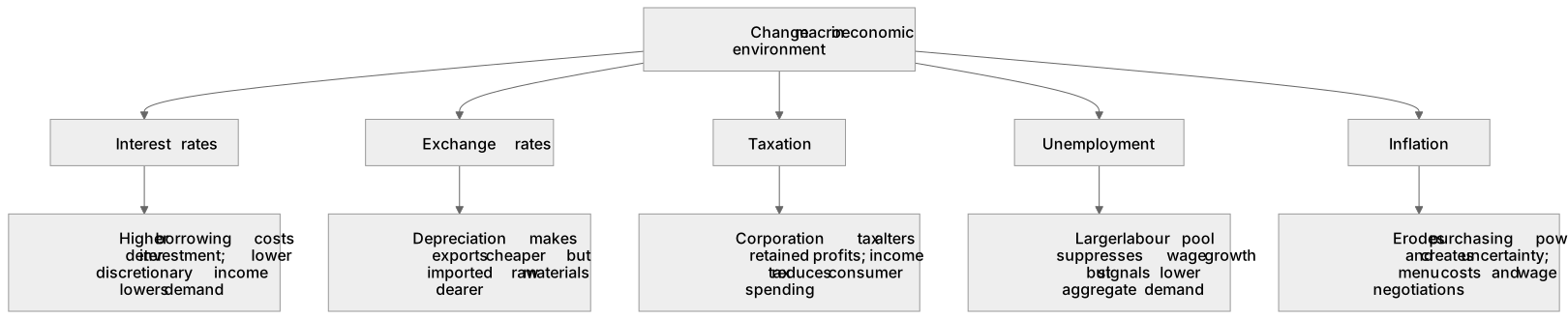
Key words
Say what each word means before you turn the card.
Interest rates
Try answering aloud or in your head before turning the card.
Exchange rates
Try answering aloud or in your head before turning the card.
Taxation
Try answering aloud or in your head before turning the card.
Inflation
Try answering aloud or in your head before turning the card.
See every definition
- Interest rates
- Higher rates raise borrowing costs, deterring investment, and reduce consumer discretionary income, lowering demand.
- Exchange rates
- Fluctuations affect competitiveness; a depreciation of the pound makes exports cheaper but imported raw materials more expensive.
- Taxation
- Changes in corporation tax alter retained profits, whereas higher income tax reduces consumer spending.
- Inflation
- Erosion of purchasing power and uncertainty force firms to frequently update prices (menu costs) and negotiate wage increases.
Label the diagram
Some boxes have lost their names. Pick the right name for each number.
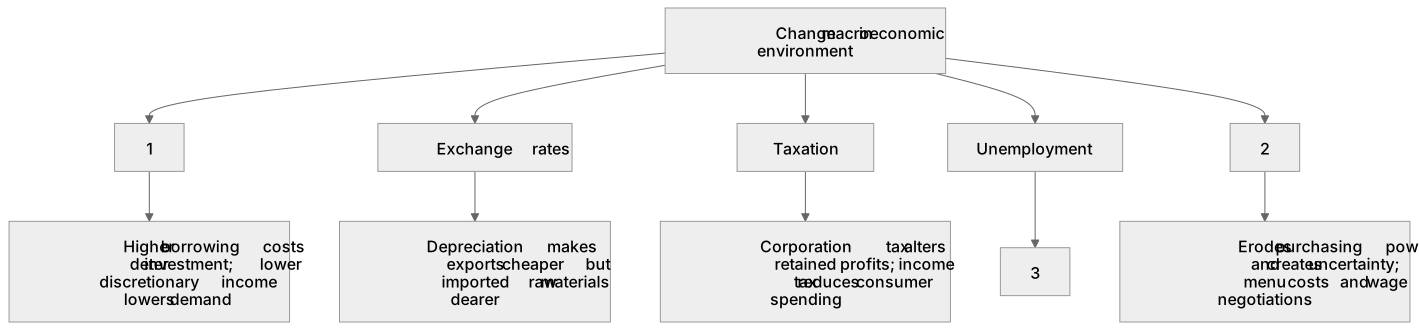
1Box 1
2Box 2
3Box 3
There is more to this lesson
The full lesson goes on to check your understanding and help you earn the marks. Create a free account to carry on, with your progress saved.
A week of Premium from your first lesson · Then the free plan continues · No card, no charge
Test your understanding of The wider economic environment: a) Implications for firms of changes in: o interest rates o exchange rates o taxation o unemployment o inflation
Active recall beats re-reading. Take an instant quiz now to test what you’ve learned and lock it into long-term memory.
A week of Premium from your first lesson · Then the free plan continues · No card, no charge