Pearson Edexcel · A-Level · Economics B
Course version: 9EB0 · Version from Sept 2015
Trade and growth: d) Foreign direct investment (FDI) and link to growth
Foreign direct investment (FDI) occurs when a firm in one country makes a physical investment or acquires significant business interests in another, such as building a new factory or acquiring a…
Checked against the Pearson Edexcel 9EB0 specification (opens in a new tab) on .
- Point 4 of 4
- 4 key terms
Study notes
From the checked teaching notes for this specification point.
The idea
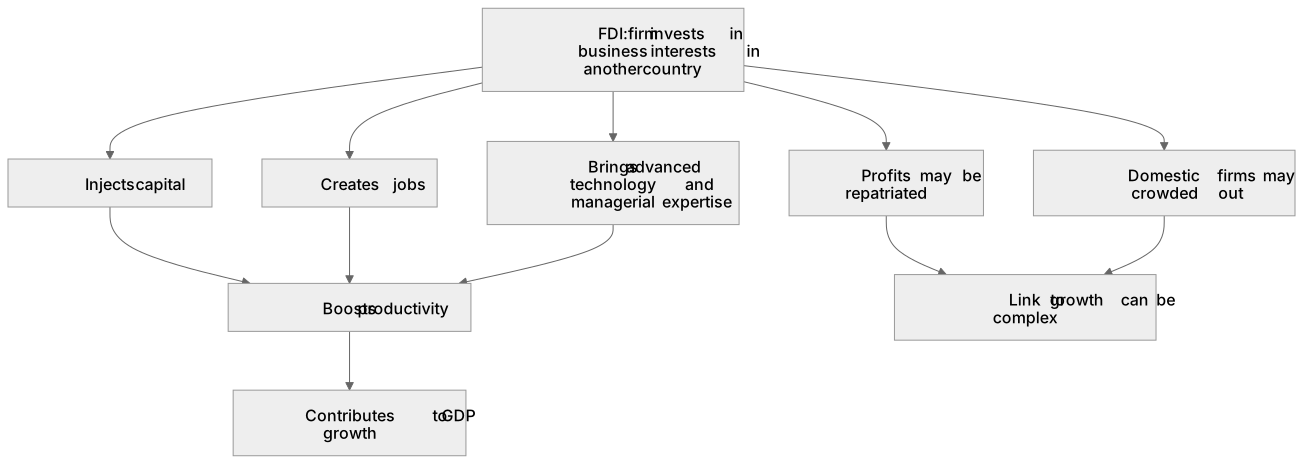
Foreign direct investment (FDI) occurs when a firm in one country makes a physical investment or acquires significant business interests in another, such as building a new factory or acquiring a foreign business. FDI is a crucial driver of economic growth for the host nation. It injects capital, creates jobs, and brings advanced technology and managerial expertise, which boosts productivity. For example, a multinational car manufacturer building a plant in a developing economy increases local employment and output, contributing directly to GDP growth. However, the link to growth can be complex; profits may be repatriated to the home country rather than reinvested, and domestic firms might be crowded out by powerful multinational competitors.
What earns the marks
- Define FDI as investment made by a firm or individual in one country into business interests located in another country.
- Explain how FDI contributes to economic growth through capital accumulation and direct job creation.
- Identify the transfer of technology, skills, and knowledge as a key long-term benefit of FDI for host countries.
- Evaluate the potential drawbacks of FDI, such as profit repatriation and the crowding out of domestic businesses.
- Distinguish between inward FDI (foreign firms investing in the domestic economy) and outward FDI (domestic firms investing abroad).
Common mistakes and how to put them right
Confusing FDI with portfolio investment.
Put it right: FDI involves acquiring a lasting management interest and physical assets, whereas portfolio investment is purely financial, such as buying shares without control.
Assuming FDI only benefits the host country.
Put it right: FDI can also benefit the home country through repatriated profits, though it may lead to job losses domestically.
Believing FDI always leads to sustained economic growth.
Put it right: The growth impact depends on how well integrated the multinational is with the local supply chain and whether profits are reinvested or repatriated.
Exam tips
- Use a specific example of a multinational corporation investing in a developing country to illustrate the tangible benefits of FDI.
- When evaluating the impact of FDI on growth, consider both the short-term effects, such as construction jobs, and long-term effects, such as technology transfer.
- Be prepared to discuss how government policies, such as tax incentives or infrastructure improvements, can be used to attract inward FDI.
Try the lesson
The start of the Trade and growth: d) Foreign direct investment (FDI) and link to growth lesson, made from checked teaching notes for this specification point.
Have a go first
A UK-based automotive company decides to expand its operations into Brazil. Which of the following actions represents foreign direct investment (FDI) that is likely to stimulate Brazil's economic growth?
Listen
Foreign direct investment (FDI) occurs when a firm in one country makes a physical investment or acquires significant business interests in another, such as building a new factory or acquiring a foreign business. FDI is a crucial driver of economic growth for the host nation. It injects capital, creates jobs, and brings advanced technology and managerial expertise, which boosts productivity. For example, a multinational car manufacturer building a plant in a developing economy increases local employment and output, contributing directly to GDP growth. However, the link to growth can be complex; profits may be repatriated to the home country rather than reinvested, and domestic firms might be crowded out by powerful multinational competitors. A strong answer earns marks for these points. Define FDI as investment made by a firm or individual in one country into business interests located in another country. Explain how FDI contributes to economic growth through capital accumulation and direct job creation. Identify the transfer of technology, skills, and knowledge as a key long-term benefit of FDI for host countries. Evaluate the potential drawbacks of FDI, such as profit repatriation and the crowding out of domestic businesses. A common slip: Confusing FDI with portfolio investment. Instead, FDI involves acquiring a lasting management interest and physical assets, whereas portfolio investment is purely financial, such as buying shares without control. Exam tip: Use a specific example of a multinational corporation investing in a developing country to illustrate the tangible benefits of FDI.
See it
Key words
Say what each word means before you turn the card.
Foreign direct investment (FDI)
Try answering aloud or in your head before turning the card.
Economic growth
Try answering aloud or in your head before turning the card.
Multinational corporations
Try answering aloud or in your head before turning the card.
Capital flows
Try answering aloud or in your head before turning the card.
See every definition
- Foreign direct investment (FDI)
- Occurs when a firm in one country makes a physical investment or acquires significant business interests in another, such as building a new factory or acquiring a foreign business.
- Economic growth
- A rise in output that FDI can drive by injecting capital, creating jobs and bringing advanced technology and managerial expertise, which boosts productivity.
- Multinational corporations
- Powerful competitors that may crowd out domestic firms in the host country.
- Capital flows
- Forms of capital movement other than FDI, from which FDI must be distinguished.
Label the diagram
Some boxes have lost their names. Pick the right name for each number.
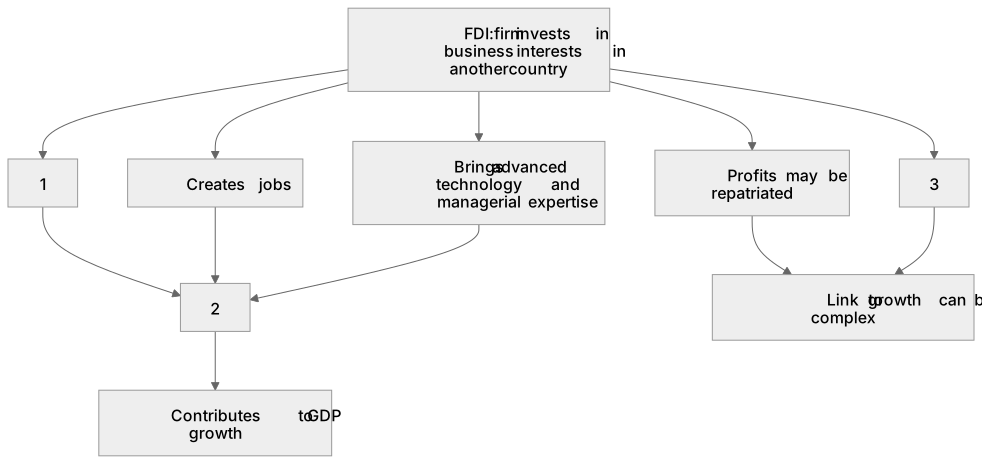
1Box 1
2Box 2
3Box 3
There is more to this lesson
The full lesson goes on to check your understanding and help you earn the marks. Create a free account to carry on, with your progress saved.
A week of Premium from your first lesson · Then the free plan continues · No card, no charge
Test your understanding of Trade and growth: d) Foreign direct investment (FDI) and link to growth
Active recall beats re-reading. Take an instant quiz now to test what you’ve learned and lock it into long-term memory.
A week of Premium from your first lesson · Then the free plan continues · No card, no charge