Pearson Edexcel · A-Level · Economics B
Course version: 9EB0 · Version from Sept 2015
B) International trade negotiations: o role of G20 o role of international…
Full specification wording
Trade policy and trade negotiations: b) International trade negotiations: o role of G20 o role of international institutions (World Trade Organisation (WTO), International Monetary Fund (IMF), World Bank) o bilateral trading agreements
International trade negotiations shape the global economy by establishing rules and resolving disputes.
Checked against the Pearson Edexcel 9EB0 specification (opens in a new tab) on .
- Point 2 of 2
- 4 key terms
Study notes
From the checked teaching notes for this specification point.
The idea
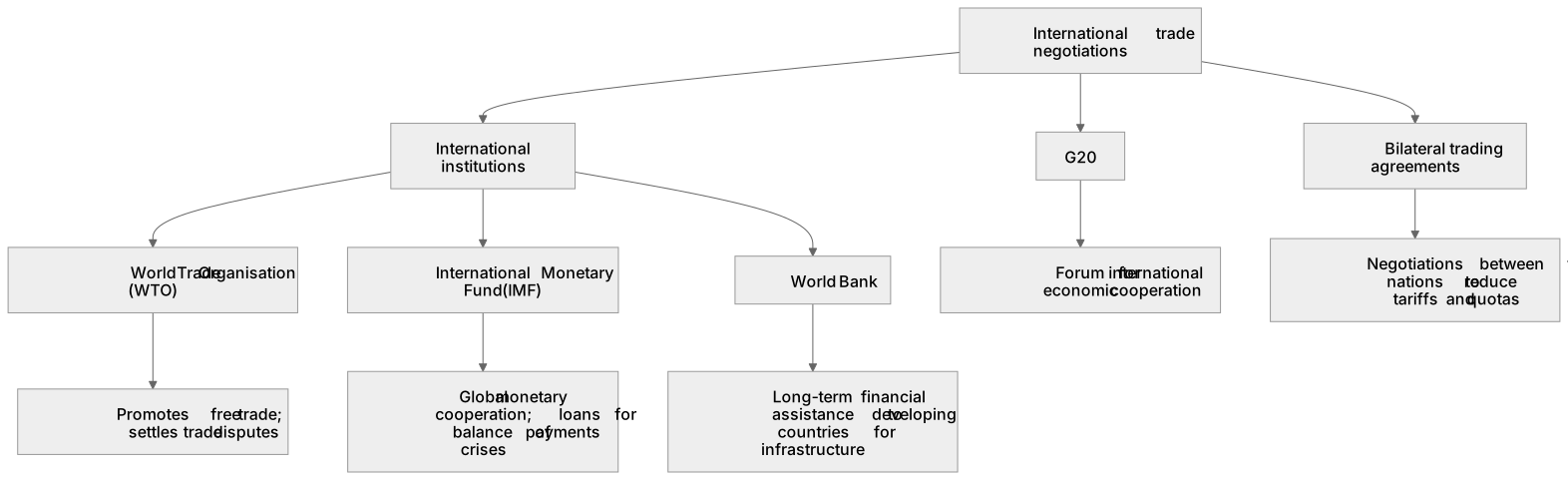
International trade negotiations shape the global economy by establishing rules and resolving disputes. The G20 acts as a forum for international economic cooperation, coordinating policy among major economies to ensure stability. The World Trade Organisation (WTO) promotes free trade by negotiating agreements and settling trade disputes. The International Monetary Fund (IMF) focuses on global monetary cooperation, providing loans to countries facing balance of payments crises. The World Bank provides long-term financial assistance to developing countries for infrastructure. Bilateral trading agreements involve negotiations between two nations to reduce tariffs and quotas, such as the UK-Australia agreement, fostering closer economic ties.
What earns the marks
- Identify the WTO as the primary institution responsible for settling international trade disputes.
- Recognise the IMF's role in providing short-term financial assistance to countries experiencing balance of payments difficulties.
- Distinguish the World Bank's function in funding long-term development projects in developing nations.
- Define a bilateral trading agreement as a trade deal negotiated exclusively between two sovereign nations.
- Understand the G20's function as an informal forum for coordinating macroeconomic policies among the world's largest economies.
Common mistakes and how to put them right
Confusing the roles of the IMF and the World Bank.
Put it right: The IMF deals with monetary stability and balance of payments, while the World Bank funds long-term development.
Assuming the G20 has legislative power to enforce trade laws.
Put it right by recognising the G20 is a forum for policy coordination, whereas the WTO has a dispute settlement mechanism.
Believing bilateral agreements involve multiple countries.
Put it right by noting 'bilateral' strictly means an agreement between exactly two nations, unlike multilateral agreements.
Exam tips
- When answering multiple-choice questions on institutions, look for keywords like 'development' (World Bank) or 'disputes' (WTO) to quickly identify the correct organisation.
- Be prepared to distinguish between the short-term crisis management role of the IMF and the long-term structural funding provided by the World Bank.
- Remember that bilateral agreements can sometimes conflict with WTO non-discrimination principles, which is a useful evaluative point.
Try the lesson
The start of the Trade policy and trade negotiations: b) International trade negotiations: o role of G20 o role of international institutions (World Trade Organisation (WTO), International Monetary Fund (IMF), World Bank) o bilateral trading agreements lesson, made from checked teaching notes for this specification point.
Have a go first
Which international institution has the primary role of providing short-term financial assistance to countries experiencing severe balance of payments difficulties?
Listen
International trade negotiations shape the global economy by establishing rules and resolving disputes. The G20 acts as a forum for international economic cooperation, coordinating policy among major economies to ensure stability. The World Trade Organisation (WTO) promotes free trade by negotiating agreements and settling trade disputes. The International Monetary Fund (IMF) focuses on global monetary cooperation, providing loans to countries facing balance of payments crises. The World Bank provides long-term financial assistance to developing countries for infrastructure. Bilateral trading agreements involve negotiations between two nations to reduce tariffs and quotas, such as the UK-Australia agreement, fostering closer economic ties. A strong answer earns marks for these points. Identify the WTO as the primary institution responsible for settling international trade disputes. Recognise the IMF's role in providing short-term financial assistance to countries experiencing balance of payments difficulties. Distinguish the World Bank's function in funding long-term development projects in developing nations. Define a bilateral trading agreement as a trade deal negotiated exclusively between two sovereign nations. A common slip: Assuming the G20 has legislative power to enforce trade laws. Instead, recognising the G20 is a forum for policy coordination, whereas the WTO has a dispute settlement mechanism. Exam tip: When answering multiple-choice questions on institutions, look for keywords like 'development' (World Bank) or 'disputes' (WTO) to quickly identify the correct organisation.
See it
Key words
Say what each word means before you turn the card.
G20
Try answering aloud or in your head before turning the card.
World Trade Organisation (WTO)
Try answering aloud or in your head before turning the card.
International Monetary Fund (IMF)
Try answering aloud or in your head before turning the card.
Bilateral trading agreements
Try answering aloud or in your head before turning the card.
See every definition
- G20
- An informal forum for international economic cooperation that coordinates policy among major economies to ensure stability.
- World Trade Organisation (WTO)
- An institution that promotes free trade by negotiating agreements and settling trade disputes.
- International Monetary Fund (IMF)
- An institution focused on global monetary cooperation that provides loans to countries facing balance of payments crises.
- Bilateral trading agreements
- Negotiations between two nations to reduce tariffs and quotas, fostering closer economic ties.
Label the diagram
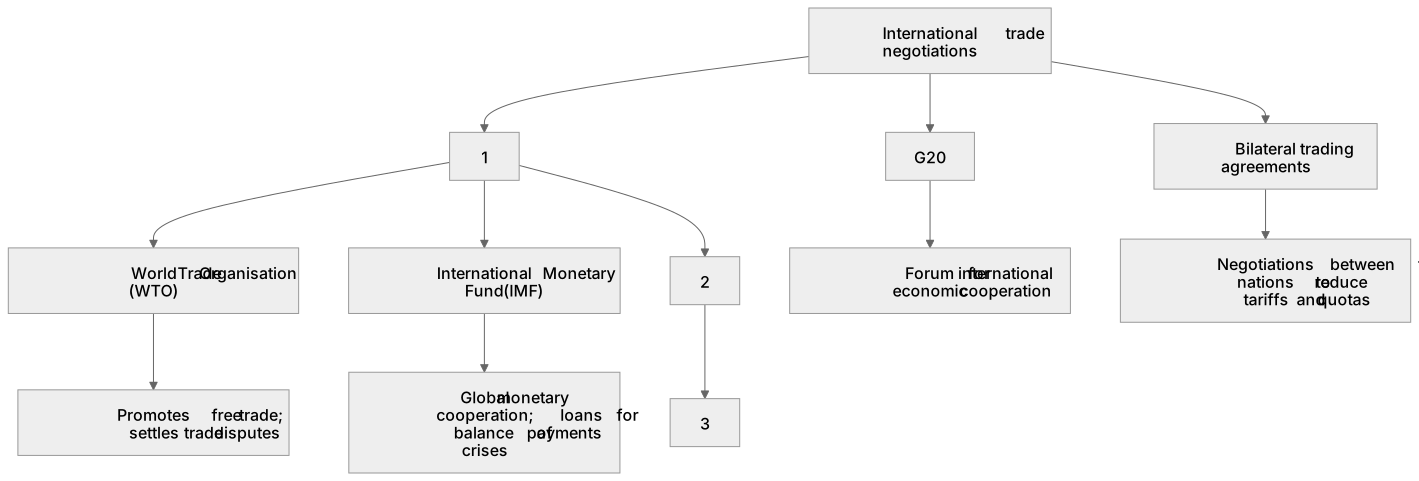
Some boxes have lost their names. Pick the right name for each number.
1Box 1
2Box 2
3Box 3
There is more to this lesson
The full lesson goes on to check your understanding and help you earn the marks. Create a free account to carry on, with your progress saved.
A week of Premium from your first lesson · Then the free plan continues · No card, no charge
Test your understanding of Trade policy and trade negotiations: b) International trade negotiations: o role of G20 o role of international institutions (World Trade Organisation (WTO), International Monetary Fund (IMF), World Bank) o bilateral trading agreements
Active recall beats re-reading. Take an instant quiz now to test what you’ve learned and lock it into long-term memory.
A week of Premium from your first lesson · Then the free plan continues · No card, no charge