Study Notes
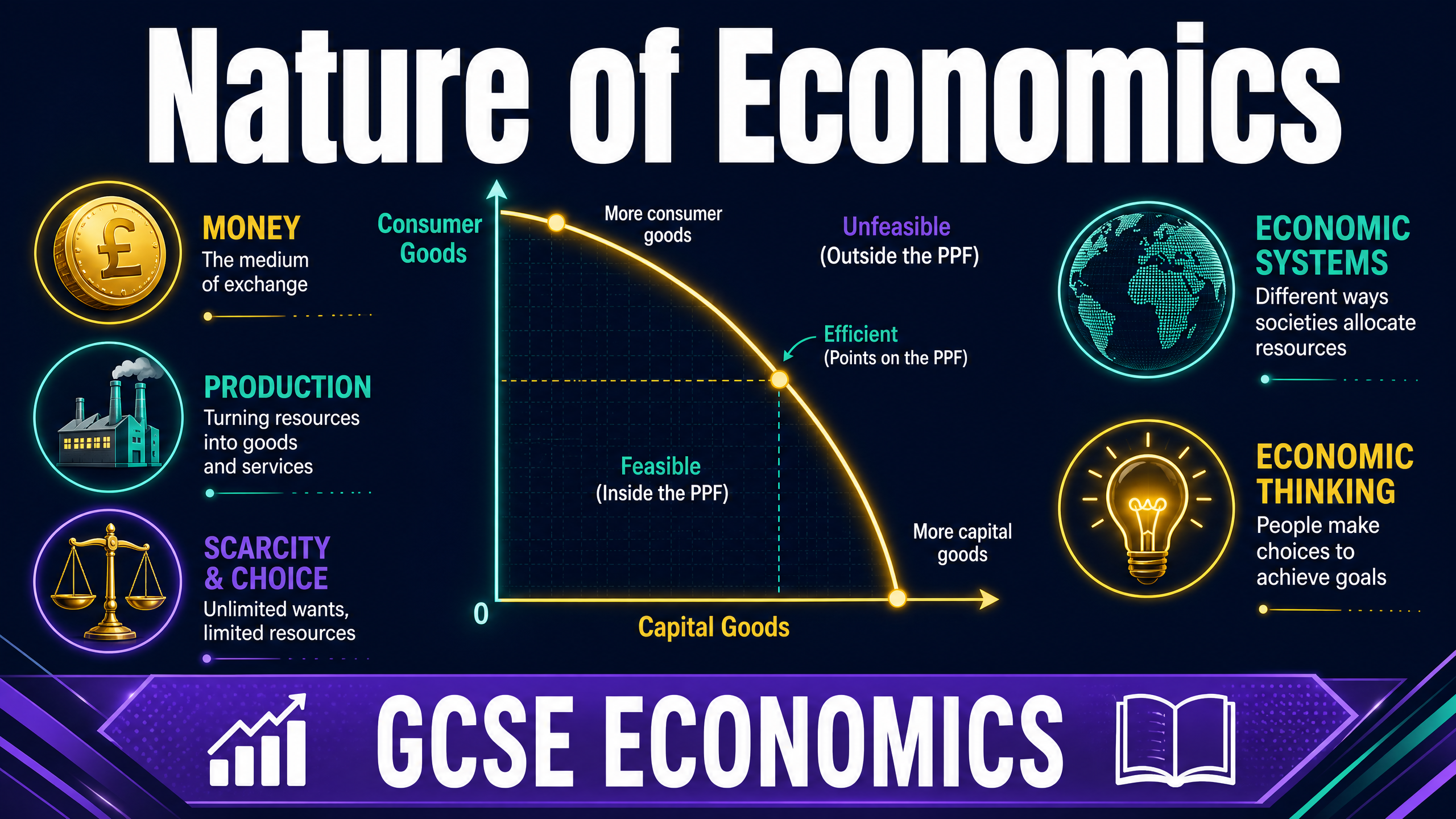
Overview
The Nature of Economics is the bedrock of your GCSE specification. This topic introduces the fundamental economic problem: how do we allocate scarce resources to satisfy unlimited human wants? Examiners expect candidates to not only define key terms precisely—such as scarcity and opportunity cost—but to apply these concepts using models like the Production Possibility Frontier (PPF). Historically, this area of study encompasses the foundational theories of Adam Smith, Friedrich Hayek, and Karl Marx, whose differing views on resource allocation shaped the modern world. Mastering this topic is crucial, as its principles (like ceteris paribus and the price mechanism) underpin every subsequent module in both microeconomics and macroeconomics.
The Podcast Lesson
Listen to our comprehensive 12-minute audio revision guide covering all core concepts, common mistakes, and a quick-fire recall quiz.
Key Concepts & Developments
The Fundamental Economic Problem
What it is: The fundamental economic problem is scarcity. Human wants are infinite, but the resources (land, labour, capital, and enterprise) available to satisfy them are finite.
Why it matters: Because of scarcity, economic agents (consumers, producers, and governments) must make choices. Every choice involves an opportunity cost.
Specific Knowledge: Examiners require the full definition: "Scarcity exists because human wants are unlimited relative to finite resources."
Opportunity Cost
What it is: The value of the next best alternative foregone when a choice is made.
Why it matters: It is the true cost of any decision. For a government, the opportunity cost of building a new hospital might be the new schools that could have been built instead.
Specific Knowledge: The phrase "next best alternative" is mandatory for full marks.
Production Possibility Frontiers (PPF)
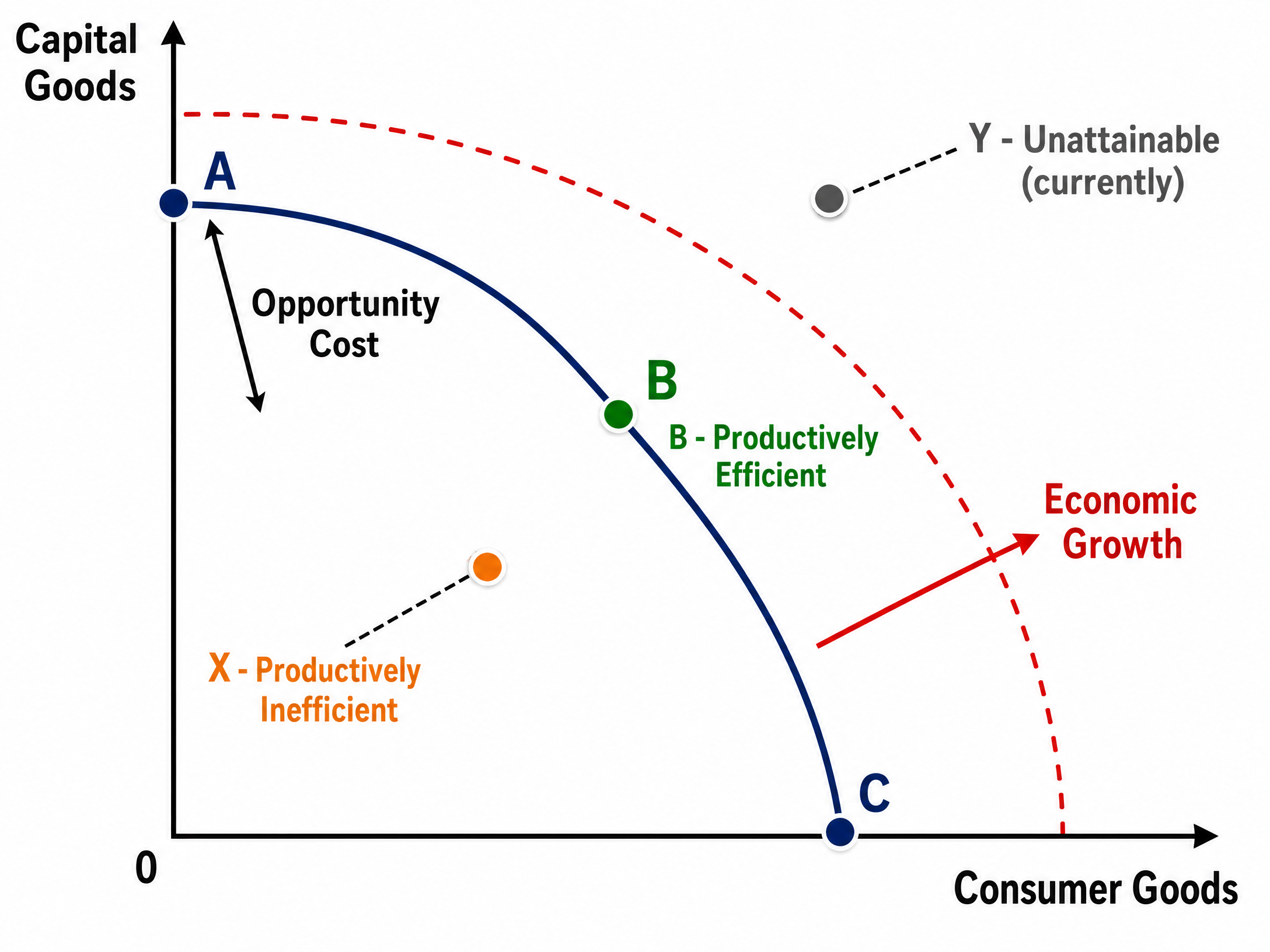
What it is: A curve showing the maximum possible combinations of two goods (usually consumer goods and capital goods) that an economy can produce when all resources are fully and efficiently employed.
Why it matters: The PPF visually demonstrates opportunity cost, productive efficiency, and economic growth.
Specific Knowledge:
- Points on the curve = productively efficient.
- Points inside the curve = productively inefficient (unemployed resources).
- Points outside the curve = currently unattainable.
- Movement along the curve = reallocation of resources (opportunity cost).
- Outward shift of the curve = economic growth (more resources or better technology).
Positive and Normative Statements
What it is:
- Positive statements are objective, factual, and can be tested against evidence (e.g., "The UK inflation rate is 3%").
- Normative statements are subjective value judgements based on opinion (e.g., "The government should reduce inflation").
Why it matters: Economists use positive statements to build models and normative statements to recommend policies. Candidates must distinguish between them in data response questions.
Specialisation and the Division of Labour
What it is: Specialisation occurs when individuals, firms, or countries focus on producing the goods they are best at. The division of labour breaks the production process into separate tasks performed by different workers.
Why it matters: It massively increases productivity and lowers average costs, though it can lead to worker boredom and over-reliance on specific industries.
Specific Knowledge: Adam Smith's 1776 pin factory example: 10 specialised workers producing 48,000 pins a day versus 1 unspecialised worker producing 20.
The Functions of Money
What it is: Money overcomes the inefficiencies of a barter economy (which requires a "double coincidence of wants").
Why it matters: It facilitates trade and economic growth.
Specific Knowledge: The four functions are: Medium of exchange, Store of value, Unit of account, and Standard of deferred payment.
Key Individuals & Economic Systems
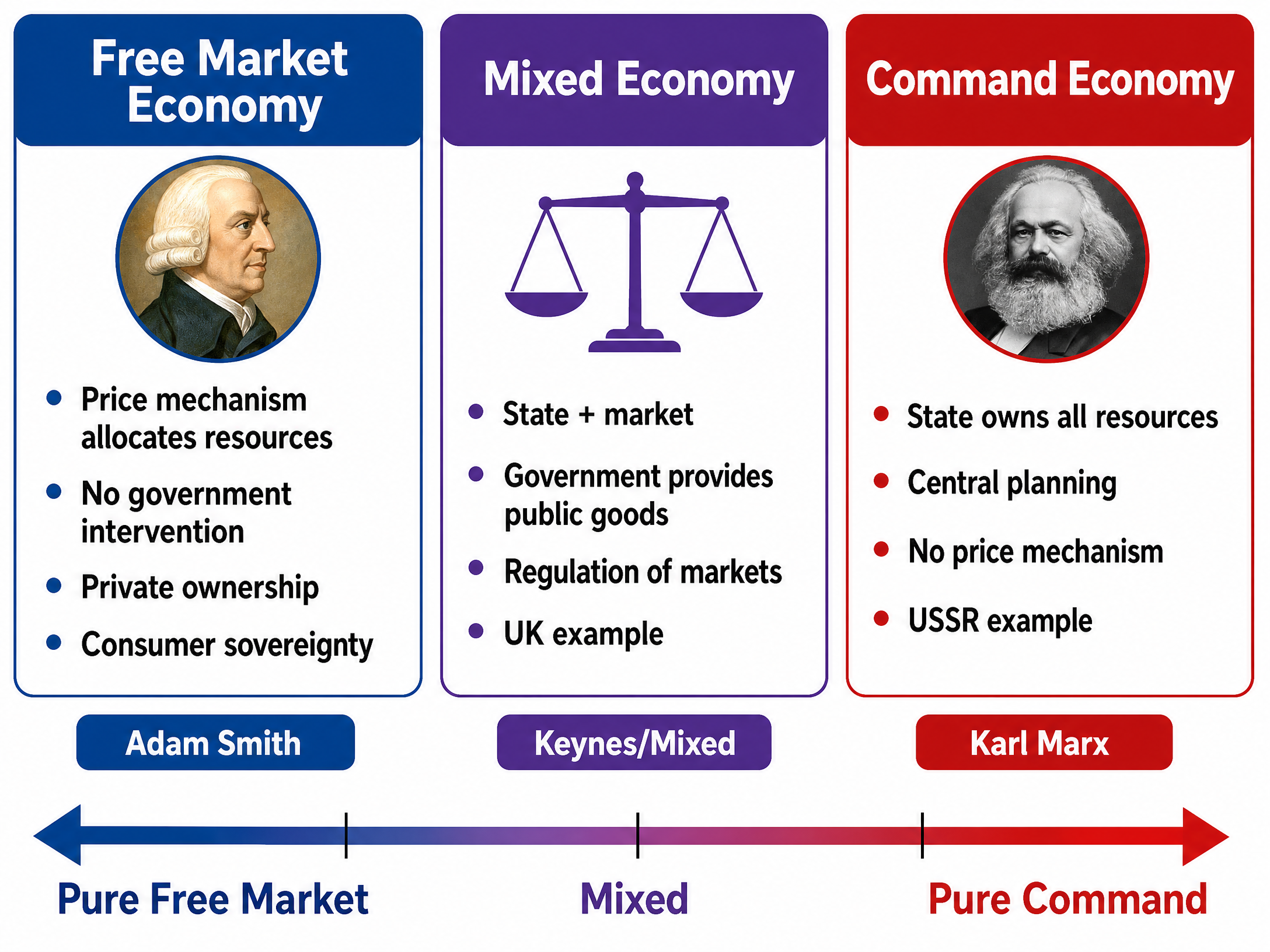
Adam Smith (Free Market Economy)
Role: 18th-century Scottish economist, author of The Wealth of Nations (1776).
Key Actions: Described the "invisible hand" of the market. Argued that individuals pursuing self-interest, guided by the price mechanism, leads to efficient resource allocation without government intervention.
Impact: Foundational thinker for Free Market economics.
Karl Marx (Command Economy)
Role: 19th-century philosopher and economist, author of Das Kapital.
Key Actions: Argued that free markets exploit the working class (proletariat). Advocated for the state to own the means of production and allocate resources via central planning.
Impact: Theoretical founder of the Command Economy (e.g., Soviet Union).
Friedrich Hayek (Mixed/Free Market Defender)
Role: 20th-century Austrian economist.
Key Actions: Fierce critic of central planning. Argued in The Road to Serfdom (1944) that governments lack the information to allocate resources efficiently, and that state control leads to a loss of freedom.
Impact: Key defender of the price mechanism against the rise of command economies.
Second-Order Concepts
Causation
Scarcity causes the need for choice. Choice causes opportunity cost. The desire to reduce opportunity cost and increase output causes the division of labour.
Consequence
The consequence of moving along a PPF is an opportunity cost. The consequence of an outward shift of a PPF is economic growth and higher living standards.
Change & Continuity
While the fundamental economic problem (scarcity) remains continuous across all human history, the systems used to address it (free market, command, mixed) have changed dramatically over time and across different nations.
Visual Resources
2 diagrams and illustrations
Interactive Diagrams
1 interactive diagram to visualise key concepts
Conceptual Flow Outline
The chain of reasoning from Scarcity to the PPF
Worked Examples
3 detailed examples with solutions and examiner commentary
Practice Questions
Test your understanding — click to reveal model answers
Using a Production Possibility Frontier (PPF) diagram, explain the concept of opportunity cost. (6 marks)
Hint: You must draw the diagram. Define opportunity cost, then explicitly reference two points on your curve to show the trade-off.
Explain two benefits of the division of labour for a manufacturing firm. (4 marks)
Hint: State a benefit (1 mark) and explain how it helps the firm (1 mark). Repeat for the second benefit.