Study Notes
Overview
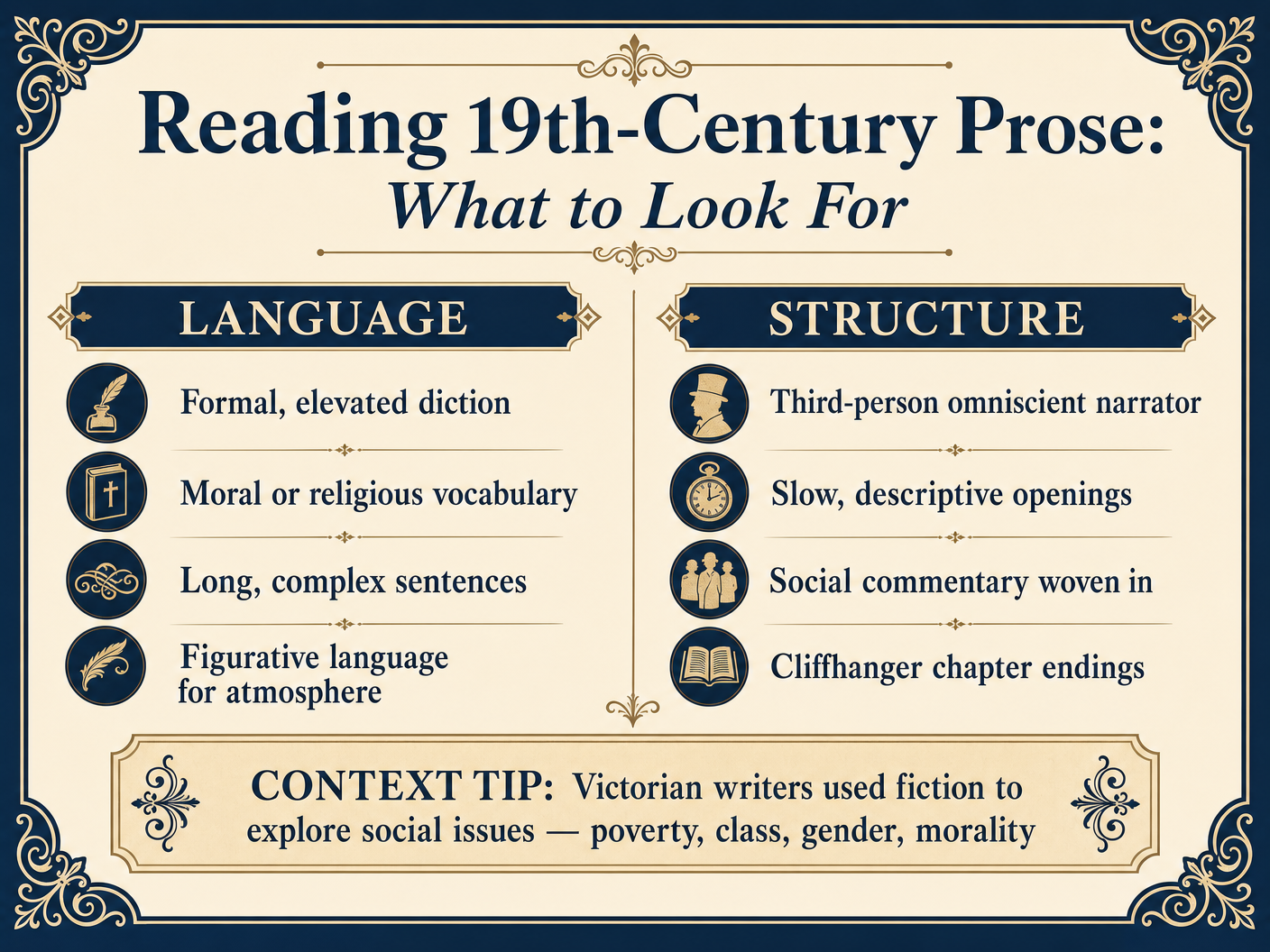
Fiction and Imaginative Writing is a core component of your GCSE English Language exam. It tests two complementary skills: your ability to dissect how writers use language and structure to create effects in unseen 19th-century texts, and your ability to apply those same techniques in your own creative writing. This is not about spotting techniques; it is about understanding the impact of those choices on the reader.
Reading Skills
Identifying Information & Ideas
When approaching an unseen 19th-century extract, your first task is to establish the explicit and implicit information. Explicit information is stated directly on the page, while implicit information requires you to read between the lines. Examiners expect you to synthesise these ideas quickly to grasp the overall theme or tone before diving into analysis.
Analysing Language
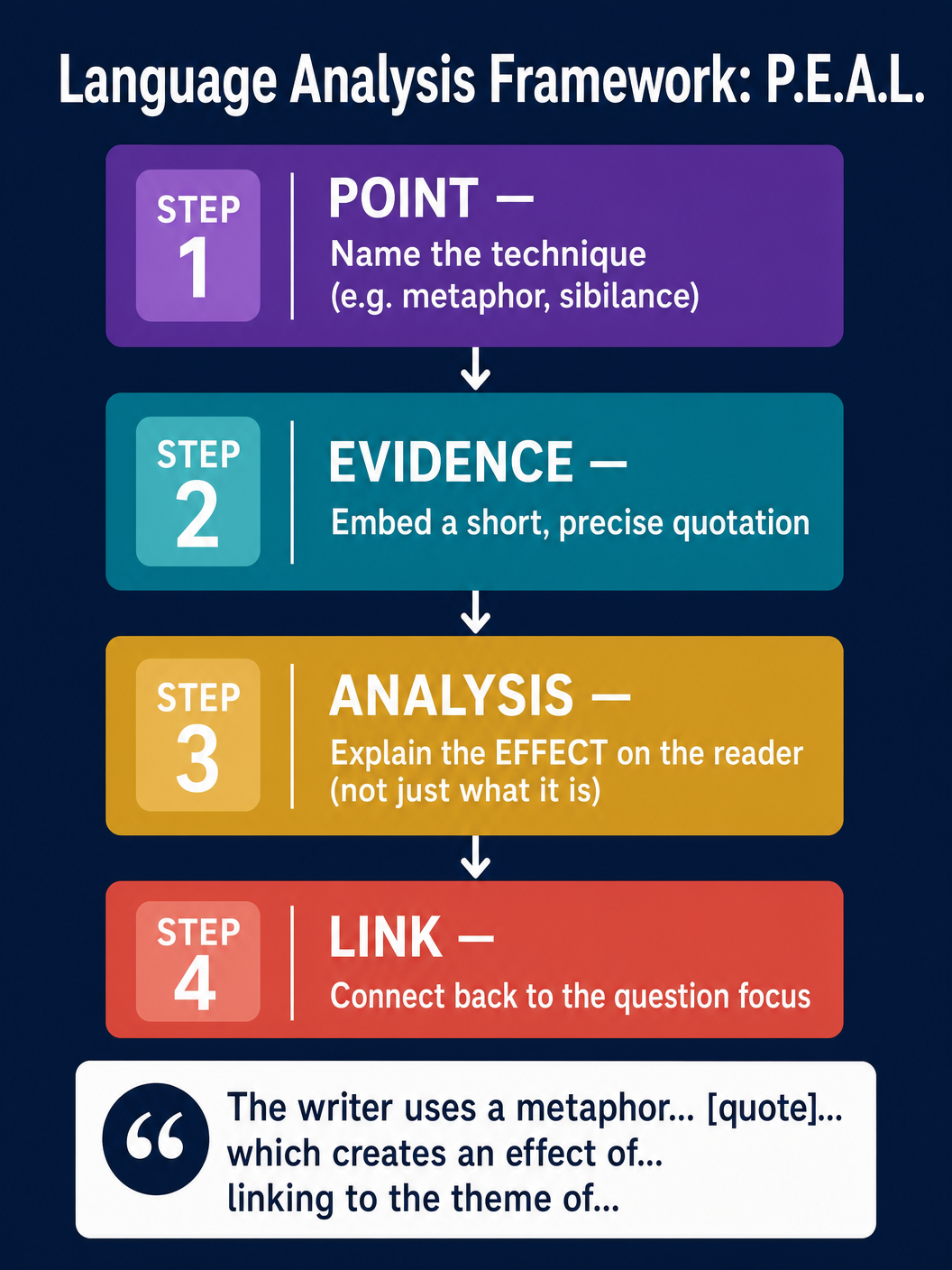
Examiners are looking for a deep understanding of how language shapes meaning. You must move beyond simply identifying techniques and instead focus on the specific effects created by the writer's choices.
Key Language Features to Identify
| Feature | Definition | Effect on Reader | Example |
|---|---|---|---|
| Metaphor | Describing something as if it is something else entirely. | Creates vivid imagery and powerful associations by linking two disparate ideas. | "The sea was a hungry beast." |
| Simile | Comparing two things using 'like' or 'as'. | Helps the reader visualise the unfamiliar by comparing it to the familiar. | "His hands were as cold as ice." |
| Pathetic Fallacy | Giving human emotions to the weather or natural environment. | Establishes atmosphere and often reflects or foreshadows a character's internal state. | "The sky wept over the ruined city." |
| Personification | Giving human qualities to non-human objects. | Makes descriptions more dynamic and relatable. | "The wind howled through the trees." |
| Sibilance | Repetition of the soft 's' sound. | Can create a hissing, sinister, or soothing whispering effect depending on context. | "The snake slithered silently." |
| Alliteration | Repetition of the same consonant sound at the start of words. | Draws attention to key phrases and can create rhythm or emphasize a specific tone. | "The brutal, bitter wind." |
| Juxtaposition | Placing two contrasting ideas side by side. | Highlights the differences between them to make a thematic point. | "A diamond resting in the mud." |
Analysing Structure
Structure is often the weakest area for candidates. Remember: structure is about how the text is organised, not the specific words used. Focus on shifts, patterns, and pacing.
Key structural features include:
- Openings: Does the text begin in media res (in the middle of the action) or with slow, atmospheric description?
- Shifts in Focus: Does the narrative zoom in from a panoramic view to a close-up detail, or shift from external action to internal thought?
- Narrative Perspective: Who is telling the story? Is it a first-person narrator, or an omniscient third-person narrator? How does this affect our understanding?
- Sentence Length Variation: Short sentences build tension or create impact. Long, complex sentences build atmosphere or reflect a chaotic situation.
- Cyclical Structure: Does the ending return to an image or idea from the beginning, creating a sense of inevitability or closure?
- Foreshadowing: Are there hints early on about what will happen later?
Evaluating Critically
Evaluation questions ask for your opinion on a statement about the text. You must provide a balanced, substantiated judgment. Use the framework: Statement → Evidence → Analysis → Link. Begin with "To some extent, I agree..." and then justify your view using specific references to the writer's methods.
Writing Skills
Creative Writing
Your imaginative writing task is an opportunity to demonstrate your technical control and creative flair. The provided image or prompt is a starting point; do not feel constrained to merely describe it.
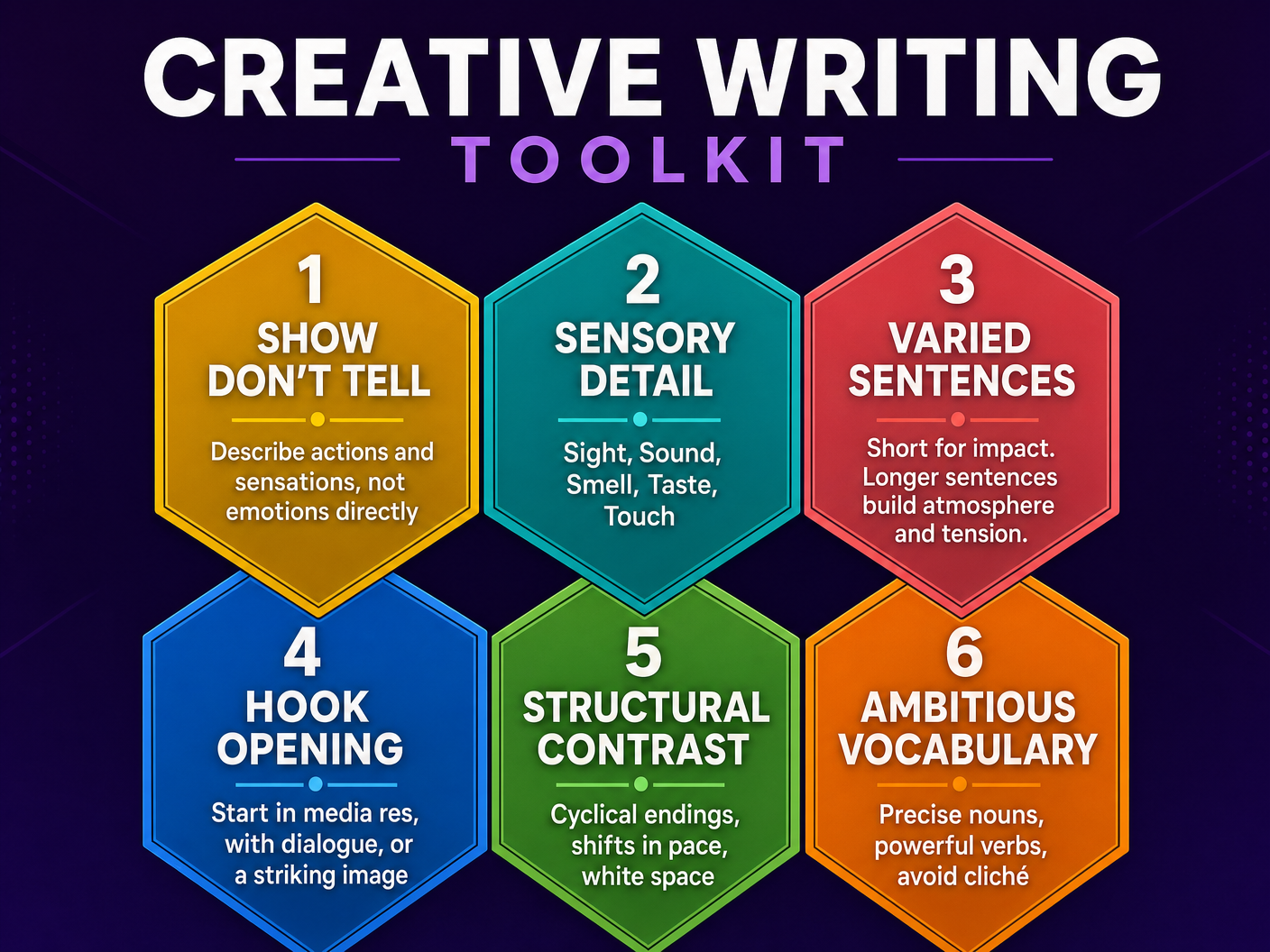
Key techniques for success:
- Show, Don't Tell: Instead of stating an emotion ("He was scared"), describe the physical manifestation of that emotion ("His hands trembled as he reached for the handle").
- Sensory Description: Engage all five senses (sight, sound, smell, touch, taste) to create a fully realised world.
- Varied Sentence Structures: Use short sentences for dramatic impact and longer sentences for descriptive flow.
- Engaging Openings: Hook the reader immediately with a striking image or an intriguing piece of dialogue.
- Satisfying Endings: Avoid clichéd endings ("It was all a dream"). Aim for a cyclical structure or a thought-provoking resolution.
- The One-Scene Rule: Focus on a single, well-developed scene or moment rather than trying to cram an entire novel's worth of plot into your response.
Technical Accuracy (SPaG)
Spelling, Punctuation, and Grammar (SPaG) carry significant marks in the writing section. Accurate spelling is expected, but ambitious punctuation is rewarded.
- Semicolons (;): Use to link two closely related independent clauses.
- Colons (:): Use to introduce a list, an explanation, or a dramatic statement.
- Dashes (—): Use for emphasis or to indicate an interruption.
- Parenthetical Commas: Use to embed extra information within a sentence.
Ensure your paragraphs link smoothly using discourse markers and cohesive devices.
Podcast Episode
Listen to our comprehensive 10-minute podcast episode covering all these core concepts, exam tips, and a quick-fire recall quiz.
Visual Resources
3 diagrams and illustrations
Interactive Diagrams
2 interactive diagrams to visualise key concepts
Conceptual Flow Outline
English Language Exam Approach Flowchart
Conceptual Flow Outline
Evaluation Question Framework
Worked Examples
3 detailed examples with solutions and examiner commentary
Practice Questions
Test your understanding — click to reveal model answers
Read the provided extract. Identify two things we learn about the setting in the first paragraph.
Hint: Look for explicit, direct statements about the location or weather.
How does the writer use language to describe the storm?
Hint: Select two strong quotations and analyse the effect of the specific words used.
Evaluate the statement: 'The writer creates a sense of profound mystery in the final paragraph.'
Hint: Provide a balanced argument. Look at how structure (like an unresolved ending) contributes to the mystery.
Write the opening of a story set in an abandoned building.
Hint: Focus on sensory details and establishing atmosphere before introducing action.
Write a descriptive piece based on an image of a crowded, bustling market.
Hint: Use the image as a prompt. Focus on the overwhelming sensory experience.