Study Notes
Overview
The Spoken Language Endorsement (Component 1EN0/03 or equivalent) is an essential, internally assessed part of your GCSE English Language qualification. While it does not contribute to your final 9-1 grade, it is reported as a separate grade (Pass, Merit, or Distinction) on your certificate. It requires candidates to undertake a prepared spoken presentation on a specific topic in a formal setting, listen and respond to questions and feedback, and use spoken English effectively.
Assessment Criteria
To succeed, candidates must demonstrate proficiency across several key areas:
1. Audibility and Delivery
Candidates must be clearly heard throughout the presentation. This involves projecting the voice, controlling pace, and using appropriate intonation to maintain audience interest. Mumbling or rushing will limit marks.
2. Spoken Standard English
The use of spoken Standard English must be intelligible and appropriate to the formal setting. This means avoiding slang, colloquialisms, and non-standard grammar (e.g., saying 'we were' instead of 'we was'). Regional accents are entirely acceptable and are not penalised.
3. Expression of Ideas
The complexity of ideas expressed determines the grade tier:
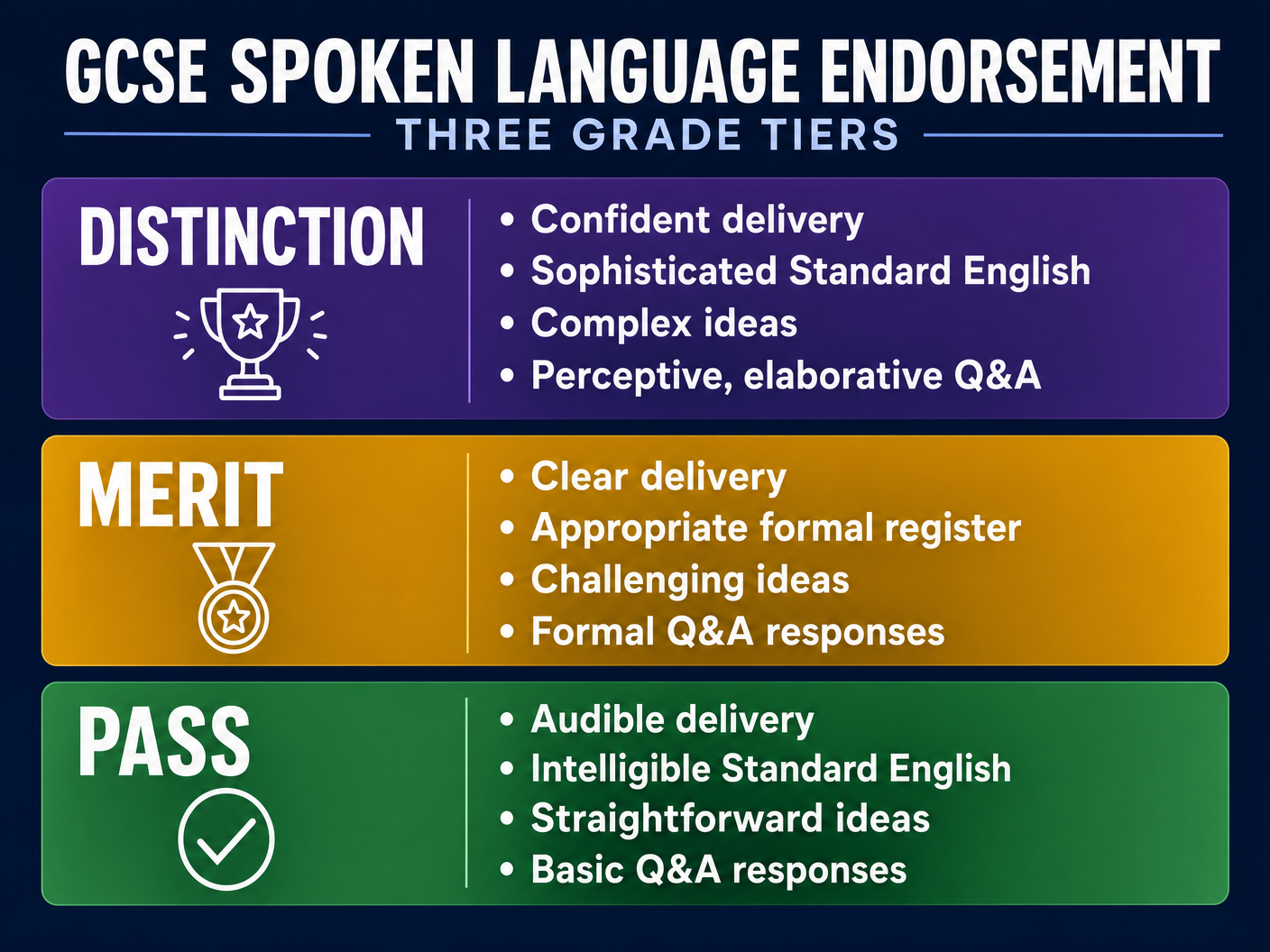
- Pass: Straightforward ideas, information, and feelings.
- Merit: Challenging ideas and information.
- Distinction: Sophisticated ideas, demonstrating deep intellectual engagement and analytical thought.
4. Organisation and Structure
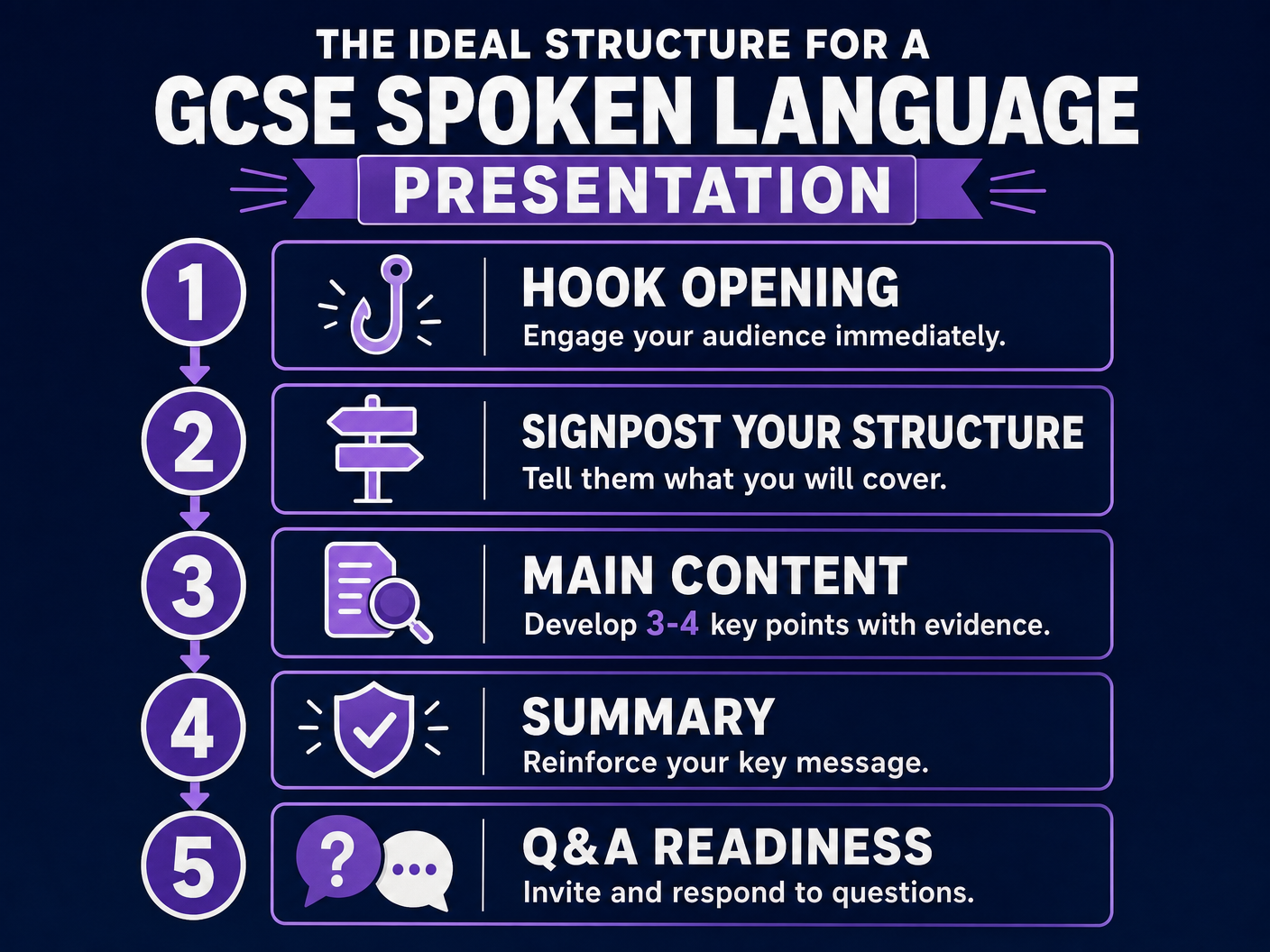
Presentations must be well-structured, with a clear introduction, developed middle section, and a purposeful conclusion.
5. Audience Engagement
Candidates must meet the needs of the audience, which must include the teacher and ideally at least one other person. This involves making eye contact, using appropriate register, and adapting content to ensure comprehension.
6. Purpose
The presentation must achieve its stated purpose—whether that is to inform, persuade, argue, or explore a topic.
7. Listening and Responding (Q&A)
The Q&A session is equally important as the presentation itself.
- Pass: Responds appropriately to questions.
- Merit: Responds formally to questions and feedback.
- Distinction: Responds perceptively and elaboratively, extending thinking and making connections.
Preparing Your Presentation
Choosing a Topic
Select a topic you are genuinely passionate about. Assessors reward candidates who show authentic interest and knowledge. Avoid overly simplistic topics; choose something that allows for 'challenging' or 'sophisticated' ideas (e.g., ethical debates, scientific advancements, social issues).
Structuring the Content
Do not write a word-for-word script. Instead, use cue cards with bullet points. This encourages natural delivery and better eye contact. Ensure your presentation lasts around 5-7 minutes, leaving ample time for the Q&A within the 10-minute maximum limit.
Technical Requirements
The presentation must be recorded in a single, unedited take. Ensure the camera captures both audio and visual clearly, and state your full name at the start of the recording.
Interactive Diagrams
2 interactive diagrams to visualise key concepts
Conceptual Flow Outline
Preparation and Delivery Flowchart
Conceptual Flow Outline
Grade Tier Requirements
Worked Examples
3 detailed examples with solutions and examiner commentary
Practice Questions
Test your understanding — click to reveal model answers
How should you respond to a question you don't immediately know the answer to during the Q&A?
Hint: Think about how to maintain a formal register while giving yourself time to think.
Draft an opening 'hook' for a presentation on the dangers of social media algorithms.
Hint: Use a rhetorical question, a shocking statistic, or a powerful statement.
Rewrite this informal sentence into Spoken Standard English: 'The government really messed up when they did that, it was well out of order.'
Hint: Remove slang and use more precise vocabulary.
What is the difference between a 'challenging' idea (Merit) and a 'sophisticated' idea (Distinction)?
Hint: Think about depth, nuance, and making connections.
Why is it important to use cue cards rather than a full script?
Hint: Consider the 'Audience' and 'Delivery' criteria.