Study Notes
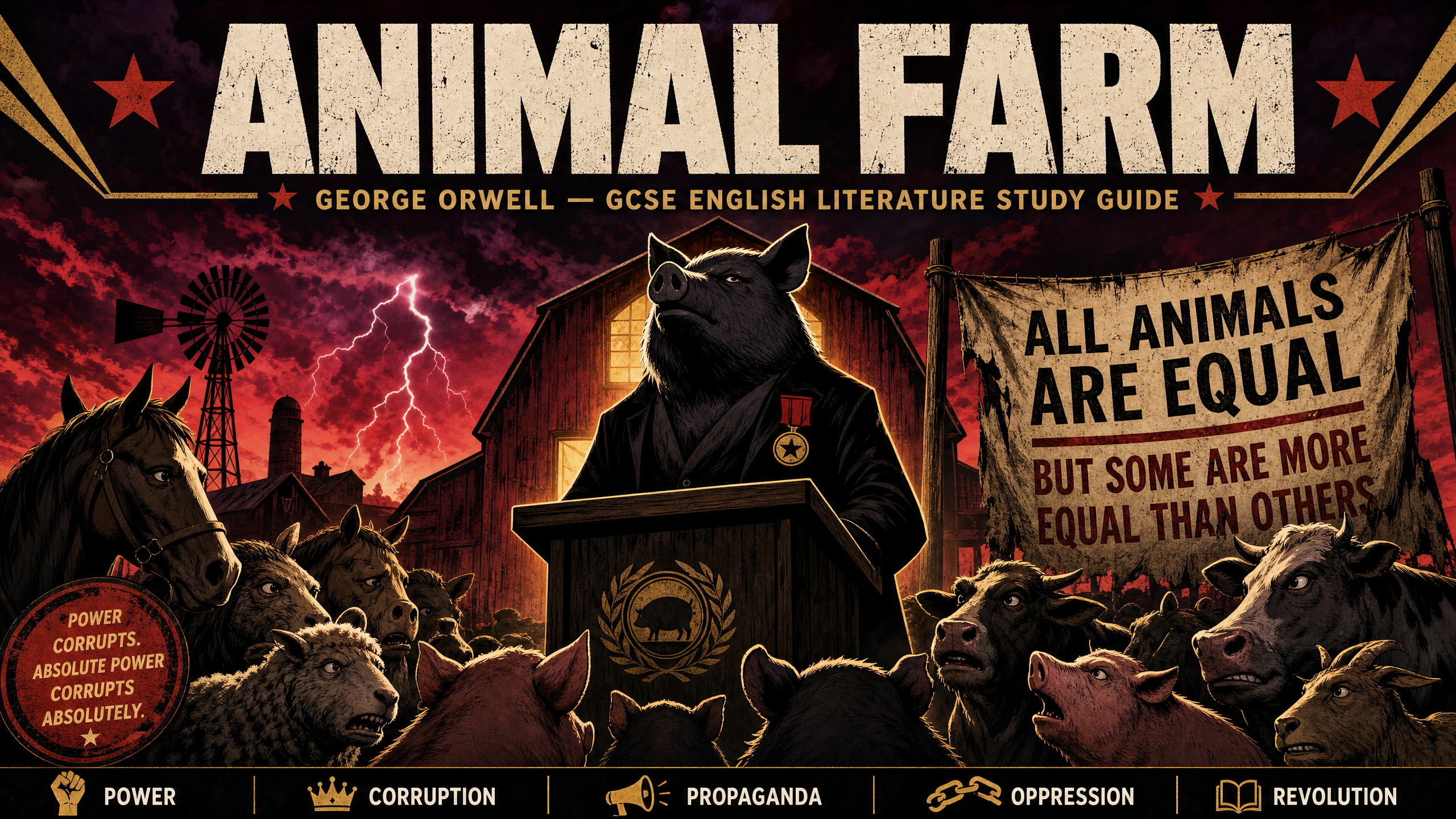
Overview
George Orwell's Animal Farm is a powerful political allegory that uses the fable form to critique totalitarianism and the corruption of power. Published in 1945, it reflects the events of the Russian Revolution and the subsequent rise of Stalinist Russia. For GCSE examiners, top-tier responses don't just recount the plot; they analyse how Orwell constructs his allegory to expose the manipulation of language, the betrayal of the working class, and the inevitable decay of revolutionary ideals. Candidates who consistently link specific language choices to Orwell's broader political purpose will secure the highest marks.
Plot/Content Overview
- Chapter 1: Old Major shares his dream of an egalitarian society (Animalism) and teaches the animals "Beasts of England".
- Chapter 2: Old Major dies. The animals rebel, drive out Mr. Jones, and establish the Seven Commandments.
- Chapter 3-4: The farm prospers initially. Snowball leads the animals to victory in the Battle of the Cowshed.
- Chapter 5: Napoleon uses his secretly trained dogs to expel Snowball and seizes total control, ending democratic meetings.
- Chapter 6-7: The windmill project begins. Napoleon starts trading with humans. The pigs move into the farmhouse. Famine and forced confessions lead to the slaughter of "traitor" animals.
- Chapter 8-9: The windmill is destroyed again. The pigs begin drinking alcohol. Boxer works himself to exhaustion and is sold to the knacker's yard to buy whisky for the pigs.
- Chapter 10: Years pass. The pigs walk on two legs and carry whips. The commandments are reduced to one contradictory maxim. The animals look from pig to human and can no longer tell the difference.
Themes
Theme 1: The Corruption of Power
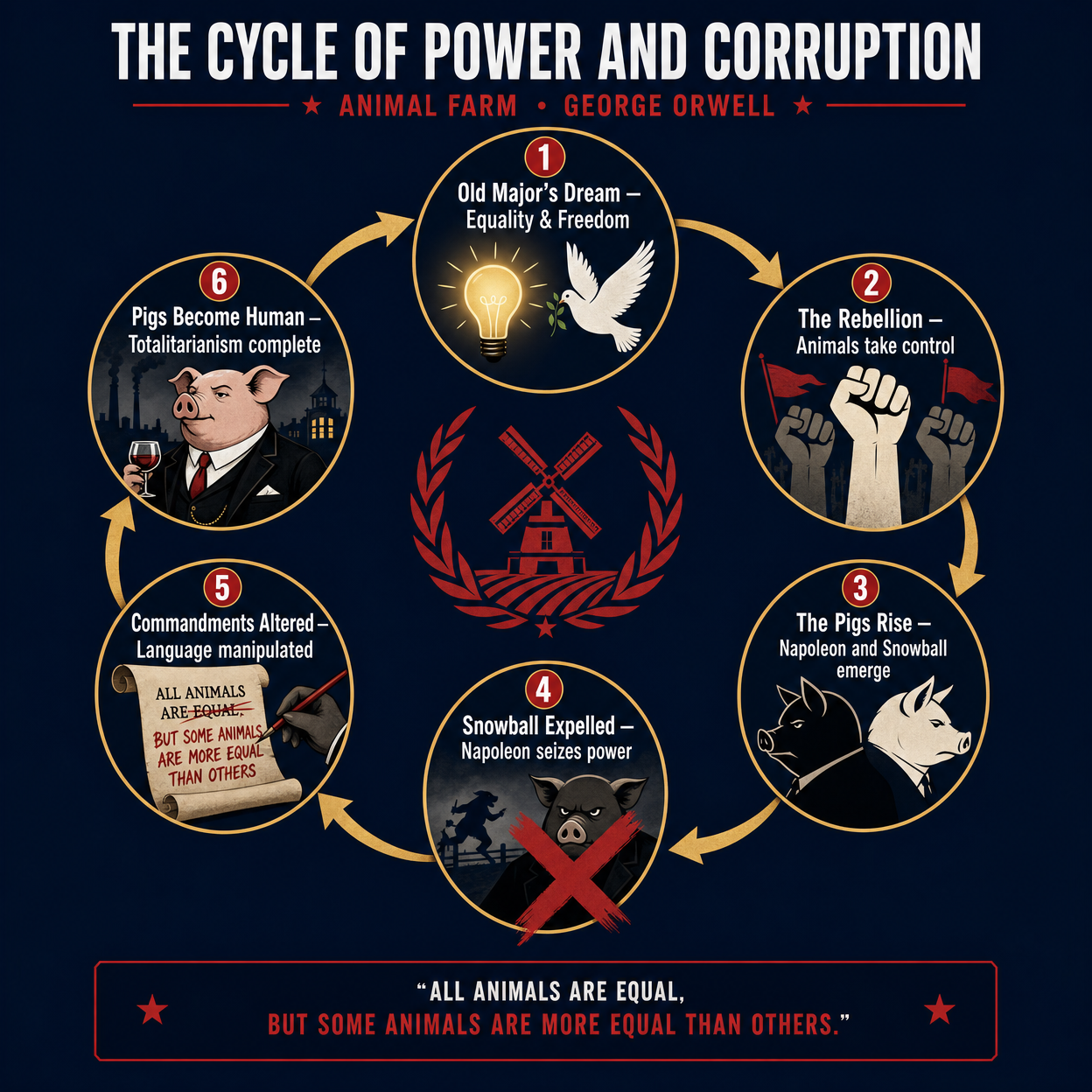
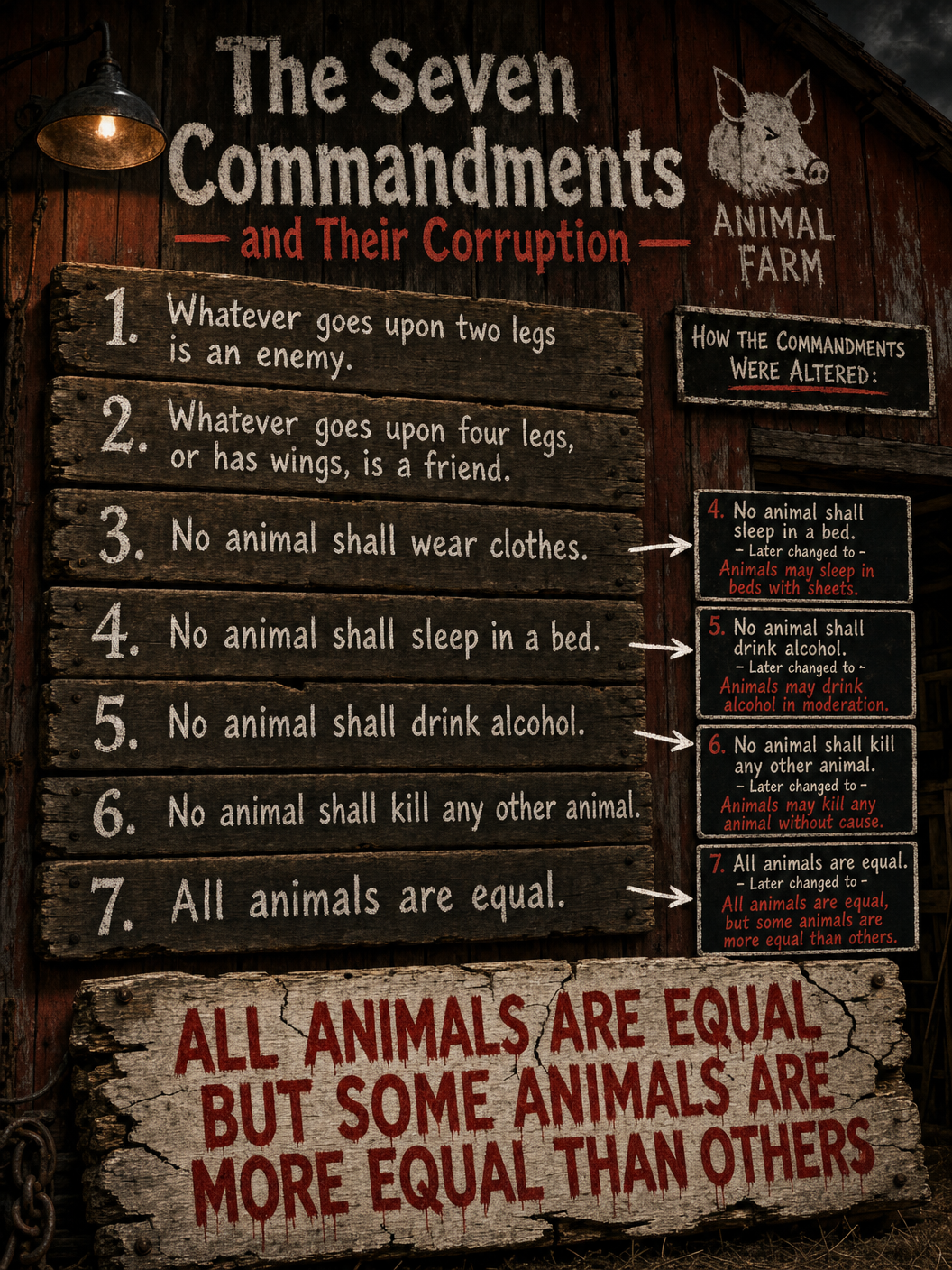
Orwell demonstrates that power corrupts absolutely. The pigs begin with genuine ideals but gradually adopt the very human vices they overthrew. The alteration of the Seven Commandments visually tracks this decay.
Key Quotes:
- "All animals are equal, but some animals are more equal than others." (Chapter 10) - The ultimate paradox that destroys Animalism. The comparative "more equal" highlights the absurdity and hypocrisy of the regime.
- "The creatures outside looked from pig to man, and from man to pig... but already it was impossible to say which was which." (Chapter 10) - The cyclical structure of the novella is completed; the new oppressors are indistinguishable from the old.
Theme 2: Propaganda and the Manipulation of Language
Squealer weaponises language to control the masses. Orwell shows how totalitarian regimes rewrite history, use confusing statistics, and employ rhetorical questions to prevent critical thought.
Key Quotes:
- "Surely, comrades, you do not want Jones back?" (Various) - Squealer's recurring rhetorical question uses fear to suppress dissent.
- "Four legs good, two legs bad" (Chapter 3) -> "Four legs good, two legs better" (Chapter 10) - The sheep's maxim demonstrates how complex thought is reduced to mindless, easily manipulated slogans.
Theme 3: Class Stratification and Exploitation
The novella highlights the tragedy of the working class (represented by Boxer), whose loyalty and physical labour are exploited by the ruling elite.
Key Quotes:
- "I will work harder" and "Napoleon is always right." (Various) - Boxer's maxims reflect blind loyalty and the tragic vulnerability of the uneducated working class.
Character Analysis
Napoleon
Role: The tyrant; represents Joseph Stalin.
Key Traits: Ruthless, calculating, manipulative, self-serving.
Character Arc: Transforms from a revolutionary leader into a dictator indistinguishable from a human farmer.
Essential Quotes:
- "Napoleon, with the dogs following him, now mounted on to the raised portion of the floor..." (Chapter 5)
- "Napoleon is always right." (Boxer's perspective, highlighting Napoleon's cultivated cult of personality).
Snowball
Role: The idealist; represents Leon Trotsky.
Key Traits: Intelligent, eloquent, visionary, but ultimately outmaneuvered.
Character Arc: Leads the initial success of the farm but is violently exiled and subsequently used as a scapegoat for all of Napoleon's failures.
Essential Quotes:
- "Snowball was a more vivacious pig than Napoleon, quicker in speech and more inventive..." (Chapter 2)
Squealer
Role: The propagandist; represents the Soviet state media (Pravda).
Key Traits: Persuasive, deceptive, hypocritical.
Character Arc: Remains Napoleon's loyal mouthpiece, continually altering reality to suit the regime's needs.
Essential Quotes:
- "He could turn black into white." (Chapter 2)
Boxer
Role: The working class; represents the dedicated, exploited proletariat.
Key Traits: Immensely strong, fiercely loyal, intellectually limited.
Character Arc: Works tirelessly for the regime, only to be callously betrayed and sold to his death when his strength fails.
Essential Quotes:
- "His answer to every problem, every setback, was 'I will work harder!'" (Chapter 3)
Writer's Methods
- Allegory: Orwell uses the microcosm of a farm to represent macrocosmic political events, making complex historical critiques accessible and universally applicable.
- Satire: The novella mocks the hypocrisy of Soviet leaders through the absurd, yet chilling, behaviour of the pigs.
- Fable Form: By using animal characters, Orwell creates a deceptive simplicity that contrasts sharply with the dark, violent themes, enhancing the shock value for the reader.
- Cyclical Structure: The narrative begins and ends with oppression, emphasizing the futility of the revolution under corrupt leadership.
- Dramatic Irony: The reader understands the pigs' manipulation long before the other animals do, creating a sense of tragic inevitability.
Context
Understanding the context of the Russian Revolution is vital for AO3. Examiners expect candidates to link characters and events to their historical counterparts (e.g., Old Major = Marx/Lenin; Napoleon = Stalin; Snowball = Trotsky; The Dogs = KGB/Secret Police). However, the most successful answers use this context to explore Orwell's broader message: a warning against totalitarianism and the fragility of democratic ideals in the face of unchecked ambition.
Visual Resources
2 diagrams and illustrations
Interactive Diagrams
1 interactive diagram to visualise key concepts
Conceptual Flow Outline
The Narrative Arc of Animal Farm: From Idealism to Tyranny
Worked Examples
2 detailed examples with solutions and examiner commentary
Practice Questions
Test your understanding — click to reveal model answers
How does Orwell present the theme of education and intelligence in Animal Farm? (30 marks + 4 AO4)
Hint: Consider how the pigs use their literacy to gain power, and how the lack of education among the other animals makes them vulnerable to exploitation.
Explore the significance of the windmill in Animal Farm. (30 marks + 4 AO4)
Hint: The windmill is a symbol. Think about what it represents initially (progress, less work) versus what it becomes (a tool for exhaustion and control).
Starting with the extract where Boxer is taken away in the van, explore how Orwell presents the betrayal of the working class. (30 marks + 4 AO4)
Hint: Focus on the emotional impact of the extract, Benjamin's reaction, and then link out to how Boxer was treated throughout the novel.
How does Orwell use the character of Old Major to explore revolutionary ideals? (30 marks + 4 AO4)
Hint: Look at Old Major's speech in Chapter 1. What does he promise? How do his warnings foreshadow the end of the novel?