Study Notes
Overview
Beatrice Garland's Kamikaze explores the psychological and social consequences of a Japanese pilot's decision to turn back from a suicide mission during World War II. For examiners, this poem is a masterclass in the conflict between personal conscience and national duty. Top-band responses (Level 5/6) will focus on how Garland uses shifting narrative perspectives, enjambment, and rich natural imagery to reveal the devastating cost of defying cultural expectations. The pilot survives the physical war but suffers a kind of social death, erased by his own family. Understanding this irony is crucial for achieving high marks in AO1 and AO2.
Listen to our comprehensive revision podcast to solidify your understanding:
Plot/Content Overview
- The Departure: The poem opens with the pilot embarking on his mission, equipped with a sword, a shaven head, and incantations, fully prepared for sacrifice.
- The Turning Point: Looking down, he sees the beauty of the ocean, the fishing boats, and the "flashing silver" of the fish, which triggers memories of his childhood.
- The Return: Overcome by the beauty of life and the pull of memory, he abandons his mission and returns home.
- The Consequence: Instead of relief, his return brings deep shame. His wife refuses to look at him, his neighbours ignore him, and eventually, even his children learn to treat him as if he were dead.
Themes
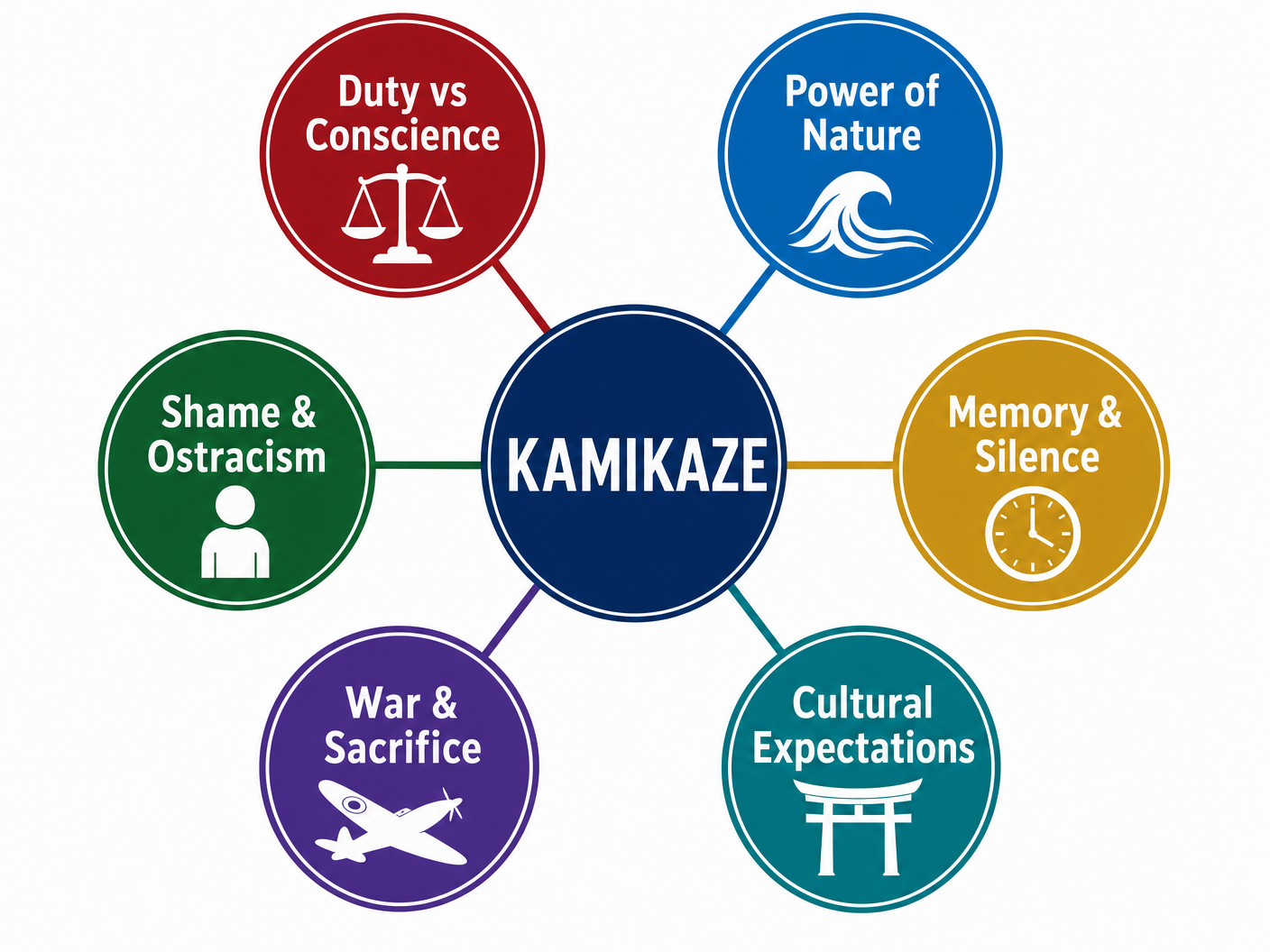
Theme 1: Duty vs Personal Conscience
The central conflict of the poem lies between the national expectation of sacrifice (duty) and the pilot's internal desire to live (conscience). Garland presents the ideology of the state as rigid and ultimately destructive, contrasting it with the natural human instinct for survival.
Key Quotes:
- "a shaven head / full of powerful incantations" (Stanza 1) - Shows the intense psychological conditioning and cultural indoctrination the pilot has undergone.
- "enough fuel for a one-way / journey into history" (Stanza 1) - Highlights the expectation of ultimate sacrifice; his death is framed as a glorious entry into national myth.
Theme 2: The Power of Nature
Nature acts as the catalyst for the pilot's change of heart. Garland uses vivid, sensory imagery to present the natural world as more powerful and compelling than the abstract ideology of war. Nature is sovereign and indifferent to human conflict.
Key Quotes:
- "the dark shoals of fishes / flashing silver as their bellies / swivelled towards the sun" (Stanza 3) - The sibilance and vivid visual imagery create a sense of vibrant, undeniable life that contrasts with his mission of death.
- "a tuna, the dark prince, muscular, dangerous." (Stanza 6) - This metaphor elevates nature to a regal, almost mythic status, suggesting a power far greater than the military forces.
Theme 3: Shame, Silence and Ostracism
The true tragedy of the poem is not death, but the social erasure the pilot experiences upon returning. The cultural expectation of honour is so absolute that his survival is viewed as a source of profound shame, leading to his isolation within his own family.
Key Quotes:
- "my mother never spoke again / in his presence" (Stanza 7) - The absolute nature of the silence highlights the severity of his ostracism.
- "we too learned / to be silent, to live as though / he had never returned" (Stanza 7) - Shows how cultural conditioning overrides natural familial love; the children are taught to participate in his social death.
Character Analysis
The Pilot
Role: The silent protagonist whose actions drive the narrative, yet whose voice is entirely absent.
Key Traits: Observant, conflicted, ultimately human.
Character Arc: Moves from a state of indoctrinated readiness to a profound awakening to the beauty of life, only to end in a state of living death, ostracised by those he chose to return to.
Essential Quotes:
- "he must have looked far down"
- "he must have wondered / which had been the better way to die"
The Daughter (Narrator)
Role: The primary voice of the poem, filtering the story through memory and inherited shame.
Key Traits: Reflective, regretful, complicit.
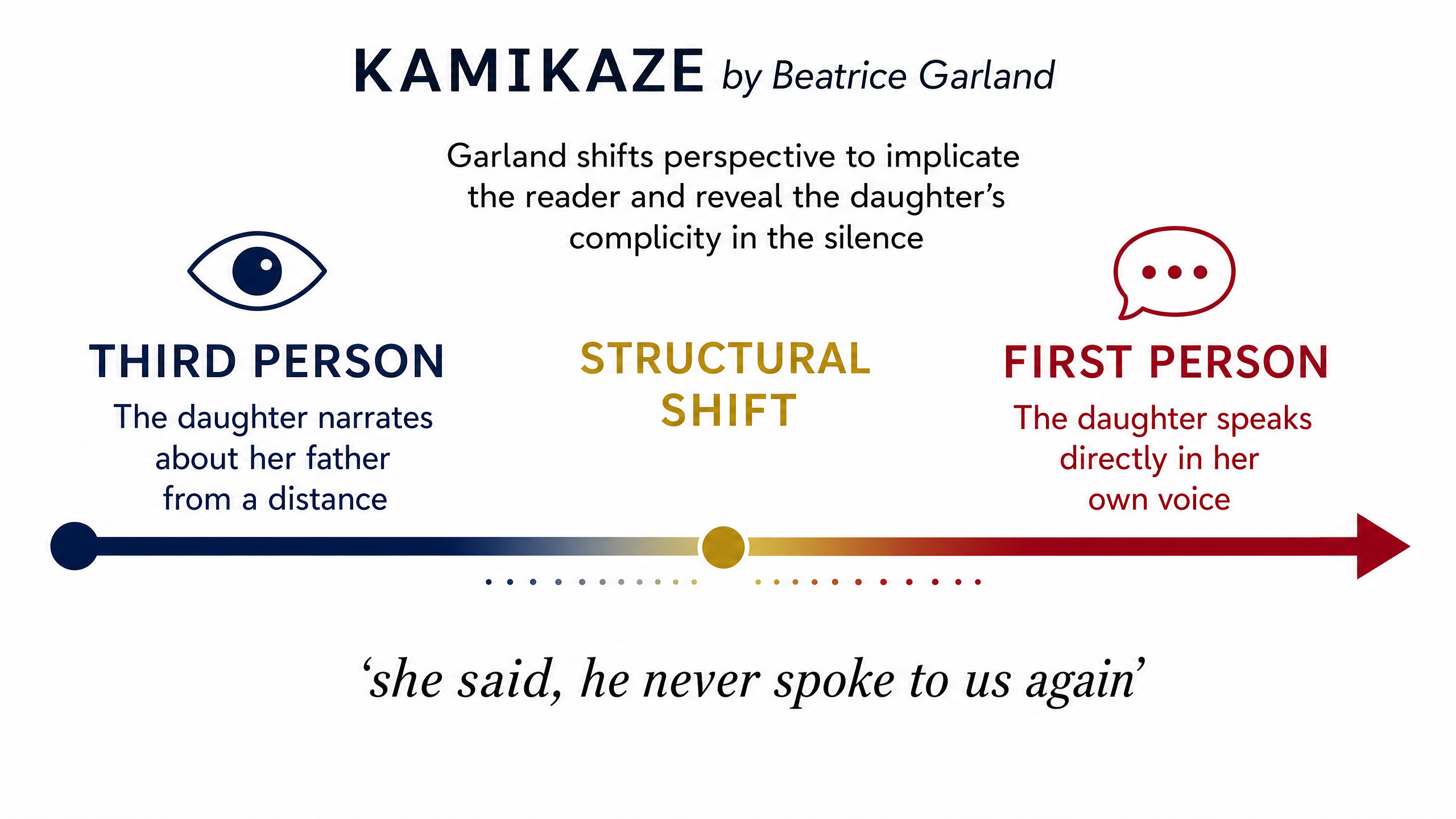
Character Arc: She begins by narrating the story from a detached, third-person perspective, but eventually shifts to the first person, acknowledging her own role in her father's isolation.
Essential Quotes:
- "And sometimes, she said, he must have wondered"
- "we children still chattered and laughed / till gradually we too learned / to be silent"
Writer's Methods
Garland's structural choices are as important as her imagery. The poem is written in free verse with no regular rhyme scheme, reflecting the pilot's decision to break away from the rigid structures of military duty and societal expectation.
The extensive use of enjambment allows the lines to flow continuously, mimicking the physical flight of the plane, the movement of the fish, and the uncontrollable cascade of the pilot's memories. It creates a sense of inevitability, which is then sharply contrasted by the heavy, silent pauses when the poem discusses his return.
The most significant structural method is the shifting narrative perspective. The poem moves from a detached third-person narration ("his father's boat") to a devastating first-person inclusion in the final stanzas ("my mother", "we too learned"). This shift implicates the narrator—and by extension, the reader—in the cruel act of silencing the pilot.
Context
To achieve high marks in AO3, context must be integrated into your analysis of the poem's meaning, not bolted on. The title refers to the Japanese Kamikaze pilots of WWII, who were expected to fly their planes into Allied ships. This was rooted in the Bushido code, a traditional samurai code of honour that valued loyalty and sacrifice above life itself. Surrender or failure to complete a mission brought profound shame (haji) upon the individual and their family. Garland uses this extreme historical context to explore universal themes of societal pressure, the conflict between state ideology and human instinct, and the devastating cost of non-conformity.
Visual Resources
2 diagrams and illustrations
Interactive Diagrams
1 interactive diagram to visualise key concepts
Conceptual Flow Outline
The Pilot's Psychological and Narrative Arc
Worked Examples
2 detailed examples with solutions and examiner commentary
Practice Questions
Test your understanding — click to reveal model answers
Compare how poets present the power of nature in 'Kamikaze' and one other poem from your anthology. (30 marks)
Hint: Focus on how nature in 'Kamikaze' is presented as more powerful than human ideology, and acts as a catalyst for the pilot's decision.
Explore how Garland presents the theme of memory in 'Kamikaze'. (15 marks)
Hint: Consider how memory functions in two ways: the pilot's memories of childhood that make him turn back, and the daughter's memory of her father's subsequent erasure.
How does Garland use language to convey the pilot's isolation? (15 marks)
Hint: Look at the contrast between the communal imagery of the fish/childhood and the singular, silent imagery of the pilot in his plane and later in his home.
Discuss the significance of the final stanza in 'Kamikaze'. (15 marks)
Hint: Focus on the shift in pronouns, the theme of regret, and the final devastating question about 'the better way to die'.