Study Notes
Overview
William Golding's Lord of the Flies is a masterclass in allegorical storytelling, presenting a microcosm of human society through the descent of marooned schoolboys into savagery. Examiners look for candidates who can look beyond the plot to analyse Golding's pessimistic view of human nature. You must evaluate how he uses characterisation, setting, and powerful symbolism to argue that the 'beast' is not an external monster, but an innate human flaw. High marks are awarded for seamlessly integrating the post-war context and analysing the specific language choices that track the breakdown of civilisation.
Listen to the companion podcast for an in-depth audio review:
Plot/Content Overview
Chapters 1-3: The Establishment of OrderFollowing a plane crash, Ralph and Piggy find a conch shell and use it to summon the surviving boys. Ralph is elected leader, establishing democratic rules and the vital signal fire. Jack, the choir leader, takes charge of hunting, though he initially hesitates to kill.
Chapters 4-6: The Cracks AppearJack's obsession with hunting grows. He paints his face, masking his civilised identity, and lets the signal fire die just as a ship passes. The boys' fear of a 'beast' intensifies, exacerbated by the arrival of a dead parachutist on the mountain.
Chapters 7-9: The Triumph of SavageryJack breaks away to form his own tribe, ruling through fear and violence. They leave a pig's head on a stick as an offering to the beast. Simon, discovering the true nature of the beast, rushes to tell the others but is brutally murdered in a frenzied tribal dance.
Chapters 10-12: The Annihilation of ReasonJack's tribe steals Piggy's glasses. When Ralph and Piggy confront them, Roger murders Piggy, destroying the conch. Ralph is hunted like an animal across the burning island until he stumbles upon a naval officer, whose arrival abruptly halts the violence but offers a bleak reflection on the adult world's own savagery.
Themes
Theme 1: Civilisation vs. Savagery
Golding presents these not as distinct groups of people, but as competing impulses within every individual. The novel charts the tragic victory of instinctual savagery over rational civilisation. The island acts as a microcosm where the removal of societal boundaries allows the boys' innate darkness to flourish.
Key Quotes:
- "Here, invisible yet strong, was the taboo of the old life." (Chapter 4) - Early on, societal conditioning still restrains Roger from hitting Henry. The adjective 'invisible' highlights the fragility of these rules.
- "He began to dance and his laughter became a bloodthirsty snarling." (Chapter 4) - Jack's transformation is marked by animalistic imagery. The verb 'snarling' strips away his humanity.
- "Ralph wept for the end of innocence, the darkness of man's heart..." (Chapter 12) - The novel's concluding thesis. The metaphor 'darkness' underscores the inherent evil Golding perceives in humanity.
Theme 2: The Nature of Evil (The Beast)
The 'beast' evolves from a childhood nightmare into a profound symbol of human depravity. Golding argues that evil is not an external force to be fought, but an internal reality to be acknowledged.
Key Quotes:
- "Maybe there is a beast... maybe it's only us." (Chapter 5) - Simon's prophetic realisation. The hesitation in 'maybe' contrasts with the terrifying truth of his conclusion.
- "Fancy thinking the Beast was something you could hunt and kill!" (Chapter 8) - The Lord of the Flies speaks to Simon. The mocking tone highlights the boys' foolishness in externalising their own dark impulses.
Theme 3: Power and Leadership
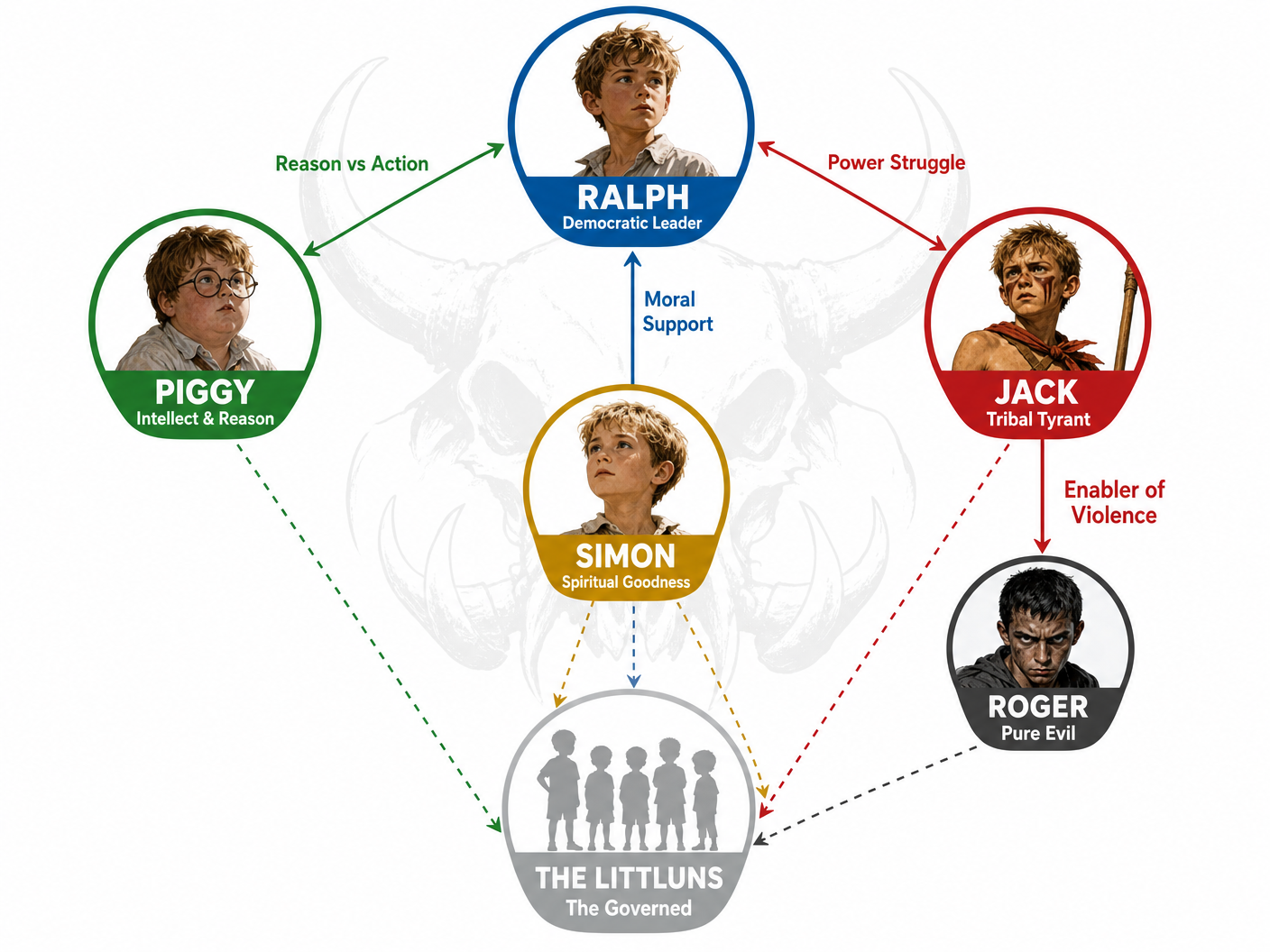
The novel contrasts Ralph's democratic, rational leadership with Jack's authoritarian, fear-based rule. Golding pessimistically suggests that humanity is more easily swayed by the immediate gratification and protection offered by a dictator than by the long-term planning of a democrat.
Key Quotes:
- "Because the rules are the only thing we've got!" (Chapter 5) - Ralph's desperate plea. The exclamation mark emphasises his panic as he senses the collapse of order.
- "Power lay in the brown swell of his forearms: authority sat on his shoulder and chattered in his ear like an ape." (Chapter 9) - Jack's power is described in physical, primal terms. The simile 'like an ape' connects his authority directly to regression and savagery.
Character Analysis
Ralph
Role: The protagonist; the embodiment of democracy, order, and civilising instinct.
Key Traits: Rational, moral, but ultimately flawed and susceptible to the island's dark pull.
Character Arc: Begins as a confident, golden boy who views the island as a playground. He gradually loses control, struggles to articulate his thoughts (the 'curtain' in his mind), participates in Simon's murder, and ends as a hunted, weeping outcast who understands the true nature of humanity.
Essential Quotes:
- "The conch. I got the conch."
- "I'm frightened. Of us."
Jack
Role: The primary antagonist; represents humanity's innate savagery, violence, and desire for power.
Key Traits: Authoritarian, aggressive, manipulative, and deeply insecure.
Character Arc: Starts as a strict, rule-abiding choirboy who cannot bring himself to kill a piglet. He quickly sheds his civilised veneer, using face paint to liberate himself from shame, and establishes a brutal dictatorship based on fear and ritual.
Essential Quotes:
- "We've got to have rules and obey them. After all, we're not savages."
- "The mask was a thing on its own, behind which Jack hid, liberated from shame and self-consciousness."
Piggy
Role: The intellectual and scientific voice of reason; Ralph's loyal advisor.
Key Traits: Intelligent, physically vulnerable, fiercely attached to the rules of the adult world.
Character Arc: Remains steadfast in his belief in science and order. His physical deterioration (losing his glasses) mirrors the island's descent into chaos. His brutal murder marks the absolute end of intellect and reason on the island.
Essential Quotes:
- "What are we? Humans? Or animals? Or savages?"
- "Which is better—to have rules and agree, or to hunt and kill?"
Simon
Role: The visionary, Christ-like figure; represents innate, spiritual goodness.
Key Traits: Perceptive, solitary, deeply connected to nature, physically frail (fainting spells).
Character Arc: The only boy who truly understands the nature of the beast. He confronts the Lord of the Flies, discovers the truth about the parachutist, and is martyred by the boys when he tries to bring them the truth.
Essential Quotes:
- "What I mean is... maybe it's only us."
- "Simon found for them the fruit they could not reach."
Writer's Methods
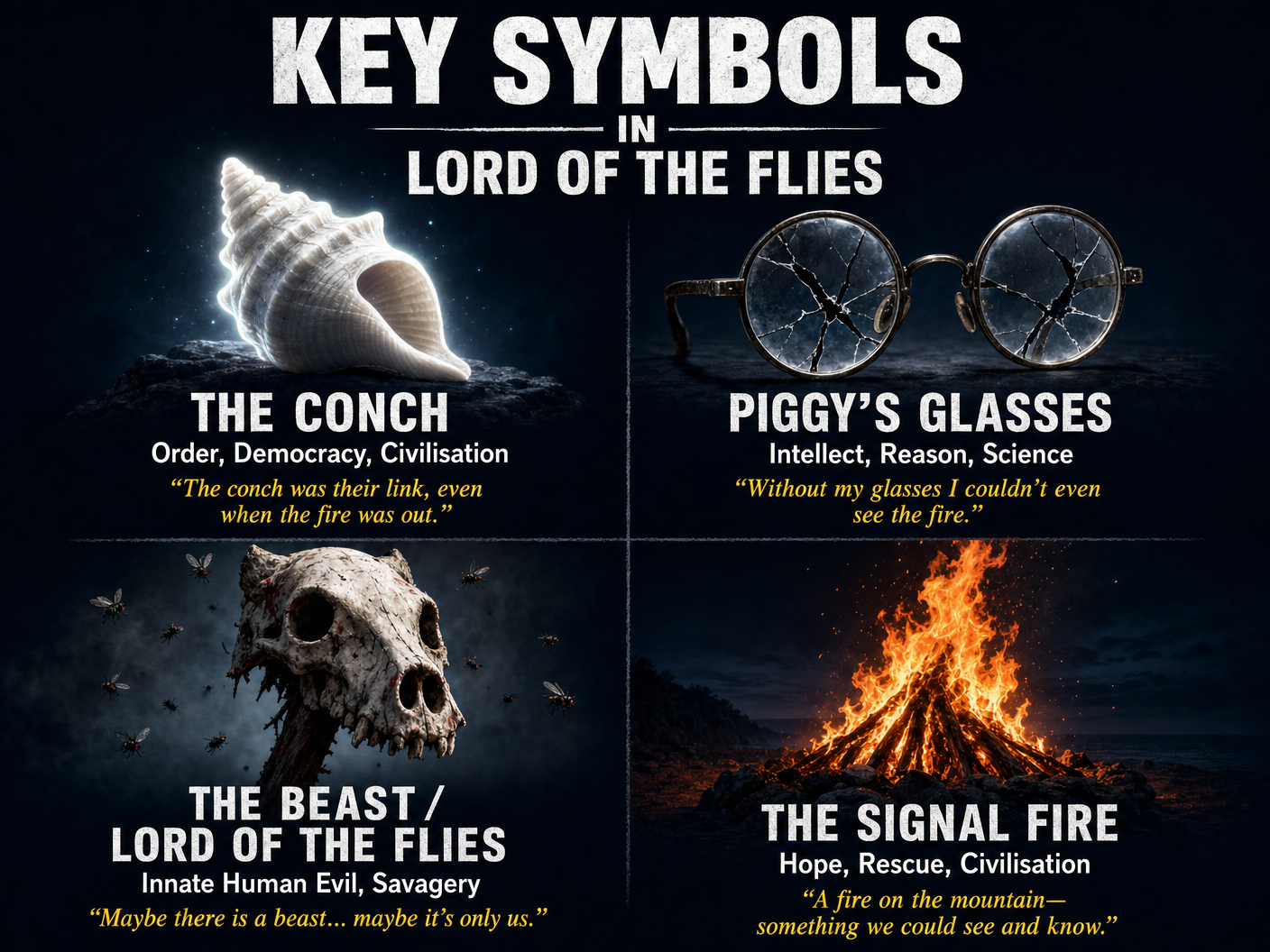
Symbolism: Golding's most prominent method. The island is a microcosm. The conch represents democracy; Piggy's glasses represent science and clarity of thought; the signal fire is hope and connection to society; the beast is the capacity for evil.
Setting and Pathetic Fallacy: The island mirrors the boys' moral state. It begins as a vibrant, idyllic 'coral island' but becomes increasingly hostile. The brutal storm during Simon's murder perfectly reflects the chaotic, violent frenzy of the boys.
Language and Imagery: Golding uses semantic fields of hunting and animalism to track the boys' regression. Words like 'snarling', 'ape', 'claws', and 'frenzy' strip the boys of their humanity.
Narrative Structure: The novel follows a linear descent from order to chaos. The irony of the ending—rescue by a naval officer engaged in a global war—forces the reader to re-evaluate the entire narrative as a critique of the adult world.
Context
Post-War Pessimism: Written in the shadow of WWII and the Holocaust, Golding was profoundly affected by the atrocities committed by supposedly 'civilised' nations. He stated, "man produces evil as a bee produces honey."
The Cold War: Published in 1954, the novel reflects the nuclear anxiety of the era (the boys are evacuated due to an atomic war). The standoff between Ralph and Jack mirrors global political tensions.
Literary Context: A direct subversion of R.M. Ballantyne's The Coral Island (1857), an optimistic Victorian novel where British boys easily conquer an island and defeat 'savages'. Golding argues this imperialist optimism is a dangerous illusion.
Visual Resources
2 diagrams and illustrations
Interactive Diagrams
1 interactive diagram to visualise key concepts
Conceptual Flow Outline
The Linear Descent into Savagery
Worked Examples
2 detailed examples with solutions and examiner commentary
Practice Questions
Test your understanding — click to reveal model answers
How does Golding present the relationship between Ralph and Jack in Lord of the Flies?
Hint: Track their relationship chronologically. Start with their initial cooperation, move to the ideological split over the fire/hunting, and end with the hunt to the death.
Explore how Golding uses the island setting to convey his ideas about human nature.
Hint: Think of the island as a blank canvas that the boys project their internal state onto. How does the description of the island change from Chapter 1 to Chapter 12?
How is the theme of fear presented in the novel?
Hint: Focus on the 'Beast'. How does fear change from a childish nightmare (snake-thing) to a tool of control for Jack?
Explore the significance of Simon in the novel.
Hint: Simon is the spiritual centre of the book. Contrast his innate goodness with the conditioned 'goodness' of Ralph and Piggy.