Study Notes
Overview
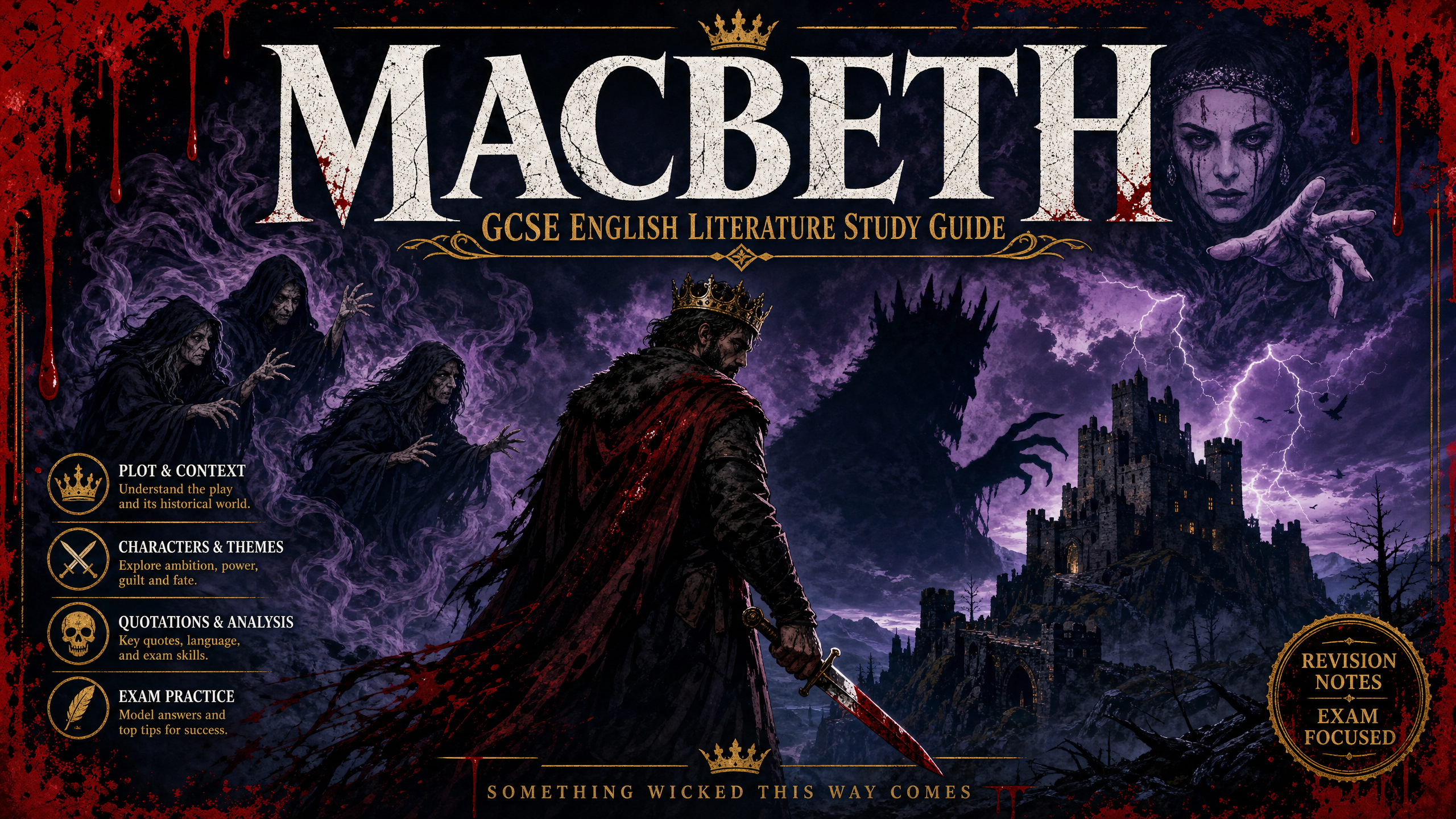
Macbeth is a masterpiece of dramatic tension, charting the rapid rise and catastrophic fall of a Scottish warrior whose "vaulting ambition" leads him to murder his king. For examiners, the play's richness lies in Shakespeare's sophisticated use of language, imagery, and structure to trace psychological decay. Top-tier candidates move beyond character summary to analyse how Shakespeare uses motifs like blood, sleep, and darkness to externalise internal guilt. Furthermore, understanding the Jacobean context—particularly anxieties surrounding witchcraft, the Divine Right of Kings, and the recent Gunpowder Plot—is essential for accessing AO3 marks. The play is not merely a story of murder, but a profound exploration of what happens when the moral and natural order is violently disrupted.
Listen to our comprehensive revision podcast below:
Plot/Content Overview
- Act 1: Returning from a victorious battle, Macbeth and Banquo encounter three witches who prophesy that Macbeth will become Thane of Cawdor and then King. When the first prophecy comes true, Macbeth's ambition is ignited. Lady Macbeth, fearing his nature is "too full o' the milk of human kindness," persuades him to murder King Duncan when he visits their castle.
- Act 2: Driven by ambition and his wife's manipulation, Macbeth murders Duncan in his sleep. The act shatters his psyche. Malcolm and Donalbain, Duncan's sons, flee in fear, casting suspicion upon themselves. Macbeth is crowned king.
- Act 3: Paranoia sets in. Fearing the witches' prophecy that Banquo's descendants will be kings, Macbeth orders the murder of Banquo and his son Fleance (who escapes). At a royal banquet, Macbeth is tormented by Banquo's ghost, a hallucination revealing his crumbling sanity.
- Act 4: Desperate, Macbeth seeks out the witches. They offer deceptive reassurances: he cannot be harmed by anyone "of woman born" and will not be defeated until Birnam Wood moves to Dunsinane. Emboldened, he unleashes a reign of terror, slaughtering Macduff's family.
- Act 5: Lady Macbeth descends into madness, sleepwalking and obsessively trying to wash imaginary blood from her hands before dying (likely by suicide). The English army, led by Malcolm and Macduff, advances, camouflaged with branches from Birnam Wood. Macduff, revealed to have been born via caesarean section, kills Macbeth. Order is restored as Malcolm takes the throne.
Themes
Theme 1: Ambition and Corruption
Ambition is the tragic flaw (hamartia) that drives the narrative. Shakespeare presents it not as a noble trait, but as a destructive, corrupting force that overrides morality.
Key Quotes:
- "I have no spur / To prick the sides of my intent, but only / Vaulting ambition, which o'erleaps itself" (Act 1, Scene 7) - Macbeth recognises his ambition is excessive and dangerous before the murder.
- "To be thus is nothing, / But to be safely thus" (Act 3, Scene 1) - Ambition is insatiable; achieving the crown brings no peace, only deeper paranoia.
Theme 2: Guilt and Conscience
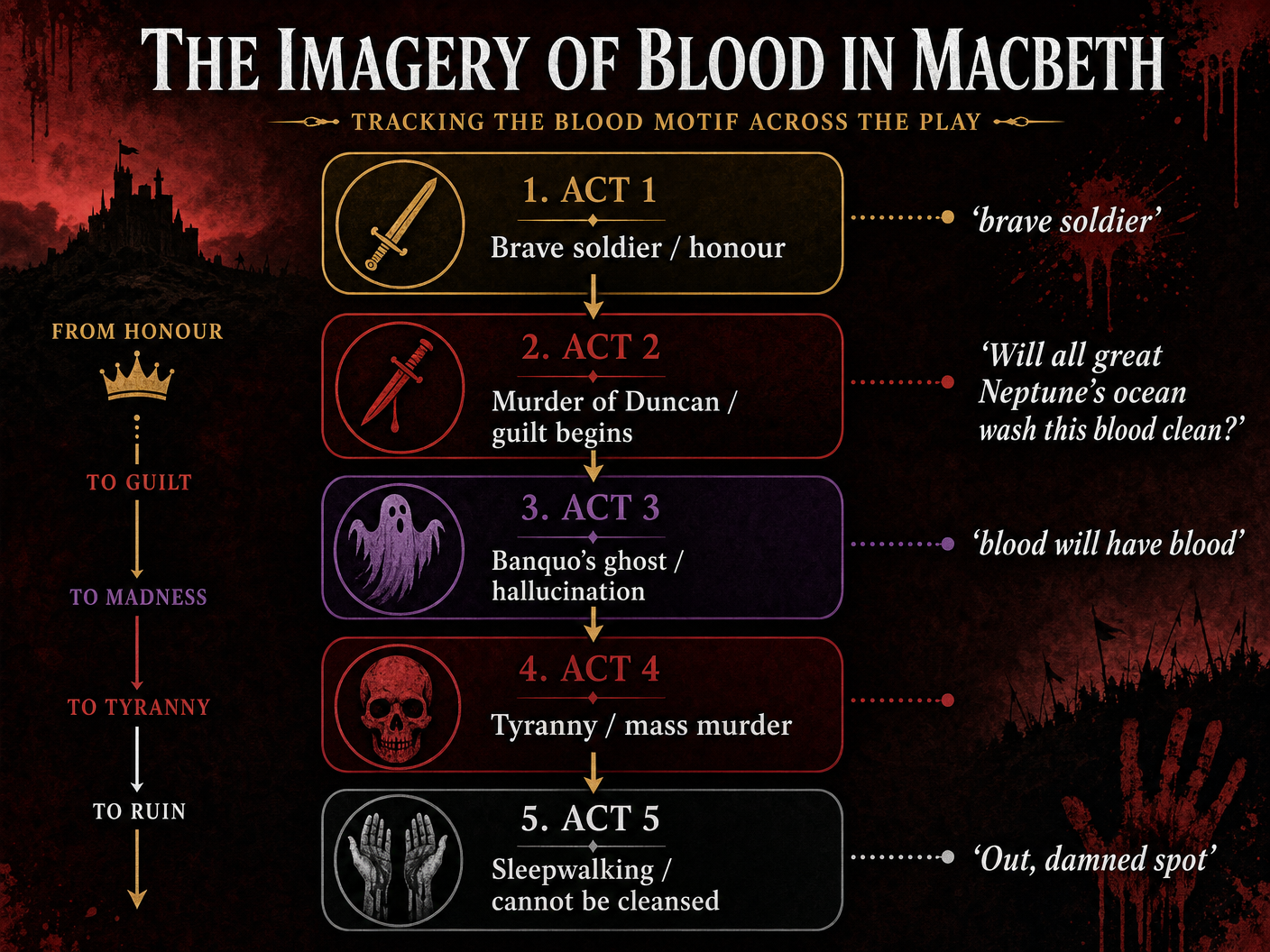
Guilt is externalised through powerful sensory imagery—blood, lack of sleep, and hallucinations. It destroys both Macbeth and Lady Macbeth, proving that actions have inescapable psychological consequences.
Key Quotes:
- "Will all great Neptune's ocean wash this blood / Clean from my hand?" (Act 2, Scene 2) - Macbeth's hyperbole illustrates the overwhelming, permanent stain of his guilt.
- "Out, damned spot! Out, I say!" (Act 5, Scene 1) - Lady Macbeth's fragmented prose reflects her broken mind, contrasting sharply with her earlier claim that "a little water clears us of this deed."
Theme 3: Appearance versus Reality
The play is built on deception. Characters hide their true intentions, and the supernatural forces speak in riddles, highlighting the danger of trusting outward appearances.
Key Quotes:
- "Look like the innocent flower, / But be the serpent under't" (Act 1, Scene 5) - Lady Macbeth instructs her husband in the art of deception, using biblical imagery of the serpent to underscore the evil of their treachery.
- "Fair is foul, and foul is fair" (Act 1, Scene 1) - The witches establish a world where moral boundaries are blurred and nothing is as it seems.
Character Analysis
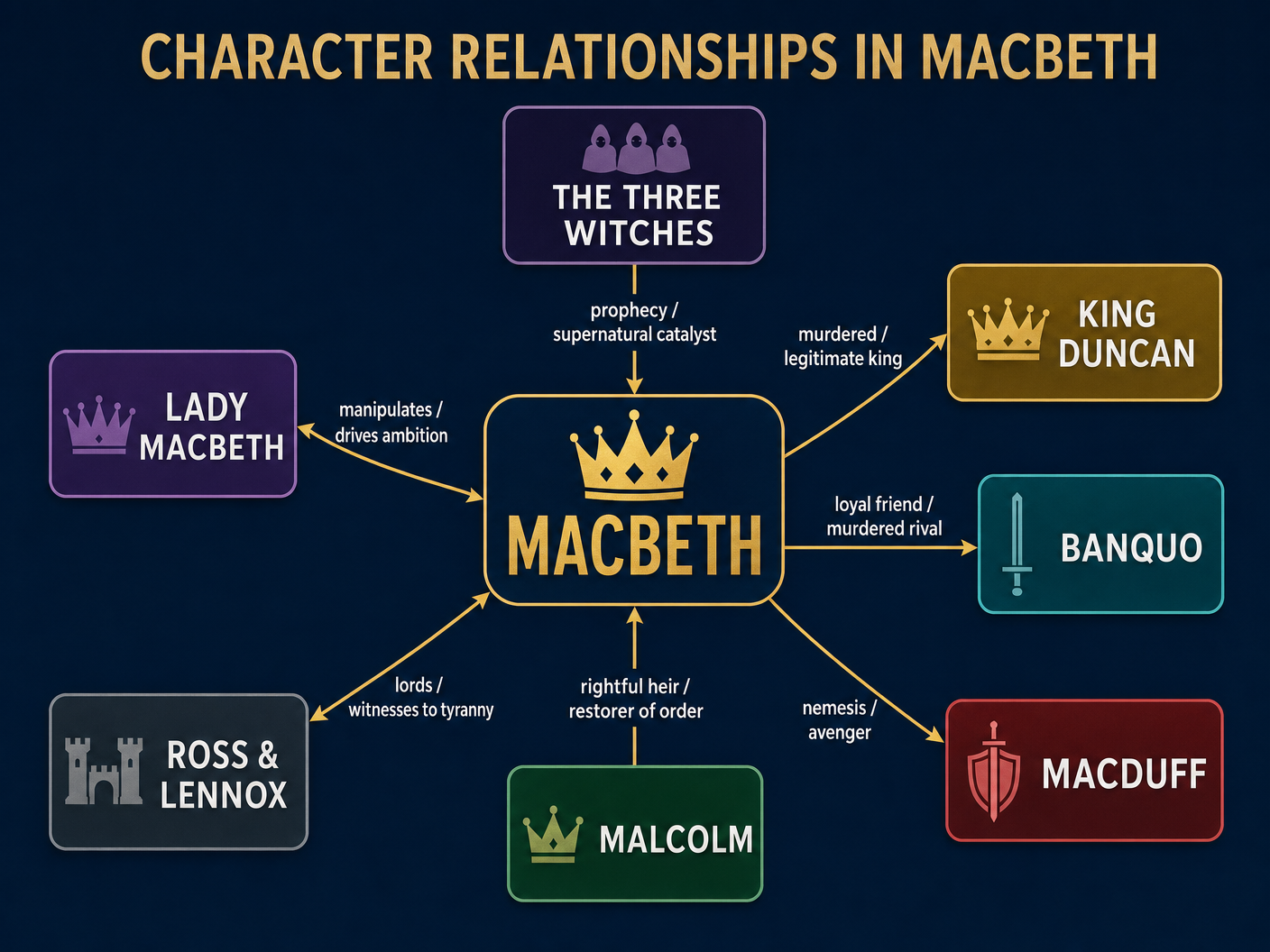
Macbeth
Role: Tragic Hero
Key Traits: Brave, ambitious, easily manipulated, deeply guilty, ultimately tyrannical.
Character Arc: He transforms from a celebrated, loyal "valiant cousin" to a "dead butcher." His journey is marked by a transition from agonizing hesitation to callous, unfeeling slaughter.
Essential Quotes:
- "Brave Macbeth - well he deserves that name" (Act 1, Scene 2)
- "O, full of scorpions is my mind, dear wife!" (Act 3, Scene 2)
- "I am in blood / Stepp'd in so far that, should I wade no more, / Returning were as tedious as go o'er" (Act 3, Scene 4)
Lady Macbeth
Role: Catalyst for Macbeth's ambition / Mirror to his guilt
Key Traits: Manipulative, commanding, ruthless (initially), vulnerable (ultimately).
Character Arc: She begins as the dominant partner, suppressing her femininity to commit murder. However, as Macbeth isolates himself, she is consumed by suppressed guilt, leading to madness and death.
Essential Quotes:
- "Unsex me here, / And fill me from the crown to the toe top-full / Of direst cruelty!" (Act 1, Scene 5)
- "My hands are of your colour, but I shame / To wear a heart so white." (Act 2, Scene 2)
- "Here's the smell of the blood still. All the perfumes of Arabia will not sweeten this little hand." (Act 5, Scene 1)
The Witches
Role: Agents of Fate / Supernatural catalysts
Key Traits: Equivocating, malicious, prophetic.
Character Arc: They do not change, but their influence drives the plot. They represent the dark, uncontrollable forces of the universe.
Essential Quotes:
- "When shall we three meet again / In thunder, lightning, or in rain?" (Act 1, Scene 1)
- "By the pricking of my thumbs, / Something wicked this way comes." (Act 4, Scene 1)
Writer's Methods
Shakespeare employs a range of dramatic and literary techniques to shape audience response:
- Dramatic Irony: The audience frequently knows more than the characters (e.g., Duncan praising the "pleasant seat" of Macbeth's castle while the audience knows he is walking into a trap). This generates immense tension.
- Imagery: Dominant motifs include blood (representing guilt), darkness/night (representing evil and concealment), and disease/sickness (representing the corruption of Scotland under a tyrant).
- Form and Metre: Noble characters typically speak in blank verse (unrhymed iambic pentameter). The witches speak in trochaic tetrameter, a chant-like rhythm that marks them as unnatural. When Lady Macbeth descends into madness, her speech breaks down into disjointed prose.
- Soliloquy: Used extensively to give the audience direct access to Macbeth's tortured internal monologue, making him a complex psychological figure rather than a simple villain.
Context
Examiners expect candidates to integrate relevant context (AO3) seamlessly into their analysis:
- The Divine Right of Kings: Jacobeans believed the monarch was appointed by God. Regicide (killing a king) was a crime against God and nature, which is why nature rebels after Duncan's death (e.g., horses eating each other).
- Witchcraft and King James I: King James was deeply paranoid about witches, having written Daemonologie. The inclusion of witches was highly topical and would have genuinely terrified a Jacobean audience.
- The Gunpowder Plot (1605): A recent Catholic plot to blow up Parliament and the King. The play's themes of treason, equivocation (a Jesuit concept), and the ultimate defeat of traitors strongly resonated with this political anxiety.
- Patriarchal Society: Lady Macbeth subverts contemporary expectations of women as submissive and maternal, making her a deeply shocking figure to original audiences.
Visual Resources
2 diagrams and illustrations
Interactive Diagrams
1 interactive diagram to visualise key concepts
Conceptual Flow Outline
Macbeth's Tragic Character Arc
Worked Examples
2 detailed examples with solutions and examiner commentary
Practice Questions
Test your understanding — click to reveal model answers
Starting with this extract (Act 3, Scene 4: The Banquet Scene), explore how Shakespeare presents Macbeth's state of mind. (30 marks + 4 AO4)
Hint: Consider how his reaction to the ghost contrasts with his public role as King. Link this to his earlier guilt over Duncan.
How does Shakespeare present the relationship between Macbeth and Lady Macbeth? (30 marks + 4 AO4)
Hint: Track the shift in power dynamics. Who is dominant in Act 1 vs Act 3 vs Act 5?
Explore the significance of the supernatural in Macbeth. (30 marks + 4 AO4)
Hint: Don't just talk about the witches. Include the dagger, the ghost, and the disruption of nature.
How does Shakespeare use the motif of blood to explore guilt in the play? (30 marks + 4 AO4)
Hint: Track how blood changes from a symbol of honour in Act 1 to a symbol of inescapable guilt.