Study Notes
Overview
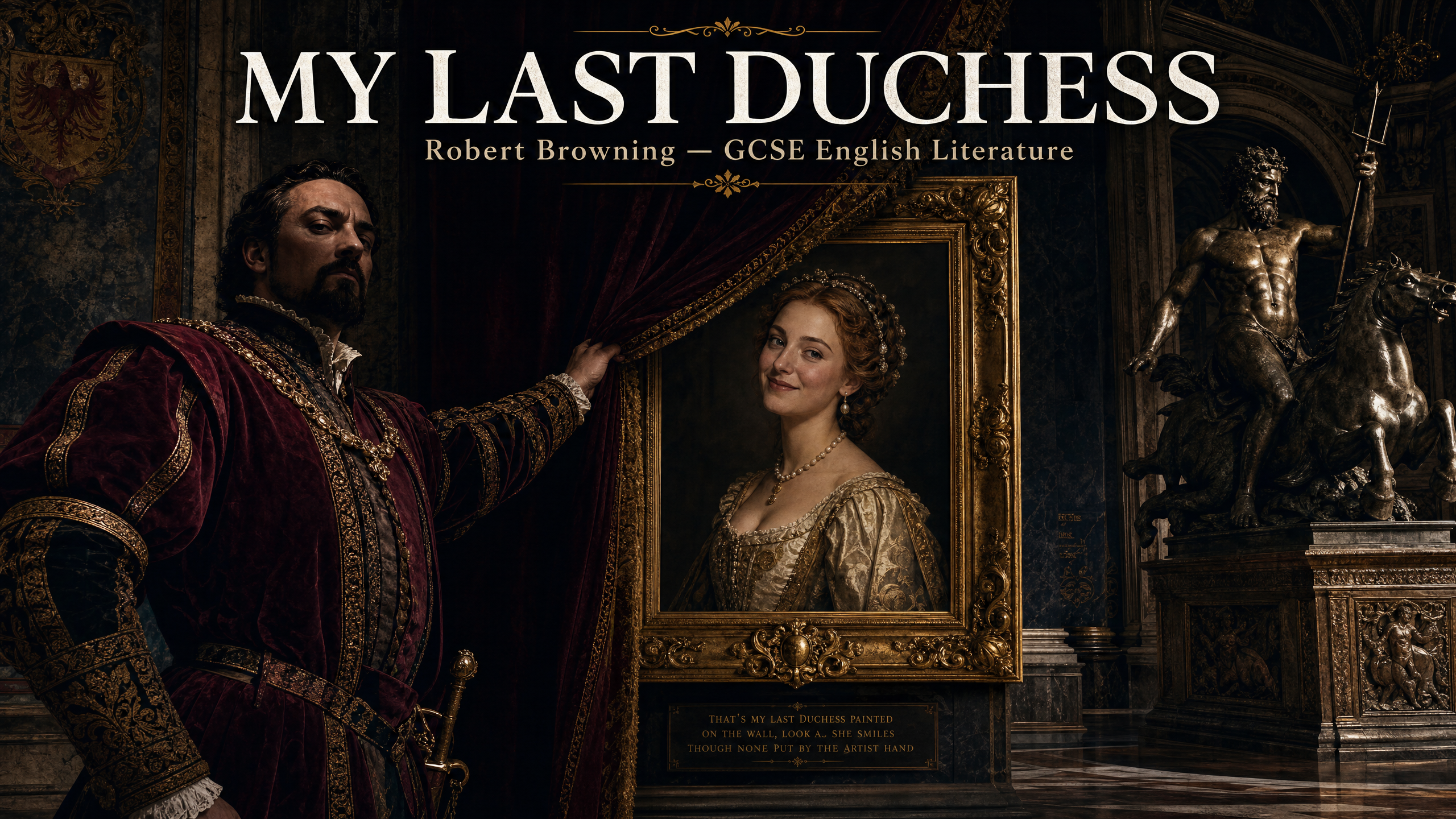
'My Last Duchess', written by Robert Browning in 1842, is a foundational text in the AQA Power and Conflict poetry cluster. The poem is a dramatic monologue spoken by the Duke of Ferrara, an Italian aristocrat, who is showing an emissary a portrait of his late wife. As the Duke speaks, he unintentionally reveals his jealous, controlling, and deeply sinister nature, strongly implying that he ordered his wife's murder because she did not value his 'nine-hundred-years-old name' above all else. Examiners highly reward candidates who can confidently distinguish between the voice of the Duke and the intentions of the poet, and who can analyze how Browning uses form and structure to critique patriarchal power.
Plot/Content Overview
- The Introduction: The Duke draws back a curtain to show an emissary a portrait of his late wife, the 'last Duchess', painted by Fra Pandolf.
- The Complaint: The Duke complains that the Duchess was 'too soon made glad' and smiled at everyone, failing to appreciate his aristocratic status.
- The Climax: Unable to control her behaviour in life, the Duke reveals he 'gave commands; / Then all smiles stopped together', implying he had her killed.
- The Conclusion: The Duke seamlessly transitions back to negotiating his next marriage with the emissary, pointing out a bronze statue of Neptune taming a sea-horse as they walk away.
Themes
Theme 1: Power and Control
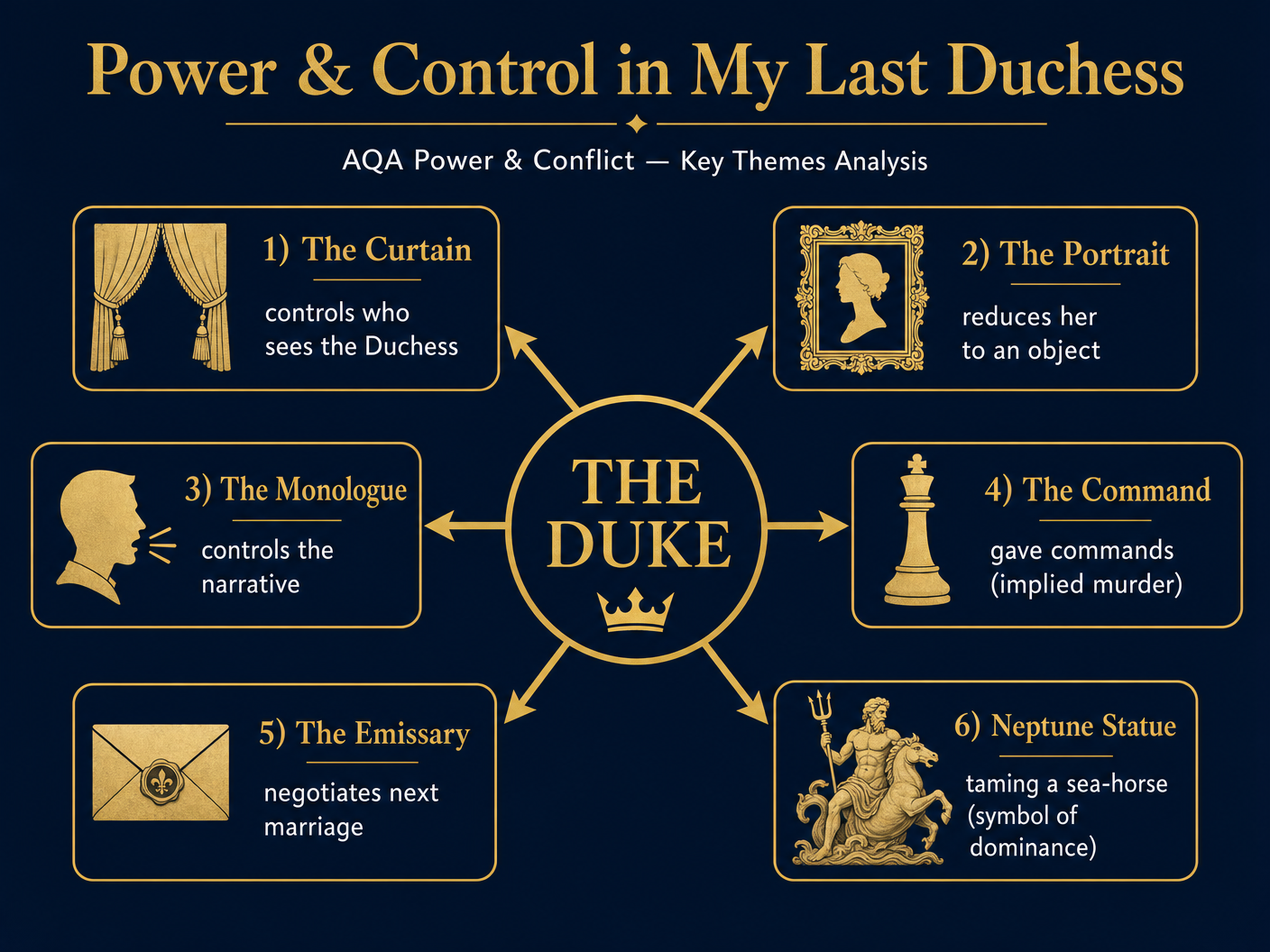
Power and control are central to the poem. The Duke's obsession with dominance is absolute; he could not control the Duchess in life, so he controls her in death. He has reduced her to an object (a painting) over which he has complete authority.
Key Quotes:
- "since none puts by / The curtain I have drawn for you, but I" (Lines 9-10) - The curtain symbolizes the Duke's ultimate control. In life, he could not control who she smiled at; in death, he controls exactly who sees her and when.
- "Notice Neptune, though, / Taming a sea-horse" (Lines 54-55) - This metaphor at the poem's conclusion explicitly mirrors the Duke's desire to dominate and 'tame' women.
Theme 2: Objectification and Gender
The poem serves as a powerful critique of patriarchal attitudes. The Duchess is entirely voiceless, existing only as an object to be possessed, admired, and ultimately disposed of when she fails to conform to the Duke's expectations.
Key Quotes:
- "That's my last Duchess painted on the wall" (Line 1) - The possessive pronoun 'my' immediately establishes ownership. She is not named; she is defined entirely by her relationship to him.
- "as if she ranked / My gift of a nine-hundred-years-old name / With anybody's gift." (Lines 32-34) - The Duke's arrogance and entitlement highlight the patriarchal assumption that a woman should be entirely subservient and grateful to her husband.
Character Analysis
The Duke of Ferrara
Role: The speaker and unreliable narrator of the poem.
Key Traits: Arrogant, controlling, jealous, cold, calculating, and deeply insecure despite his status.
Character Arc: The Duke does not change; rather, the reader's perception of him changes from seeing a cultured aristocrat to recognizing a cold-blooded murderer.
Essential Quotes:
- "I choose / Never to stoop." (Lines 42-43) - Highlights his immense pride and refusal to communicate his feelings, preferring violence over compromise.
- "I gave commands; / Then all smiles stopped together." (Lines 45-46) - The chilling climax revealing his ruthlessness.
The Last Duchess
Role: The subject of the poem and victim of the Duke's control.
Key Traits: Joyful, appreciative, easily pleased, egalitarian (treating everyone with the same warmth).
Essential Quotes:
- "A heart—how shall I say?—too soon made glad" (Line 22) - The Duke's criticism of her joyful nature, which he interprets as a lack of respect for him.
- "she liked whate'er / She looked on, and her looks went everywhere." (Lines 23-24) - Her innocent appreciation of life, which fatally triggered the Duke's jealousy.
Writer's Methods
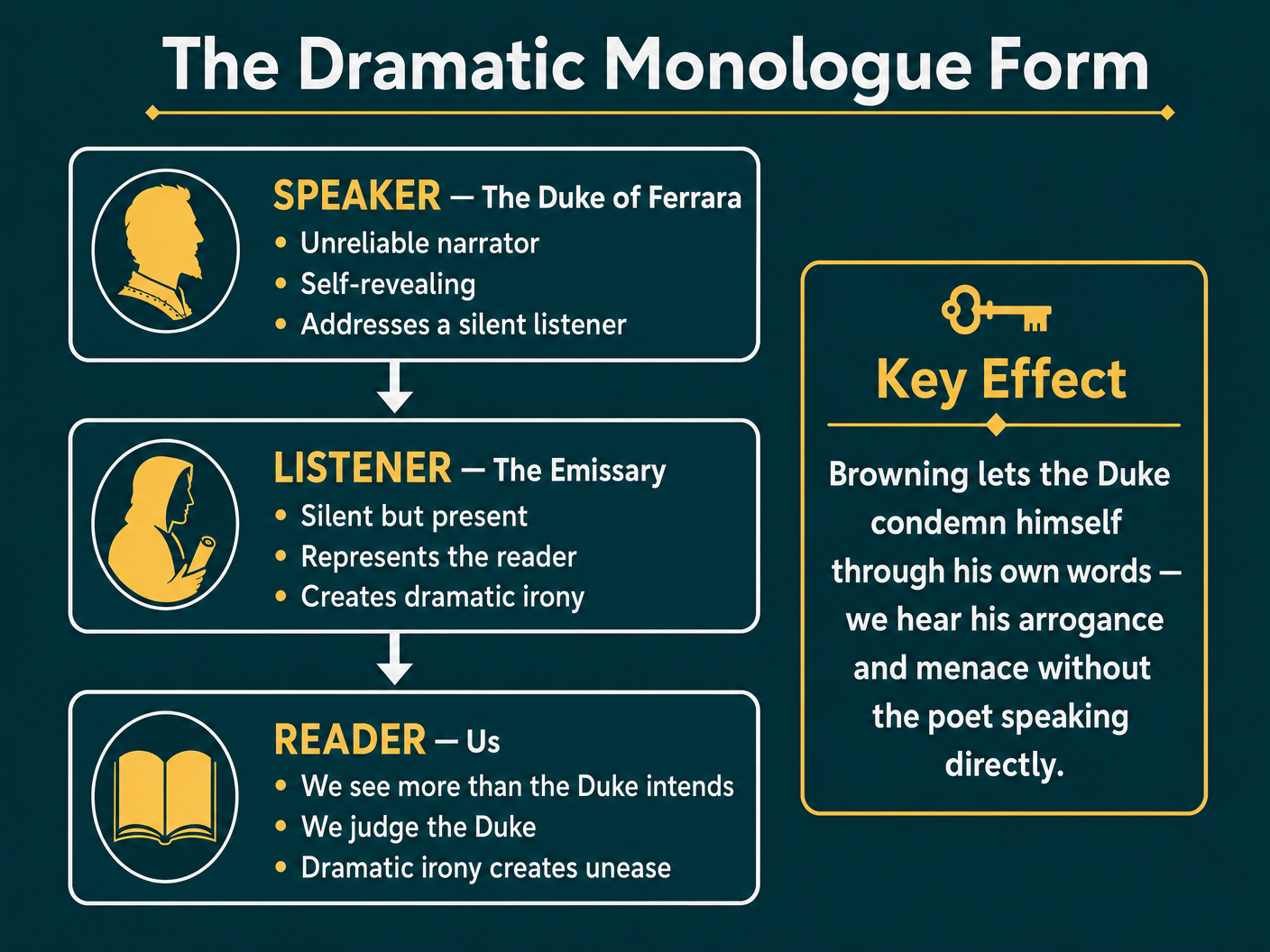
Browning's use of form and structure is masterful and highly rewardable under AO2. The poem is a dramatic monologue, meaning the Duke speaks to a silent listener. This creates dramatic irony: the Duke believes he is justifying his actions, but he is actually exposing his own tyranny.
The poem is written in iambic pentameter and heroic couplets, giving it a tight, controlled rhythm that reflects the Duke's desire for order and control. However, Browning frequently uses enjambment (sentences running over line breaks) and caesura (mid-line pauses). This disrupts the rhythm, making the speech sound natural and conversational, while also hinting at the uncontrollable anger and volatility lurking beneath the Duke's polished exterior.
Context
For AO3, examiners expect candidates to link the poem's themes to its context. The poem is set in Renaissance Italy, a deeply patriarchal society where women were often considered the property of their fathers or husbands. However, Browning was writing in the Victorian era, and the poem can be read as a critique of the rigid gender roles and domestic oppression prevalent in 19th-century Britain. The character is loosely based on Alfonso II d'Este, the fifth Duke of Ferrara, whose young wife Lucrezia died under suspicious circumstances in 1561.
Visual Resources
2 diagrams and illustrations
Interactive Diagrams
1 interactive diagram to visualise key concepts
Conceptual Flow Outline
The Cycle of Control and Violence in My Last Duchess
Worked Examples
2 detailed examples with solutions and examiner commentary
Practice Questions
Test your understanding — click to reveal model answers
How does Browning present the theme of pride in 'My Last Duchess'?
Hint: Consider how the Duke's pride prevents him from communicating with his wife, and how his pride is linked to his heritage and material possessions.
Compare how poets present attitudes towards women in 'My Last Duchess' and one other poem.
Hint: A strong choice for comparison would be 'London' (the exploitation of the youthful Harlot) or 'Tissue' (the vulnerability of human life).
How does Browning use the setting of the poem to reflect the Duke's character?
Hint: Look at the art gallery, the portrait, the curtain, and the statue of Neptune.
Explore the significance of the emissary (the listener) in 'My Last Duchess'.
Hint: The emissary is silent, but his presence is crucial. He represents the Count (the next victim's father) and also acts as a proxy for the reader.