Study Notes
Overview
Stephen Kelman's 'Pigeon English' is a vital contemporary text that examines the harsh realities of inner-city London through the eyes of an innocent, newly arrived Ghanaian immigrant, Harrison Opoku. Examiners look for a sophisticated understanding of how Kelman uses Harri's naive, first-person narrative voice to create dramatic irony and expose the failures of adult society. Top-band responses will consistently analyse Kelman's structural choices (such as the countdown and the pigeon's perspective) and his linguistic hybridity, linking these methods to the wider social context of knife crime and urban poverty, specifically the real-life Damilola Taylor case.
Listen to our comprehensive audio guide for a deeper dive into these concepts:
Plot/Content Overview
Arrival and Discovery: Harri has recently moved from Ghana to a London housing estate with his mother and baby sister. The novel opens with the shocking discovery of a dead boy outside their building.
The Investigation: Inspired by CSI and detective shows, Harri and his best friend Dean decide to investigate the murder. Their innocent, childlike approach to detective work contrasts sharply with the very real danger they are in.
The Pull of the Gang: Harri is increasingly drawn to the Dell Farm Crew, led by X-Fire. He admires their power and status, not fully understanding the violence and corruption they represent.
The Countdown: As the novel progresses, the chapter numbers count backwards. Harri navigates school life, a crush on Poppy Morgan, and the increasing threat from the gang.
Tragic Climax: Harri discovers who killed the dead boy. In the final, devastating chapter, as he runs to tell his mother, he is stabbed. The narrative voice shifts to the pigeon as Harri dies.
Themes
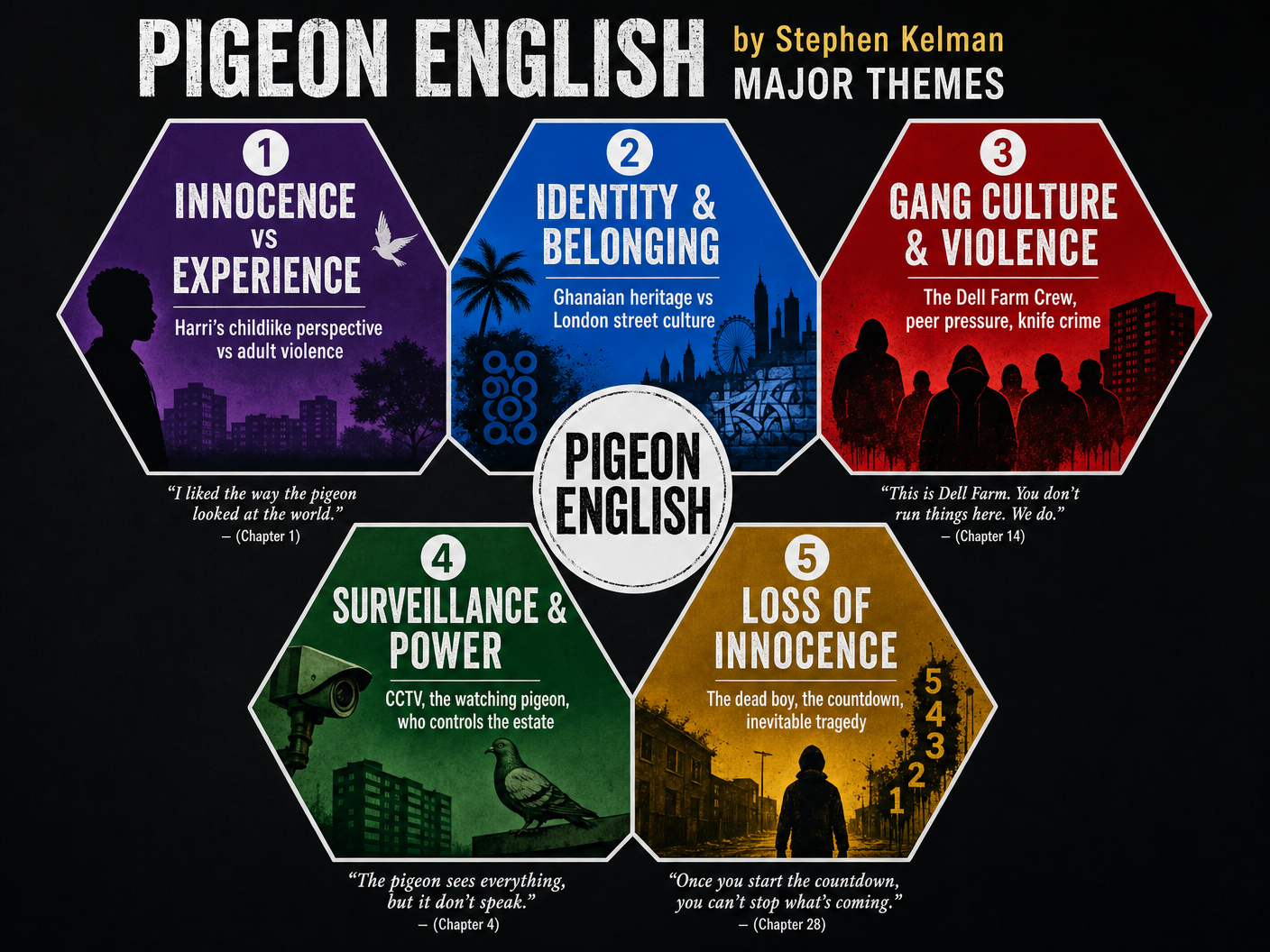
Theme 1: Innocence vs Experience
Kelman places Harri's profound innocence against the backdrop of a deeply experienced, violent world. This contrast is the novel's central driving force. Harri's innocence is not merely a character trait; it is a deliberate narrative technique used to highlight the corruption of the environment around him.
Key Quotes:
- "I liked the way the pigeon looked at the world." (Chapter 1) - Demonstrates Harri's pure, untainted perspective and his connection to the symbolic pigeon.
- "You could see the blood. It was darker than you thought." (Chapter 1) - The immediate intrusion of brutal reality into his childlike world.
Theme 2: Identity and Belonging
Harri is caught between two worlds: his Ghanaian heritage and his new London environment. His language, a mix of Twi, standard English, and London street slang, perfectly encapsulates this hybrid identity. He desperately seeks belonging, which makes the gang so dangerous.
Key Quotes:
- "Man can get Pigeon English, still." - Shows his adaptation to local slang and his desire to fit in.
- "I was the man of the house." - Harri's premature assumption of adult responsibility due to his father's absence.
Theme 3: Gang Culture and Violence
The novel explores how gang culture preys on vulnerable, marginalised youth. The Dell Farm Crew offers protection, status, and a twisted form of family. Kelman shows that children join gangs not out of inherent evil, but out of a need for survival and belonging.
Key Quotes:
- "This is Dell Farm. You don't run things here. We do." (X-Fire) - Establishes the gang's territorial control and power.
- "A soldier is a soldier." - Harri's misunderstanding of gang violence, romanticising it through the lens of action movies.
Character Analysis
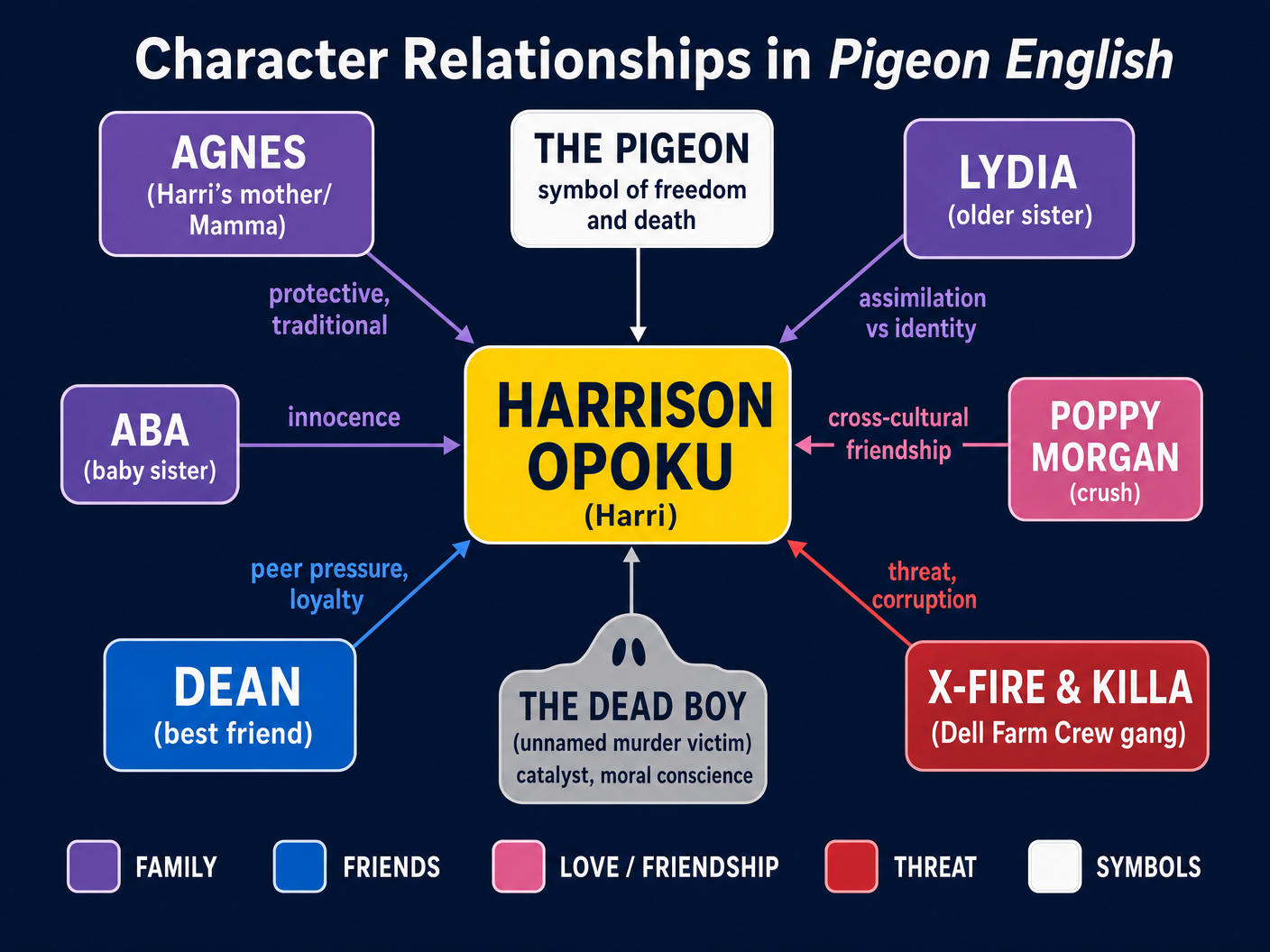
Harrison Opoku (Harri)
Role: Protagonist and first-person narrator.
Key Traits: Innocent, observant, funny, desperate to fit in, morally grounded but easily influenced.
Character Arc: Moves from an innocent observer to an active investigator, eventually becoming a victim of the violence he failed to fully comprehend.
Essential Quotes:
- "I am the fastest boy in Year 7."
- "It's just a game. Everything's a game."
The Pigeon
Role: Symbolic observer, secondary narrator.
Key Traits: Omniscient, free, detached yet compassionate.
Character Arc: Watches Harri's journey, providing a broader, philosophical perspective, and ultimately narrates his death.
Essential Quotes:
- "The pigeon sees everything, but it don't speak."
- "I watched him fall."
X-Fire
Role: Antagonist, leader of the Dell Farm Crew.
Key Traits: Ruthless, manipulative, territorial, a product of his environment.
Character Arc: Represents the constant, looming threat that eventually consumes Harri.
Essential Quotes:
- "You better watch your back, little man."
Writer's Methods
Narrative Voice: The use of a naive, first-person child narrator creates powerful dramatic irony. The reader understands the danger long before Harri does, creating tension and pathos.
Structure (The Countdown): The chapters count down from 264 to 1. This creates a sense of fatalistic inevitability; the reader knows a tragic end is approaching, even if the protagonist does not.
Language and Dialect: Kelman uses a constructed idiolect for Harri, blending Ghanaian expressions, standard English, and London slang. This authenticates Harri's voice and highlights his dual cultural identity.
Symbolism: The pigeon serves as a motif for freedom, surveillance, and the soul. It provides a structural counterpoint to Harri's grounded, limited perspective.
Context
Examiners expect candidates to integrate context smoothly. The novel is heavily inspired by the real-life murder of Damilola Taylor, a 10-year-old Nigerian boy killed in Peckham in 2000. Kelman uses this context to critique systemic failures in modern Britain: poverty, the normalisation of knife crime, absent fathers, and the inadequacy of the police and social services on inner-city estates.
Visual Resources
2 diagrams and illustrations
Interactive Diagrams
1 interactive diagram to visualise key concepts
Conceptual Flow Outline
Harri's Character Arc and the Countdown to Tragedy
Worked Examples
2 detailed examples with solutions and examiner commentary
Practice Questions
Test your understanding — click to reveal model answers
How does Kelman use the character of the pigeon to explore important ideas in the novel?
Hint: Think about structure (when does the pigeon speak?) and symbolism (what does it represent compared to Harri?).
Explore how Kelman presents the challenges of growing up on the estate.
Hint: Focus on the physical environment, the threat of gangs, and the lack of adult protection.
How does Kelman present Harri's relationship with his family?
Hint: Consider the physical separation of the family and Harri's role as the 'man of the house'.
Starting with chapter 1, explore how Kelman creates a sense of tension and danger.
Hint: Look at the juxtaposition of the dead boy with Harri's childish observations, and the structural countdown.