Study Notes
Overview
Written by Alfred, Lord Tennyson in 1854, 'The Charge of the Light Brigade' commemorates the bravery and tragic loss of British cavalry soldiers during the Battle of Balaclava in the Crimean War. As Poet Laureate, Tennyson was obliged to honour the fallen, but the poem simultaneously serves as a subtle critique of the military blunder that sent them to their deaths. Examiners reward candidates who can explore this dual perspective—the tension between glorifying the soldiers' heroism and criticising the leadership's catastrophic error. Key to high marks is analysing Tennyson's masterful use of dactylic dimeter, which immerses the reader in the relentless momentum of the charge.
Audio Revision
Listen to our comprehensive 10-minute podcast covering context, themes, and exam technique:
Plot/Content Overview
- Stanza 1: The brigade is ordered to advance 'Half a league' into the 'valley of Death'.
- Stanza 2: The soldiers obey without question ('Theirs not to reason why'), even though 'Someone had blundered'.
- Stanza 3: The brigade is surrounded by cannon fire ('Cannon to right of them...') as they ride 'Into the jaws of Death'.
- Stanza 4: The soldiers attack the Russian gunners with sabres, displaying immense bravery before retreating.
- Stanza 5: The shattered remnants of the brigade return through the cannon fire. Not all of the 'noble six hundred' survive.
- Stanza 6: The poem concludes with a rhetorical question demanding eternal glory and honour for the Light Brigade.
Themes
Theme 1: Duty and Obedience
The poem highlights the absolute, unquestioning obedience expected of Victorian soldiers. They are stripped of agency, reduced to instruments of the commanders' will.
Key Quotes:
- "Theirs not to make reply, / Theirs not to reason why, / Theirs but to do and die" (Stanza 2) - The repetition of 'Theirs' (anaphora) emphasizes their collective lack of choice. The word 'but' implies a tragic limitation to their existence.
- "Forward, the Light Brigade!" (Stanza 1) - The imperative command sets the poem's relentless tone.
Theme 2: Heroism and Glorification
Tennyson fulfills his role as Poet Laureate by immortalising the soldiers' bravery, ensuring their sacrifice is remembered with awe rather than just pity.
Key Quotes:
- "When can their glory fade?" (Stanza 6) - A rhetorical question that asserts the immortality of their heroic act.
- "Honour the charge they made! / Honour the Light Brigade" (Stanza 6) - Imperative verbs direct the reader to respect the fallen, shifting from narrative to direct address.
Theme 3: The Reality and Chaos of War
The poem does not shy away from the brutality of the conflict, using vivid, violent imagery to depict the sensory overload of the battlefield.
Key Quotes:
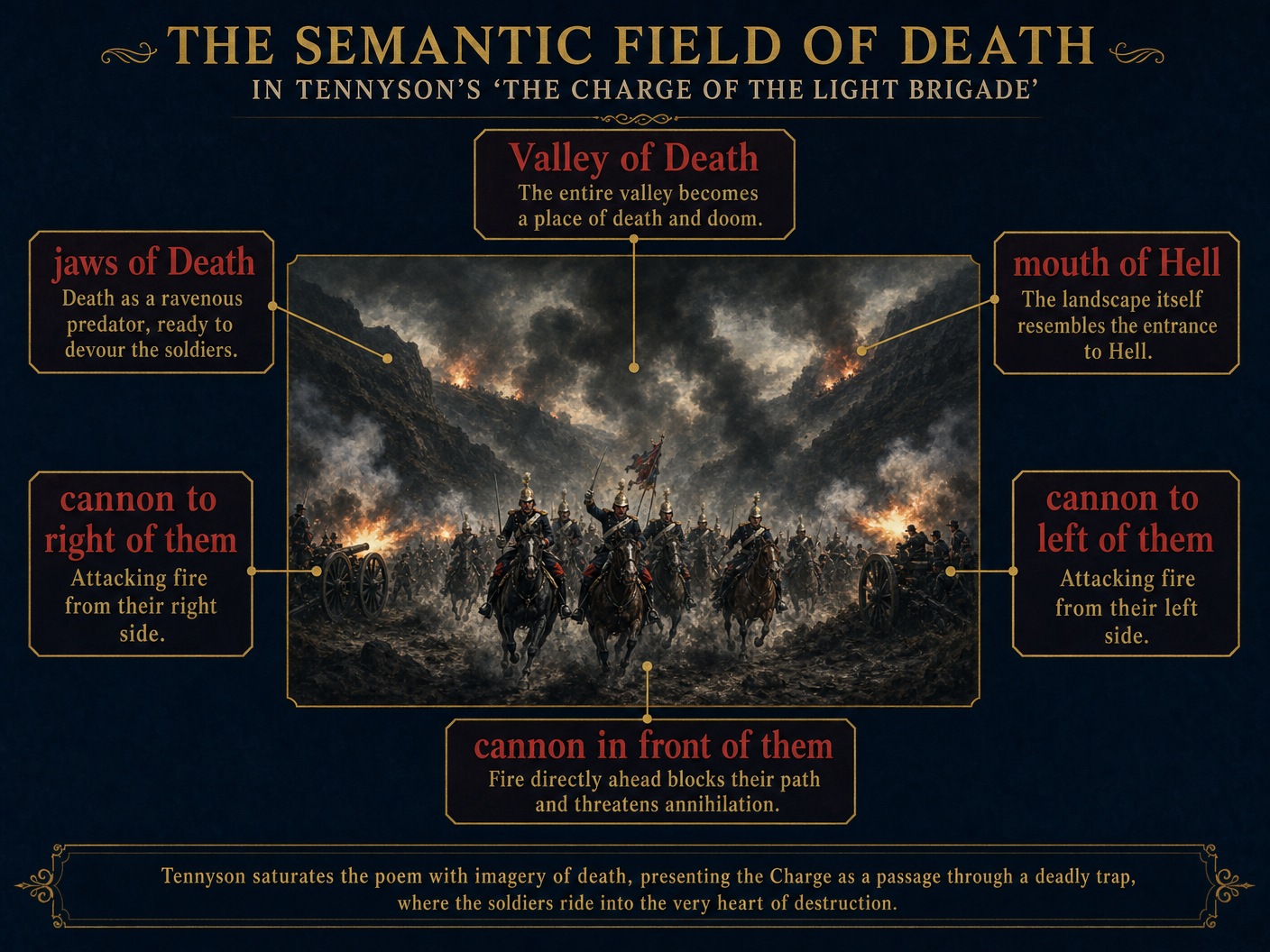
- "Volley'd and thunder'd; / Storm'd at with shot and shell" (Stanza 3) - Violent, dynamic verbs and sibilance recreate the deafening noise of artillery.
- "Into the jaws of Death, / Into the mouth of Hell" (Stanza 3) - Personification transforms the battlefield into a ravenous, mythological monster consuming the soldiers.
Theme 4: Critique of Leadership
Beneath the patriotism lies a quiet anger at the aristocratic commanders whose miscommunication caused the slaughter.
Key Quotes:
- "Someone had blundered" (Stanza 2) - The indefinite pronoun 'someone' deliberately avoids naming the guilty party, reflecting Tennyson's careful tightrope walk as Poet Laureate. The disruption of the dactylic metre here mirrors the mistake.
Writer's Methods
Form and Structure
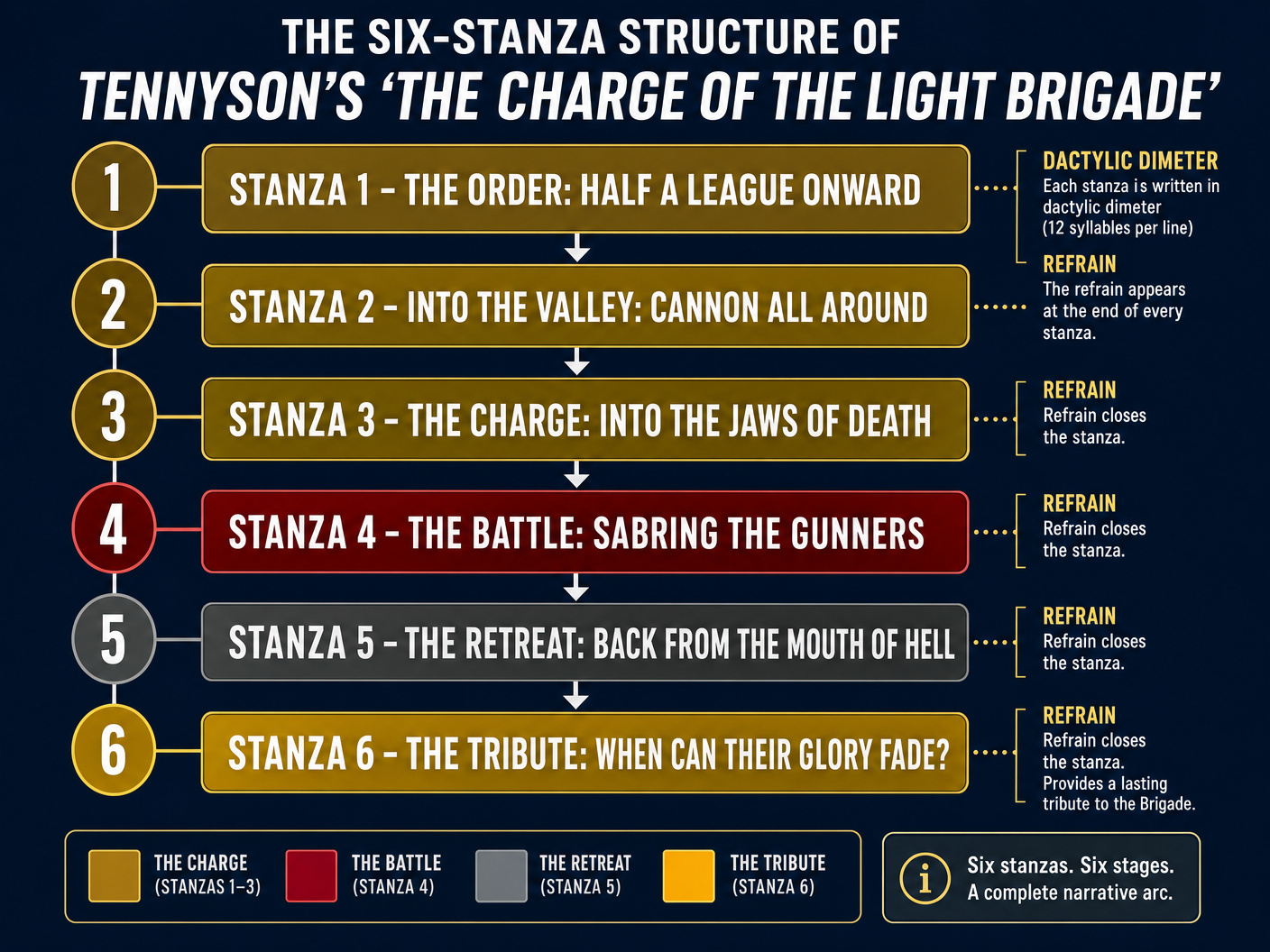
- Dactylic Dimeter: The dominant metre (one stressed syllable followed by two unstressed: DUM-da-da) mimics the galloping of horses' hooves, creating a relentless, driving rhythm that pulls the reader into the charge.
- Metrical Disruption: When the rhythm breaks (e.g., 'Someone had blundered'), it forces the reader to pause, reflecting the chaos and the fatal error in command.
- Refrain: The repetition of phrases like 'Rode the six hundred' at the end of stanzas creates a sense of inevitability and tragic doom.
Language and Imagery
- Semantic Field of Death: The repeated use of 'Death' and 'Hell' (capitalised for emphasis) elevates the historical event to a mythological, almost apocalyptic scale.
- Anaphora: Repetition at the start of lines ('Cannon to right of them, / Cannon to left of them') creates a feeling of being surrounded and trapped.
Context
- The Crimean War (1853-1856): Britain, France, and the Ottoman Empire fought the Russian Empire. It was one of the first wars to be covered by modern journalism (William Howard Russell for The Times), meaning the public knew about military blunders quickly.
- The Class System: The commanders (Lord Raglan, Lord Lucan, Lord Cardigan) were wealthy aristocrats who bought their commissions, while the cavalrymen were working-class. The 'blunder' highlights the fatal consequences of this class divide.
- The Poet Laureate: Tennyson was the official poet of the monarch. His job was to write poetry for national occasions, meaning he had to balance patriotic tribute with his own dismay at the loss of life.
Worked Examples
2 detailed examples with solutions and examiner commentary
Practice Questions
Test your understanding — click to reveal model answers
Compare how Tennyson presents the reality of conflict in 'The Charge of the Light Brigade' with how conflict is presented in one other poem from the anthology.
Hint: Consider comparing with 'Bayonet Charge' for similarities in duty/blunder, or 'Exposure' for the visceral, terrifying reality of the battlefield.
How does Tennyson use language and structure to present the theme of duty in 'The Charge of the Light Brigade'?
Hint: Focus on the refrain in stanza 2, the use of imperative verbs, and the relentless metre.