Study Notes
Overview
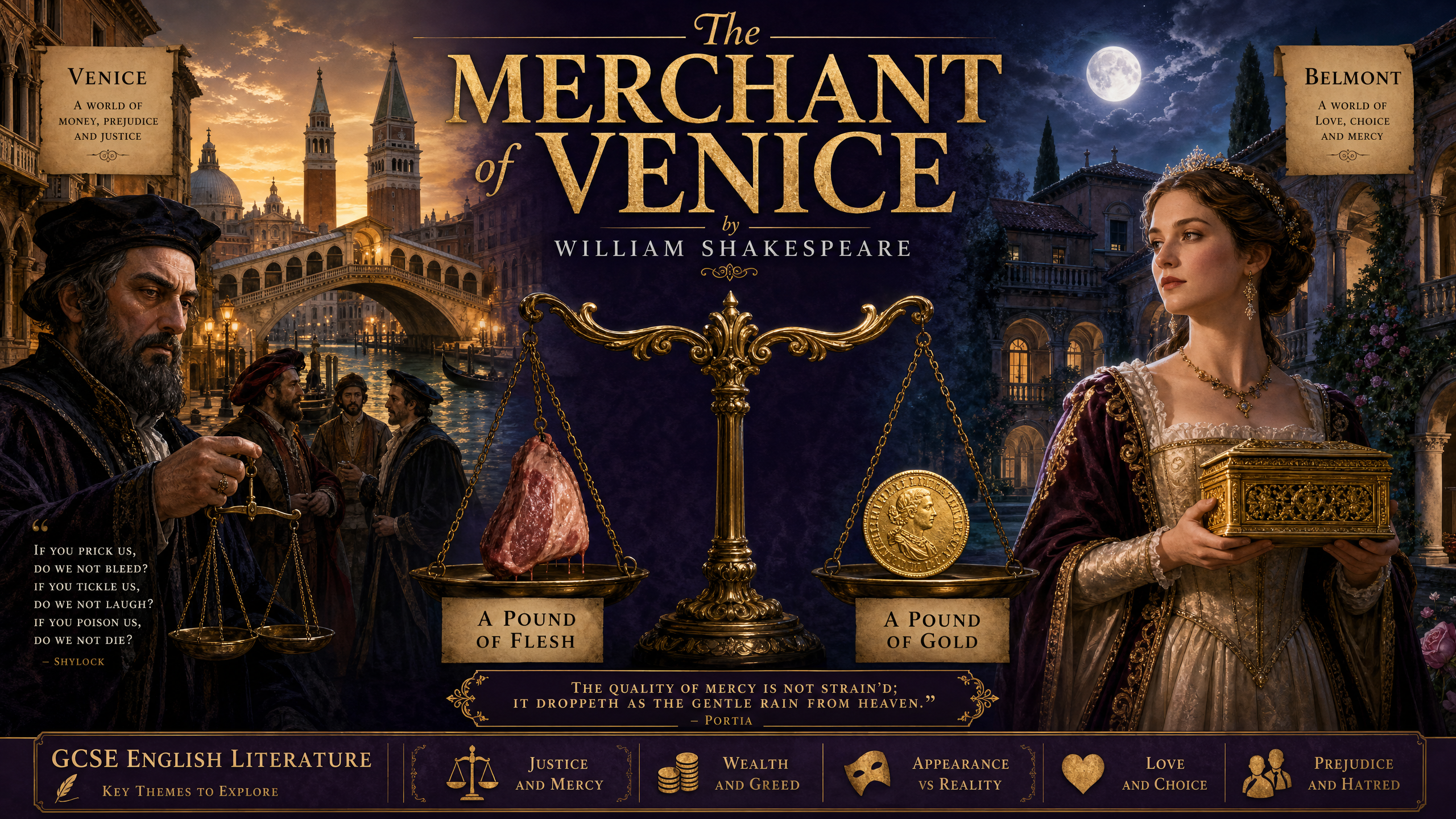
The Merchant of Venice intertwines the romantic fairy-tale of Belmont with the harsh, mercantile reality of Venice. Examiners reward candidates who move beyond treating the play as a simple comedy and instead engage with its profound ambiguities—particularly the characterisation of Shylock and the uneasy resolution of the trial scene. To achieve high marks, you must analyse Shakespeare's language closely, connect the casket and bond plots, and thoughtfully integrate Elizabethan context regarding antisemitism, gender, and law.
Plot/Content Overview
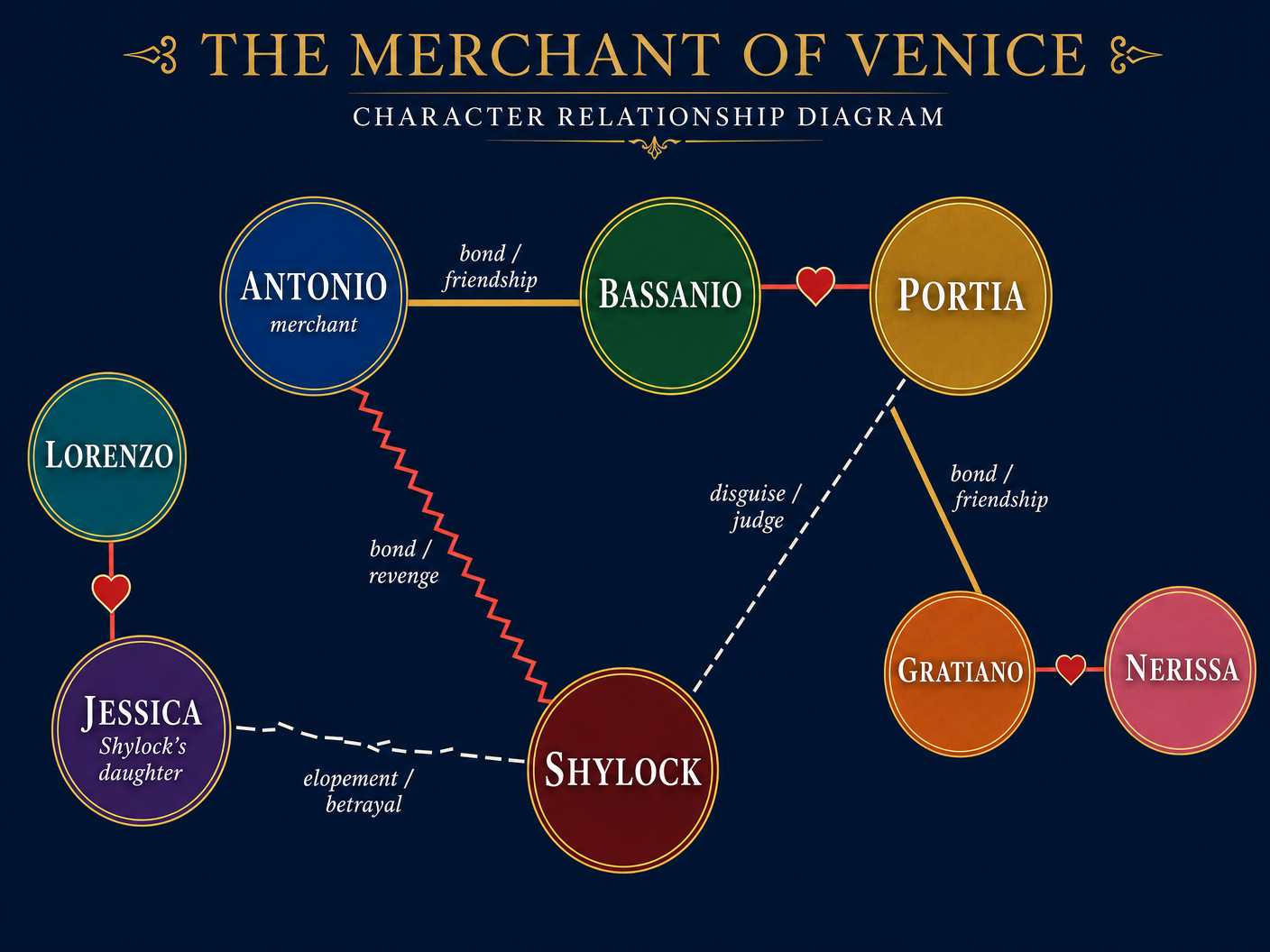
Act 1: Antonio, a melancholic merchant, borrows 3,000 ducats from the Jewish moneylender Shylock to fund his friend Bassanio's courtship of Portia. Shylock demands a pound of Antonio's flesh as collateral. In Belmont, Portia laments the casket test devised by her late father.
Act 2: Various suitors fail the casket test. Shylock's daughter, Jessica, elopes with the Christian Lorenzo, stealing her father's wealth, which deepens Shylock's desire for revenge against the Christians.
Act 3: Bassanio correctly chooses the lead casket and wins Portia. News arrives that Antonio's ships are lost and his bond to Shylock is forfeit. Bassanio rushes to Venice, while Portia secretly follows, disguised as a male lawyer.
Act 4: The climax. In the Venetian court, Shylock demands his pound of flesh, refusing all offers of money. Portia (disguised as Balthazar) pleads for mercy but ultimately uses a legal loophole to defeat Shylock: he may take flesh, but no blood. Shylock is stripped of his wealth and forced to convert to Christianity.
Act 5: The characters return to Belmont. Portia and Nerissa trick their husbands about the rings they gave away, before revealing the truth. Antonio's ships miraculously return, providing a superficially happy, though deeply uneasy, resolution.
Themes
Theme 1: Justice vs. Mercy
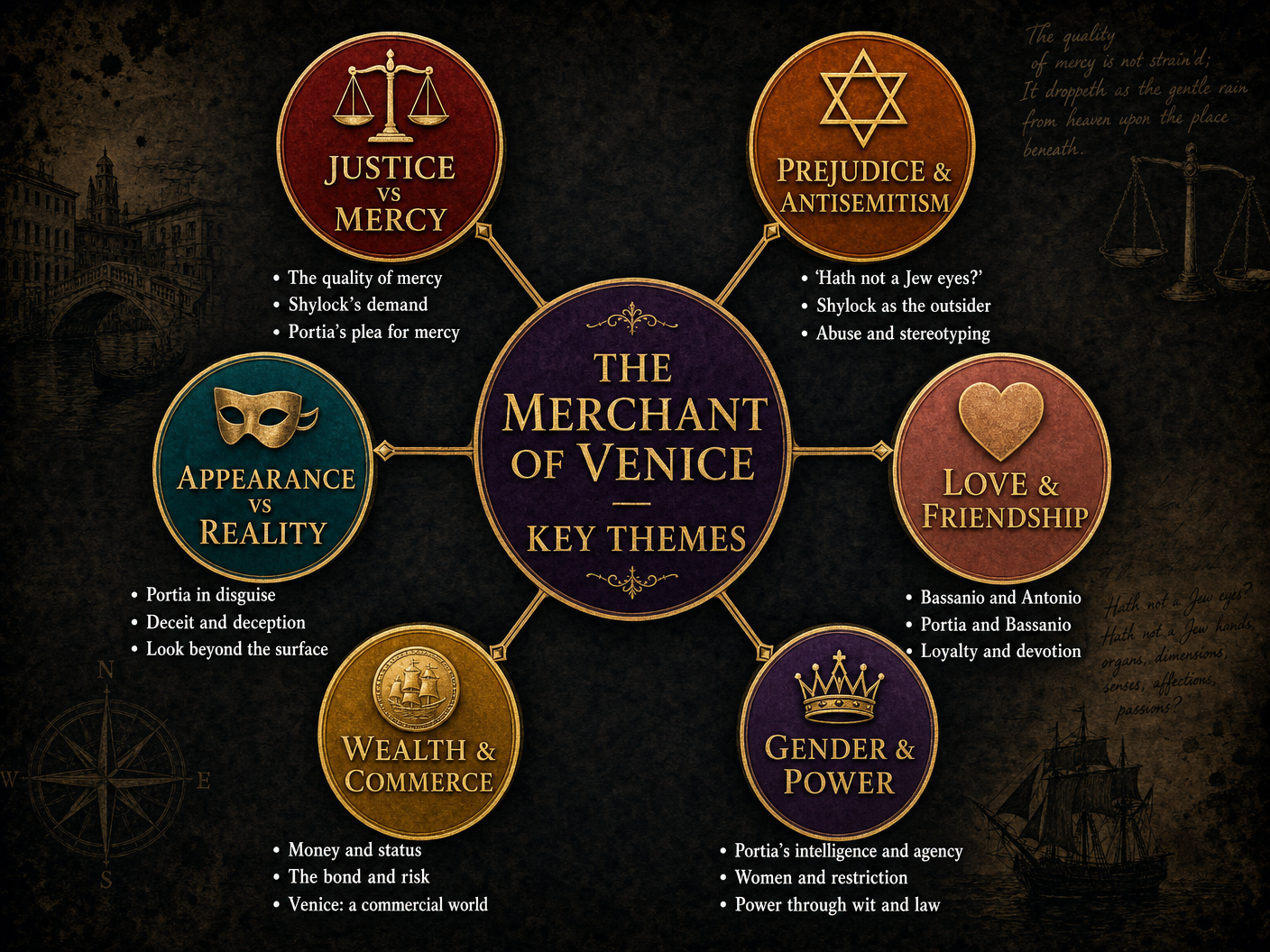
The conflict between the strict letter of the law (justice) and the spirit of compassion (mercy) drives the play. Shylock represents rigid Old Testament justice, demanding exactly what his bond entitles him to. Portia advocates for New Testament mercy, arguing it is a divine quality. However, the 'mercy' ultimately shown to Shylock—forced conversion—is highly problematic and invites critical debate.
Key Quotes:
- "I crave the law, / The penalty and forfeit of my bond." (Act 4, Scene 1) - Shylock's rigid adherence to legalism.
- "The quality of mercy is not strain'd; / It droppeth as the gentle rain from heaven" (Act 4, Scene 1) - Portia elevates mercy above human law, using natural imagery to suggest it is a divine gift.
Theme 2: Prejudice and Discrimination
Antisemitism is systemic in Venice. Shylock is spat upon, insulted, and isolated. His villainy is presented not as inherent, but as a reaction to this relentless abuse. Candidates must acknowledge this context to access the highest marks.
Key Quotes:
- "You call me misbeliever, cut-throat dog, / And spit upon my Jewish gaberdine" (Act 1, Scene 3) - Highlights the physical and verbal abuse Shylock endures.
- "Hath not a Jew eyes?" (Act 3, Scene 1) - Shylock's powerful prose assertion of shared humanity, challenging the Christians' hypocrisy.
Theme 3: Appearance vs. Reality
Things in this play are rarely what they seem. The gold and silver caskets hide failure, while lead hides true worth. Portia's male disguise allows her to wield power denied to women. The theme warns against superficial judgments.
Key Quotes:
- "All that glisters is not gold" (Act 2, Scene 7) - The scroll in the gold casket explicitly states the theme.
- "So may the outward shows be least themselves" (Act 3, Scene 2) - Bassanio correctly reasons that true value is hidden, leading him to choose the lead casket.
Character Analysis
Shylock
Role: The antagonist, Jewish moneylender, and the play's most complex figure.
Key Traits: Vengeful, rigid, deeply wounded, articulate.
Character Arc: Moves from a cautious businessman to a man consumed by a desire for revenge after his daughter's betrayal, ultimately becoming a broken, humiliated victim of the Venetian state.
Essential Quotes:
- "I will feed fat the ancient grudge I bear him." (Act 1, Scene 3)
- "The villainy you teach me I will execute" (Act 3, Scene 1)
- "I am not well." (Act 4, Scene 1 - his final, defeated words)
Portia
Role: The heroine, heiress of Belmont, and the intellectual centre of the play.
Key Traits: Highly intelligent, resourceful, constrained by patriarchy but capable of subverting it.
Character Arc: Begins as a frustrated daughter bound by her father's will, but takes control of her destiny and the play's resolution through her disguise in Venice.
Essential Quotes:
- "I may neither choose who I would, nor refuse who I dislike" (Act 1, Scene 2)
- "Tarry a little; there is something else. / This bond doth give thee here no jot of blood" (Act 4, Scene 1)
Antonio
Role: The titular merchant, devoted friend to Bassanio, and Shylock's rival.
Key Traits: Melancholic, generous to friends, casually cruel to Shylock.
Character Arc: Moves from passive melancholy to passive acceptance of death, before being saved by Portia. He remains somewhat isolated at the play's end.
Essential Quotes:
- "In sooth, I know not why I am so sad" (Act 1, Scene 1)
- "I am a tainted wether of the flock, / Meetest for death" (Act 4, Scene 1)
Writer's Methods
Prose vs. Blank Verse: Shakespeare uses blank verse (unrhymed iambic pentameter) for noble characters and elevated themes (like Portia's mercy speech). He uses prose for lower-class characters or for moments of raw emotion. Crucially, Shylock's "Hath not a Jew eyes?" is in prose, breaking the poetic rhythm to deliver a blunt, unvarnished truth.
Dramatic Irony: Used extensively, particularly regarding Portia's disguise. The audience knows the judge is Portia, but Bassanio and Antonio do not. This creates tension and comedy, and highlights the characters' blindness to reality.
Antithesis: Shakespeare frequently uses contrasting ideas within parallel grammatical structures to highlight conflict, e.g., Shylock's contrast of Christian teaching and Christian practice.
Context
Elizabethan Antisemitism: Jews had been expelled from England in 1290. The Elizabethan audience would have had little contact with Jewish people and likely viewed Shylock as a comic villain or a 'devil'. Shakespeare challenges this by giving Shylock profound humanity, though the play ultimately enforces Christian dominance.
Gender Roles: Women were legally subservient to men (fathers, then husbands). Portia's intelligence is a subversion of this, but note that she must dress as a man to exercise power in the public sphere of Venice.
Usury vs. Venture Capitalism: Charging interest on loans (usury) was historically condemned by the Church. Antonio represents the new, celebrated venture capitalism (investing in trade), while Shylock represents the older, stigmatised practice of moneylending.
Visual Resources
2 diagrams and illustrations
Interactive Diagrams
1 interactive diagram to visualise key concepts
Conceptual Flow Outline
Shylock's Character Arc
Worked Examples
2 detailed examples with solutions and examiner commentary
Practice Questions
Test your understanding — click to reveal model answers
Explore how Shakespeare presents the theme of appearance versus reality in The Merchant of Venice. (30 marks)
Hint: Consider the caskets in Belmont, Portia's disguise in Venice, and Shylock's outward villainy vs his inward humanity.
How does Shakespeare present the relationship between Antonio and Bassanio? (30 marks)
Hint: Look at Antonio's extreme sacrifices for Bassanio and contrast this with Bassanio's actions.