Study Notes
Overview
'An Inspector Calls' by J.B. Priestley is a three-act didactic play that functions as a powerful critique of capitalist society. Set in 1912 but written and first performed in 1945, the play relies heavily on this temporal gap to create dramatic irony. Examiners are looking for candidates who understand that this is not merely a detective story, but a moral interrogation. High-scoring responses will treat characters not as real people, but as constructs used by Priestley to convey his socialist message about collective responsibility. To achieve top bands (AO1 and AO2), you must analyze Priestley's use of stagecraft, lighting, and the cyclical structure of the narrative, while seamlessly integrating your understanding of the post-war context (AO3).
Listen to our comprehensive revision podcast to solidify your understanding:
Plot/Content Overview
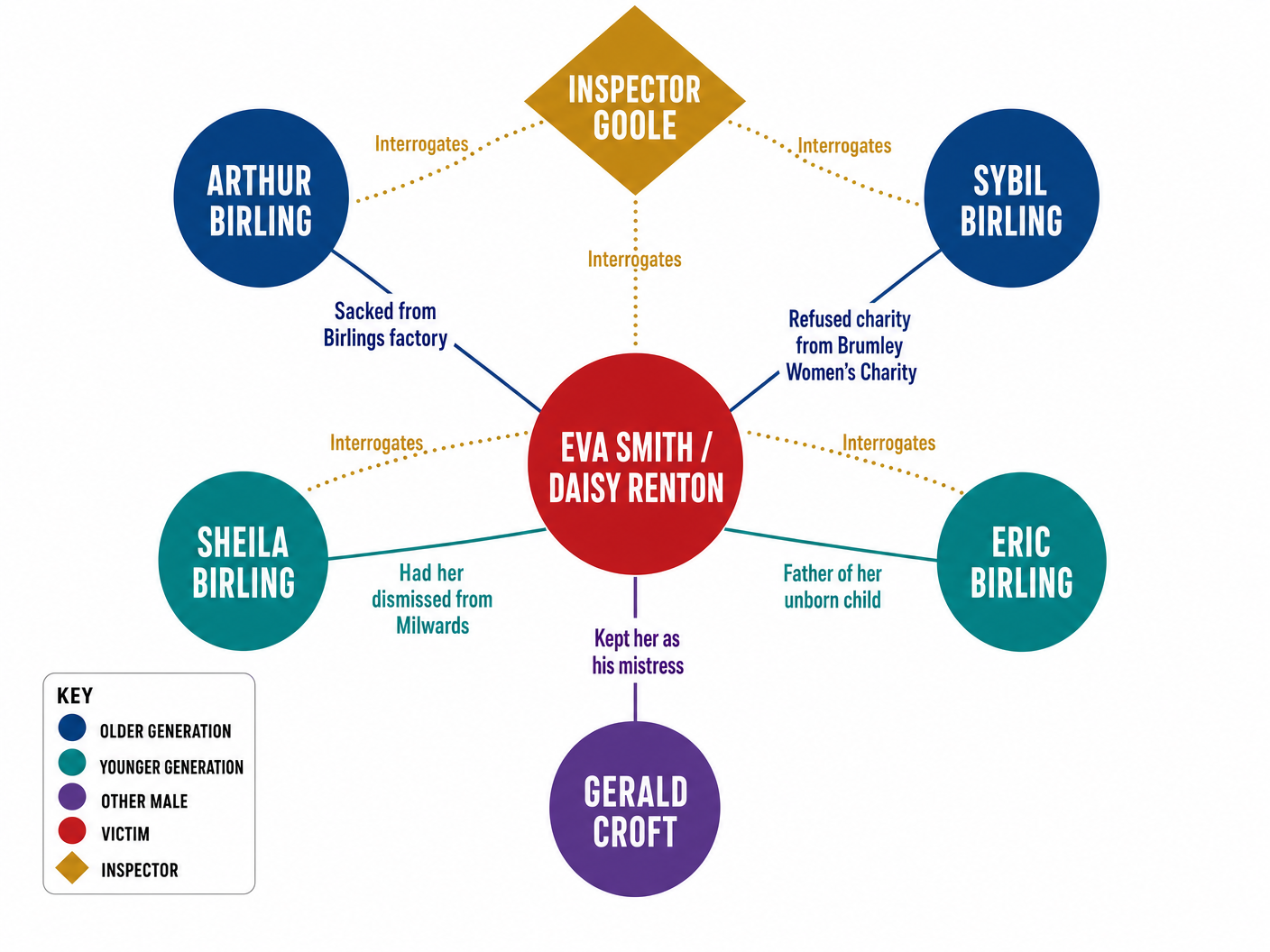
Act 1: The Birling family is celebrating the engagement of Sheila Birling to Gerald Croft in their comfortable suburban home. Arthur Birling delivers pompous speeches about capitalist self-reliance and the impossibility of war. The mood is shattered by the arrival of Inspector Goole, who announces that a young woman, Eva Smith, has died by suicide after swallowing disinfectant. He interrogates Arthur, who admits to sacking her for leading a strike, and then Sheila, who confesses to having her fired from a dress shop out of jealousy.
Act 2: The interrogation continues. Gerald admits to keeping Eva (under the name Daisy Renton) as his mistress before abandoning her. Sybil Birling is then questioned; she reveals that she used her influence as head of a women's charity to deny Eva financial help when she was pregnant and desperate. Sybil proudly shifts the blame to the unborn child's father, demanding he be made an example of, only to realize with horror that the father is her own son, Eric.
Act 3: Eric confesses to forcing himself on Eva and stealing money from his father's business to support her. The Inspector delivers a final, prophetic speech about social responsibility and leaves. Gerald discovers that Goole is not a real police officer and that no girl has died at the infirmary. The older Birlings celebrate their escape from public scandal, while Sheila and Eric remain deeply affected. Just as Arthur mocks the younger generation, the phone rings: a girl has just died on her way to the hospital, and a real police inspector is on his way.
Themes

Theme 1: Social Responsibility
This is the core didactic message of the play. Priestley uses the contrast between Mr. Birling's capitalist individualism and the Inspector's socialist collectivism to argue that society must care for its most vulnerable members. The play tracks the journey of characters either accepting or rejecting this responsibility.
Key Quotes:
- "a man has to mind his own business and look after himself and his own" (Act 1, Birling) - Priestley uses Birling as a mouthpiece for capitalist selfishness, positioning him as the ideological antagonist to the Inspector.
- "We don't live alone. We are members of one body. We are responsible for each other." (Act 3, Inspector) - The use of collective pronouns ("We") emphasizes the socialist message of interconnectedness.
Theme 2: Generational Conflict
The play presents a stark divide between the older generation (Arthur and Sybil), who are fixed in their ways and obsessed with social status, and the younger generation (Sheila and Eric), who are capable of change and empathy. Priestley positions the youth as the hope for a better post-war society.
Key Quotes:
- "the famous younger generation who know it all. And they can't even take a joke-" (Act 3, Birling) - Birling's mockery is abruptly cut off by the final phone call, undermining his authority and validating the younger generation's guilt.
- "It frightens me the way you talk" (Act 3, Sheila) - Sheila's fear highlights the moral chasm that has opened between parents and children.
Theme 3: Class and Inequality
Eva Smith functions as a symbol of the exploited working class. The Birlings' treatment of her demonstrates how the Edwardian class system allowed the wealthy to use and discard the poor without consequence.
Key Quotes:
- "Girls of that class-" (Act 2, Mrs. Birling) - The dismissive demonstrative pronoun "that" reveals Mrs. Birling's ingrained prejudice and dehumanization of the working class.
- "But these girls aren't cheap labour - they're people." (Act 1, Sheila) - Sheila's early realization marks the beginning of her moral awakening and challenges her father's capitalist commodification of workers.
Character Analysis
Inspector Goole
Role: Priestley's mouthpiece; a catalyst for truth and moral judgment.
Key Traits: Authoritative, omniscient, unimpressed by social status, methodical.
Character Arc: He does not change, but forces change in others. He arrives as a police officer but leaves as a prophetic, almost supernatural figure.
Essential Quotes:
- "massiveness, solidity and purpose" (Act 1, Stage Directions)
- "If men will not learn that lesson, then they will be taught it in fire and blood and anguish." (Act 3)
Arthur Birling
Role: The embodiment of Edwardian capitalist complacency and patriarchal authority.
Key Traits: Pompous, self-centered, status-obsessed, lacking in self-awareness.
Character Arc: Static. He begins the play concerned only with his knighthood and profits, and ends it concerned only with avoiding a public scandal.
Essential Quotes:
- "hard-headed practical man of business" (Act 1)
- "unsinkable, absolutely unsinkable" (Act 1)
Sheila Birling
Role: The proxy for the audience's moral awakening; represents the capacity for the younger generation to change.
Key Traits: Initially superficial and materialistic, becomes perceptive, remorseful, and challenging of authority.
Character Arc: Undergoes the most significant transformation, shifting from a naive, protected girl to a mature, socially conscious woman who adopts the Inspector's role after he leaves.
Essential Quotes:
- "Oh - how horrible! Was it an accident?" (Act 1)
- "I know I'm to blame - and I'm desperately sorry" (Act 2)
Writer's Methods
Dramatic Irony: Priestley relies on the 1912/1945 temporal gap. When Birling predicts peace and prosperity, the 1945 audience, having lived through two World Wars and the Great Depression, views him as foolish and unreliable. This discredits his capitalist ideology from the outset.
Stagecraft and Lighting: The opening stage directions dictate that the lighting should be "pink and intimate" until the Inspector arrives, and then it should be "brighter and harder." This symbolizes the Inspector shining a spotlight on the Birlings' secrets, stripping away their comfortable illusions.
The Unities: The play adheres to the classical unities of time, place, and action. It occurs in real-time, in a single room, focusing on a single plotline. This creates a claustrophobic, pressure-cooker atmosphere where the characters cannot escape interrogation.
Cyclical Structure: The play ends exactly where it began—with the Birlings facing an investigation into a girl's death. This structure reinforces the Inspector's warning: if lessons are not learned, history will repeat itself.
Context
Examiners expect candidates to integrate context (AO3) fluidly.
1912 vs 1945: Set in the Edwardian era (1912), a time of rigid class structures, extreme inequality, and patriarchal dominance. Written in 1945, immediately after WWII, when Britain was experiencing a desire for social change, leading to the landslide victory of the Labour Party and the creation of the Welfare State.
Priestley's Socialism: Priestley was a prominent socialist and broadcaster. He used the play didactically to advocate for a fairer, more equal post-war society, warning against returning to the selfish individualism of the pre-war years.
Visual Resources
2 diagrams and illustrations
Interactive Diagrams
1 interactive diagram to visualise key concepts
Conceptual Flow Outline
The Cyclical Structure of An Inspector Calls
Worked Examples
2 detailed examples with solutions and examiner commentary
Practice Questions
Test your understanding — click to reveal model answers
How does Priestley use the character of the Inspector to suggest ways that society could be improved? (30 marks + 4 AO4)
Hint: Focus on the Inspector as a mouthpiece for Priestley's socialist views. Contrast him with Mr. Birling.
Explore how Priestley presents the theme of gender in An Inspector Calls. (30 marks + 4 AO4)
Hint: Consider the vulnerability of working-class women (Eva) versus the protected but patronized status of middle-class women (Sheila).
How does Priestley explore the importance of social class in An Inspector Calls? (30 marks + 4 AO4)
Hint: Look at how each character treats Eva Smith based on her class.
Starting with this extract (Act 1, Birling's speech about the Titanic), explore how Priestley presents Arthur Birling. (30 marks + 4 AO4)
Hint: Focus heavily on Dramatic Irony in the extract, then look at his lack of change at the end of the play.