Study Notes
Overview
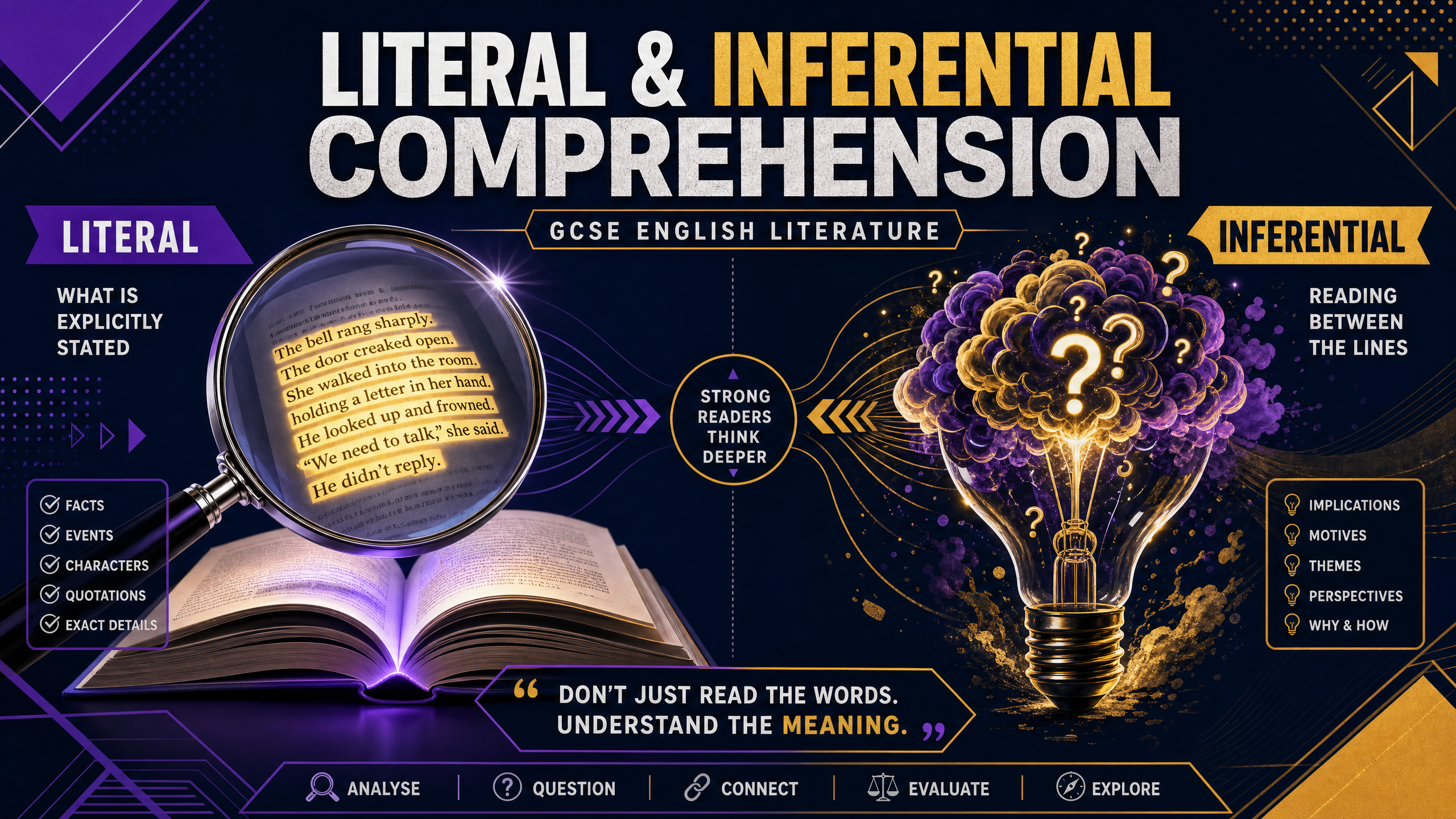
Literal and inferential comprehension is the foundation of all GCSE English Literature responses. Examiners consistently note that candidates who fail to reach the higher bands do so because they rely on narrative summary—retelling the plot—rather than analysing the text. This guide explores how to transition from simply identifying explicit information (literal comprehension) to exploring implied meanings, character motivations, and the writer's methods (inferential comprehension).
The Comprehension Ladder
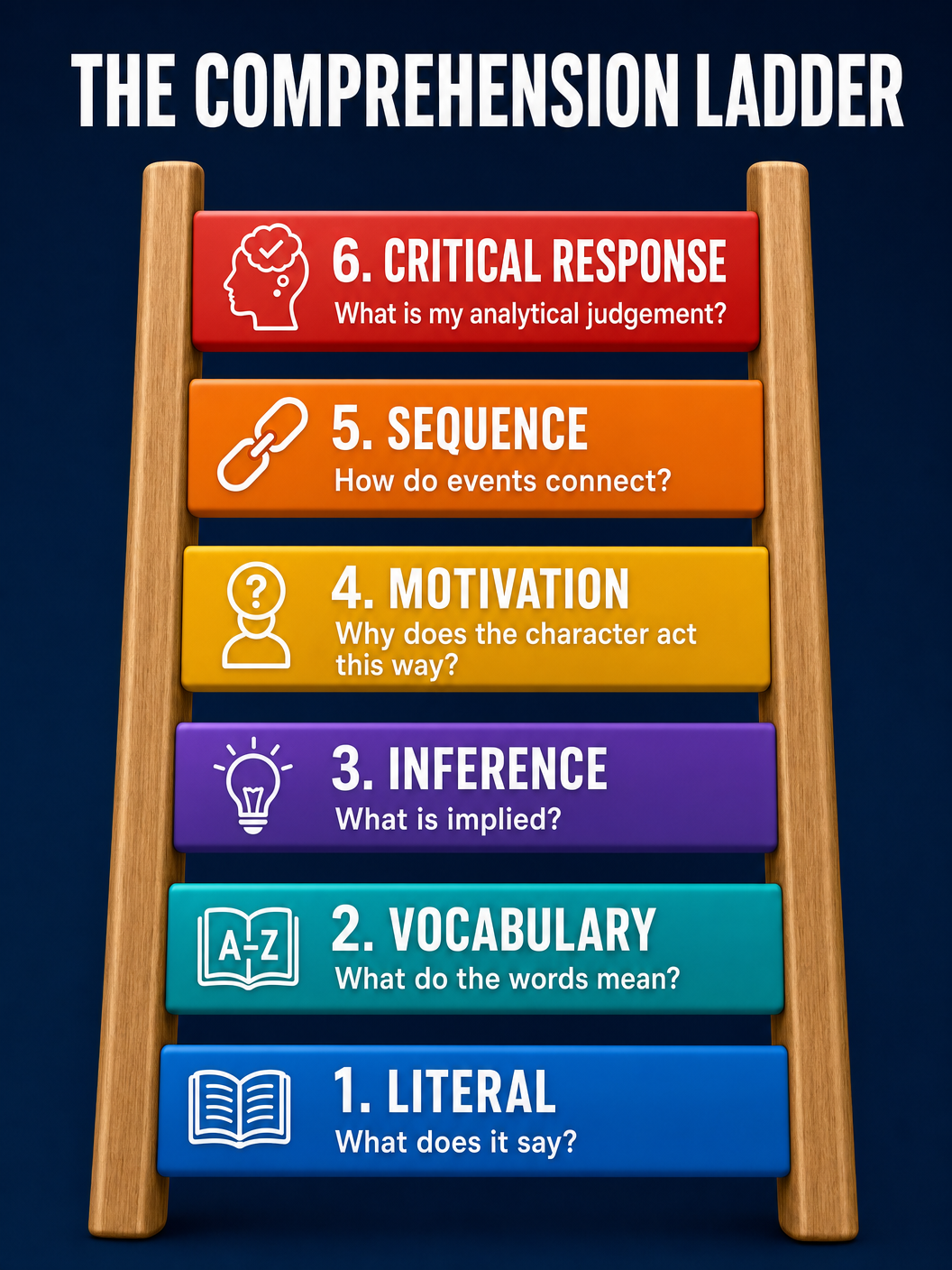
To achieve top marks, candidates must demonstrate an understanding of how writers construct meaning. This involves climbing the comprehension ladder:
- Literal Meaning: Understanding what is explicitly stated.
- Vocabulary: Understanding word choices in context.
- Inference: Understanding what is implied beneath the surface.
- Motivation: Understanding why characters behave as they do.
- Sequence: Understanding how events connect and influence one another.
- Critical Response: Evaluating the writer's methods and the text's overall impact.
Core Skills
Literal Comprehension: The Foundation
Literal comprehension is the ability to understand exactly what the text says. It involves extracting facts, events, and explicit descriptions.
Key Actions:
- Identifying who is involved in a scene.
- Tracing the chronological sequence of events.
- Recognising explicit descriptions of setting and character.
Examiner Note: While essential, literal comprehension alone only satisfies lower-level Assessment Objective 1 (AO1) criteria. It demonstrates basic understanding but lacks the critical depth required for higher grades.
Inferential Comprehension: Reading Between the Lines
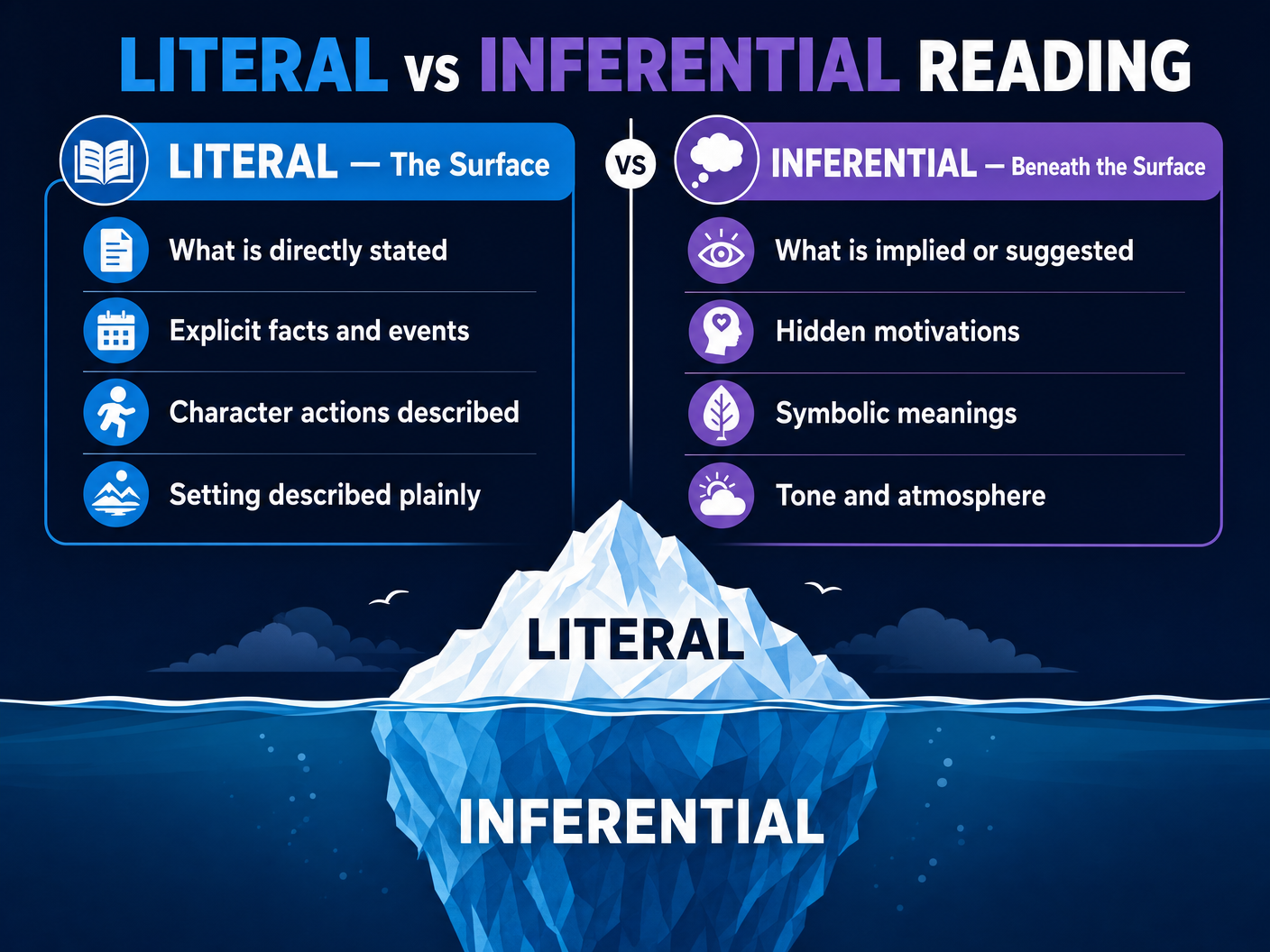
Inferential comprehension requires candidates to interpret implied meanings. It is the process of drawing conclusions based on textual evidence rather than explicit statements.
Key Actions:
- Deducing character emotions and motivations from their actions or dialogue.
- Interpreting the atmosphere or tone of a setting.
- Recognising foreshadowing and symbolic meaning.
Examiner Note: Strong inferential skills directly address the higher bands of AO1 (perceptive interpretation) and AO2 (analysis of writer's methods). Candidates must consistently ask: What does this suggest?
Writer's Methods (AO2)
Examiners heavily reward the analysis of the writer's methods. This means moving beyond what the text means to how the writer creates that meaning.
Language Choices
When analysing language, candidates must explore the connotations of specific words.
Example: If a writer describes a character as 'skulking' rather than 'walking', the literal meaning is movement, but the inferential meaning suggests stealth, malice, or cowardice.
Structure and Sequence
The sequence of events is a deliberate structural choice.
Example: Revealing a character's tragic past immediately after they have acted cruelly shifts the reader's response from anger to sympathy. Candidates must explain why the writer structured the narrative this way.
The PEAL Paragraph Framework
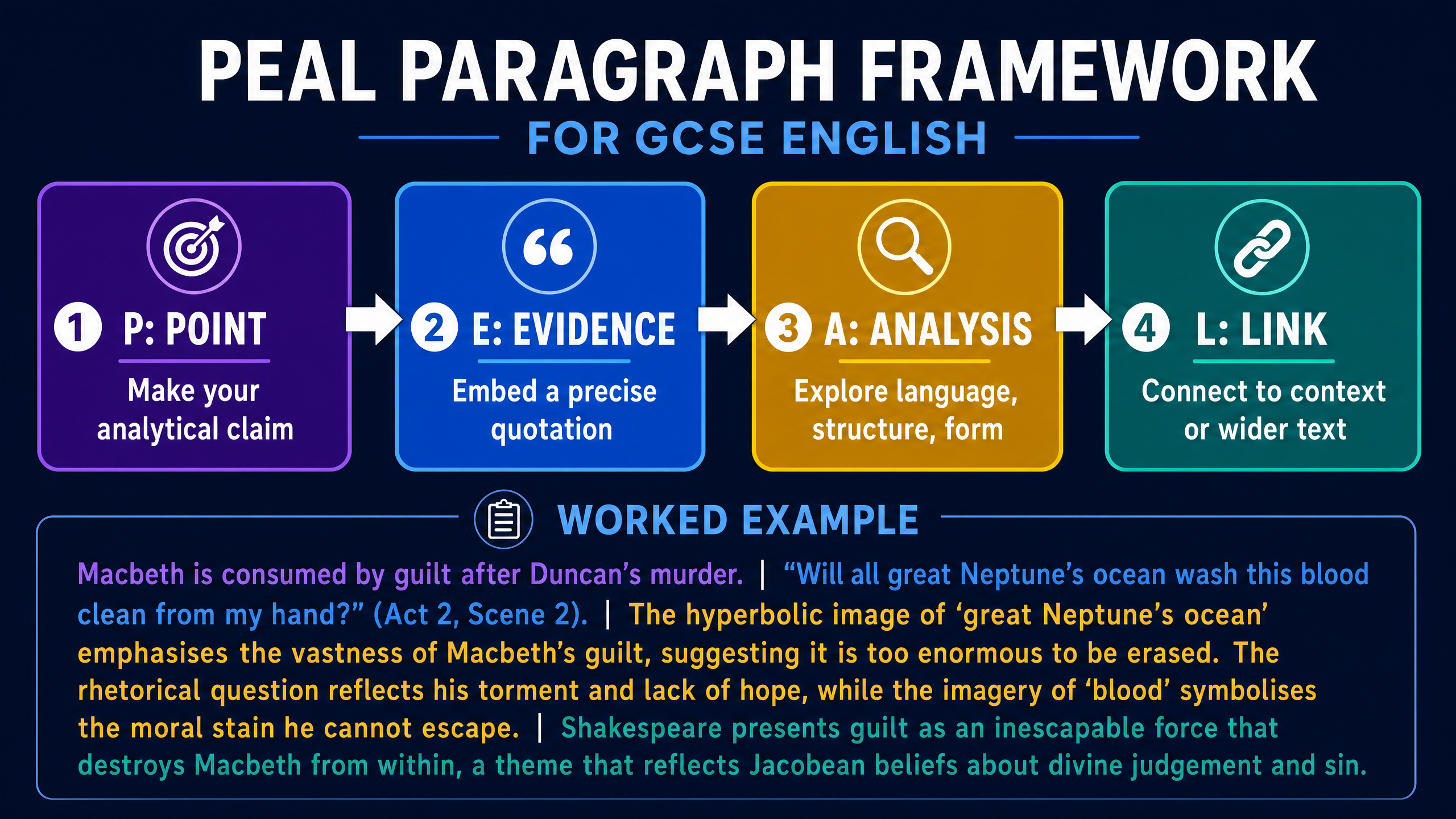
To effectively demonstrate comprehension, candidates should structure their responses using the PEAL framework:
- Point: Make a clear, inferential claim addressing the question.
- Evidence: Embed a precise, relevant quotation.
- Analysis: Explore the language, structure, or form, focusing on implied meanings.
- Link: Connect the analysis back to the question, the wider text, or relevant context (AO3).
Context (AO3)
Context should never be 'bolted on' as a historical fact. Instead, it must be integrated into the inferential analysis. How does understanding the social, historical, or literary context change or deepen our interpretation of the text?
Visual Resources
3 diagrams and illustrations
Interactive Diagrams
1 interactive diagram to visualise key concepts
Conceptual Flow Outline
The progression from literal observation to critical judgement in an exam response.
Worked Examples
2 detailed examples with solutions and examiner commentary
Practice Questions
Test your understanding — click to reveal model answers
Read the provided extract. How does the writer use language and structure to reveal the character's hidden motivations? (30 marks)
Hint: Start by identifying the literal actions, then use the 'This suggests...' structure to infer *why* they are acting that way.
Explore how the writer presents the theme of deception in the text as a whole. (30 marks)
Hint: Deception inherently involves a gap between literal truth and inferential reality. Focus on dramatic irony and hidden meanings.
Starting with this extract, explore how the writer creates a threatening atmosphere. (30 marks)
Hint: Atmosphere is rarely stated literally ('it was a threatening room'). It is inferred through descriptive choices. Focus on the connotations of the setting description.
Compare how poets present the effects of conflict in Poem A and one other poem from the anthology. (30 marks)
Hint: Use your inferential skills to look beyond the literal events of the conflict to the psychological or emotional effects on the speakers.