
Non-fiction and Transactional Writing
Click to watch full video explainer
Study Notes
Overview
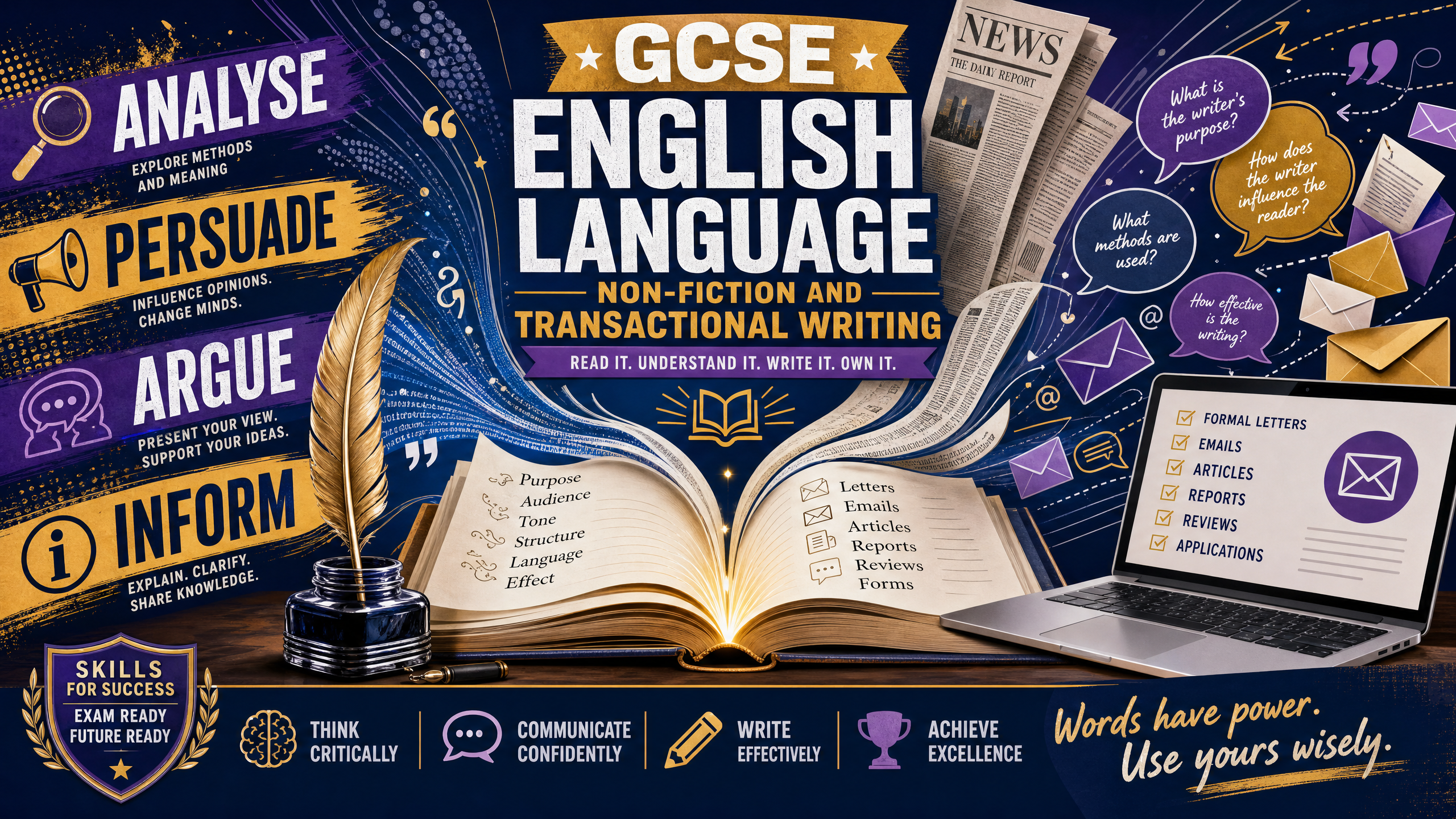
Component 2: Non-fiction and Transactional Writing is a crucial part of your GCSE English Language qualification. This paper tests two distinct but connected skill sets: your ability to critically read and analyse non-fiction texts (such as articles, letters, speeches, and travel writing), and your ability to produce your own transactional writing for a specific real-world purpose and audience.
Examiners are looking for active, engaged readers who can spot how a writer is manipulating their audience, and skilled, adaptable writers who can do the same to their own readers.
Reading Skills
Identifying Information & Ideas
Questions testing this skill often ask you to 'Identify', 'List', or 'Give two things...'. They require you to locate explicit information (stated directly in the text) and implicit information (suggested or implied).
Examiner Tip: Keep answers brief. If a question is worth 2 marks, find 2 points and write them down. Do not waste time writing full analytical paragraphs for identification questions.
Analysing Language
This is where a significant portion of marks is awarded. When asked how a writer uses language, you must move beyond simply 'feature-spotting' (naming techniques) and focus on the effect on the reader.
Key Language Features to Identify
| Feature | Definition | Effect on Reader | Example |
|---|---|---|---|
| Metaphor | Direct comparison stating one thing is another | Creates vivid, immediate imagery and strong emotional associations | 'The city was a concrete jungle' |
| Simile | Comparison using 'like' or 'as' | Helps the reader visualize the unfamiliar by comparing it to the familiar | 'The wind howled like a wounded animal' |
| Personification | Giving human qualities to non-human things | Creates empathy or makes abstract concepts feel immediate and threatening | 'The shadows danced across the wall' |
| Alliteration | Repetition of consonant sounds | Creates rhythm, draws attention to key phrases, and can sound forceful | 'Cruel, cold, calculating' |
| Sibilance | Repetition of soft 's' sounds | Can create a soothing, calm atmosphere, or a sinister, snake-like hiss | 'The snake slithered silently' |
| Juxtaposition | Placing contrasting ideas side by side | Highlights differences and creates tension or shock | 'A beacon of hope in a sea of despair' |
| Hyperbole | Deliberate exaggeration | Emphasizes a point dramatically, often for comic or persuasive effect | 'I've told you a million times' |
Analysing Structure
Structure refers to how the text is put together and sequenced. Examiners reward candidates who can link structural choices to the writer's meaning and the reader's journey through the text.
Look for:
- Openings: Does it start in media res (in the middle of action)? Does it use a hook?
- Shifts in Focus: Where does the writer move from the general to the specific, or from the outside to the inside?
- Sentence Length Variation: Short sentences build tension, pace, and emphasis. Long, complex sentences can convey overwhelming detail or build atmosphere.
- Paragraph Structure: Look for single-sentence paragraphs used for dramatic impact.
- Cyclical Structure: Does the ending return to an idea from the beginning, creating a sense of completeness or inescapable reality?
Evaluating Critically
Evaluation questions ask you to judge how successfully a writer has achieved something. You must state a clear opinion and support it with evidence.
Structure for Evaluation:
- Statement: State your viewpoint clearly (e.g., 'To a large extent, the writer successfully creates a sense of panic...').
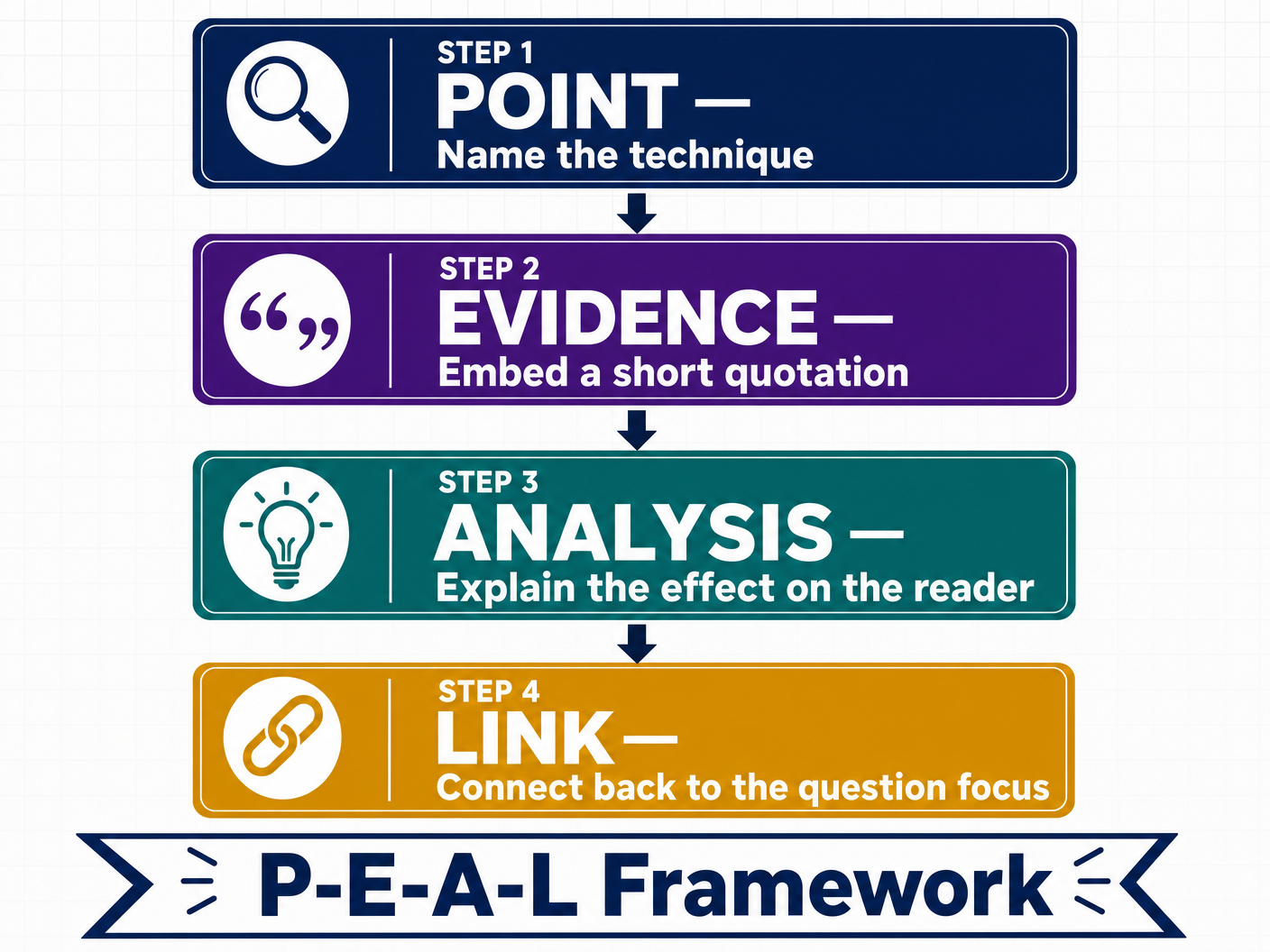
- Evidence: Provide a short, embedded quotation.
- Analysis: Explain how the quotation supports your view.
- Counter-argument (for top marks): Consider a different perspective (e.g., 'However, it could be argued that the use of hyperbole slightly undermines the genuine threat...').
Comparing Writers' Viewpoints
Comparison questions require you to look at two texts side-by-side. You must compare both what the writers are saying (their ideas and perspectives) and how they are saying it (their methods).
Always use comparative connectives: whereas, similarly, in contrast, both writers, unlike, on the other hand.
Writing Skills
Transactional/Non-Fiction Writing
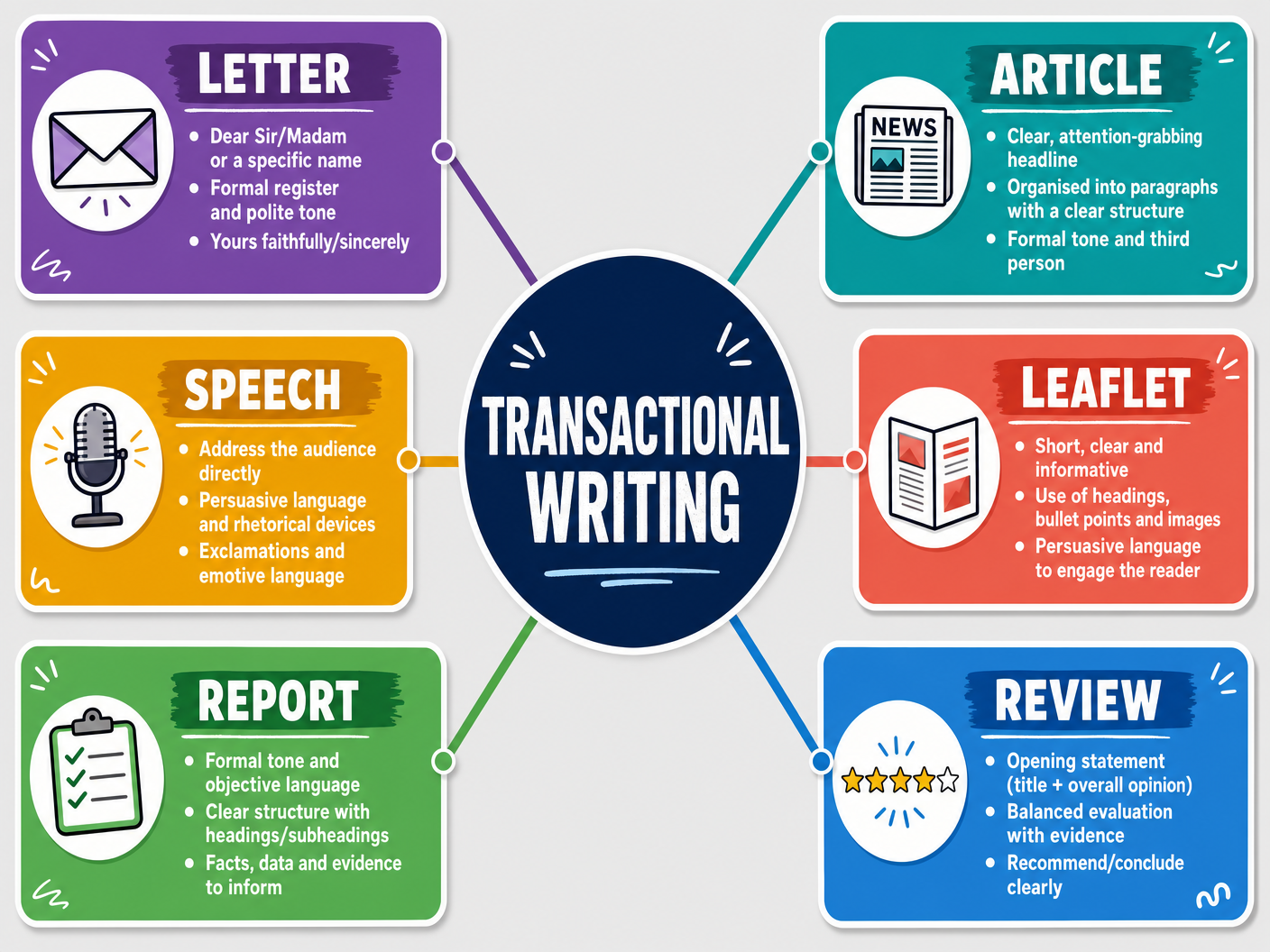
Transactional writing is writing with a real-world purpose. Before you write a single word, you must identify the Form, Purpose, and Audience.
- Form: What are you writing? (Letter, article, speech, leaflet, report, review). You must include the correct conventions (e.g., a letter needs a greeting and sign-off; an article needs a headline).
- Purpose: Why are you writing? (To persuade, argue, advise, inform, explain). This dictates your tone and the techniques you use.
- Audience: Who are you writing for? This dictates your register (formal or informal) and vocabulary choices.
Use the AFOREST techniques to make your writing persuasive and engaging.
Technical Accuracy (SPaG)
Spelling, Punctuation, and Grammar (SPaG) marks are crucial in the writing section. To access the highest bands, you must demonstrate a conscious control of language.
- Ambitious Punctuation: Use semicolons to link closely related independent clauses; use colons to introduce lists or explanations; use dashes for dramatic pauses or parenthetical asides.
- Sentence Variety: Deliberately mix simple, compound, and complex sentences for effect.
- Paragraph Cohesion: Use discourse markers (e.g., Furthermore, Consequently, Nevertheless, In contrast) to guide the reader smoothly from one idea to the next.
Listen to the Podcast
For a deeper dive into exam technique and a quick-fire revision quiz, listen to our comprehensive 10-minute podcast episode:
Visual Resources
2 diagrams and illustrations
Interactive Diagrams
2 interactive diagrams to visualise key concepts
Conceptual Flow Outline
English Language Exam Approach Flowchart
Conceptual Flow Outline
Comparison Question Framework
Worked Examples
3 detailed examples with solutions and examiner commentary
Practice Questions
Test your understanding — click to reveal model answers
Read the first paragraph. Identify two things the writer says about the weather. (2 marks)
Hint: Look for explicit information. Do not over-write; two brief bullet points are enough.
Analyse how the writer uses language to describe the crowd's reaction to the announcement. (8 marks)
Hint: Use PEAL. Focus on specific words or techniques and explain their effect on the reader.
Write a speech to be delivered to your school assembly, persuading students to volunteer in the local community. (24 marks + 16 marks SPaG)
Hint: Plan your response. Remember the form (speech = direct address), purpose (persuade = AFOREST), and audience (peers = engaging, relatable register).
Evaluate the statement: 'The writer successfully creates a sense of profound isolation in this extract.' To what extent do you agree? (15 marks)
Hint: Form a judgement immediately. Use evidence to support your view, and consider a nuanced or balanced perspective for top marks.
Compare how the writers of Text A and Text B present their views on climate change. (14 marks)
Hint: Compare both ideas and methods. Use comparative connectives constantly.