OCR · GCSE · English Language
Planning, Drafting and Editing
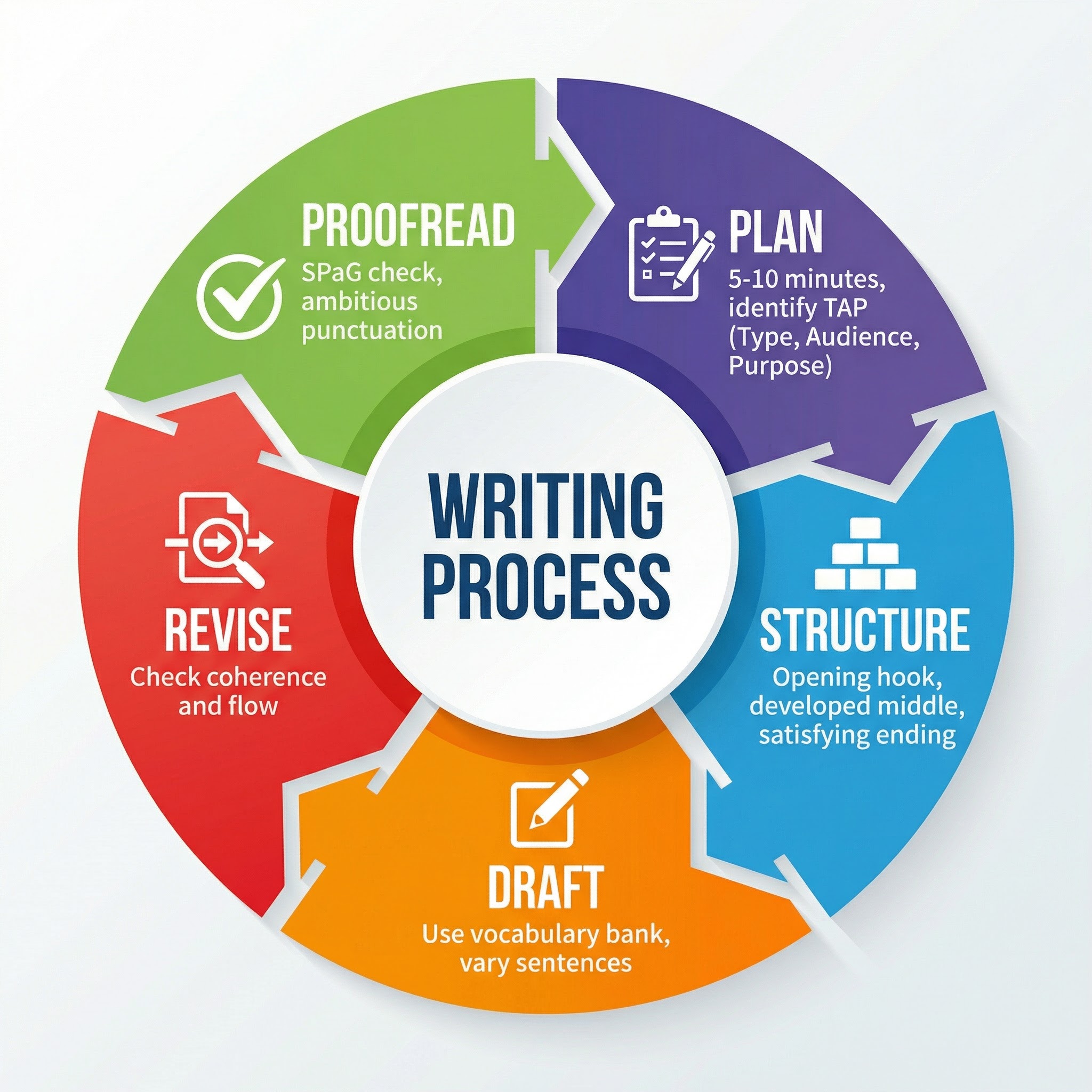
This guide focuses on the essential skills of Planning, Drafting, and Editing for OCR GCSE English Language. Mastering this process is the key to unlocking high marks in AO5 (Organisation) and AO6 (Technical Accuracy) in your written responses."
- 6 min read
- 3 worked examples
- 5 practice questions
Study Notes

Overview
Effective planning, drafting, and editing are the foundational skills for high-level performance in OCR J351 Components 01 and 02 Section B. These skills are not just about avoiding errors; they are the mechanism by which candidates demonstrate structural cohesion (AO5) and conscious control over language (AO6). This guide will break down the reading and writing skills required to excel.
Reading Skills
Identifying Information & Ideas
To secure marks in reading comprehension, candidates must be able to locate both explicit (obvious) and implicit (suggested) information in unseen texts. This involves careful reading and the ability to infer meaning from the writer's choices.
Analysing Language
Key Language Features to Identify
| Feature | Definition | Effect on Reader | Example |
|---|---|---|---|
| Metaphor | A figure of speech in which a word or phrase is applied to an object or action to which it is not literally applicable. | Creates a powerful image, making an abstract concept more concrete and relatable. | 'The classroom was a zoo.' |
| Simile | A figure of speech involving the comparison of one thing with another thing of a different kind, used to make a description more emphatic or vivid (e.g., as brave as a lion). | Makes a description more vivid and easier for the reader to visualise. | 'He was as strong as an ox.' |
| Pathetic Fallacy | The attribution of human feelings and responses to inanimate things or animals, especially in art and literature. | Creates a specific mood or atmosphere that reflects the emotional state of a character. | 'The miserable weather reflected his mood.' |
| Personification | The attribution of a personal nature or human characteristics to something non-human, or the representation of an abstract quality in human form. | Brings an object or idea to life, allowing the reader to connect with it on an emotional level. | 'The wind whispered through the trees.' |
| Alliteration | The occurrence of the same letter or sound at the beginning of adjacent or closely connected words. | Draws attention to a particular phrase and can create a specific sound effect (e.g., harsh, soft). | 'The sweet smell of success.' |
| Sibilance | A figure of speech in which a hissing sound is created within a group of words through the repetition of 's' sounds. | Can create a sinister, soft, or flowing sound, depending on the context. | 'The snake slithered silently.' |
| Juxtaposition | The fact of two things being seen or placed close together with contrasting effect. | Highlights the differences between two things, often to create a dramatic effect. | 'The pristine new building stood next to the crumbling ruins.' |
Analysing Structure

Structural analysis involves looking at how a writer has organised their text to create meaning and effects. Key features to consider include:
- Openings: How does the writer hook the reader?
- Shifts in focus: Where does the narrative or argument change direction?
- Narrative perspective: First, second, or third person? How does this affect the reader's relationship with the text?
- Sentence length variation: How are short and long sentences used for effect?
- Paragraph structure: How are paragraphs used to build ideas or tension?
- Cyclical structure: Does the ending link back to the opening?
- Flashback/Foreshadowing: How is time manipulated to create suspense or provide context?
Evaluating Critically
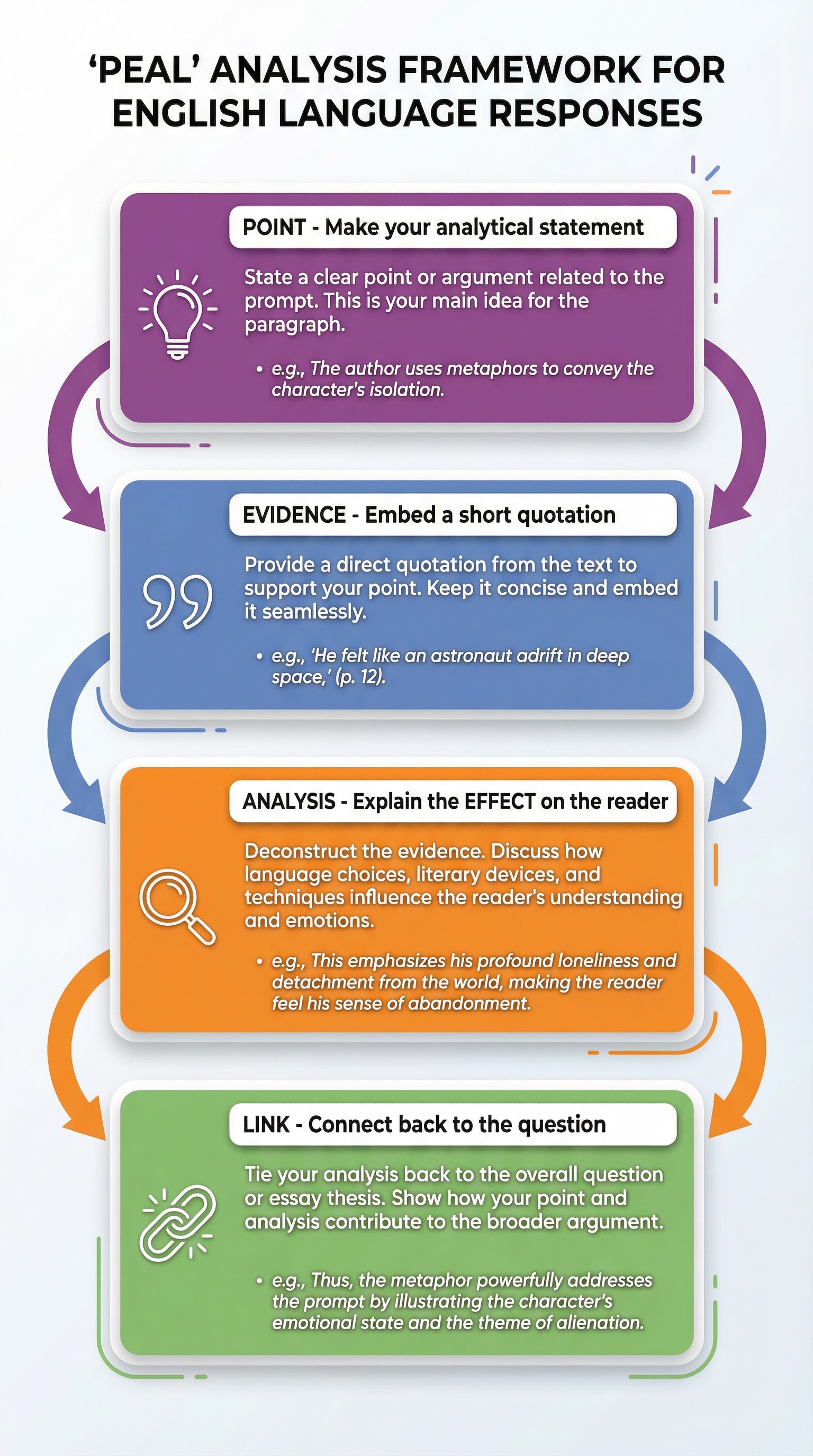
This skill requires you to form and express a personal judgement about a writer's methods. A strong evaluative response follows this structure:
- Statement: Make a clear point about the writer's success.
- Evidence: Select a short, relevant quotation.
- Analysis: Explain how the writer's choices create a particular effect.
- Link: Connect your analysis back to the overall question.
Comparing Writers' Viewpoints
For comparison questions, you need a clear framework:
- Identify Viewpoints: What is the main argument or perspective of each writer?
- Compare Methods: How do the writers use language and structure to present their viewpoints? Compare specific features.
- Evaluate Effectiveness: Which writer is more successful in conveying their message and why?
Writing Skills
Creative Writing

For narrative and descriptive tasks, focus on these techniques:
- Show, Don't Tell: Instead of saying a character is angry, describe their clenched fists and narrowed eyes.
- Sensory Description: Appeal to all five senses to immerse the reader in the scene.
- Varied Sentence Structures: Mix simple, compound, and complex sentences to create rhythm and pace.
- Engaging Openings: Start with action, dialogue, or a mystery.
- Satisfying Endings: Provide a sense of closure, perhaps by linking back to the opening.
- One-Scene Rule: Focus on a single, significant moment rather than trying to tell a long story.
Transactional/Non-Fiction Writing
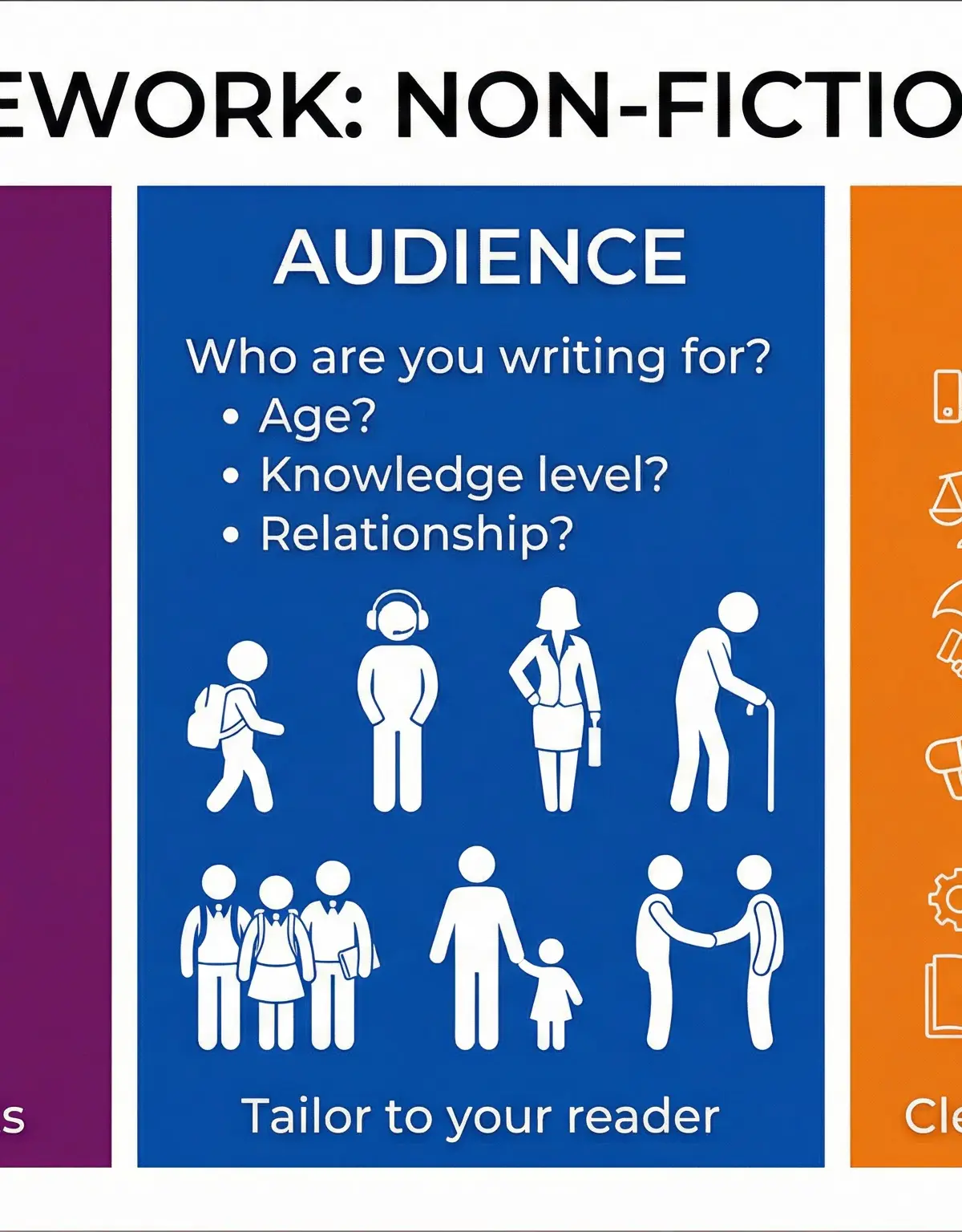
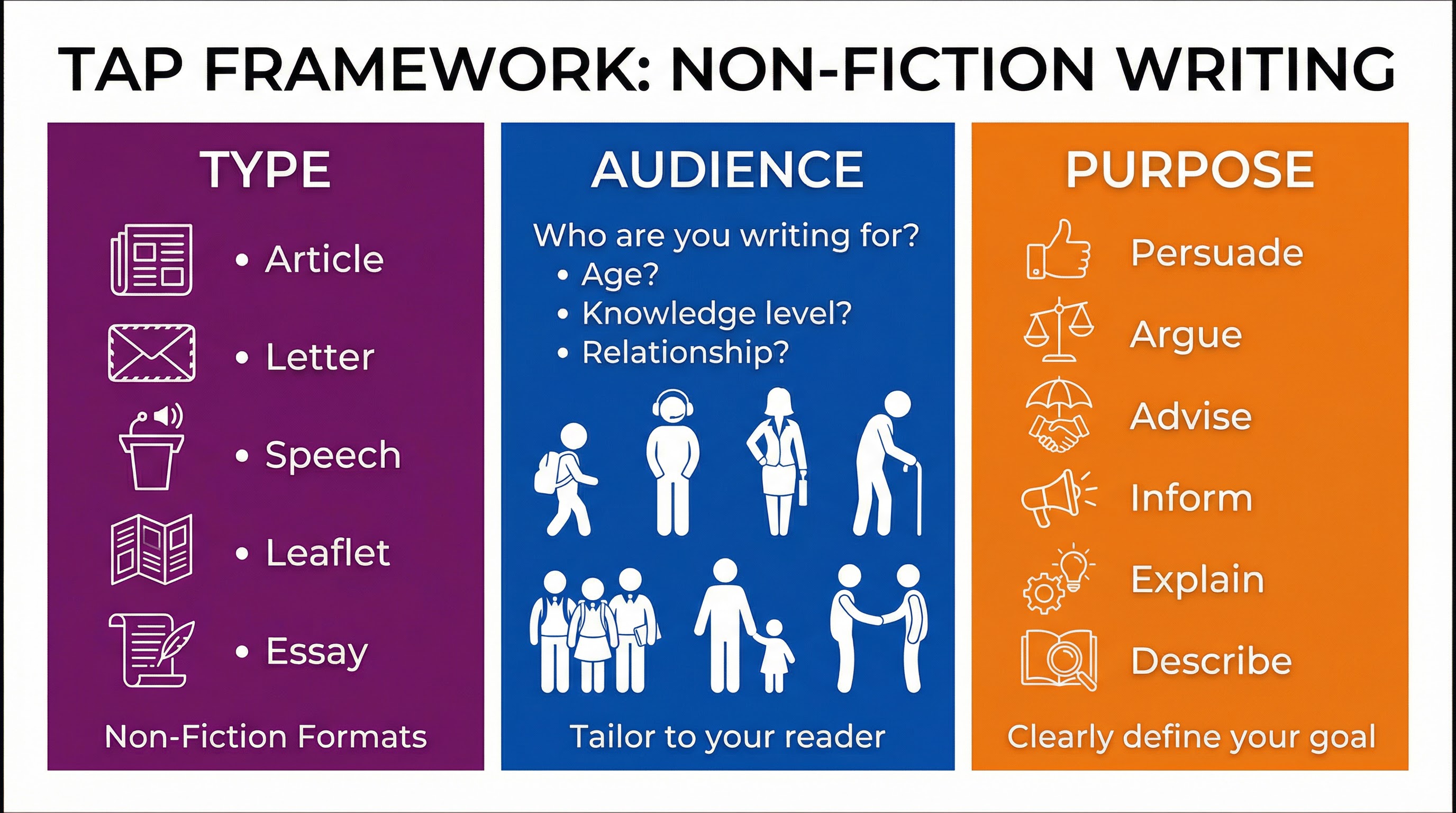
For letters, articles, speeches, and leaflets, structure is key. Use the AFOREST model for persuasive techniques:
- Alliteration
- Facts
- Opinions
- Rhetorical questions
- Emotive language
- Statistics
- Three (Rule of)
Always consider the Purpose-Form-Audience framework to ensure your tone and style are appropriate.
Technical Accuracy (SPaG)
Spelling, punctuation, and grammar (SPaG) are worth a significant portion of the marks. To impress examiners, use ambitious punctuation correctly:
- Semicolons (;) to link two closely related independent clauses.
- Colons (:) to introduce a list, explanation, or quotation.
- Dashes (-) to add emphasis or a dramatic pause.
- Parenthetical Commas (,) to add extra, non-essential information.
Paragraphs should be clearly structured with topic sentences and discourse markers (e.g., 'Furthermore', 'In contrast') to guide the reader."
Worked Examples
3 worked examples — open one to explore the question and available guidance.
Practice Questions
Test your understanding — click to reveal model answers
Identify two phrases from a text (not provided) that suggest a character is feeling anxious.",
"marks": 2
Explain how the writer uses language to describe the setting.
Hint: Use the PEAL structure. Find a good quotation and explain the effect of specific words within it.
Write a description of a bustling market.",
"marks": 24
Evaluate how successfully the writer creates a feeling of tension.",
"marks": 12
Write a letter to your local council arguing for better facilities for young people in your area.",
"marks": 40