Critical reading and comprehension: identifying and interpreting themes, ideas and information in a range of literature and other high-quality writing; reading in different ways for different purposes, and comparing and evaluating the usefulness, relevance and presentation of content for these purposes; drawing inferences and justifying these with evidence; supporting a point of view by referring to evidence within the text; identifying bias and misuse of evidence, including distinguishing between statements that are supported by evidence and those that are not; reflecting critically and evaluatively on text, using the context of the text and drawing on knowledge and skills gained from wider reading; recognising the possibility of different responses to a text
This topic tests your ability to read high-quality, unseen texts critically, identifying explicit and implicit information, and analysing how writers use language and structure to achieve effects. In the exam, you will need to compare viewpoints across texts, evaluate writers' methods with evidence, and apply these skills to produce your own effective creative and transactional writing.
Study Notes
Overview
Welcome to Critical Reading and Comprehension for GCSE English Language. This unit is the foundation of your entire qualification. Whether you are analysing a 19th-century extract or writing a modern speech, the core skills remain the same: understanding how writers craft texts to influence readers, and applying those same techniques to your own writing. Examiners are looking for candidates who read actively, question the text, and can explain how meaning is constructed.
Reading Skills
Identifying Information & Ideas (AO1)
This skill involves locating both explicit (clearly stated) and implicit (suggested) information in unseen texts.
Explicit Information: When asked to list four things about a character, simply find the facts in the text and write them down. Keep it brief.
Implicit Information: When asked "What impressions do you get?", you must draw inferences. If a character "slammed the door without looking back," the writer hasn't explicitly stated they are angry, but you can infer it. Always support your inferences with a short quotation.
Analysing Language (AO2)
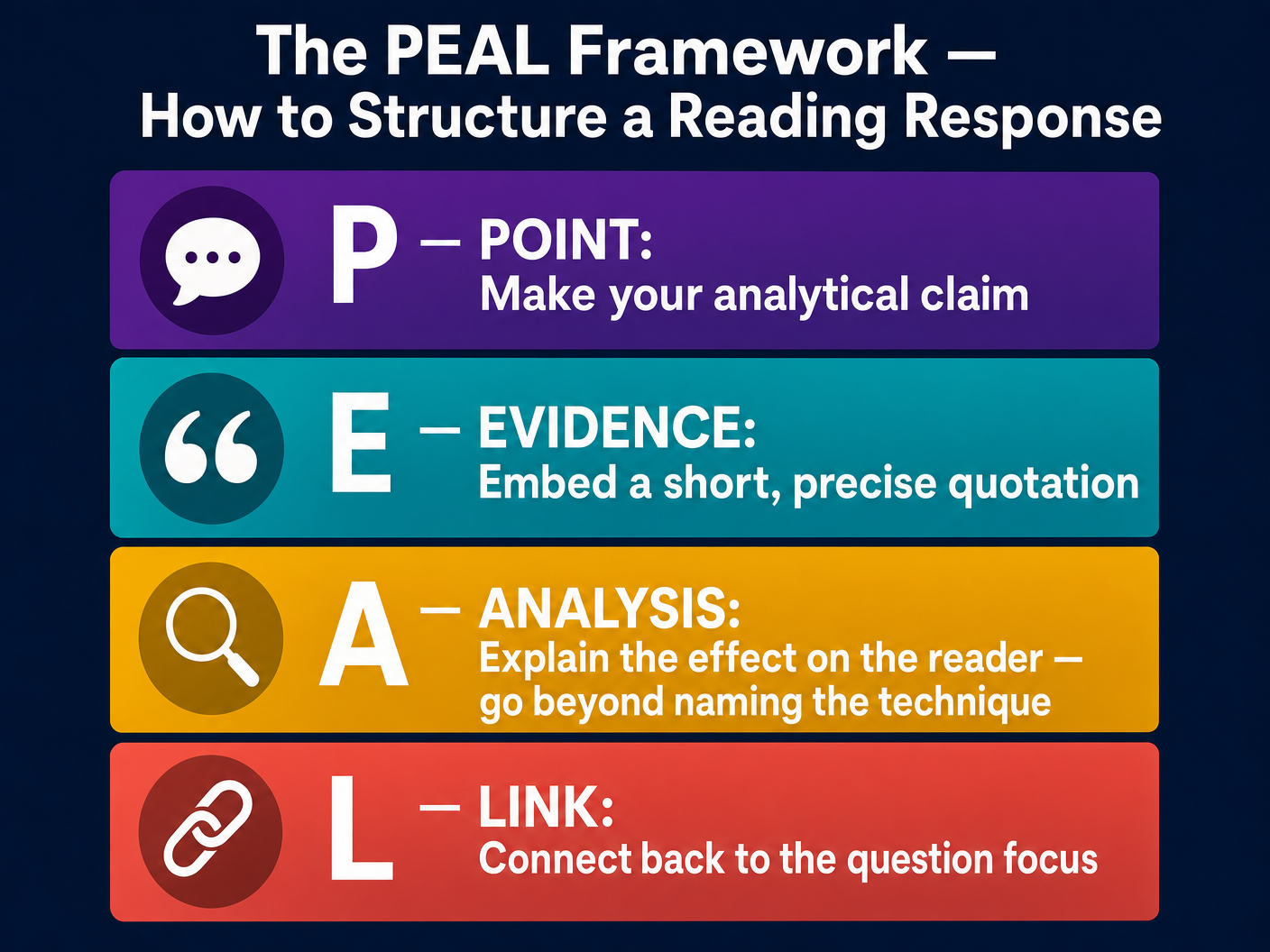
This is where many candidates lose marks by simply "feature-spotting" (naming a technique without explaining its effect). To achieve high marks, you must use the NAME, QUOTE, EFFECT approach.
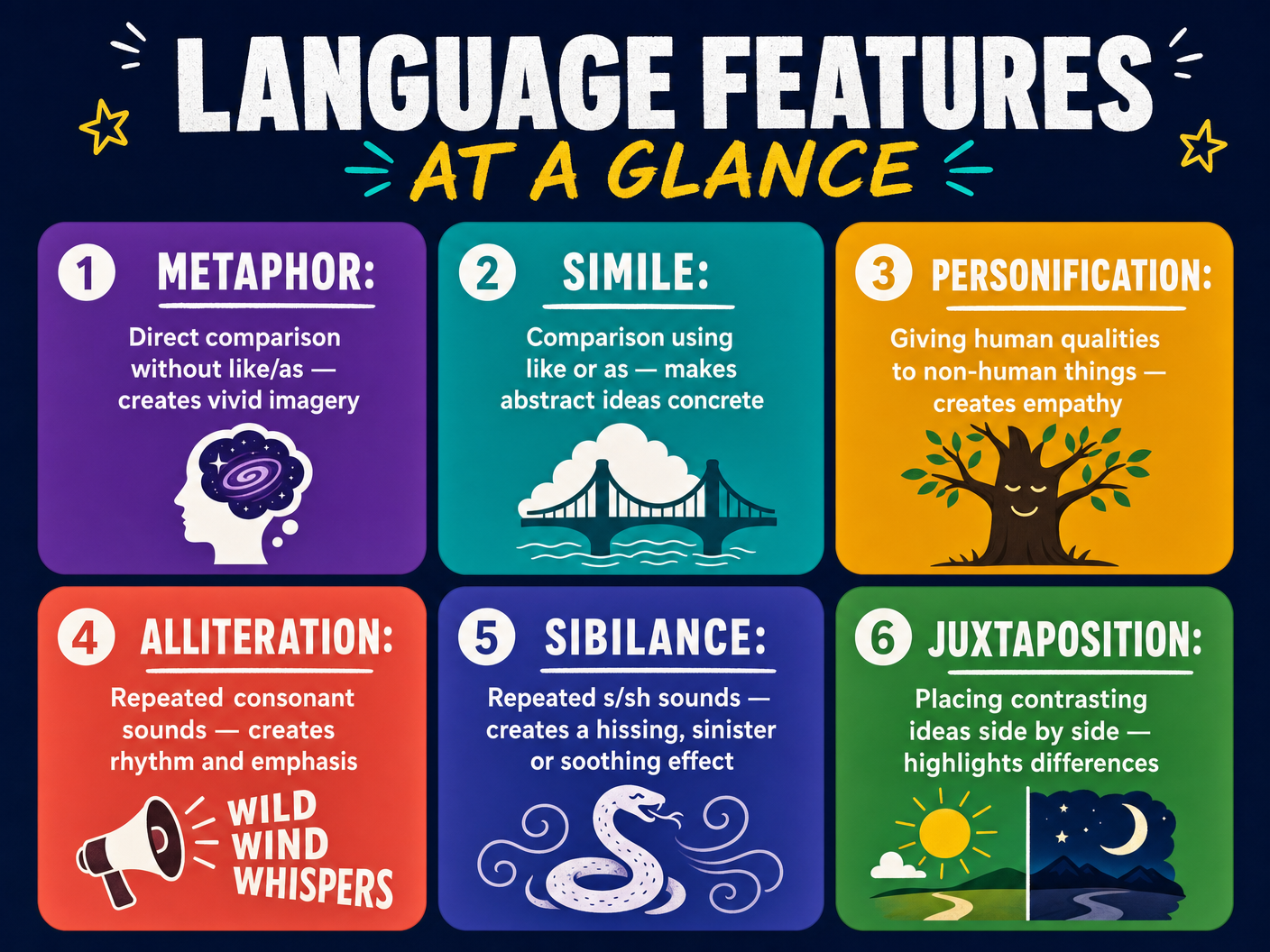
Key Language Features to Identify
| Feature | Definition | Effect on Reader | Example |
|---|---|---|---|
| Metaphor | A direct comparison stating one thing is another. | Creates vivid, memorable imagery by transferring qualities. | "The classroom was a zoo." |
| Simile | A comparison using like or as. | Makes abstract or unfamiliar ideas concrete and relatable. | "He was as quiet as a shadow." |
| Personification | Giving human qualities to non-human things. | Creates empathy, atmosphere, or a sense of threat/vitality. | "The wind howled in anger." |
| Alliteration | Repetition of consonant sounds at the start of words. | Creates rhythm, emphasis, or mimics a specific sound. | "The wild wind whipped." |
| Sibilance | Repetition of 's' or 'sh' sounds. | Can create a sinister, hissing effect, or a soft, soothing tone. | "The snake slithered silently." |
| Juxtaposition | Placing contrasting ideas side by side. | Highlights differences and creates tension or irony. | "A peaceful garden next to a warzone." |
| Pathetic Fallacy | Using weather or environment to reflect human emotion. | Sets the mood and foreshadows events. | "Rain lashed against the windows as she cried." |
Analysing Structure (AO2)
Structural features are about how a text is organised. Examiners want you to notice:
- Openings and Endings: Does it start in medias res (in the middle of the action)? Is there a cyclical structure where the ending echoes the beginning?
- Shifts in Focus: Does the writer move from the setting to a character, or from the past to the present? Why?
- Sentence Length Variation: Short sentences create tension and pace; long, complex sentences can reflect overwhelming thoughts or detailed descriptions.
- Narrative Perspective: Is it first-person (intimate, biased) or third-person (omniscient, detached)?
Examiner Tip: When analysing structure, always link it back to the reader's experience. For example, "The sudden shift to a short, fragmented sentence mirrors the character's panic, making the reader feel the urgency of the situation."
Evaluating Critically (AO4)
Evaluation questions ask you to form an opinion about a statement (e.g., "A student said: 'The writer makes the setting seem terrifying.' To what extent do you agree?").
To succeed here, you must:
- State your opinion clearly (e.g., "I strongly agree that...").
- Select the best evidence to support your view.
- Analyse how the writer's methods (language/structure) create that effect.
- Consider alternative interpretations (e.g., "However, it could also be argued that...").
Comparing Writers' Viewpoints (AO3)
When comparing two texts, you must identify the viewpoints of both writers, compare the methods they use, and evaluate their effectiveness.
Framework for Comparison:
- Identify Viewpoints: What does Writer A think? What does Writer B think?
- Compare Methods: How does Writer A show this (e.g., emotive language)? How does Writer B show this (e.g., statistics)?
- Evaluate Effectiveness: Which approach is more convincing and why?
Always use connective phrases to signal comparison: Similarly, In contrast, Whereas, Both writers...

Writing Skills
Creative Writing (AO5 & AO6)
Creative writing tasks (narrative or descriptive) require you to craft an engaging text.
- Show, Don't Tell: Instead of saying "He was nervous," describe his "trembling hands and erratic breathing."
- Sensory Description: Use all five senses to immerse the reader.
- The One-Scene Rule: In exam conditions, it is better to describe one scene in vivid detail than to rush through a complex plot spanning several years.
- Engaging Openings: Hook the reader immediately with action, dialogue, or a striking setting.
Transactional/Non-Fiction Writing (AO5 & AO6)
Transactional writing (letters, articles, speeches, leaflets) must be adapted for a specific Purpose, Audience, and Form (PAF).
- Purpose: Are you arguing, persuading, advising, or informing?
- Audience: Are you writing to teenagers, adults, or a headteacher? Adjust your tone and register accordingly.
- Form: Follow the conventions. A letter needs addresses and a formal sign-off; an article needs a headline and subheadings.
Use the AFOREST techniques to make persuasive writing compelling.
Technical Accuracy (SPaG - AO6)
Spelling, Punctuation, and Grammar (SPaG) account for a significant portion of your writing marks.
- Ambitious Punctuation: Try to use semicolons to link related independent clauses, colons to introduce lists or dramatic statements, and dashes for emphasis.
- Paragraph Cohesion: Use discourse markers (e.g., Furthermore, Consequently, On the other hand) to link your paragraphs logically.
- Proofreading: Always leave 5 minutes at the end of the exam to check for basic errors like missing capital letters or incorrect homophones (there/their/they're).
Listen to the Podcast
For a comprehensive review of these skills, including exam tips and a quick-fire quiz, listen to our 10-minute revision podcast:
Visual Resources
4 diagrams and illustrations
Interactive Diagrams
2 interactive diagrams to visualise key concepts
Conceptual Flow Outline
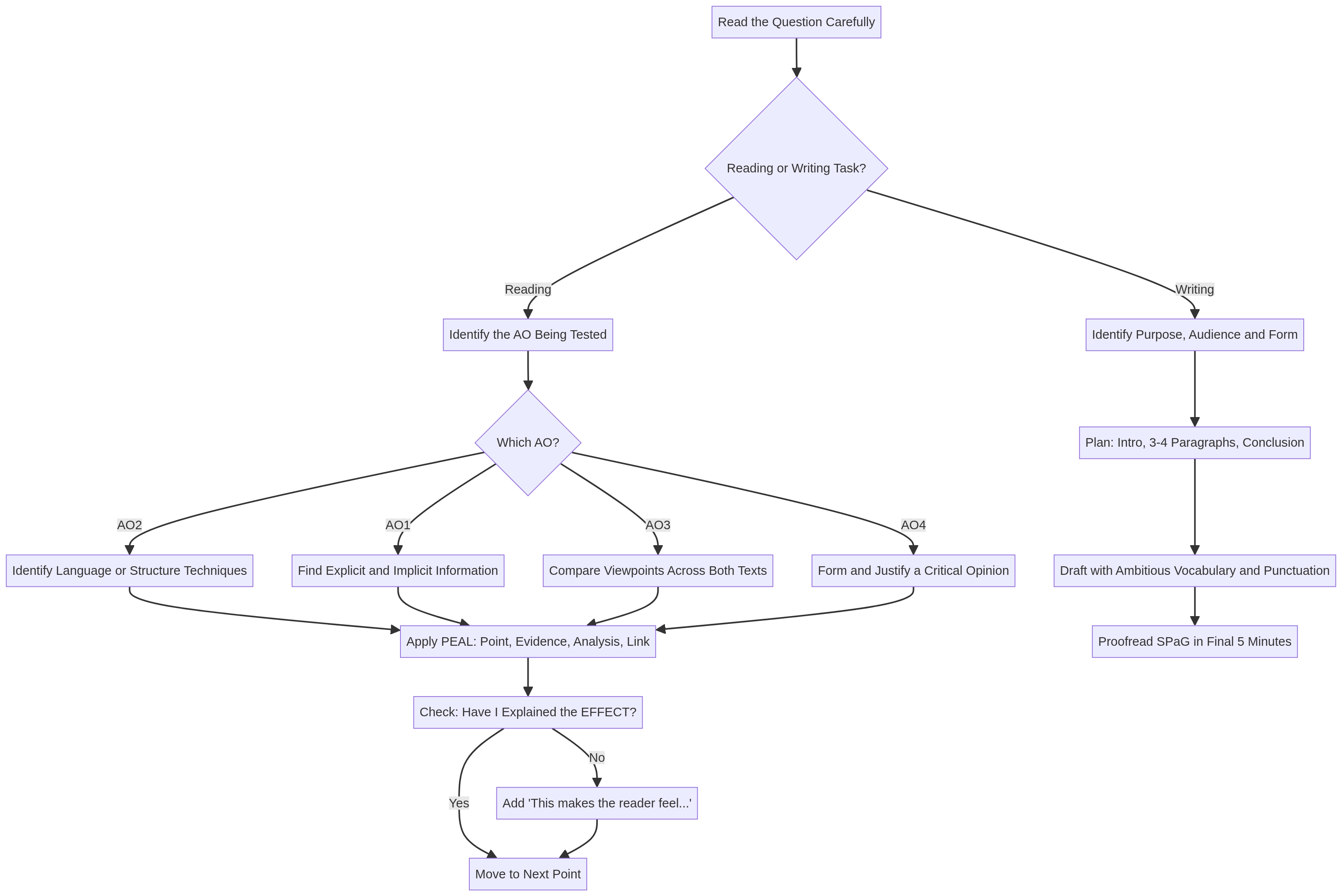
English Language Exam Approach Flowchart
Conceptual Flow Outline
Comparison Framework for Reading Responses
Worked Examples
3 detailed examples with solutions and examiner commentary
Practice Questions
Test your understanding — click to reveal model answers
Read lines 1-5. List four things you learn about the setting.
Hint: Only use information from lines 1-5. Keep your answers brief. You do not need to write in full sentences or analyse.
How does the writer use language to describe the character's fear? (8 marks)
Hint: Use the PEAL structure. Focus on specific word choices, imagery, and their effect on the reader.
Compare how the writers convey their different attitudes towards technology. (16 marks)
Hint: Identify the viewpoint in Text A, then Text B. Compare the methods they use (e.g., tone, statistics vs. anecdotes) and evaluate which is more effective.
Write a description suggested by this picture [A busy city street in the rain]. (24 marks content, 16 marks SPaG)
Hint: Focus on sensory details. Use ambitious vocabulary. Do not write a story with a complex plot; focus on describing the atmosphere of the single scene.
A student said: 'The writer effectively builds tension in this extract.' To what extent do you agree? (20 marks)
Hint: State your agreement, select evidence, and evaluate HOW the writer builds tension (look at sentence length, withheld information, and sensory language).