AQA · GCSE · English Literature
Course version: 8702 · Version from Sept 2015
Bayonet Charge
Bayonet Charge is a visceral, fast-paced poem that plunges the reader directly into the chaos of a World War I battlefield. It's highly rewarding to study because it offers profound existential questions about patriotism, dehumanisation, and the terrifying reality of conflict, providing rich opportunities for structural and linguistic analysis.
- 6 min read
- 2 worked examples
- 4 practice questions
- 8 key terms
Try the lesson
The start of the Bayonet Charge lesson, made from checked teaching notes for this specification point.
Have a go first
How does Hughes present the soldier's attitude towards patriotic ideals in the line 'King, honour, human dignity, etcetera'?
There is more to this lesson
The full lesson goes on to check your understanding and help you earn the marks. Create a free account to carry on, with your progress saved.
7 days Premium · Then the free plan continues · No card, no charge
Check what you remember
Read the wording for your board, then hide it and explain In media res in your own words. Rough notes are fine. This is a self-check, with no mark or grade.
Reference: AQA
Starting a narrative in the middle of the action.
Study Notes
Overview
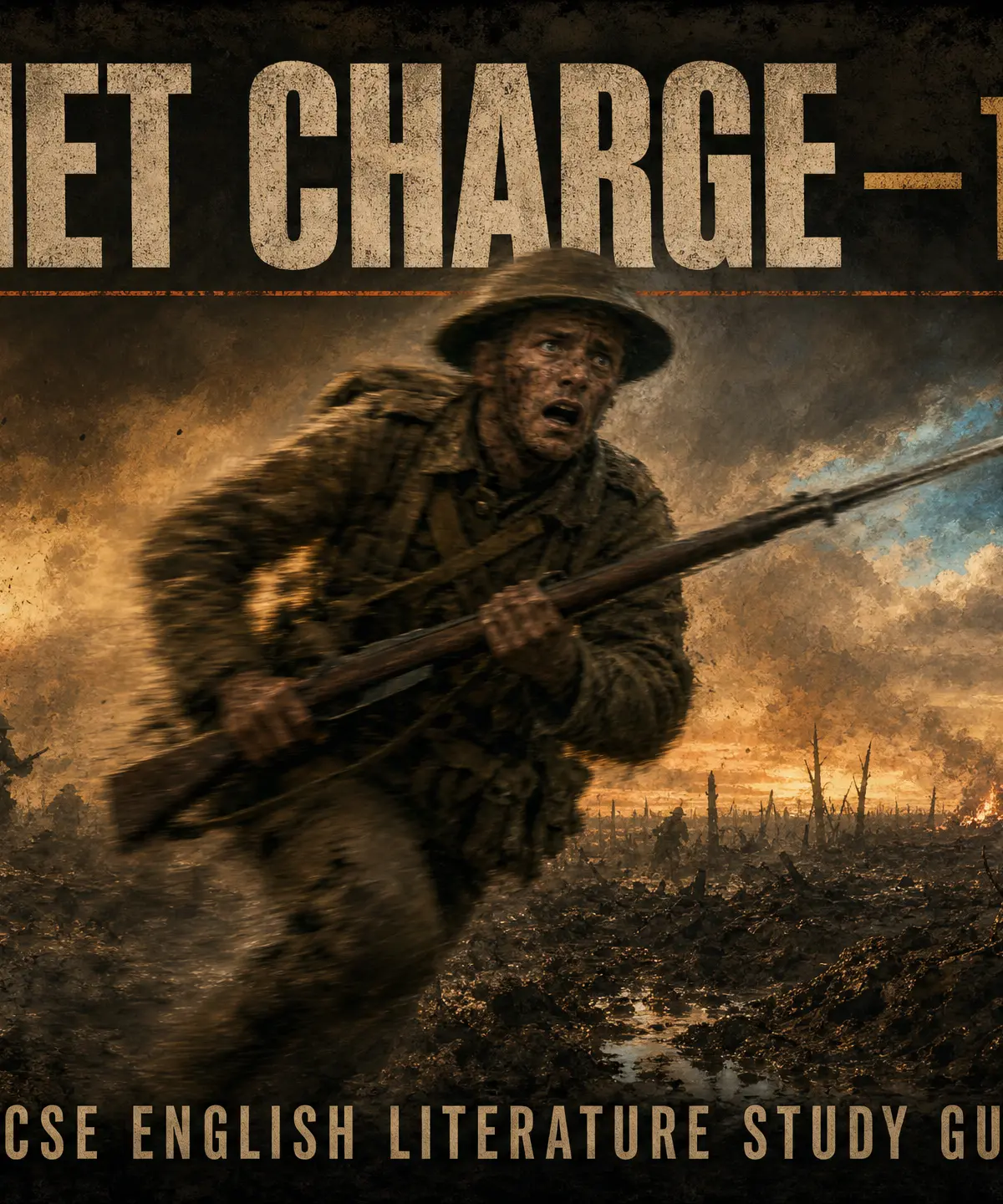
'Bayonet Charge' by Ted Hughes presents a soldier's sudden awakening into the brutal reality of war during a World War I charge. The poem explores the soldier's psychological fragmentation as patriotic ideals dissolve into instinctual terror and existential questioning. Hughes employs vivid, often violent imagery and a disruptive free-verse structure to convey the chaos and dehumanisation of combat. Examiners reward candidates who can move beyond the surface-level violence to analyse the poem's existential themes—specifically, how the soldier's humanity and ideology are stripped away by the mechanics of war. High-scoring responses seamlessly integrate context (Hughes's post-war perspective and inherited trauma) with precise analysis of form and language.
Audio Guide
Listen to our expert examiner break down the poem, common mistakes, and top-tier strategies:
Poem Structure & Form Overview
The poem is structured in three distinct stanzas that chart the psychological journey of the soldier.
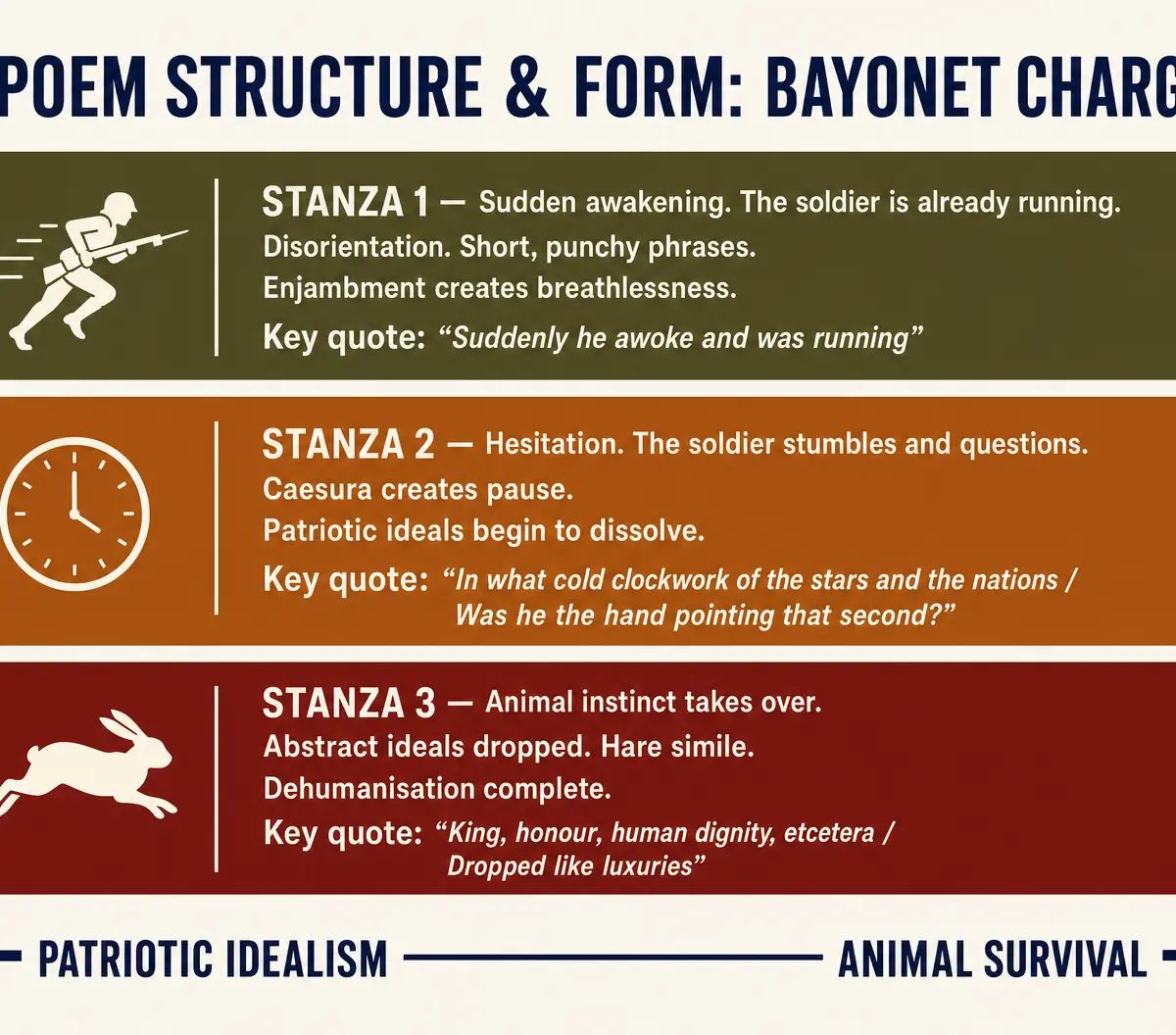
Form: The poem is written in free verse. The lack of a regular rhyme scheme or metre reflects the chaos and unpredictability of the battlefield. The uneven line lengths and stanza structures visually mirror the stumbling, frantic movement of the soldier.
Enjambment and Caesura: Hughes uses enjambment heavily, particularly in the first stanza, forcing the reader to read quickly without pausing for breath, mimicking the soldier's panic and momentum. Caesura is used effectively in the second stanza ("Statuary in mid-stride. Then the shot-slashed furrows") to create a sudden, jarring halt, representing the soldier's moment of hesitation and existential questioning.
Themes
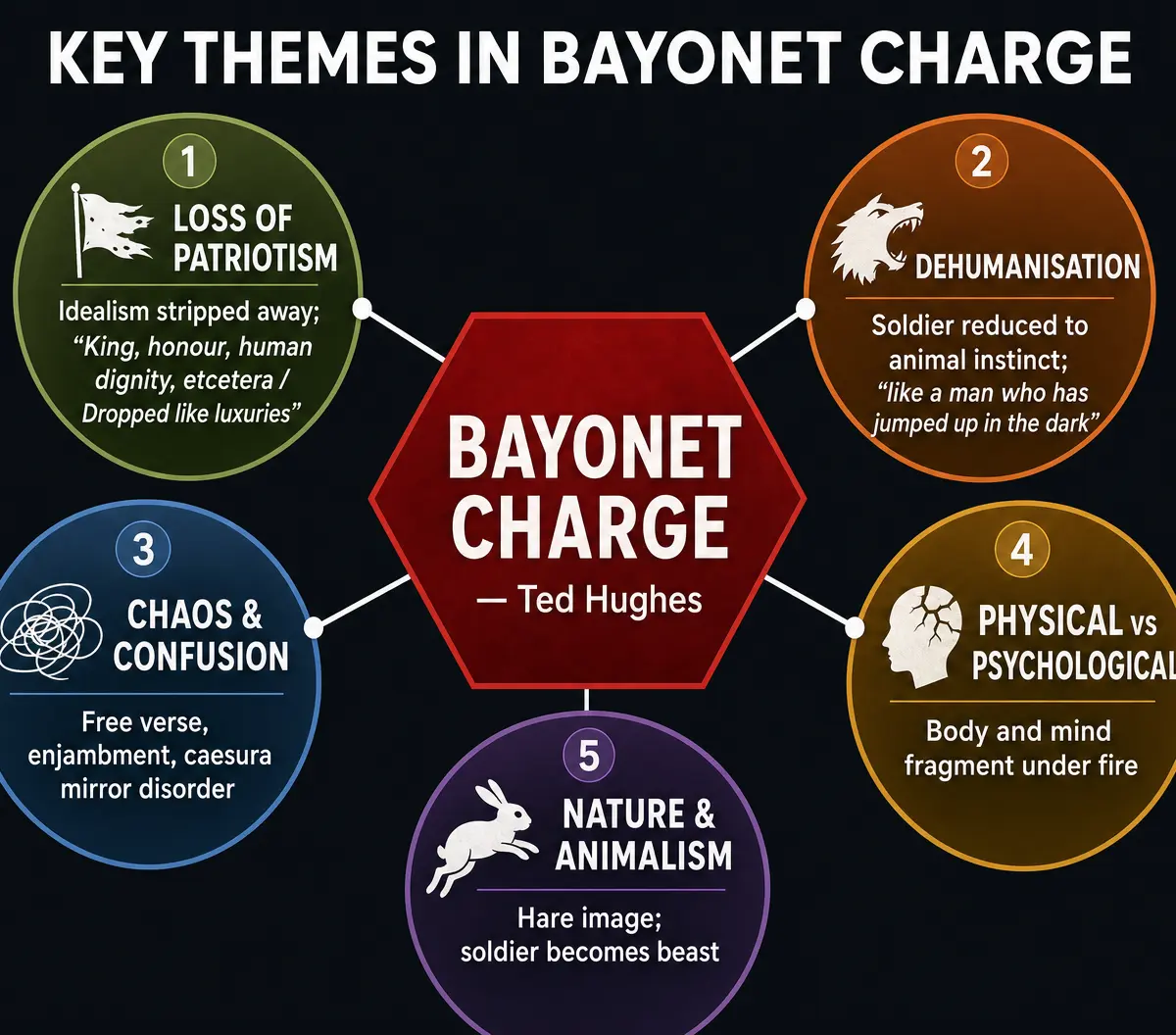
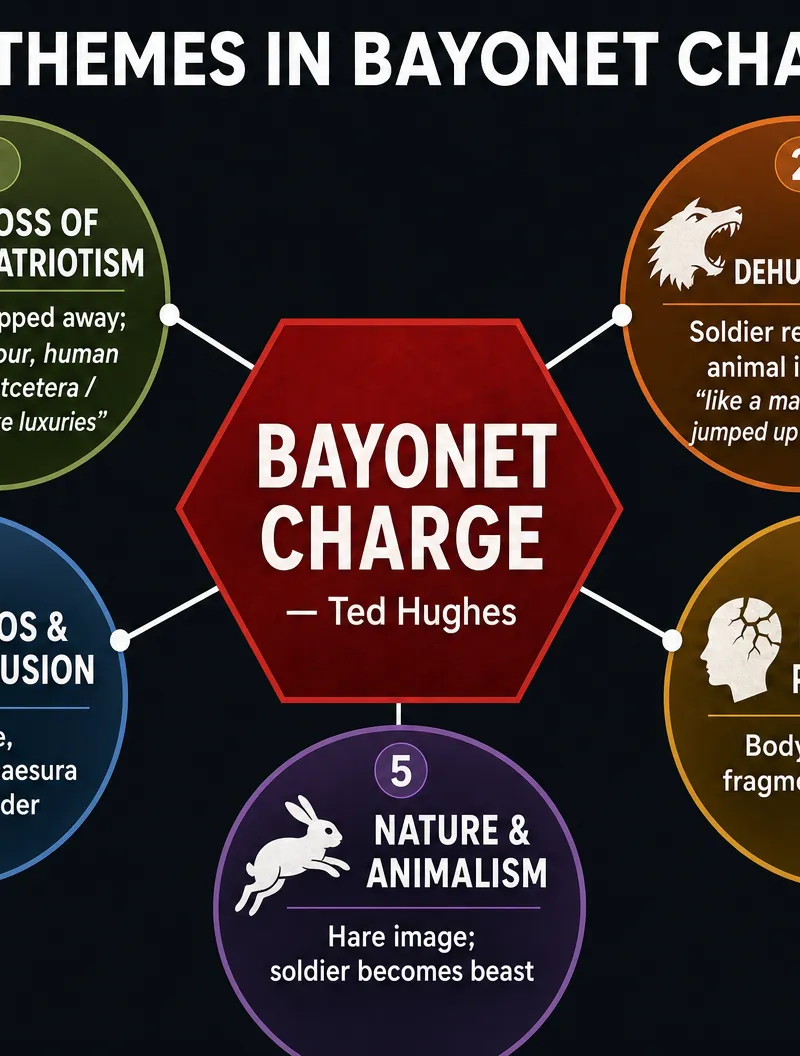
Theme 1: The Loss of Patriotism and Ideology
Hughes explores how abstract ideals like patriotism, honour, and duty cannot survive the visceral reality of combat. The poem charts the violent destruction of these concepts.
Key Quotes:
- "The patriotic tear that had brimmed in his eye / Sweating like molten iron from the centre of his chest" (Stanza 1) - The transition from emotion (the tear) to physical agony (sweating molten iron) symbolises the painful stripping away of naive idealism. The tear is no longer a symbol of pride but a physical burden.
- "King, honour, human dignity, etcetera / Dropped like luxuries" (Stanza 3) - The dismissive "etcetera" undermines the grand concepts that society uses to justify war. Calling them "luxuries" implies they are unnecessary and burdensome when the primary goal is simply survival.
Theme 2: Dehumanisation and Animal Instinct
As the soldier's human ideals are stripped away, he is reduced to a state of pure, animalistic survival. The boundary between human and animal dissolves.
Key Quotes:
- "Suddenly he awoke and was running - raw / In raw-seamed hot khaki" (Stanza 1) - The repetition of "raw" suggests both physical exposure and an unrefined, primal state. The soldier is no longer a thinking individual but a reacting body.
- "a yellow hare / That rolled like a flame / And crawled in a threshing circle" (Stanza 3) - The hare acts as a mirror for the soldier. Both are innocent creatures caught in a mechanized slaughter, driven only by panic.
Theme 3: Chaos, Confusion, and Existential Terror
The poem captures the disorienting experience of suddenly finding oneself in a life-or-death situation, questioning the very purpose of existence in that moment.
Key Quotes:
- "In what cold clockwork of the stars and the nations / Was he the hand pointing that second?" (Stanza 2) - This metaphor presents the universe and political powers as an indifferent, mechanical "clockwork." The soldier is merely a tiny, insignificant cog ("the hand") controlled by forces vastly larger and colder than himself.
- "He lugged a rifle numb as a smashed arm" (Stanza 1) - The simile transfers the numbness and violence of the battlefield onto the weapon itself, blurring the line between the soldier's body and his instrument of war.
Writer's Methods
Hughes employs a range of techniques to immerse the reader in the soldier's experience:
In Media Res: The poem begins "Suddenly he awoke and was running". This structural choice throws the reader directly into the action without preamble, forcing us to share the soldier's disorientation.
Sensory Imagery: Hughes overwhelms the reader with sensory details: "smacking the belly out of the air", "raw-seamed hot khaki", "sweating like molten iron". This forces the reader to experience the physical reality of the charge, rather than just observing it intellectually.
Subversion of Heroic Imagery: The simile "his foot hung like / Statuary in mid-stride" takes a traditional symbol of military glory (the statue) and subverts it. The soldier is frozen not in triumph, but in terror and hesitation.
Context
To achieve high marks (AO3), context must be integrated into your analysis, not bolted on.
Inherited Trauma: Ted Hughes did not fight in WWI; he wrote this poem decades later. His father, however, was a veteran of the Gallipoli campaign and was deeply traumatised by it. Hughes grew up in the shadow of this trauma. The poem is not a first-hand account but an imaginative recreation and a critique of the historical narrative of the war.
Anti-Propaganda: The poem can be seen as a reaction against the patriotic propaganda that encouraged young men to enlist. Hughes strips away the myth of the "glorious charge" to reveal the terrifying reality, aligning him thematically with WWI poets like Wilfred Owen and Siegfried Sassoon, though writing from a post-war, retrospective viewpoint.
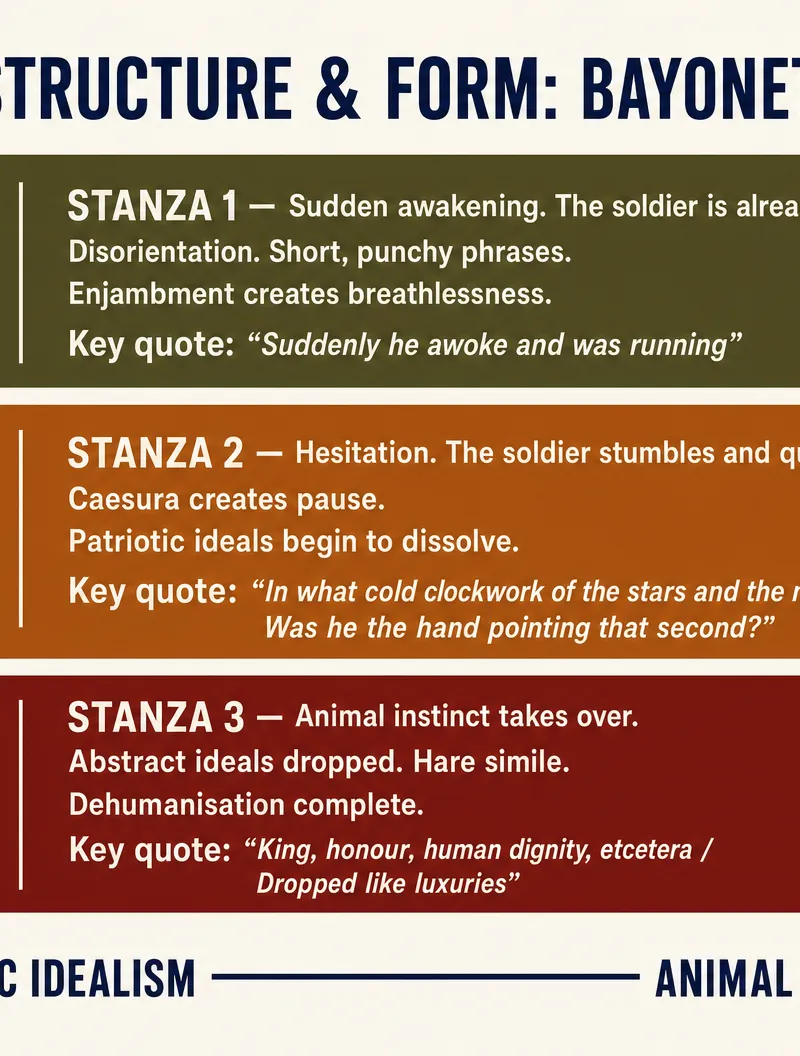
Interactive Diagrams
1 interactive diagram to visualise key concepts
Conceptual Flow Outline
The psychological progression across the three stanzas
Worked Examples
2 worked examples — open one to explore the question and available guidance.
Practice Questions
Try the question, then reveal an answer plan or example response
Compare how poets present the psychological effects of war in 'Bayonet Charge' and one other poem from the anthology.
Hint: Consider comparing with 'Remains' (psychological trauma after war) or 'Exposure' (psychological torture of waiting).
How does Hughes use natural imagery to present ideas about conflict in 'Bayonet Charge'?
Hint: Look closely at the 'green hedge', the 'yellow hare', and the 'clods' of earth. How does war corrupt or interact with nature?
Explore the significance of the poem's title, 'Bayonet Charge'.
Hint: Think about what a bayonet is (close combat, visceral) and what a charge implies (momentum, lack of thought).
How does Hughes present the theme of patriotism in the poem?
Hint: Look at the 'patriotic tear' in stanza 1 and the list of ideals in stanza 3.
Exam technique
How to turn what you know into marks
How to approach the question
Always identify the core theme in the question (e.g., 'reality of war', 'power of nature'). Choose your comparison poem immediately. Plan 3-4 paragraphs where you compare BOTH poems in EVERY paragraph based on a specific sub-theme or method.
How to structure your answer
Use comparative topic sentences. Analyze Poem A (Method + Quote + Effect + Context), use a comparative connective ('Similarly', 'Conversely'), then analyze Poem B (Method + Quote + Effect + Context). Link back to the question.
Timing
For a 30-mark poetry comparison, spend 5-7 minutes planning your comparative points, and 40 minutes writing.
Common pitfalls
- Writing about Poem A completely, then Poem B completely (the 'block' approach) - this limits comparative marks.
- Feature spotting (e.g., 'Hughes uses a simile') without analyzing the *effect* of that feature on the reader.
- Including historical facts (e.g., 'WWI started in 1914') that don't actually help interpret the poem's meaning.
What the command words want
- Compare
- Focus on both similarities and differences in how the poets present their ideas. Use comparative language constantly.
- How does the poet present
- This is an AO2 focus. You must write about the *methods* (language, form, structure) the poet uses to create meaning.
Watch or listen (optional)
Test your understanding of Bayonet Charge
Active recall beats re-reading. Take an instant quiz now to test what you’ve learned and lock it into long-term memory.
7 days Premium · Then the free plan continues · No card, no charge