AQA · GCSE · English Literature
Course version: 8702 · Version from Sept 2015
Before You Were Mine
Dive into Carol Ann Duffy's 'Before You Were Mine', a deeply moving exploration of a daughter's complex, possessive love for the glamorous, free-spirited mother she never knew. This guide equips you with the analytical tools and contextual knowledge to secure top marks by mastering Duffy's shifting tenses, vivid imagery, and themes of nostalgia and identity.
- 6 min read
- 2 worked examples
- 4 practice questions
- 8 key terms
Try the lesson
The start of the Before You Were Mine lesson, made from checked teaching notes for this specification point.
Have a go first
In 'Before You Were Mine', who is the speaker addressing?
Listen
A dramatic monologue in which a daughter addresses her mother, imagining her as a glamorous young woman in the 1950s before the speaker was born. The speaker reconstructs a past of dancing, friends and romance, apparently prompted by old photographs, and contrasts it with the mother's life of motherhood. The tone blends admiration and nostalgia with a sense of loss on her mother's behalf, and a hinted guilt at being the cause of change, marked by the speaker's 'loud, possessive yell'. The daughter looks back at her mother's youth with an almost maternal tenderness, so that memory, identity and family bonds are shown as shaped by time and sacrifice. The poem is a tribute to the mother as an individual, separate from her parental role.
There is more to this lesson
The full lesson goes on to check your understanding and help you earn the marks. Create a free account to carry on, with your progress saved.
7 days Premium · Then the free plan continues · No card, no charge
Check what you remember
Read the wording for your board, then hide it and explain Enjambment in your own words. Rough notes are fine. This is a self-check, with no mark or grade.
Reference: AQA
When a sentence or phrase runs over from one line or stanza to the next without terminal punctuation.
Study Notes
Overview
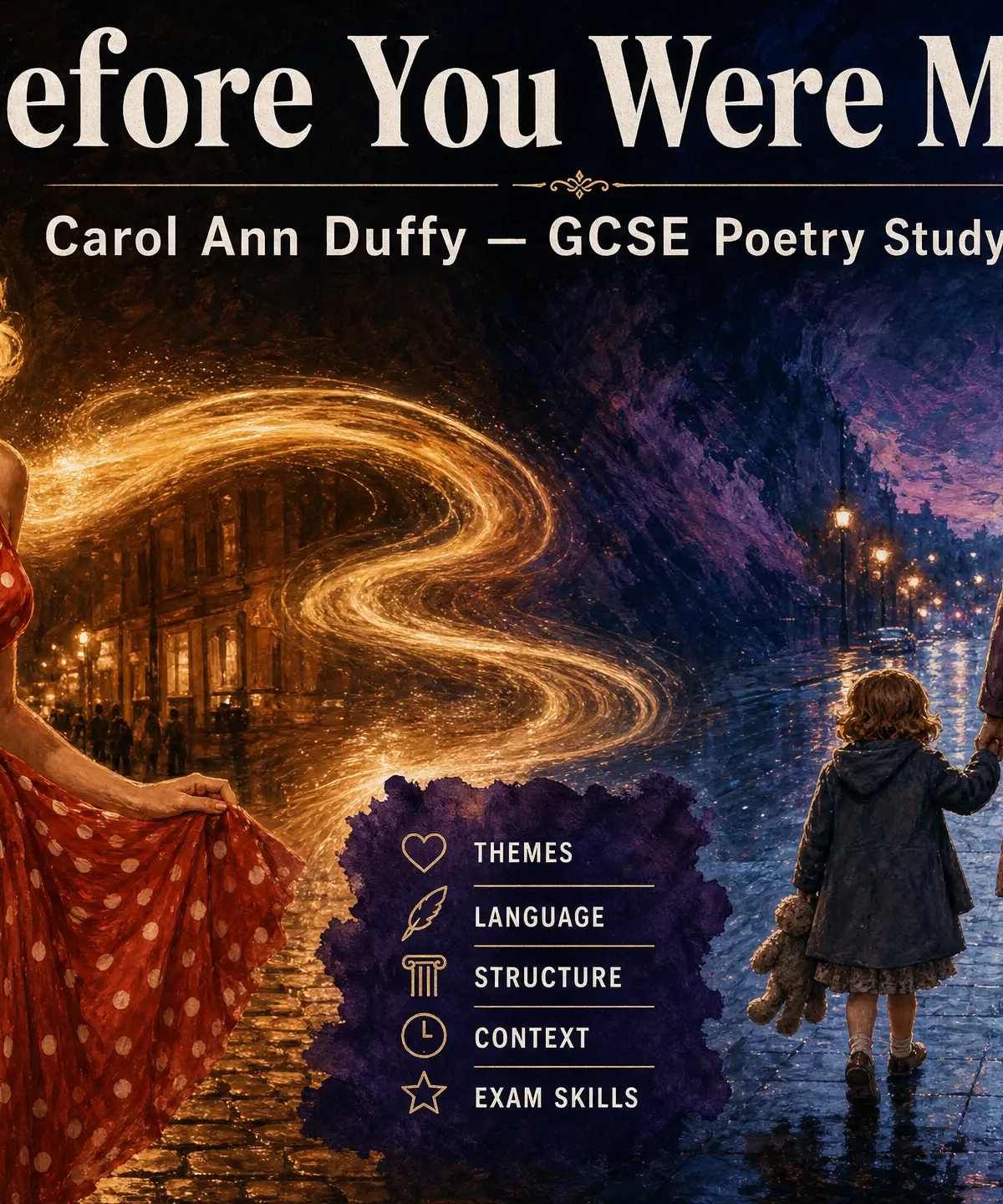
'Before You Were Mine' is a profound and intimate poem in which Carol Ann Duffy explores the complex relationship between mother and daughter. Written from the perspective of a child addressing her mother, the poem imagines the mother's glamorous, carefree life in the 1950s before motherhood changed her identity. Examiners highly reward candidates who move beyond simple readings of nostalgia to analyse the poem's emotional complexity: the speaker's possessive love, the tension between past vitality and present responsibility, and the haunting sense of loss. Top-tier responses will closely examine Duffy's use of shifting tenses, colloquial language, and vivid imagery to convey this poignant blend of celebration and mourning.
Podcast Episode
Listen to our 10-minute deep dive into the poem, covering core concepts, exam tips, and a quick-fire recall quiz.
Plot/Content Overview
- Stanza 1: The speaker imagines her mother ten years before her birth, laughing with friends on a street corner in a glamorous, movie-star fashion.
- Stanza 2: The focus shifts to a specific memory of the mother's youth, highlighting her vitality and the speaker's possessive, almost jealous recognition of the "decade ahead" of her.
- Stanza 3: The speaker places herself in the scene as an observer, contrasting the mother's vibrant past with the domestic reality that followed her birth.
- Stanza 4: The poem concludes with a poignant reflection on the mother's lost glamour, described as a "ghost" and "relics," cementing the sense of irreversible change brought about by motherhood.
Themes
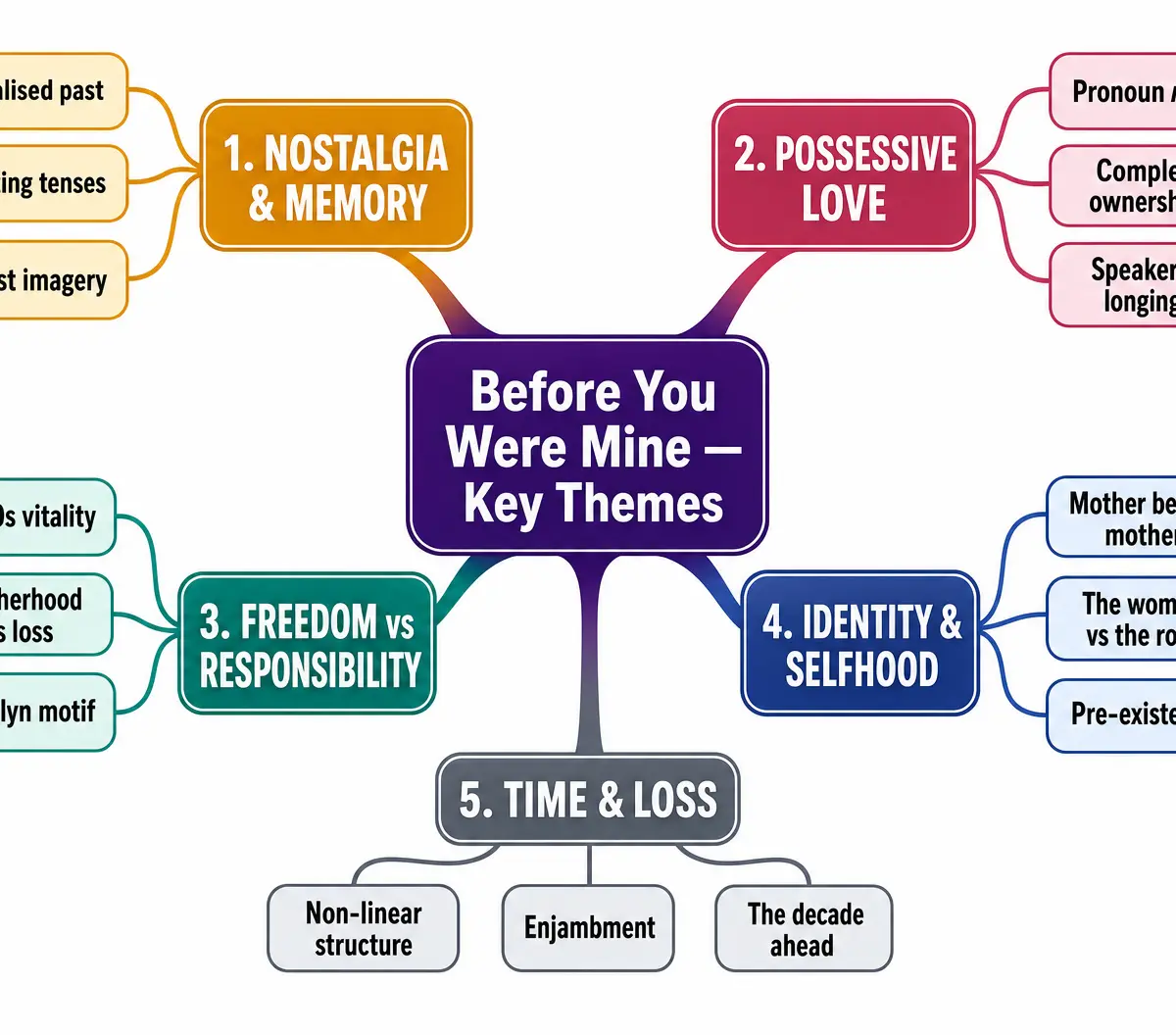
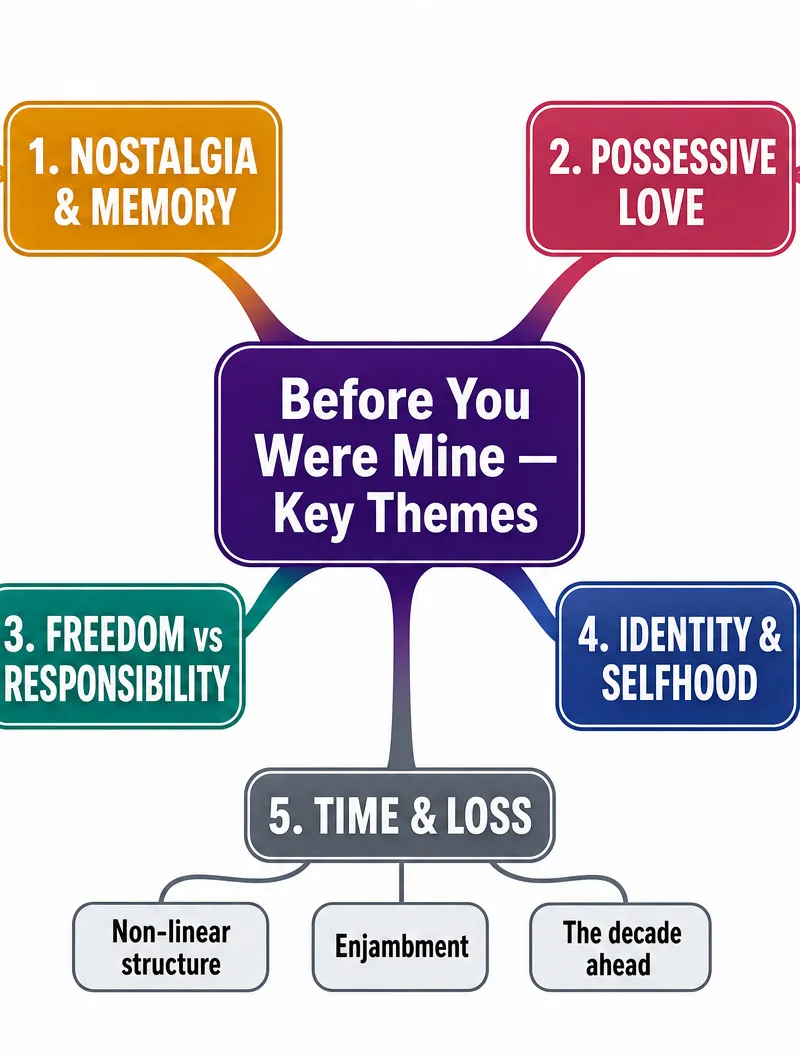
Theme 1: Nostalgia and Memory
Duffy constructs a vivid, almost dreamlike vision of the past, blending imagination with memory to recreate the mother's youth. The poem is steeped in nostalgia, but it is a complex, second-hand nostalgia for a time the speaker never actually experienced.
Key Quotes:
- "I'm not here yet. The thought of me doesn't occur" (Stanza 1) - Highlights the speaker's awareness of her absence in this idealized past.
- "I remember my hands in those high-heeled red shoes, relics" (Stanza 4) - The use of "relics" elevates the mother's past to something sacred and lost.
Theme 2: Possessive Love and Guilt
The title itself, 'Before You Were Mine', establishes a tone of ownership. The speaker's love is deeply possessive, tinged with a subtle guilt that her own existence ended the mother's carefree youth.
Key Quotes:
- "Before you were mine" (Title/Stanza 2) - The repetition of this phrase underscores the speaker's claim over her mother.
- "loud, possessive yell" (Stanza 3) - Directly acknowledges the demanding nature of the child's love, which disrupts the mother's freedom.
Theme 3: Freedom vs. Responsibility
The poem sharply contrasts the mother's vibrant, independent youth with the constraints of motherhood. The 1950s setting is crucial here, representing a brief window of freedom before the domestic expectations of the era took hold.
Key Quotes:
- "the fizzy, movie tomorrows" (Stanza 1) - Conveys the sparkling potential and excitement of the mother's youth.
- "You'd teach me the steps on the way home from Mass" (Stanza 4) - Shows the blending of the mother's fun-loving past (dancing) with her present domestic/religious duties.
Character Analysis
The Mother
Role: The central figure and subject of the speaker's intense focus and imagination.
Key Traits: Glamorous, vivacious, rebellious, and ultimately, sacrificed to motherhood.
Character Arc: Transitions from a carefree, Marilyn-esque figure of the 1950s to a mother whose past identity becomes a "ghost."
Essential Quotes: "Your polka-dot dress blows round your legs. Marilyn."; "whose small bites on your neck, sweetheart?"
The Speaker (Daughter)
Role: The observer and narrator, constructing her mother's past.
Key Traits: Possessive, observant, nostalgic, and subtly guilty.
Character Arc: Moves from imagining the past to acknowledging her role in ending it, culminating in a poignant acceptance of loss.
Essential Quotes: "I wanted the bold girl winking in Portobello"; "my loud, possessive yell."
Writer's Methods
Form and Structure:
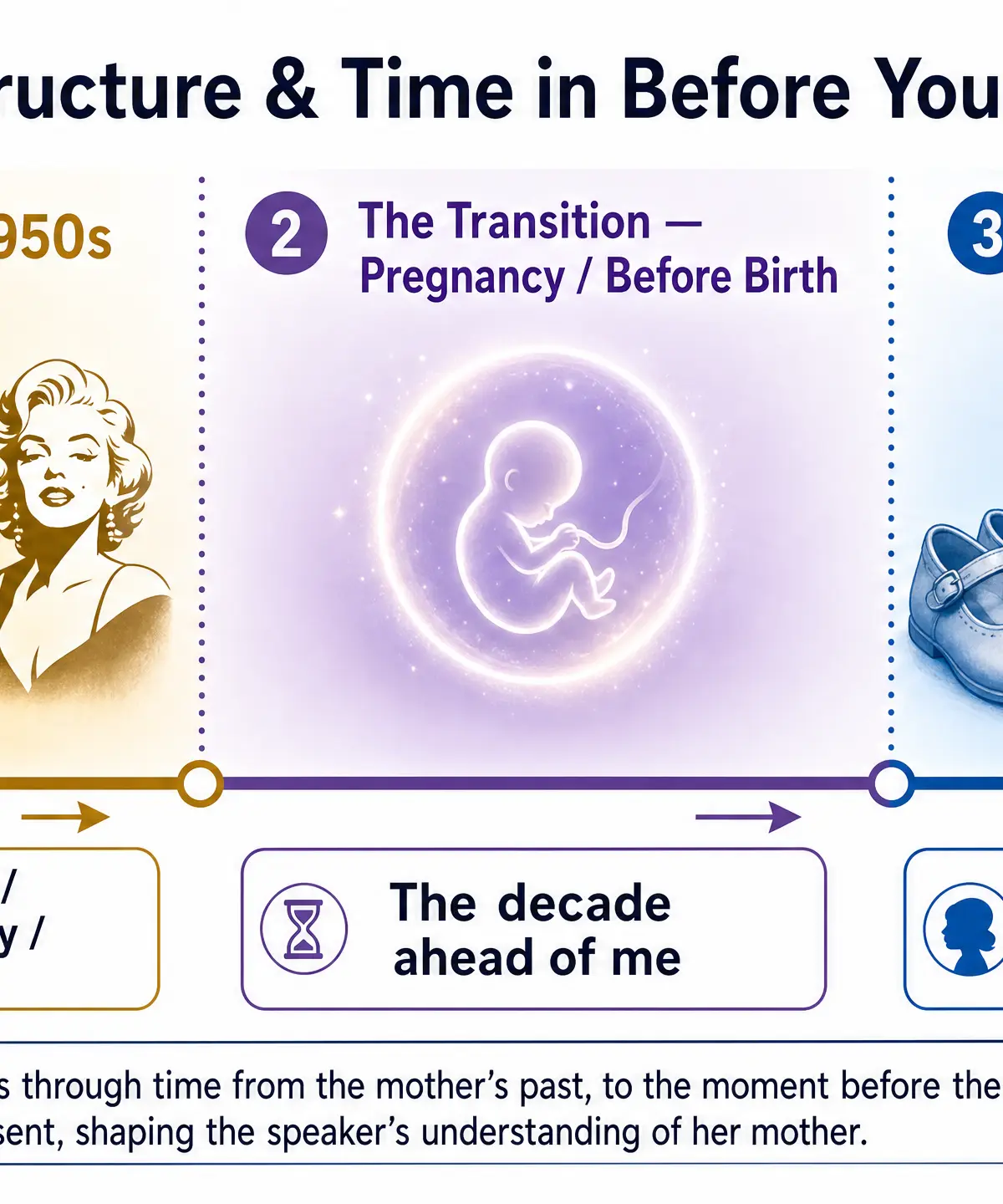
- Non-linear Time: Duffy masterfully shifts between past and present tenses, creating a fluid, cinematic quality that mirrors the nature of memory. The present tense ("Your polka-dot dress blows...") makes the past feel immediate and alive.
- Enjambment and Caesura: The frequent use of enjambment creates a conversational, intimate tone, as if the speaker is thinking aloud or talking directly to a photograph. Caesuras (e.g., ". Marilyn.") force the reader to pause and reflect on key images.
Language and Imagery:
- Colloquialisms: Phrases like "Maggie McGeeney" and "sweetheart" ground the poem in a specific, relatable reality, enhancing the intimacy of the address.
- Sensory Imagery: The poem is rich in sensory details—"fizzy, movie tomorrows," "high-heeled red shoes," "clatters"—which bring the mother's past vividly to life.
Context
1950s Post-War Britain: The poem is deeply rooted in the 1950s, a decade characterised by a sense of optimism and emerging youth culture (symbolised by Marilyn Monroe and dancing), but also by strict gender roles. Women were generally expected to marry and embrace domesticity, sacrificing personal freedom for family life. Understanding this tension is crucial for AO3 marks, as it explains the magnitude of the mother's sacrifice and the speaker's complex guilt.
Worked Examples
2 worked examples — open one to explore the question and available guidance.
Practice Questions
Try the question, then reveal an answer plan or example response
Compare how poets present complex family relationships in 'Before You Were Mine' and one other poem from your anthology.
Hint: Consider poems like 'Walking Away', 'Mother, any distance', or 'Follower' which also deal with the tension between parents and children, separation, and identity.
Explore how Duffy presents the theme of memory in 'Before You Were Mine'.
Hint: Focus heavily on AO2: how do the shifting tenses and vivid sensory imagery construct a memory of a time the speaker never actually lived through?
How does Duffy use the motif of Marilyn Monroe to convey her ideas about her mother?
Hint: Think about what Marilyn Monroe represents: glamour, beauty, but also tragedy and a life cut short.
Starting with the final stanza ('I remember my hands...'), explore how Duffy presents the passage of time.
Hint: Analyze the words 'relics' and 'ghost' in the extract, then link to how time is presented earlier in the poem (e.g., 'the decade ahead of me').
Exam technique
How to turn what you know into marks
How to approach the question
1. Highlight the command words and key themes in the question. 2. Select 3-4 key quotes from the poem that address the theme. 3. If comparative, select a poem with strong thematic links and identify 3-4 quotes from it. 4. Plan your paragraphs around points of comparison or thematic development.
How to structure your answer
Use integrated paragraphs: Start with a conceptual point -> Embed a quote -> Analyse the language/structure (AO2) -> Link to context (AO3) -> Connect to the question/other poem.
Timing
For a 30-mark poetry essay, spend 5 minutes planning, 40 minutes writing, and 5 minutes checking your work.
Common pitfalls
- Describing the speaker as simply 'selfish' without exploring the nuance of her possessive love.
- Treating the 1950s context as a bolt-on history lesson rather than explaining how it shapes the mother's identity.
- Spotting enjambment without explaining *why* it is used (e.g., to create a conversational tone or reflect the flow of memory).
What the command words want
- Compare
- Do not write two separate essays. Use comparative connectives (Similarly, Conversely) in every paragraph to evaluate both poems together.
- Explore
- Look at multiple angles. Explore language, structure, form, and context to provide a comprehensive analysis.
- How does the poet present...
- Focus heavily on AO2. Discuss *methods*—the specific choices the poet made to create meaning.
Test your understanding of Before You Were Mine
Active recall beats re-reading. Take an instant quiz now to test what you’ve learned and lock it into long-term memory.
7 days Premium · Then the free plan continues · No card, no charge