AQA · GCSE · English Literature
Course version: 8702 · Version from Sept 2015
Checking Out Me History
John Agard's 'Checking Out Me History' is a defiant, energetic reclamation of Caribbean heritage against a colonial education system. It's a fantastic poem to study because its bold use of Creole dialect and structural juxtaposition makes AO2 analysis straightforward, while its themes of identity and power offer deep, perceptive AO1 and AO3 discussions.
- 6 min read
- 2 worked examples
- 2 practice questions
- 8 key terms
Check what you remember
Read the wording for your board, then hide it and explain Creole Dialect in your own words. Rough notes are fine. This is a self-check, with no mark or grade.
Reference: AQA
A stable natural language developed from a mixture of different languages. Agard uses Caribbean Creole.
Study Notes
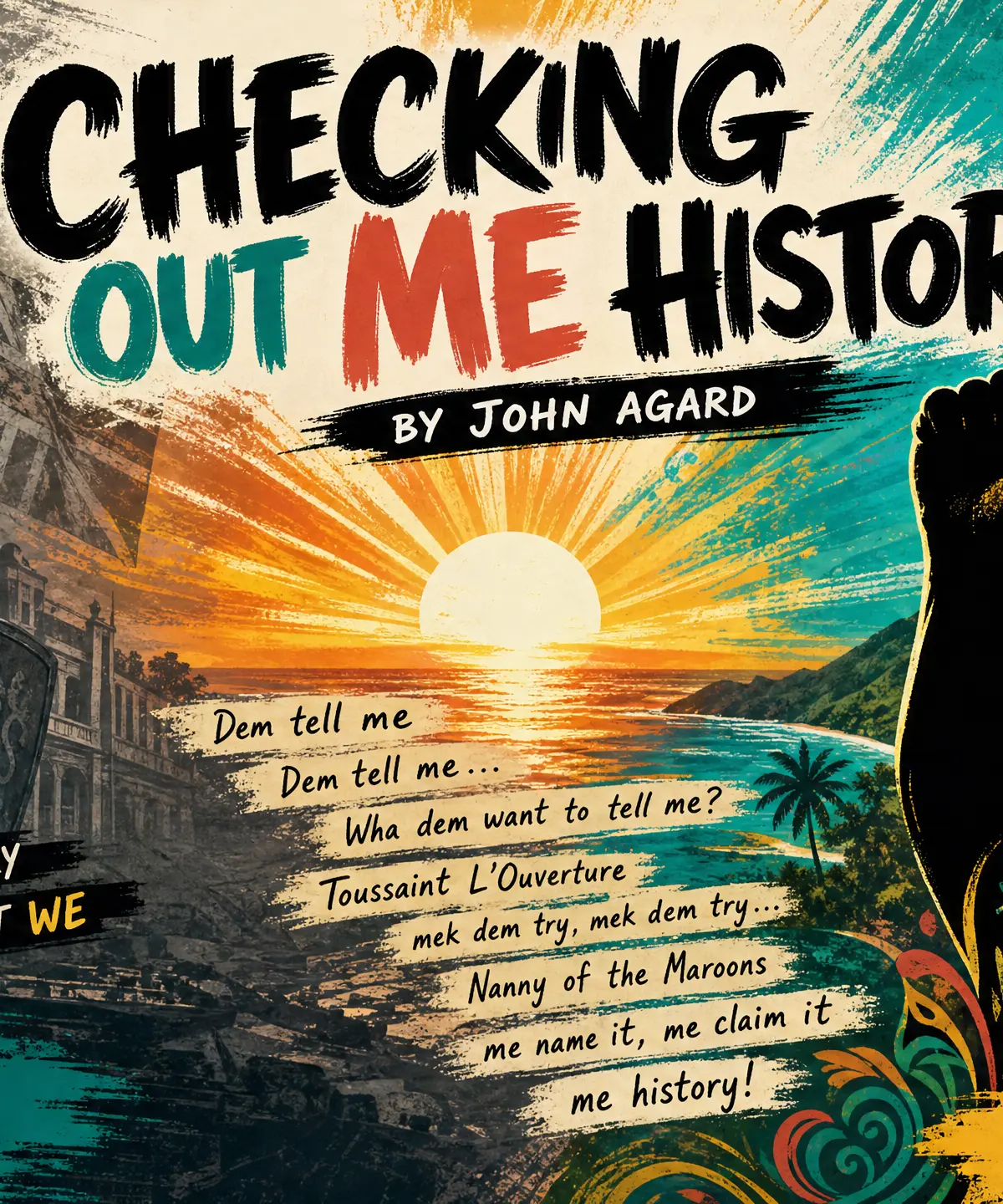
Overview
'Checking Out Me History' by John Agard is a powerful critique of the British education system and its erasure of black history. Written by a poet of the Windrush generation, it contrasts the trivial, Eurocentric figures taught in schools (like Dick Whittington) with the heroic, revolutionary figures of Caribbean history (like Toussaint L'Ouverture). Examiners look for candidates who can analyse Agard's deliberate use of Creole dialect and non-standard phonetic spelling not as errors, but as a political assertion of identity. Top-band responses will explore how the poem's structural shifts—from rigid, italicised stanzas to free-flowing, enjambed verse—enact the speaker's journey from indoctrination to self-determination.
Podcast Revision
Listen to our 10-minute deep dive into the poem, covering key themes, structural analysis, and exam tips:
Plot/Content Overview
The poem does not have a traditional narrative plot, but rather a thematic progression:
- The Accusation: The speaker begins by repeatedly stating "Dem tell me", establishing that his education has been controlled by others who "blind me to me own identity".
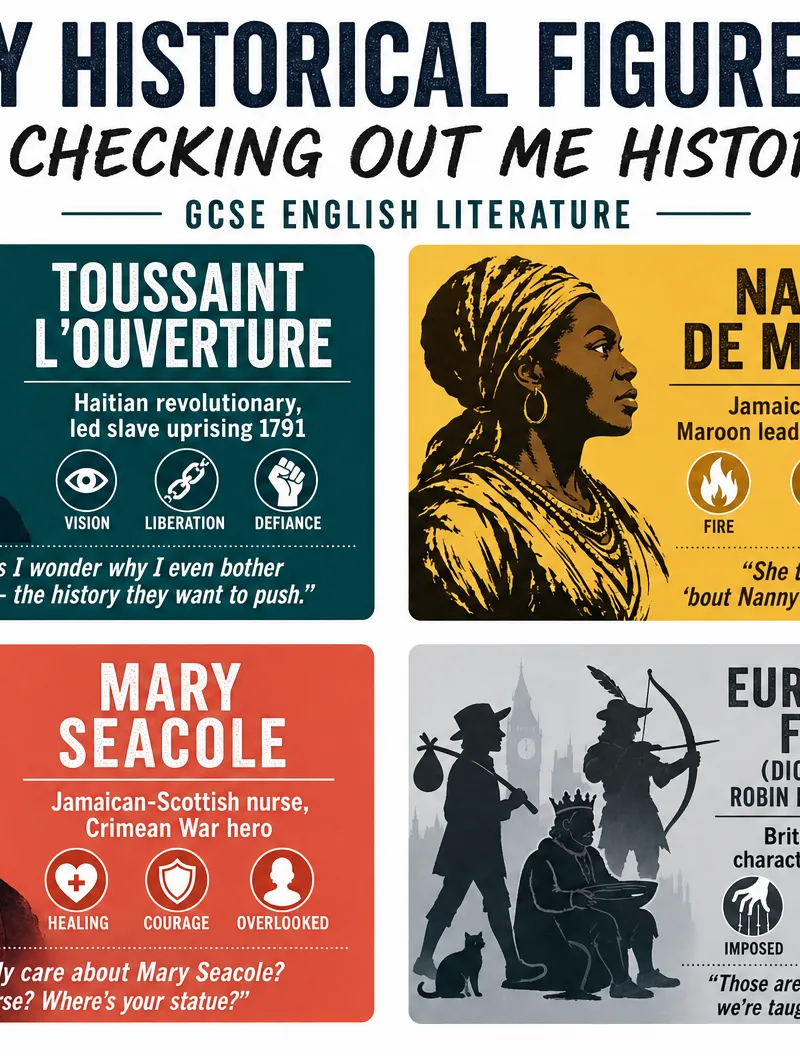
- The Contrast: He lists British historical and nursery rhyme figures (1066, Dick Whittington, Old King Cole) juxtaposed against significant black historical figures who were ignored (Toussaint L'Ouverture, Nanny de Maroon, Mary Seacole).
- The Reclamation: The poem concludes with the speaker actively rejecting this imposed history, stating "now I checking out me own history / I carving out me identity".
Themes
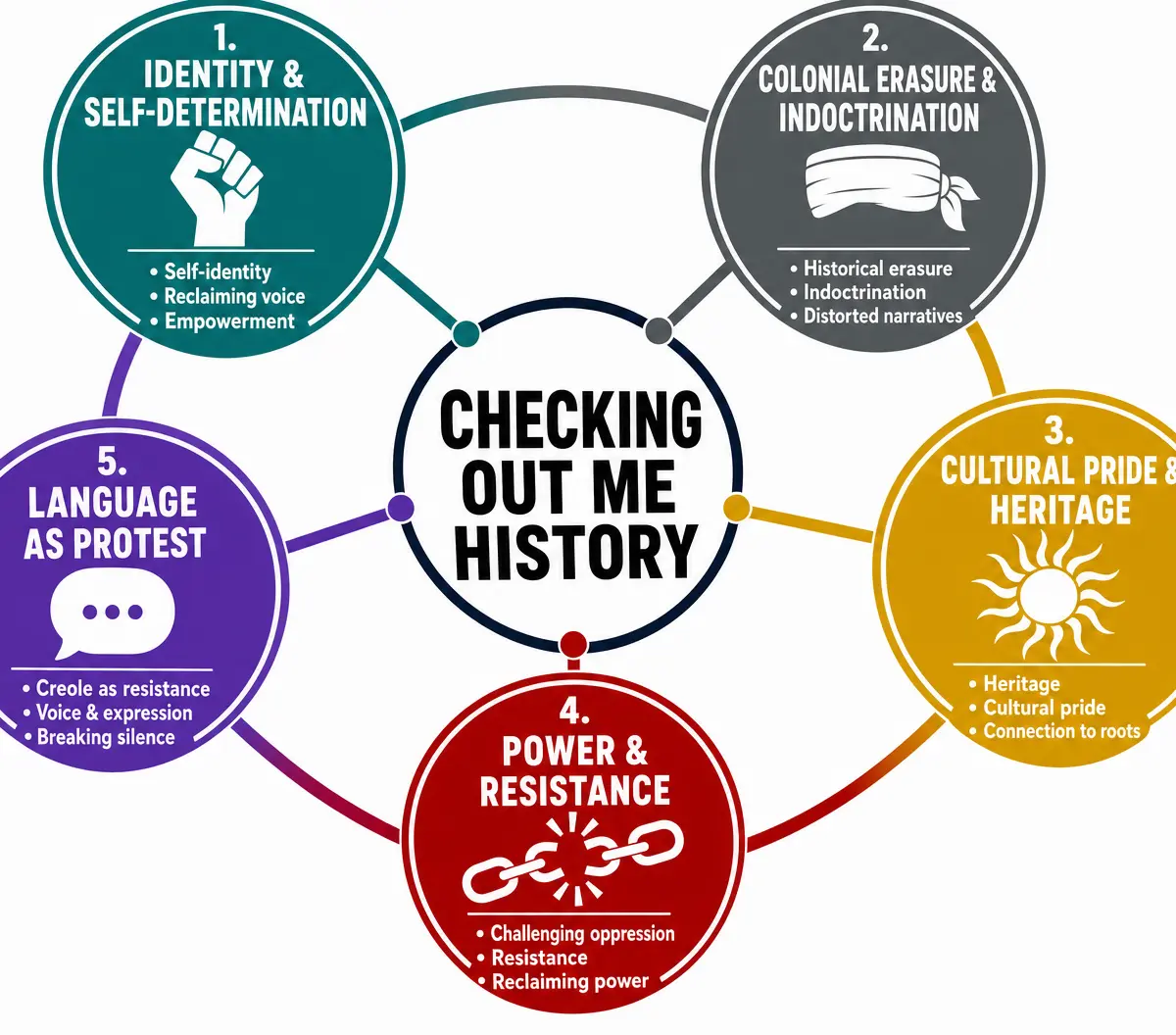
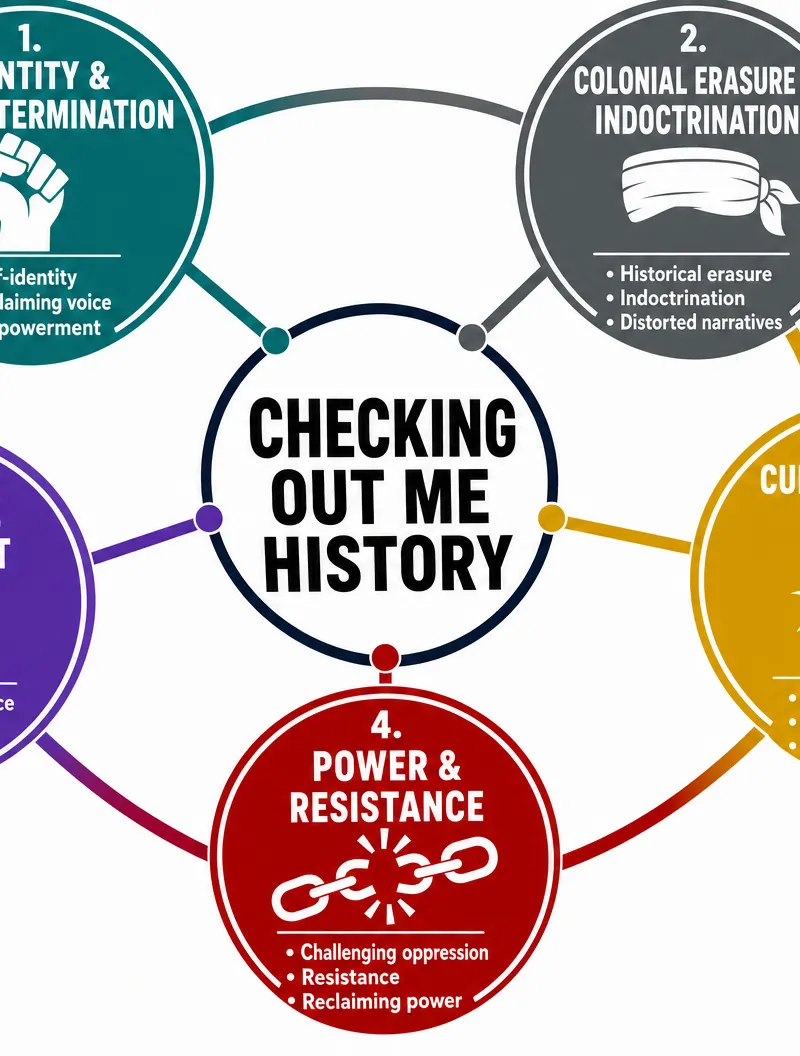
Theme 1: Identity and Self-Determination
The central conflict of the poem is the struggle to define oneself when one's history has been erased. Agard suggests that identity is inextricably linked to knowing your past.
Key Quotes:
- "Bandage up me eye with me own history / Blind me to me own identity" - The violent verbs "bandage" and "blind" suggest that the colonial education system actively harmed the speaker, preventing him from seeing his true self.
- "I carving out me identity" - The active verb "carving" implies that discovering one's identity requires hard, deliberate work; it is an active process of creation, not passive reception.
Theme 2: Colonial Erasure and Indoctrination
Agard critiques how the British education system prioritised white, Eurocentric narratives, reducing black history to non-existence.
Key Quotes:
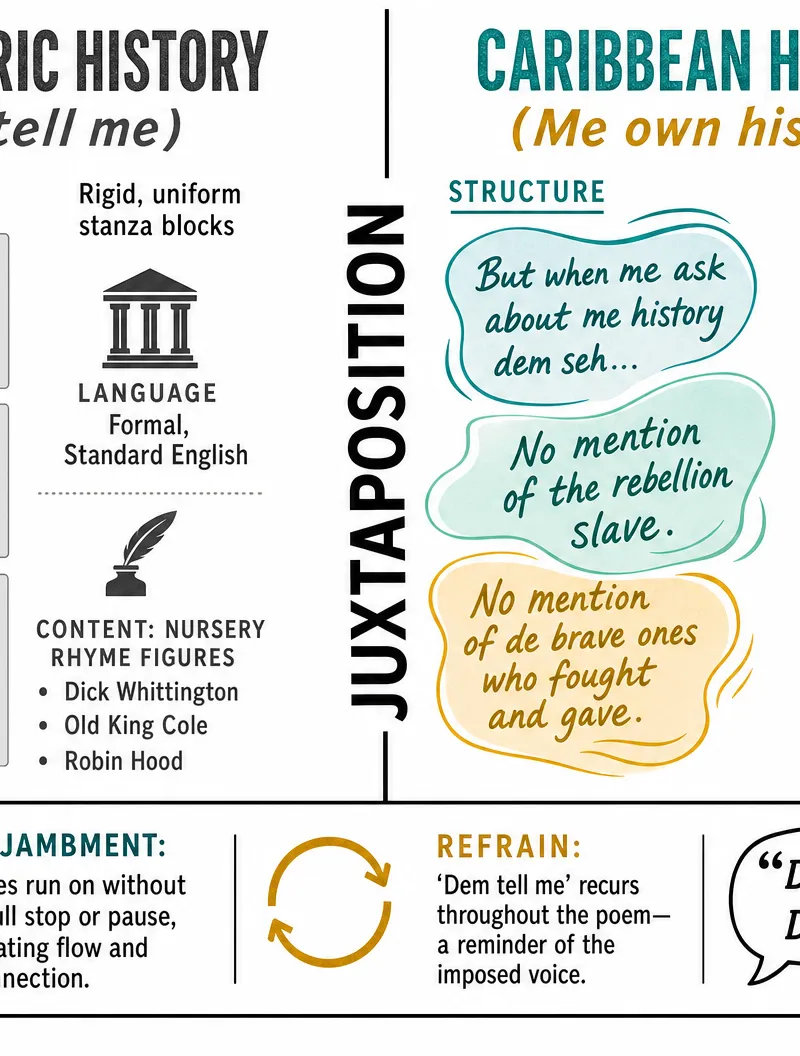
- "Dem tell me" - The repeated refrain highlights the passive role of the student and the imposition of a singular narrative by an unnamed, powerful authority ("Dem").
- "Robin Hood was a nobleman bold / But dem never tell me bout Nanny de maroon" - The juxtaposition of a fictional British myth with a real, powerful Jamaican historical figure highlights the absurdity and injustice of the curriculum.
Theme 3: Power and Resistance
The figures Agard chooses to celebrate are all individuals who resisted oppression or overcame immense obstacles, mirroring his own linguistic resistance in the poem.
Key Quotes:
- "Toussaint / a slave / with vision" - Agard reclaims Toussaint L'Ouverture not just as a historical fact, but as a symbol of visionary leadership and resistance against the odds.
- "a healing star / among the wounded / a yellow sunrise / to the dying" - The description of Mary Seacole uses natural, light-based imagery, contrasting with the "blindness" imposed by the British education system.
Character Analysis
While this is a poem rather than a play or novel, the historical figures function as characters representing different aspects of heritage.
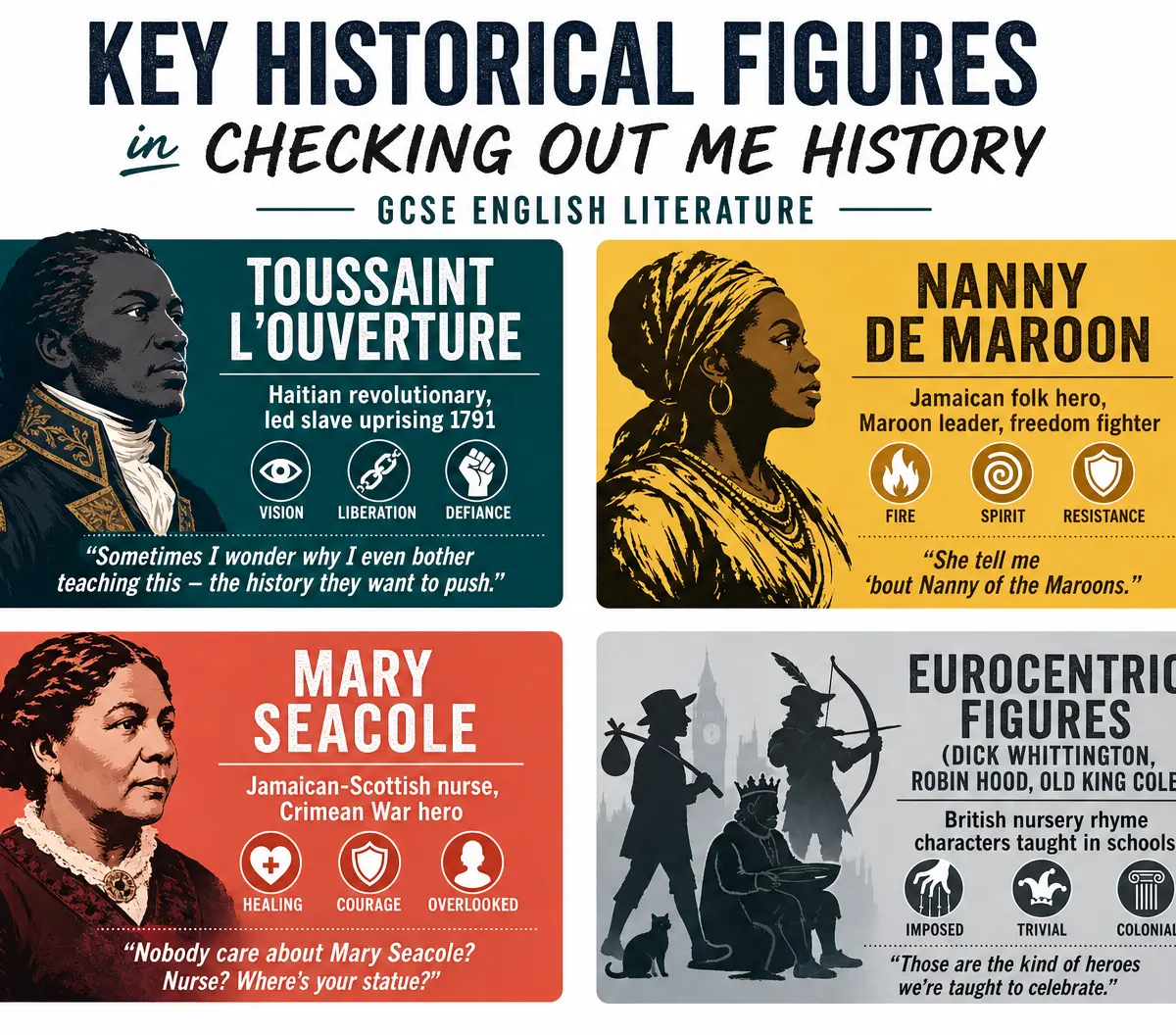
The Speaker (Agard's Persona)
Role: The voice of resistance and reclamation.
Key Traits: Defiant, culturally proud, transitioning from passive to active.
Character Arc: Moves from being a passive recipient of imposed history ("Dem tell me") to an active creator of his own identity ("I carving out me identity").
Essential Quotes:
- "Dem tell me"
- "I checking out me own history"
The Caribbean Figures
Role: Symbols of true history, resistance, and healing.
Key Traits: Visionary (Toussaint), spiritual and fierce (Nanny), nurturing and brave (Mary Seacole).
Essential Quotes:
- "Toussaint de beacon"
- "fire-woman struggle / hopeful stream" (Nanny)
- "healing star" (Mary Seacole)
Writer's Methods
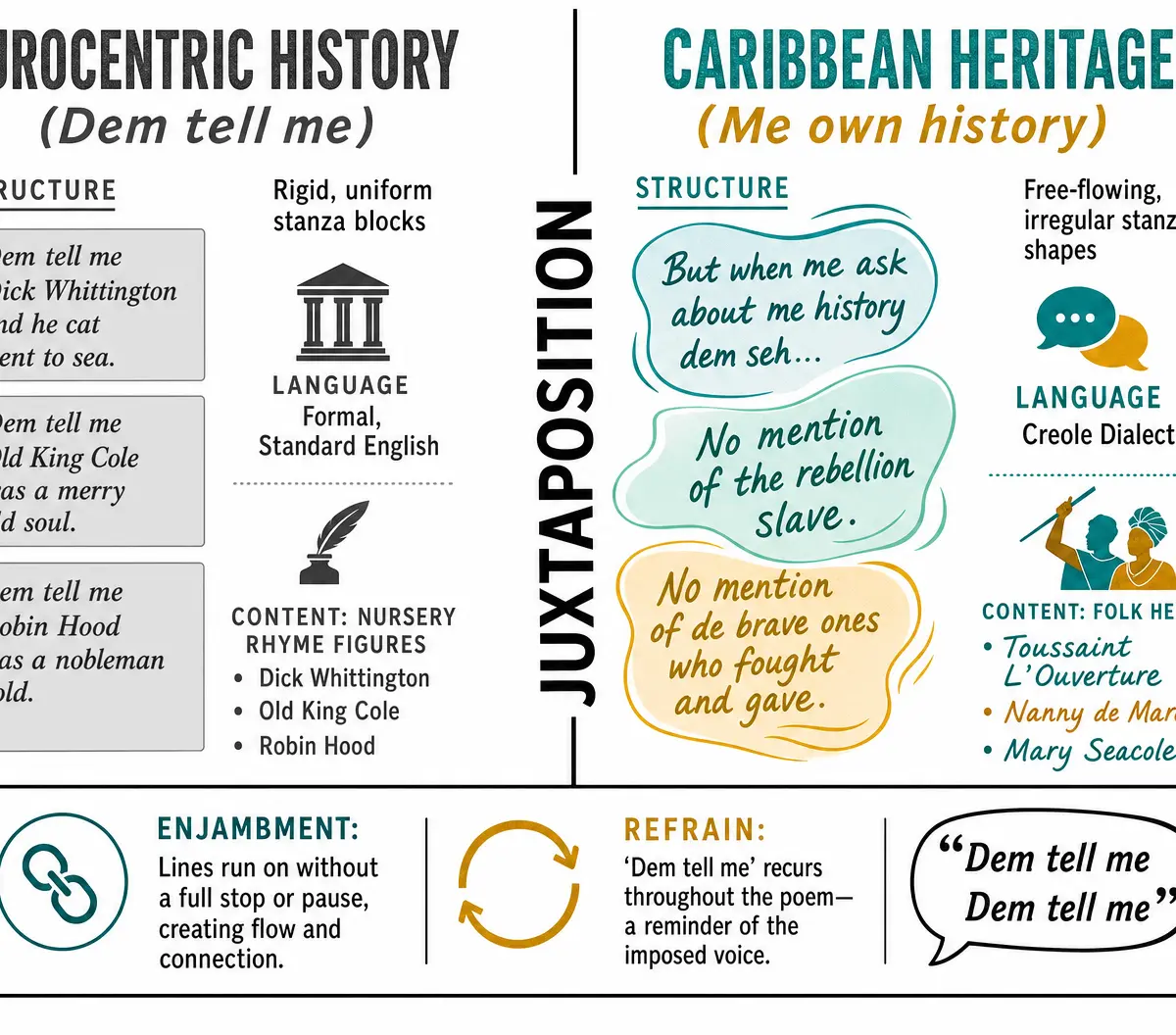
Language and Dialect
Agard's most significant method is his use of Creole dialect and phonetic spelling (e.g., "dem", "wha", "mek"). This is a deliberate political choice, a form of linguistic resistance against Standard English, which represents the coloniser. By forcing the reader to read in a Caribbean cadence, he asserts the validity and dignity of his cultural voice.
Form and Structure
The poem uses structural juxtaposition to separate the two histories. The Eurocentric history is presented in regular, rhyming, italicised stanzas—mimicking the rote learning of nursery rhymes. In contrast, the Caribbean history is presented in free-flowing, irregular stanzas with short lines and enjambment. This structural freedom reflects the vitality, reality, and uncontainable nature of the speaker's true heritage.
Metaphor and Imagery
Agard uses light and vision imagery throughout. The British system "blind[s]" and "bandage[s]" the speaker, whereas the Caribbean figures are associated with light: Toussaint is a "beacon", Nanny is a "see-far woman", and Mary Seacole is a "yellow sunrise". This creates a clear dichotomy between the darkness of ignorance/indoctrination and the light of historical truth.
Context
John Agard was born in Guyana (then British Guiana) in 1949 and moved to Britain in 1977. He is part of the Windrush generation. Growing up in a British colony, he was subjected to a curriculum designed in London, which taught British history and literature while ignoring the rich history of the Caribbean. The poem was published in 2004 in the collection Half-Caste and Other Poems. Understanding this context is crucial for AO3: examiners expect you to link Agard's personal experience of colonial education to the poem's themes of erasure and linguistic rebellion.
Visual Resources
3 diagrams and illustrations
Interactive Diagrams
1 interactive diagram to visualise key concepts
Conceptual Flow Outline
The Speaker's Journey of Reclamation
Worked Examples
2 worked examples — open one to explore the question and available guidance.
Practice Questions
Try the question, then reveal an answer plan or example response
How does Agard use language and structure to present the power of history in 'Checking Out Me History'? (30 marks)
Hint: Consider how the structure on the page separates the two types of history, and how the use of Creole dialect reclaims power.
Compare how poets present the effects of conflict on identity in 'Checking Out Me History' and 'Kamikaze'. (30 marks)
Hint: Agard deals with cultural conflict and colonial erasure, while Garland deals with internal conflict and national expectations.
Exam technique
How to turn what you know into marks
How to approach the question
Underline the theme in the question. Quickly list 3 methods Agard uses to present that theme. If it's a comparison question, choose a poem that offers a clear similarity or difference in approach.
How to structure your answer
Use comparative PEAL paragraphs if comparing: Point (connecting both poems) -> Evidence & Analysis Poem 1 -> Comparative Connective -> Evidence & Analysis Poem 2 -> Link to Context.
Timing
For a 30-mark poetry essay, spend 5 minutes planning and selecting quotes, and 40 minutes writing.
Common pitfalls
- Calling the phonetic spelling 'bad English' or 'slang' instead of 'Creole dialect' or 'non-standard English'.
- Summarising the lives of Toussaint, Nanny, and Mary Seacole instead of analysing the poetic methods Agard uses to describe them.
- Ignoring the structural layout of the poem on the page, which is crucial to its meaning.
What the command words want
- Compare
- You must write about both poems in every paragraph. Use words like 'Similarly', 'Conversely', 'Whereas', 'In a similar vein'.
- How does the poet present...
- Focus heavily on AO2. You must discuss language choices, structural shifts, and form. Do not just explain what the poem is about.
Watch or listen (optional)
Test your understanding of Checking Out Me History
Active recall beats re-reading. Take an instant quiz now to test what you’ve learned and lock it into long-term memory.
7 days Premium · Then the free plan continues · No card, no charge