AQA · GCSE · English Literature
Course version: 8702 · Version from Sept 2015
Jane Eyre
Jane Eyre is a powerful Bildungsroman exploring one woman's journey from a powerless orphan to an independent equal. Studying it rewards close analysis of Gothic elements, a strong understanding of Victorian social constraints, and the tension between passion and moral duty.
- 8 min read
- 2 worked examples
- 4 practice questions
- 8 key terms
Try the lesson
The start of the Jane Eyre lesson, made from checked teaching notes for this specification point.
Have a go first
In Jane Eyre, where does Jane spend her childhood before she goes to Lowood School?
Listen
Charlotte Brontë's Jane Eyre (1847) is a Bildungsroman told from Jane's first-person perspective. The novel charts her journey from an oppressed orphan at Gateshead and Lowood School to her role as a governess at Thornfield Hall, where she falls for her mysterious employer, Mr Rochester. Brontë explores themes of social class, gender inequality, religion, and the quest for independence and love. The novel blends realism with Gothic elements, such as the mysterious secrets of Thornfield and the 'madwoman in the attic', to create suspense and explore psychological states. Assessment requires analysis of an extract and the whole novel.
There is more to this lesson
The full lesson goes on to check your understanding and help you earn the marks. Create a free account to carry on, with your progress saved.
7 days Premium · Then the free plan continues · No card, no charge
Check what you remember
Read the wording for your board, then hide it and explain Bildungsroman in your own words. Rough notes are fine. This is a self-check, with no mark or grade.
Reference: AQA
A novel dealing with one person's formative years or spiritual education.
Study Notes
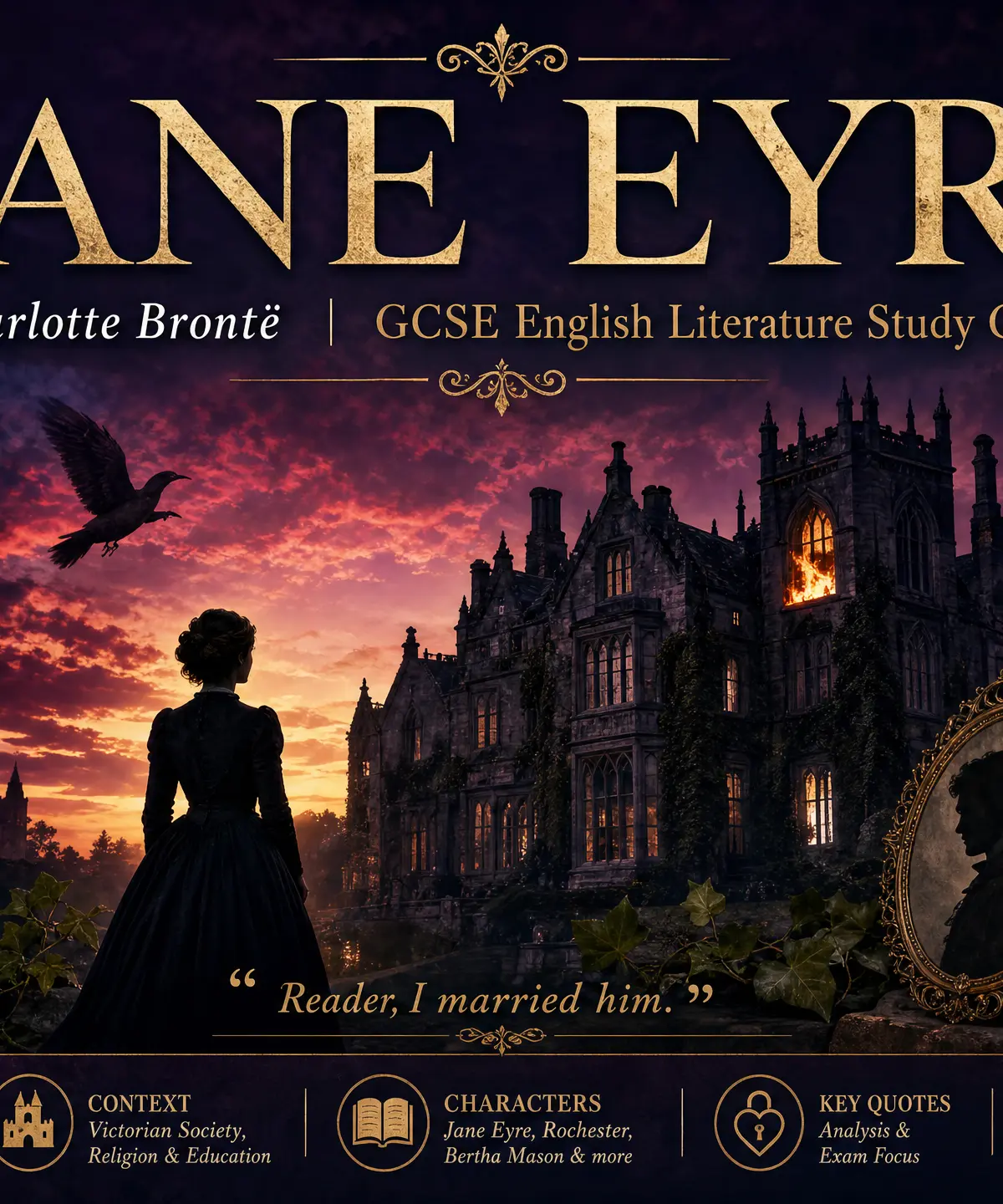
Overview
Charlotte Brontë's 'Jane Eyre' (1847) is a seminal Victorian text that combines elements of the Gothic, the Bildungsroman (coming-of-age novel), and social realism. It traces the psychological and moral development of its eponymous protagonist. Examiners look for candidates who can analyze Brontë's use of the retrospective first-person narrative voice, her symbolic use of settings (like Gateshead, Lowood, and Thornfield), and her critique of Victorian social norms regarding gender, class, and religion. High-level responses will seamlessly integrate context—such as the precarious position of the governess and contemporary debates on female autonomy—with close analysis of Brontë's language and structure.
Plot/Content Overview
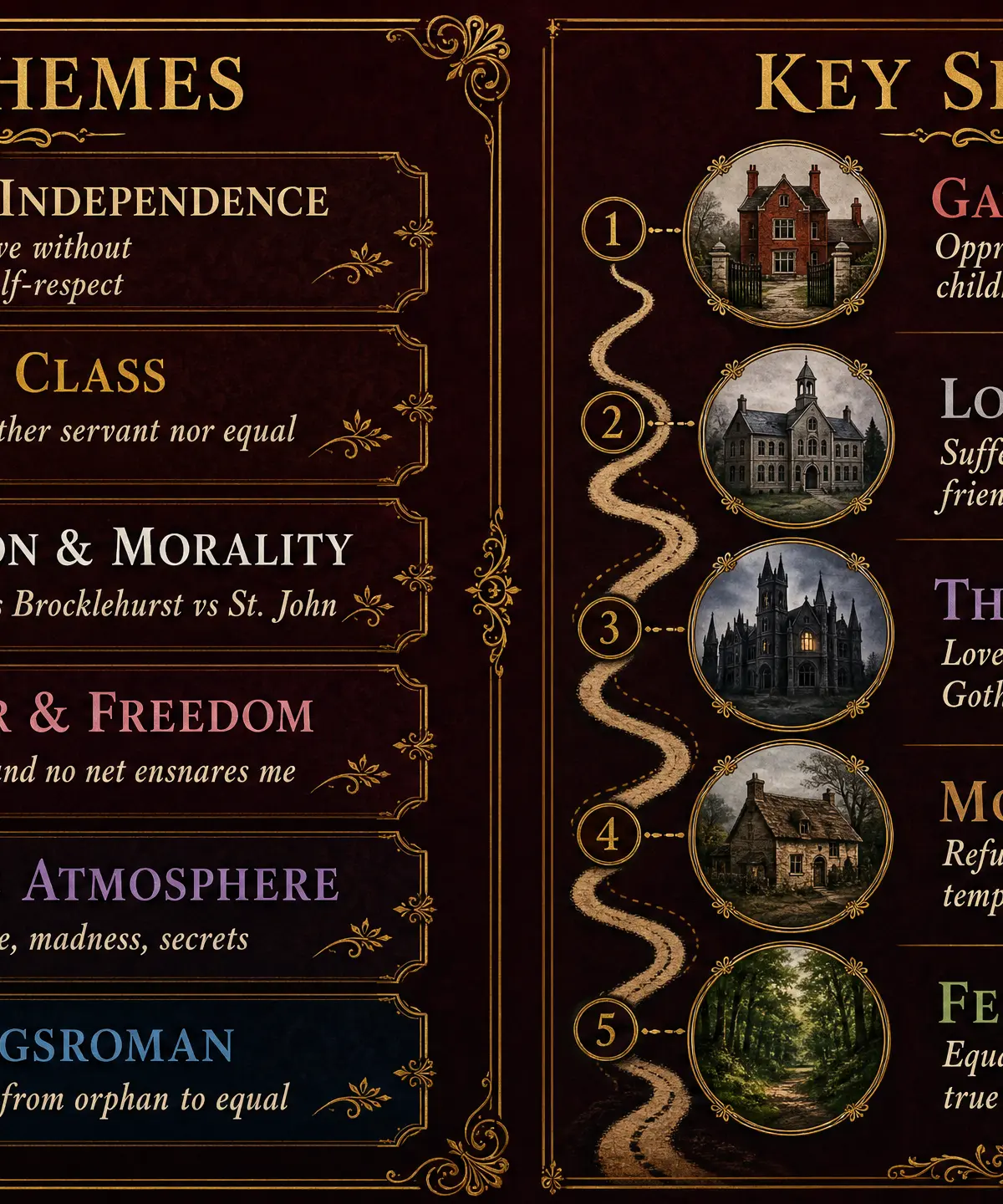
- Gateshead Hall: The orphaned Jane suffers abuse from her cruel aunt, Mrs. Reed, and cousin John. She is unjustly locked in the terrifying 'red-room', a traumatic event that shapes her fierce sense of injustice.
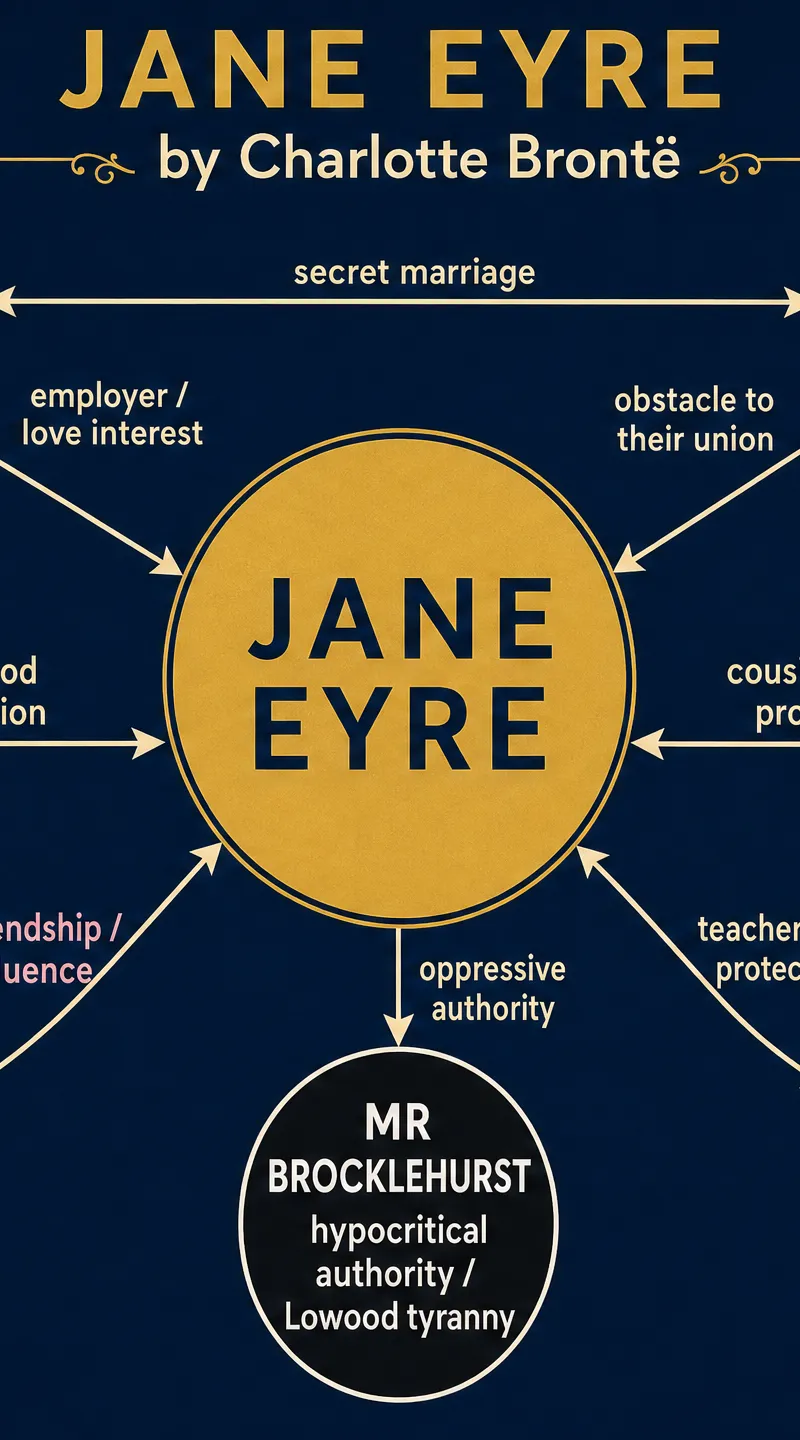
- Lowood School: Jane is sent to a charity school run by the hypocritical Mr. Brocklehurst. Despite the harsh conditions and the tragic death of her friend Helen Burns, Jane gains an education and learns emotional resilience.
- Thornfield Hall: Jane becomes a governess and falls in love with her employer, the brooding Edward Rochester. Their wedding is halted when it is revealed Rochester is already married to Bertha Mason, who is kept hidden in the attic.
- Moor House: Fleeing Thornfield to preserve her moral integrity, Jane is taken in by the Rivers family (who turn out to be her cousins). She inherits a fortune and rejects St. John Rivers' loveless proposal to become a missionary.
- Ferndean: Jane returns to Rochester, who has been blinded and maimed in a fire set by Bertha (who died in the blaze). Now his equal in wealth and independence, they marry.
Themes
Theme 1: Love and Independence
Jane's central conflict is finding a balance between her deep need for love and her fierce desire for independence. She refuses to compromise her self-respect for affection. When she discovers Bertha, she leaves Rochester, demonstrating that her moral integrity outweighs her passion.
Key Quotes:
- "I am no bird; and no net ensnares me: I am a free human being with an independent will." (Chapter 23) - Brontë uses the bird metaphor and the emphatic repetition of "no" to assert Jane's refusal to be caged by social expectation or dominant male figures.
- "I care for myself. The more solitary, the more friendless, the more unsustained I am, the more I will respect myself." (Chapter 27) - The syntactic parallelism highlights Jane's stoic self-reliance and moral fortitude.
Theme 2: Social Class and Gender
As a governess, Jane occupies a liminal space: educated but poor, a lady but an employee. Brontë critiques the rigid Victorian class system and the limited options available to women, using Jane's journey to advocate for equality based on intellect and spirit rather than wealth or gender.
Key Quotes:
- "Do you think, because I am poor, obscure, plain, and little, I am soulless and heartless? You think wrong!" (Chapter 23) - The listing of her supposed deficits contrasts with the power of her assertion, demanding equality of the soul.
- "Women are supposed to be very calm generally: but women feel just as men feel." (Chapter 12) - A direct challenge to Victorian gender norms, expressing the repressed desires of women.
Theme 3: Religion and Morality
Brontë presents three contrasting models of religion: the hypocritical, punitive Evangelicalism of Mr. Brocklehurst; the passive, self-sacrificing endurance of Helen Burns; and the cold, ambitious duty of St. John Rivers. Jane rejects all three, forging her own balanced, personal spirituality that accommodates both passion and morality.
Key Quotes:
- "It is not violence that best overcomes hate—nor vengeance that most certainly heals injury." (Chapter 6) - Helen Burns' philosophy of Christian forgiveness, which influences Jane but which she cannot entirely adopt.
- "God and nature intended you for a missionary's wife. It is not personal, but mental endowments they have given you." (Chapter 34) - St. John Rivers' utilitarian view of religion, which threatens to extinguish Jane's passion.
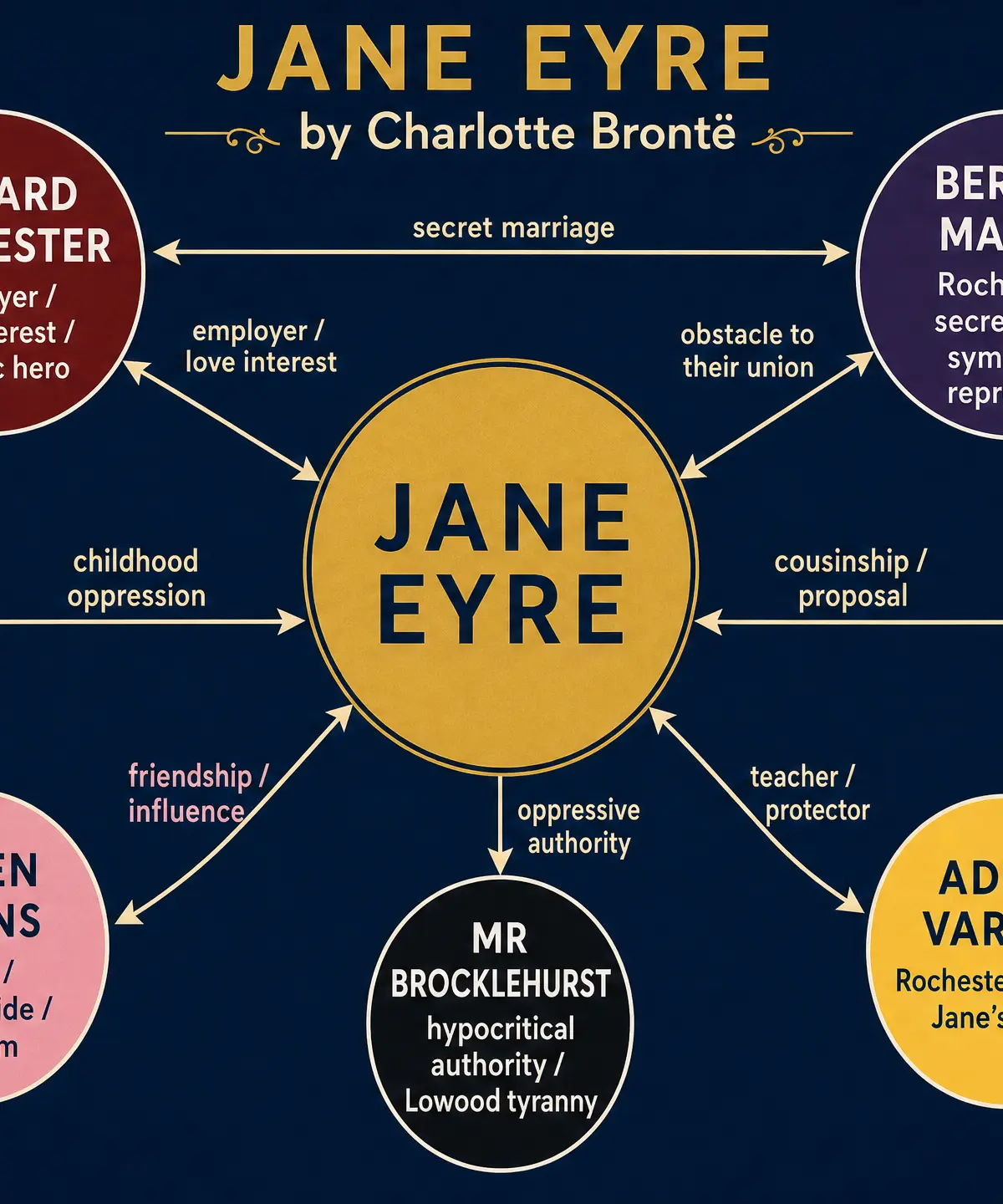
Character Analysis
Jane Eyre
Role: Protagonist and retrospective narrator.
Key Traits: Passionate, principled, independent, plain but intellectually fierce.
Character Arc: Evolves from a powerless, angry child at Gateshead to an independent, wealthy, and morally mature woman at Ferndean who can marry Rochester as an equal.
Essential Quotes:
- "I am a free human being with an independent will."
- "Reader, I married him."
Edward Rochester
Role: Jane's employer and love interest; the quintessential Byronic hero.
Key Traits: Brooding, passionate, morally ambiguous, physically imposing but not conventionally handsome.
Character Arc: Moves from arrogant entitlement and deception to physical humbling and spiritual redemption, allowing for an equal marriage with Jane.
Essential Quotes:
- "I have a right to get pleasure out of life: and I will get it, cost what it may."
- "I am no better than the old lightning-struck chestnut-tree in Thornfield orchard."
Bertha Mason
Role: Rochester's secret Creole wife; the 'madwoman in the attic'.
Key Traits: Violent, animalistic, passionate, silenced.
Character Arc: A static character in the plot, but symbolically acts as Jane's 'dark double', expressing the rage and sexual passion that Victorian society forces Jane to repress. Her death by fire clears the path for Jane.
Essential Quotes:
- "What it was, whether beast or human being, one could not, at first sight, tell: it grovelled, seemingly, on all fours; it snatched and growled like some strange wild animal."
Writer's Methods
- Narrative Voice: Brontë uses a first-person retrospective narrative. The older, wiser Jane narrates her past, allowing for dramatic irony and reflective commentary. The direct address ("Reader, I married him") creates intimacy.
- Gothic Elements: Brontë utilizes Gothic tropes (the spooky Thornfield Hall, mysterious laughs, prophetic dreams, the 'madwoman') to externalize internal psychological states and critique female repression.
- Symbolism:
- Fire and Ice: Fire represents passion, vitality, and danger (Rochester, Bertha, Jane's anger). Ice represents emotional repression, duty, and death (Lowood, St. John Rivers).
- The Red-Room: Symbolizes unjust imprisonment and the patriarchal forces that attempt to confine female passion.
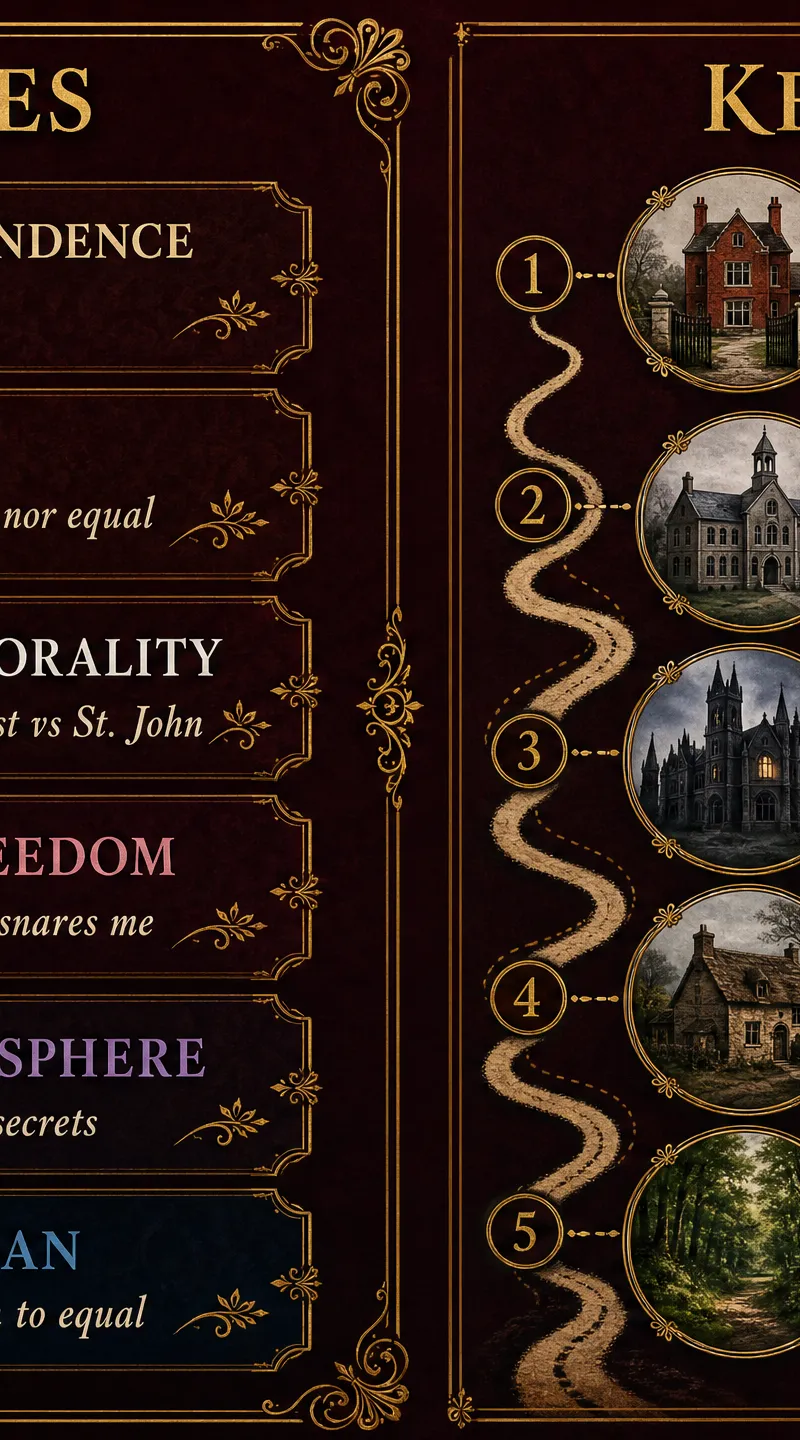
- Structure: The novel is structured in five distinct stages (Gateshead, Lowood, Thornfield, Moor House, Ferndean), mirroring a Bildungsroman journey of moral and psychological growth.
Context
- The Governess: In Victorian society, the governess was a figure of social anxiety—a middle-class woman forced to work, placing her awkwardly between the family and the servants.
- Gender Roles: The concept of the 'Angel in the House' dictated that women should be passive, domestic, and submissive. Jane's assertion of equality and passion was deeply radical and controversial at the time of publication.
- Empire and Race: Bertha Mason is a white Creole woman from Jamaica. Postcolonial readings (like Jean Rhys's Wide Sargasso Sea) highlight how Bertha represents the exploitation of the colonies to fund British wealth (Rochester married her for her £30,000).
- Religion: The 19th century saw intense religious debate. Brontë critiques the harsh Evangelicalism of her time (Brocklehurst is based on William Carus Wilson of the Cowan Bridge School, which Brontë attended).
Listen to our 10-minute revision podcast for a deep dive into themes, methods, and exam strategy!
Visual Resources
2 diagrams and illustrations
Interactive Diagrams
1 interactive diagram to visualise key concepts
Conceptual Flow Outline
The Five-Stage Bildungsroman Structure of Jane Eyre
Worked Examples
2 worked examples — open one to explore the question and available guidance.
Practice Questions
Try the question, then reveal an answer plan or example response
Starting with this extract (the red-room scene in Chapter 2), explore how Brontë presents the theme of childhood suffering. Write about how childhood suffering is presented in the extract and in the novel as a whole.
This prompt needs an extract from your set text. Use the extract provided by your teacher or exam paper; this question card does not include one.
Hint: Link the physical imprisonment in the red-room to the emotional and social imprisonment Jane feels. Compare Gateshead to Lowood.
How does Brontë present the character of St. John Rivers and his significance in the novel?
Hint: St. John is the foil to Rochester. Think about the symbolism of ice vs. fire, and duty vs. passion.
Explore how Brontë presents the importance of social class in Jane Eyre.
Hint: Focus on Jane's status as a governess and how money changes her relationship with Rochester.
How does Brontë use settings to reflect Jane's state of mind?
Hint: Use the five stages of the novel. Settings are psychological landscapes, not just backdrops.
Exam technique
How to turn what you know into marks
How to approach the question
Underline the key theme/character in the question. Select 3-4 key moments from across the whole text that show development. Ensure at least one point is based on the provided extract.
How to structure your answer
Use a conceptualised thesis statement. Then write 4-5 paragraphs using: Point (Argument) -> Evidence (Embedded quote) -> Analysis (Zoom in on language/methods) -> Context (Why Brontë wrote it this way).
Timing
For a 30+4 mark question, spend 5 minutes planning, 40 minutes writing, and 5 minutes proofreading for SPaG.
Common pitfalls
- Retelling the plot instead of analysing methods.
- Writing a 'history essay' paragraph about Victorian society that doesn't link to a quote.
- Ignoring the ending of the novel (Ferndean) when discussing character arcs.
What the command words want
- How does Brontë present...
- Focus heavily on AO2. Use phrases like 'Brontë constructs', 'The writer utilizes', 'Through the motif of...'
- Starting with this extract...
- Ensure a 50/50 balance. Use the extract as a springboard to discuss the wider text. Always link back to the core question.
Test your understanding of Jane Eyre
Active recall beats re-reading. Take an instant quiz now to test what you’ve learned and lock it into long-term memory.
7 days Premium · Then the free plan continues · No card, no charge