AQA · GCSE · English Literature
Course version: 8702 · Version from Sept 2015
Poetry anthology: Power and Conflict: Extract from ‘The Prelude’
This extract from Wordsworth's autobiographical poem explores a pivotal childhood memory where the speaker's youthful arrogance is confronted by the terrifying power of nature.
Checked against the AQA 8702 specification (opens in a new tab) on .
- Point 4 of 15
- 4 key terms
Study notes
From the checked teaching notes for this specification point.
The idea
This extract from Wordsworth's autobiographical poem explores a pivotal childhood memory where the speaker's youthful arrogance is confronted by the terrifying power of nature. After stealing a boat, the speaker's initial pleasure and sense of mastery are shattered by the sudden appearance of a vast, menacing mountain peak. This encounter with the sublime—a force both beautiful and terrifying—induces a profound sense of fear and insignificance. The experience leaves a lasting psychological mark, transforming his understanding of the world and teaching him a humbling lesson about the true scale of power. The poem presents nature as a formidable force that can shape human consciousness and morality, though the mountain is not literally a living entity; the speaker's personification of it as a pursuing figure reflects his own terror rather than any literal animation.
What earns the marks
- AO1: Select precise, short quotations to support your interpretation of the speaker's changing emotions, from arrogance to terror.
- AO1: Explain how the poem's narrative structure charts a clear psychological journey from innocence to a more troubled experience.
- AO1: When comparing, focus on the specific ways nature is presented as powerful in both poems, rather than just stating that it is.
- AO2: Analyse how the use of blank verse and enjambment creates a conversational yet serious tone, reflecting the flow of memory.
- AO2: Explore the effect of personification in transforming the mountain from a geographical feature into a monstrous, conscious being.
- AO2: Comment on the shift in language from the graceful and elegant ('elfin pinnace') to the simple and visceral ('huge peak, black and huge').
- AO3: Link the poem's depiction of nature to the Romantic concept of the 'sublime' – an experience of awe, terror, and wonder in the face of nature's grandeur.
- AO3: Consider how the poem reflects the Romantic belief in the importance of childhood experiences in shaping adult identity and morality.
- AO3: Explain that 'The Prelude' is an autobiographical poem, and this extract is Wordsworth reflecting on a real event from his own past to make a wider point.
Common mistakes and how to put them right
The poem is just about a boy being scared of a mountain.
Put it right: The poem uses this specific event to explore a much bigger idea: the humbling of human pride by the immense power of the natural world. It's a spiritual and psychological turning point, not just a scary story.
Wordsworth is the speaker, so I should just write 'Wordsworth feels...'.
Put it right: While the poem is autobiographical, it is good practice to refer to 'the speaker'. This maintains a critical distance and shows you understand the difference between a writer and the narrative voice they create, even when they are closely linked.
The poem is written in one long stanza because Wordsworth didn't know how to use paragraphs.
Put it right: The single, unbroken verse paragraph is a deliberate structural choice. It mirrors the continuous, overwhelming flow of the memory and the speaker's breathless emotional state, immersing the reader in the experience without a break.
Exam tips
- Compare with Ozymandias: The power of nature to overcome human pride and power. Difference: In 'The Prelude', nature's power is presented as a direct, living and terrifying force that actively confronts the speaker in a single moment. In 'Ozymandias', nature's power is an indifferent, erosive force that works over a vast timescale to destroy a human monument. Useful when: How poets present nature as more powerful than humanity.
- Compare with Storm on the Island: A direct confrontation between humanity and the power of nature. Difference: The speaker in 'Storm on the Island' begins with a sense of collective confidence ('We are prepared') which is then tested, whereas the speaker in 'The Prelude' is a lone individual whose personal confidence is quickly shattered. The fear in 'Storm' is a shared experience, while in 'The Prelude' it is a solitary, psychological one. Useful when: How poets explore feelings of fear in the face of nature.
- Compare with Kamikaze: The influence of a powerful, life-changing memory connected to nature. Difference: The memory in 'The Prelude' is of nature's terrifying power, leading to a profound but internal transformation for the speaker. In 'Kamikaze', the pilot's memory of nature's beauty leads to a decision that results in his social and familial death, an external consequence. Useful when: How poets present the lasting impact of a single experience.
- Compare with Remains: The lasting psychological trauma and haunting memories of a single event. Difference: The trauma in 'The Prelude' is caused by an encounter with the natural world, leading to a sense of awe and introspection. The trauma in 'Remains' is caused by an act of human violence in war, leading to PTSD and guilt that is destructive rather than educational. Useful when: How poets explore the way memory can haunt an individual.
Try the lesson
The start of the Poetry anthology: Power and Conflict: Extract from ‘The Prelude’ lesson, made from checked teaching notes for this specification point.
Have a go first
In the extract from 'The Prelude', which word does Wordsworth repeat to emphasise the enormous size of the mountain peak?
Listen
This extract from Wordsworth's autobiographical poem explores a pivotal childhood memory where the speaker's youthful arrogance is confronted by the terrifying power of nature. After stealing a boat, the speaker's initial pleasure and sense of mastery are shattered by the sudden appearance of a vast, menacing mountain peak. This encounter with the sublime—a force both beautiful and terrifying—induces a profound sense of fear and insignificance. The experience leaves a lasting psychological mark, transforming his understanding of the world and teaching him a humbling lesson about the true scale of power. The poem presents nature as a formidable force that can shape human consciousness and morality, though the mountain is not literally a living entity; the speaker's personification of it as a pursuing figure reflects his own terror rather than any literal animation. A strong answer earns marks for these points. Select precise, short quotations to support your interpretation of the speaker's changing emotions, from arrogance to terror. Explain how the poem's narrative structure charts a clear psychological journey from innocence to a more troubled experience. When comparing, focus on the specific ways nature is presented as powerful in both poems, rather than just stating that it is. Analyse how the use of blank verse and enjambment creates a conversational yet serious tone, reflecting the flow of memory. A common slip: The poem is just about a boy being scared of a mountain. Instead, The poem uses this specific event to explore a much bigger idea: the humbling of human pride by the immense power of the natural world. It's a spiritual and psychological turning point, not just a scary story. Exam tip: Compare with Ozymandias: The power of nature to overcome human pride and power. Difference: In 'The Prelude', nature's power is presented as a direct, living and terrifying force that actively confronts the speaker in a single moment. In 'Ozymandias', nature's power is an indifferent, erosive force that works over a vast timescale to destroy a human monument. Useful when: How poets present nature as more powerful than humanity.
See it
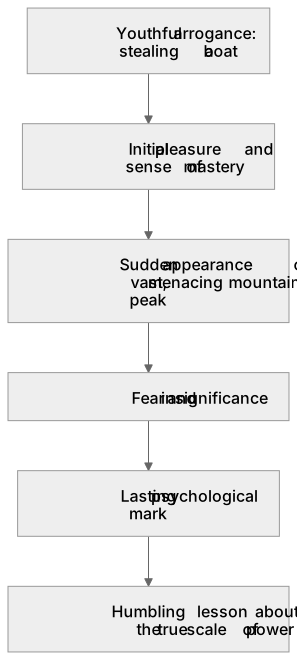
Put it in order
Put these steps in the order they happen.
- 1. Sudden appearance of a vast, menacing mountain peak
- 2. Initial pleasure and sense of mastery
- 3. Youthful arrogance: stealing a boat
- 4. Humbling lesson about the true scale of power
- 5. Lasting psychological mark
- 6. Fear and insignificance
Watch it explained
Compare how poets present nature as more powerful than humanity in 'The Prelude' and 'Ozymandias'.
Read the described scene instead
Welcome to this AQA GCSE study breakdown on Wordsworth's extract from The Prelude. This autobiographical poem explores a pivotal childhood memory in which the speaker's youthful arrogance is confronted by the terrifying power of nature. After stealing a boat, the speaker's initial pleasure and sense of mastery are shattered by the sudden appearance of a vast, menacing mountain peak. This encounter with the sublime—a force both beautiful and terrifying—induces fear and insignificance and leaves a lasting psychological mark. Today we will track the psychological journey, analyse blank verse, enjambment and personification, and connect the poem to Romantic ideas and comparison questions. Let's map the central ideas. The extract moves from youthful arrogance—stealing a boat and feeling mastery—to a sublime encounter with a huge, black mountain peak. That confrontation produces fear, insignificance and a humbling lesson about the true scale of power. Wordsworth presents nature as a formidable force that can shape human consciousness and morality. Remember, the mountain is not literally a living entity; personifying it as a pursuing figure reflects the speaker's own terror. The poem is autobiographical, but in analysis refer to 'the speaker' to maintain critical distance. For close analysis, select precise, short quotations. 'An act of stealth and troubled pleasure' uses oxymoron to reveal internal conflict: the boy knows his action is wrong, yet feels thrill, hinting at youthful arrogance and an already troubled conscience. 'A huge peak, black and huge' uses emphatic repetition to convey shock and the boy's inability to find more sophisticated words; 'black' adds menace and sublime terror. 'Upreared its head' personifies the mountain with monstrous, bestial qualities, turning landscape into a conscious entity asserting dominance. 'Strode after me' uses an active verb to suggest purposeful, relentless pursuit. Finally, 'a trouble to my dreams' is literal: the experience has infiltrated his subconscious, suggesting a permanent shift in perception and vulnerability. The narrative charts a clear psychological journey from innocence to a more troubled experience. It begins with youthful arrogance and the pleasure of stealing a boat. The turning point is the sudden appearance of the vast, menacing mountain peak, which shatters the speaker's sense of mastery. Afterwards he feels fear and insignificance, and the experience becomes 'a trouble to my dreams.' Structurally, the single unbroken verse paragraph is deliberate: it mirrors the continuous, overwhelming flow of memory and the speaker's breathless emotional state. Blank verse and enjambment create a conversational yet serious tone, reflecting the flow of memory. Let's work through a comparison question: how do poets present nature as more powerful than humanity? In 'The Prelude,' focus on nature as a direct, living and terrifying force that actively confronts the speaker in a single moment. Analyse personification in 'Upreared its head' and 'Strode after me,' plus the visceral repetition of 'huge peak, black and huge.' In 'Ozymandias,' contrast this with nature as an indifferent, erosive force working over a vast timescale to destroy a human monument. Use short quotations and explain specific effects, rather than just stating that nature is powerful. Avoid common mistakes. First, don't reduce the poem to a boy being scared of a mountain: it uses that event to explore the humbling of human pride by the immense power of the natural world—a spiritual and psychological turning point. Second, although the poem is autobiographical, refer to 'the speaker' rather than writing 'Wordsworth feels,' to maintain critical distance. Third, the single unbroken stanza is not a mistake; it deliberately mirrors the continuous, overwhelming flow of the memory and the speaker's breathless emotional state. To recap: trace the speaker's changing emotions from youthful arrogance and 'troubled pleasure' to fear, insignificance and humility. Analyse the oxymoron, the repetition of 'huge,' and the personification of the mountain as a monstrous, pursuing figure. Remember the shift from graceful 'elfin pinnace' to simple, visceral 'huge peak, black and huge.' Link the poem to the Romantic sublime and the belief that childhood experiences shape adult identity and morality. For comparison, contrast The Prelude's direct, living and terrifying nature with Ozymandias's indifferent, erosive power over vast time. Refer to 'the speaker,' and treat the single verse paragraph as a deliberate structural choice.
Key words
Say what each word means before you turn the card.
The power of nature
Try answering aloud or in your head before turning the card.
Memory and the past
Try answering aloud or in your head before turning the card.
Fear and terror
Try answering aloud or in your head before turning the card.
Human pride vs. nature's power
Try answering aloud or in your head before turning the card.
See every definition
- The power of nature
- A formidable force that can shape human consciousness and morality, presented as both beautiful and terrifying.
- Memory and the past
- A pivotal childhood memory that leaves a lasting psychological mark and transforms the speaker's understanding of the world.
- Fear and terror
- A profound sense of fear and insignificance induced by an encounter with the sublime.
- Human pride vs. nature's power
- Youthful arrogance confronted and humbled by the terrifying power of nature, teaching a humbling lesson about the true scale of power.
Label the diagram
Some boxes have lost their names. Pick the right name for each number.
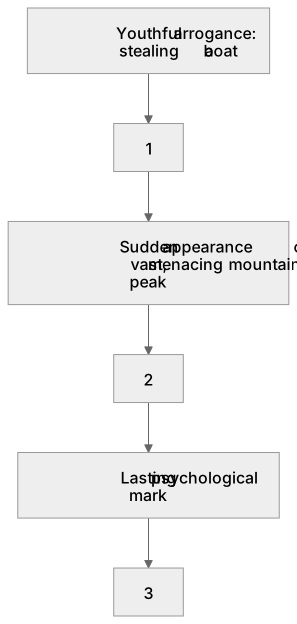
1Box 1
2Box 2
3Box 3
There is more to this lesson
The full lesson goes on to check your understanding and help you earn the marks. Create a free account to carry on, with your progress saved.
A week of Premium from your first lesson · Then the free plan continues · No card, no charge
Test your understanding of Poetry anthology: Power and Conflict: Extract from ‘The Prelude’
Active recall beats re-reading. Take an instant quiz now to test what you’ve learned and lock it into long-term memory.
A week of Premium from your first lesson · Then the free plan continues · No card, no charge