AQA · GCSE · English Literature
Course version: 8702 · Version from Sept 2015
Poetry anthology: Worlds and Lives: With Birds You’re Never Lonely
The poem contrasts the overwhelming, isolating noise of an urban coffeehouse with the meaningful connection found in nature and memory.
Checked against the AQA 8702 specification (opens in a new tab) on .
- Point 15 of 15
- 4 key terms
Study notes
From the checked teaching notes for this specification point.
The idea
The poem contrasts the overwhelming, isolating noise of an urban coffeehouse with the meaningful connection found in nature and memory. The d/Deaf speaker struggles with communication in the cafe, but finds a rich, tangible presence in the silence created by turning off a hearing aid. This experience leads to a reflection on urban trees and a memory of a Māori woman, whose inherited wisdom offers a profound truth: a connection with the natural world, particularly birds, provides a form of companionship that transcends human language and loneliness. The poem champions alternative ways of perceiving the world and values the quiet wisdom passed down through generations over the cacophony of modern city life.
What earns the marks
- AO1: Understand and respond to the poem’s central contrast between the noisy, isolating coffee shop and the peaceful, connective world of nature.
- AO1: Refer to the speaker’s journey from a specific moment of difficulty to a broader reflection on memory, wisdom, and belonging.
- AO1: Make clear and relevant links to another poem, for example comparing the presentation of urban life here with its portrayal in ‘In a London Drawingroom’.
- AO2: Analyse how Antrobus uses couplets to create connections and pairings, reflecting the poem’s themes of communication and relationships.
- AO2: Explain the effect of sensory language, such as the onomatopoeic ‘Spoons slam’, to create the overwhelming atmosphere of the cafe.
- AO2: Discuss how the paradoxical phrase 'a silence that was not an absence' presents silence as meaningful rather than empty, conveying the speaker's sensory experience.
- AO3: Link the poem’s exploration of sensory perception to the context of Raymond Antrobus’s identity as a d/Deaf poet.
- AO3: Consider how the reference to the Māori woman and her grandfather’s wisdom reflects a respect for indigenous knowledge and its emphasis on connection to nature.
- AO3: Discuss how the poem reflects contemporary concerns about urbanisation and the human need to find connection with the natural world.
Common mistakes and how to put them right
The poem is simply about a dislike of coffee shops.
Put it right: The coffee shop is a specific setting used to explore wider themes of sensory overload, difficult communication, and the alienating nature of some urban environments for a d/Deaf person.
The speaker turns off their hearing aid because they want complete silence.
Put it right: The speaker describes 'a silence that was not an absence'. This paradox suggests a different sensory experience that remains rich and meaningful, rather than a total lack of sensation.
The main message is that all cities are bad and all nature is good.
Put it right: The poem presents a more nuanced personal experience. It contrasts a specific, overwhelming urban moment with the solace found in nature and memory. The urban trees also prompt reflection, showing that nature can be found within the city.
Exam tips
- Compare with Lines Written in Early Spring: The relationship between humanity and the natural world. Difference: Antrobus’s speaker finds personal solace and a model for connection in nature, seeing it as an antidote to urban isolation. Wordsworth’s speaker observes harmony in nature but this leads to a melancholy lament for what ‘man has made of man’, focusing on humanity’s destructive disconnection. Useful when: How poets present nature as a source of comfort or reflection.
- Compare with In a London Drawingroom: A critical perspective on a modern city environment. Difference: Antrobus portrays the city as a place of overwhelming sensory input that prompts an escape into memory and nature. Eliot presents a more totalising and inescapable vision of London as a monotonous, oppressive ‘prison-house’ that stifles all inhabitants. Useful when: How poets portray the negative effects of city life.
- Compare with A Portable Paradise: Finding a personal sanctuary to cope with life’s pressures. Difference: In Antrobus’s poem, the sanctuary is found by connecting with the external natural world, a wisdom learned from another person. In Robinson’s poem, the ‘paradise’ is an internalised, private memory of heritage that is carried and concealed for personal resilience. Useful when: How poets explore ideas about finding peace or paradise.
- Compare with Homing: The importance of heritage and alternative forms of expression. Difference: Antrobus’s speaker finds wisdom in the heritage of another culture, focusing on a universal connection to nature. Berry’s speaker seeks to recover a personal, suppressed family heritage, specifically a regional accent as a form of linguistic and cultural identity. Useful when: How poets present ideas about identity and inheritance.
Try the lesson
The start of the Poetry anthology: Worlds and Lives: With Birds You’re Never Lonely lesson, made from checked teaching notes for this specification point.
Have a go first
The poem opens, 'I can't hear the barista / over the coffee machine.' Which setting is most strongly established by this detail?
Listen
The poem contrasts the overwhelming, isolating noise of an urban coffeehouse with the meaningful connection found in nature and memory. The d/Deaf speaker struggles with communication in the cafe, but finds a rich, tangible presence in the silence created by turning off a hearing aid. This experience leads to a reflection on urban trees and a memory of a Māori woman, whose inherited wisdom offers a profound truth: a connection with the natural world, particularly birds, provides a form of companionship that transcends human language and loneliness. The poem champions alternative ways of perceiving the world and values the quiet wisdom passed down through generations over the cacophony of modern city life. A strong answer earns marks for these points. Understand and respond to the poem’s central contrast between the noisy, isolating coffee shop and the peaceful, connective world of nature. Refer to the speaker’s journey from a specific moment of difficulty to a broader reflection on memory, wisdom, and belonging. Make clear and relevant links to another poem, for example comparing the presentation of urban life here with its portrayal in ‘In a London Drawingroom’. Analyse how Antrobus uses couplets to create connections and pairings, reflecting the poem’s themes of communication and relationships. A common slip: The poem is simply about a dislike of coffee shops. Instead, The coffee shop is a specific setting used to explore wider themes of sensory overload, difficult communication, and the alienating nature of some urban environments for a d/Deaf person. Exam tip: Compare with Lines Written in Early Spring: The relationship between humanity and the natural world. Difference: Antrobus’s speaker finds personal solace and a model for connection in nature, seeing it as an antidote to urban isolation. Wordsworth’s speaker observes harmony in nature but this leads to a melancholy lament for what ‘man has made of man’, focusing on humanity’s destructive disconnection. Useful when: How poets present nature as a source of comfort or reflection.
See it
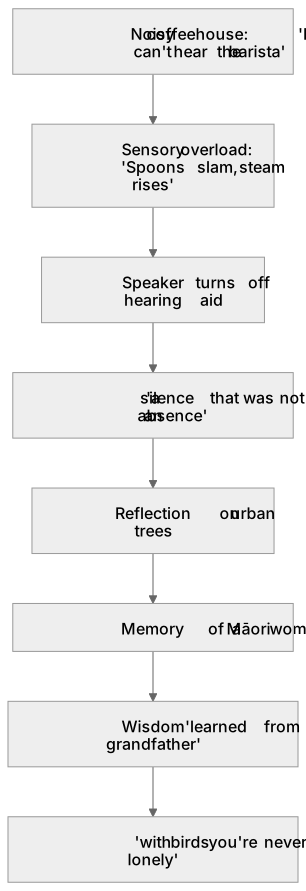
Put it in order
Put these steps in the order they happen.
- 1. Reflection on urban trees
- 2. 'with birds you're never lonely'
- 3. Memory of a Māori woman
- 4. Noisy coffeehouse: 'I can't hear the barista'
- 5. Sensory overload: 'Spoons slam, steam rises'
- 6. Wisdom 'learned from her grandfather'
- 7. Speaker turns off hearing aid
- 8. 'a silence that was not an absence'
Watch it explained
What is the one idea the video explains? Say it in a sentence.
Read the described scene instead
Raymond Antrobus’s ‘With Birds You’re Never Lonely’ explores communication, sensory perception and connection. The poem contrasts a noisy coffeehouse with the meaningful presence found in nature and memory. As a d/Deaf speaker, the narrator shows how alternative ways of perceiving the world can challenge loneliness and urban isolation. The poem’s central contrast is between the overwhelming, isolating coffeehouse and the peaceful, connective world of nature. In the cafe, the speaker says, ‘I can’t hear the barista’; this direct statement establishes difficult communication and a sense of exclusion. Turning off a hearing aid creates ‘a silence that was not an absence’—a meaningful sensory state, not an empty void. Urban trees then prompt reflection, leading to memory and inherited wisdom. Antrobus uses sensory language to make the cafe feel overwhelming. ‘Spoons slam, steam rises’ combines harsh sound and visual detail, conveying sensory overload. The poem is written in couplets, and these paired lines create connections and pairings that reflect its themes of communication and relationships. The reported wisdom ‘learned from her grandfather’ introduces intergenerational and cultural inheritance, contrasting deep knowledge with impersonal city interactions. Pause here and think: why does the poem call silence ‘a silence that was not an absence’? Now the explanation. The phrase is a paradox. Turning off the hearing aid does not create a total lack of sensation; instead, silence becomes a meaningful sensory state. This reframes the speaker’s experience and presents an alternative to the cafe’s overwhelming noise. It also supports the poem’s interest in different ways of perceiving the world. Avoid three common mistakes. First, the poem is not simply about disliking coffee shops; the cafe is a specific setting for exploring sensory overload, difficult communication and urban alienation for a d/Deaf person. Second, the speaker does not turn off the hearing aid for complete silence; the paradox shows a rich, meaningful sensory experience. Third, the poem does not say all cities are bad and all nature is good; it contrasts one overwhelming urban moment with solace in nature and memory, and even urban trees prompt reflection. To recap, the poem contrasts the isolating noise of the coffeehouse with a rich, tangible presence in nature and memory. The d/Deaf speaker’s experience of ‘a silence that was not an absence’ values alternative perception. The Māori woman’s inherited wisdom, ‘with birds you’re never lonely’, presents nature as companionship that transcends human language. For comparison, ‘In a London Drawingroom’ presents the city as a more totalising, oppressive prison-house, while Antrobus’s speaker finds solace through nature and memory.
Key words
Say what each word means before you turn the card.
Communication and Miscommunication
Try answering aloud or in your head before turning the card.
Nature vs. Urban Environments
Try answering aloud or in your head before turning the card.
Sensory Perception and Deafness
Try answering aloud or in your head before turning the card.
Inherited Wisdom and Connection
Try answering aloud or in your head before turning the card.
See every definition
- Communication and Miscommunication
- The poem's central conflict of difficult communication within a specific, noisy urban setting, where the d/Deaf speaker struggles in the cafe.
- Nature vs. Urban Environments
- The contrast between the noisy, isolating coffee shop and the peaceful, connective world of nature, including urban trees that prompt reflection.
- Sensory Perception and Deafness
- The speaker's d/Deaf identity and sensory experience, including turning off a hearing aid to find a silence that was not an absence.
- Inherited Wisdom and Connection
- Intergenerational wisdom and cultural inheritance, as the Māori woman's grandfather's aphorism proposes that connection with nature offers companionship that combats isolation.
Label the diagram
Some boxes have lost their names. Pick the right name for each number.
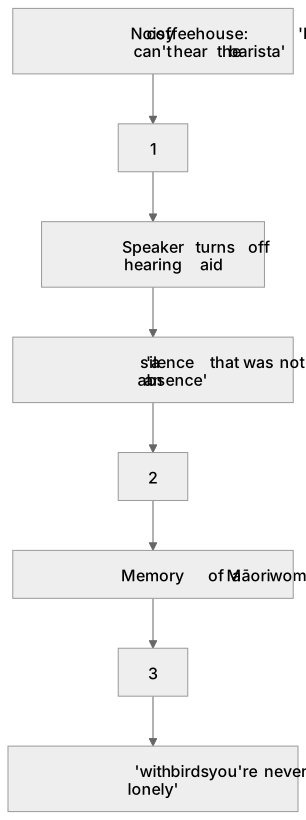
1Box 1
2Box 2
3Box 3
There is more to this lesson
The full lesson goes on to check your understanding and help you earn the marks. Create a free account to carry on, with your progress saved.
A week of Premium from your first lesson · Then the free plan continues · No card, no charge
Test your understanding of Poetry anthology: Worlds and Lives: With Birds You’re Never Lonely
Active recall beats re-reading. Take an instant quiz now to test what you’ve learned and lock it into long-term memory.
A week of Premium from your first lesson · Then the free plan continues · No card, no charge