AQA · GCSE · English Literature
Course version: 8702 · Version from Sept 2015
Romeo and Juliet
Romeo and Juliet is Shakespeare's iconic tragedy of young love destroyed by an ancient family feud. Studying this play rewards candidates with a deep understanding of dramatic irony, the tension between fate and free will, and how Elizabethan patriarchal structures shaped character choices.
- 8 min read
- 2 worked examples
- 4 practice questions
- 8 key terms
Check what you remember
Read the wording for your board, then hide it and explain Dramatic Irony in your own words. Rough notes are fine. This is a self-check, with no mark or grade.
Reference: AQA
When the audience knows something the characters do not.
Study Notes
Overview

Romeo and Juliet is perhaps the most famous tragedy in the English language, written by William Shakespeare around 1595. For GCSE Literature, examiners are looking for perceptive analysis of how Shakespeare uses language, form, and structure to present his themes. You are not just reading a story about two teenagers; you are analysing a dramatic construct designed to explore the destructive nature of conflict, the power of consuming love, and the tension between human agency and fate. A high-level response will always consider the Elizabethan context, particularly patriarchal control and the concept of the 'Great Chain of Being'.
Listen to our comprehensive revision podcast to solidify your understanding:
Plot/Content Overview
Act 1: The play opens with a street brawl between the Montagues and Capulets, establishing the violent backdrop. Romeo is introduced as a melancholic Petrarchan lover pining for Rosaline. Meanwhile, Juliet's father arranges for her to marry Count Paris. Romeo and his friends crash the Capulet feast, where Romeo and Juliet meet and instantly fall in love, only to discover they are from enemy families.
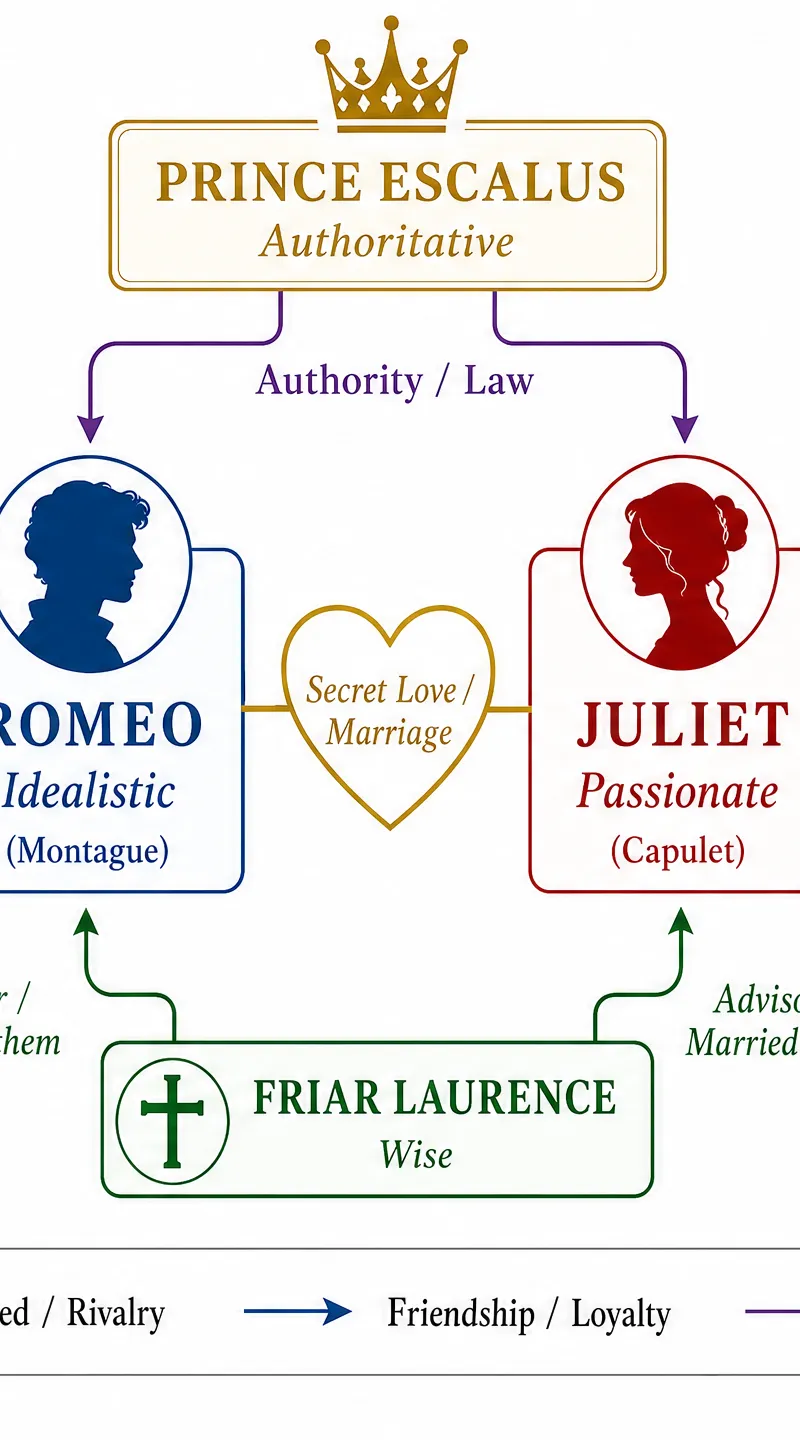
Act 2: In the famous balcony scene, the lovers declare their passion and agree to marry. Friar Laurence agrees to perform the secret ceremony, hoping it will end the ancient feud.
Act 3: The turning point of the tragedy. Tybalt (Juliet's cousin) challenges Romeo. Romeo refuses to fight, leading his friend Mercutio to fight Tybalt instead. When Tybalt kills Mercutio, an enraged Romeo kills Tybalt and is banished from Verona by the Prince. Lord Capulet, unaware of Juliet's secret marriage, orders her to marry Paris immediately.
Act 4: Juliet, desperate to avoid bigamy and reunite with Romeo, seeks help from Friar Laurence. He gives her a potion that will make her appear dead for 42 hours. She takes it, and her family, believing her dead, places her in the Capulet tomb.
Act 5: The Friar's message explaining the plan fails to reach Romeo. Hearing only that Juliet is dead, Romeo buys poison and goes to her tomb. He kills Paris, who is mourning there, then drinks the poison and dies beside Juliet. Juliet wakes up, finds Romeo dead, and stabs herself with his dagger. The play ends with the Prince rebuking the families, who finally reconcile over the bodies of their children.
Themes
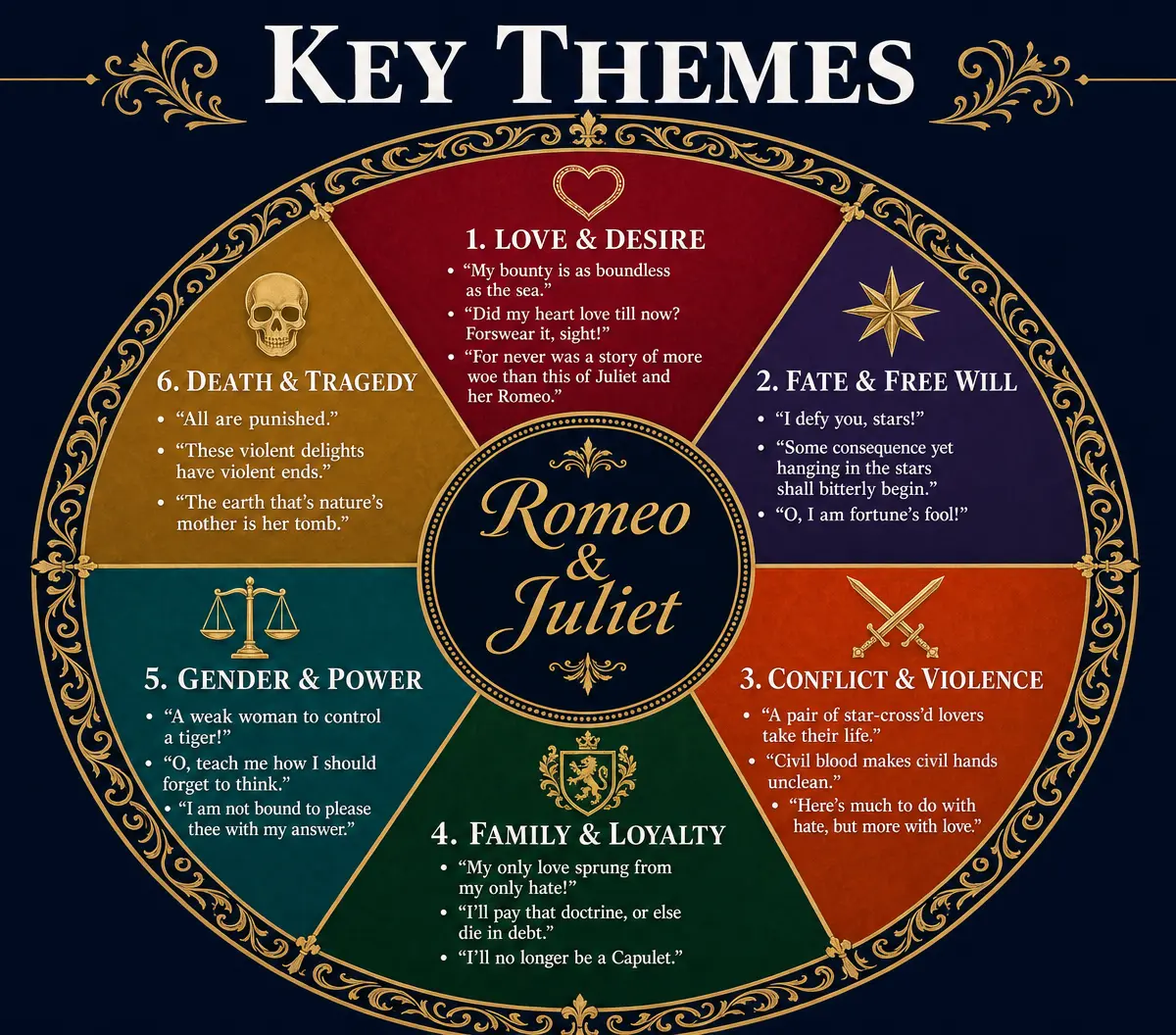
Theme 1: Love and Desire
Shakespeare presents love as a powerful, consuming, and often dangerous force. He contrasts the artificial, performative 'courtly love' Romeo initially feels for Rosaline with the transformative, genuine passion he shares with Juliet. However, this love is also inherently violent and inextricably linked to death.
Key Quotes:
- "O brawling love, O loving hate" (Act 1, Scene 1) - Romeo uses oxymorons to describe his unrequited love for Rosaline, showing it is confusing and contradictory, yet somewhat superficial.
- "My bounty is as boundless as the sea, / My love as deep" (Act 2, Scene 2) - Juliet uses a simile to describe her love. Examiners reward candidates who note that the sea is infinite but also powerful and destructive.
- "These violent delights have violent ends" (Act 2, Scene 6) - Friar Laurence foreshadows the tragic outcome, linking intense passion directly to destruction.
Theme 2: Fate and Free Will
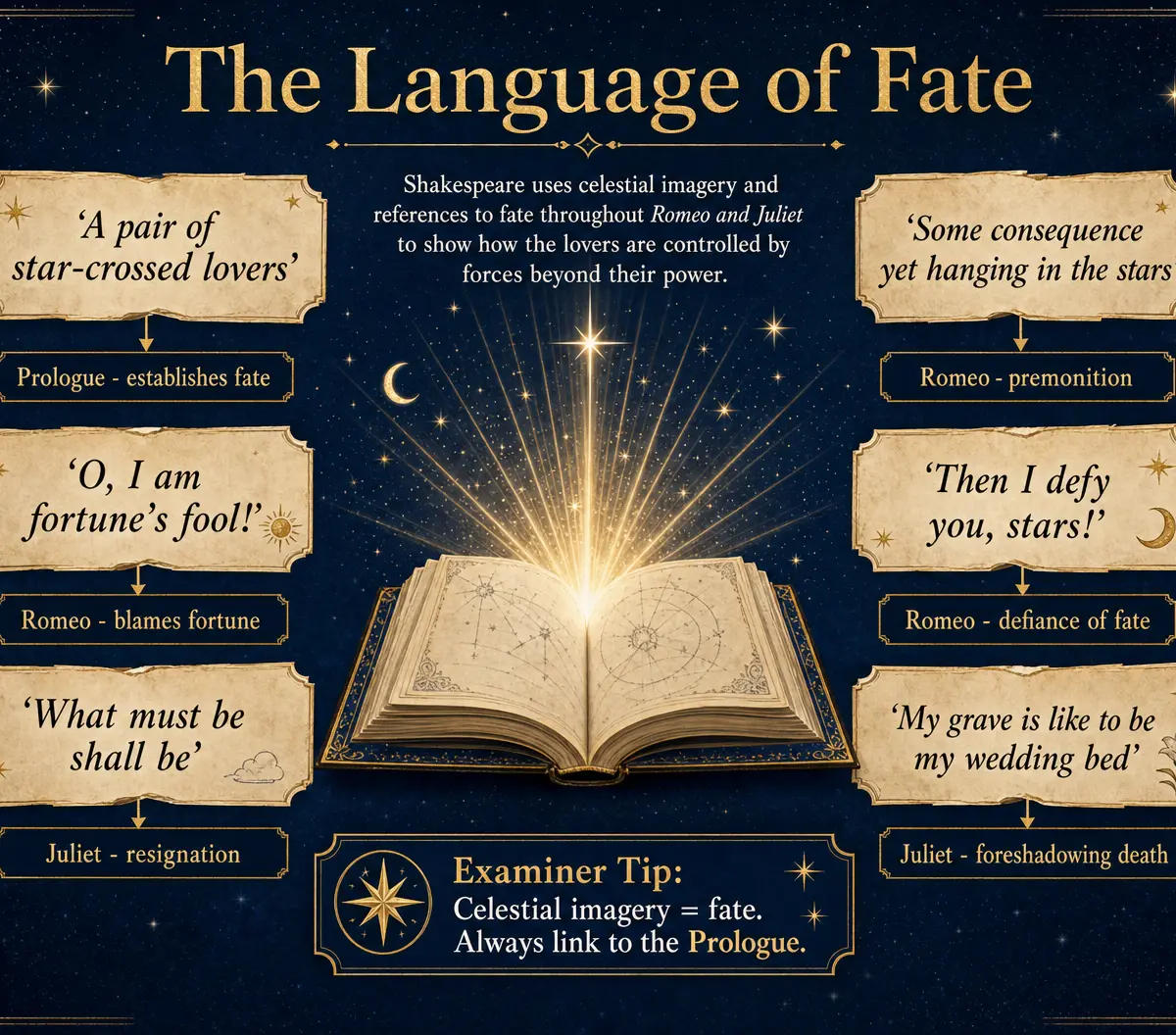
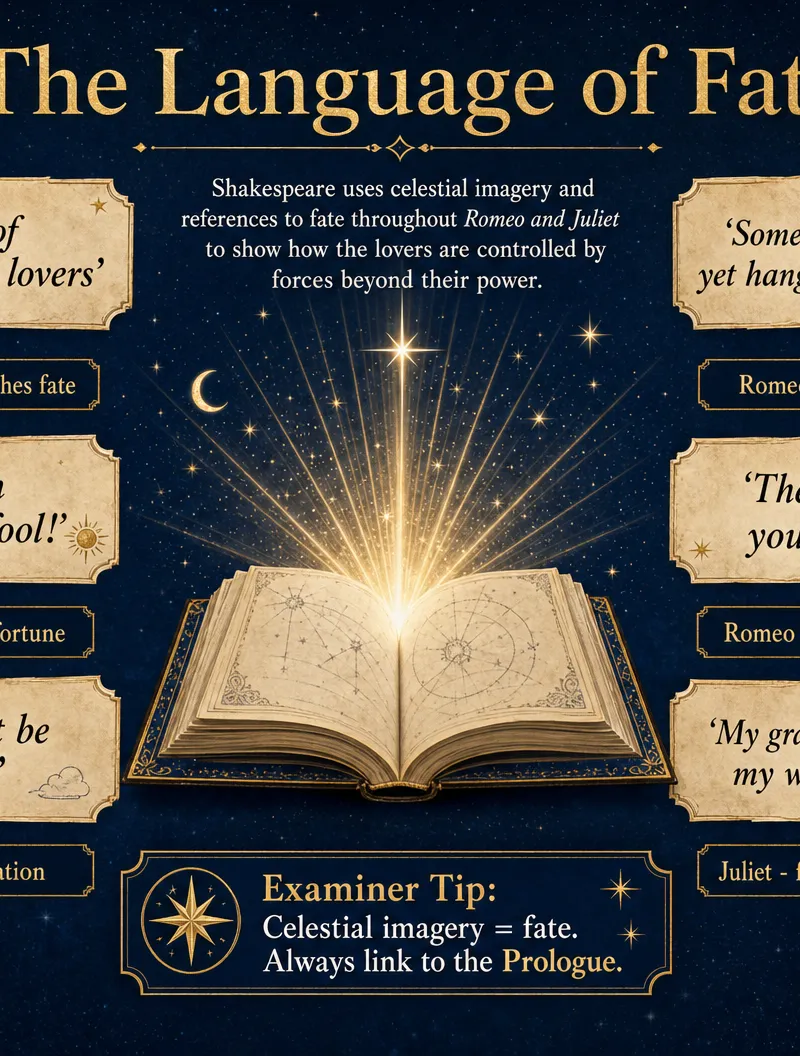
The tension between destiny and human agency is central to the tragedy. Shakespeare establishes a sense of inevitability in the Prologue, yet throughout the play, characters make impulsive choices that accelerate their doom. Are they victims of the stars, or of their own rashness?
Key Quotes:
- "A pair of star-crossed lovers take their life" (Prologue) - The adjective 'star-crossed' explicitly connects the lovers' fate to astrology, a common Elizabethan belief.
- "O, I am fortune's fool!" (Act 3, Scene 1) - Romeo cries this after killing Tybalt. He blames fate (fortune) for his actions, yet he made the active choice to draw his sword.
- "Then I defy you, stars!" (Act 5, Scene 1) - Romeo's final act of defiance against fate is ironically what seals his tragic destiny.
Theme 3: Conflict and Violence
The feud between the Montagues and Capulets infects every aspect of life in Verona. Shakespeare shows how honour-based violence perpetuates itself, destroying the younger generation.
Key Quotes:
- "What, drawn, and talk of peace! I hate the word, / As I hate hell, all Montagues, and thee" (Act 1, Scene 1) - Tybalt's dialogue establishes him as the embodiment of the feud. The rule of three equates Montagues with hell.
- "Civil blood makes civil hands unclean" (Prologue) - The repetition of 'civil' highlights the unnaturalness of citizens killing citizens.
Character Analysis
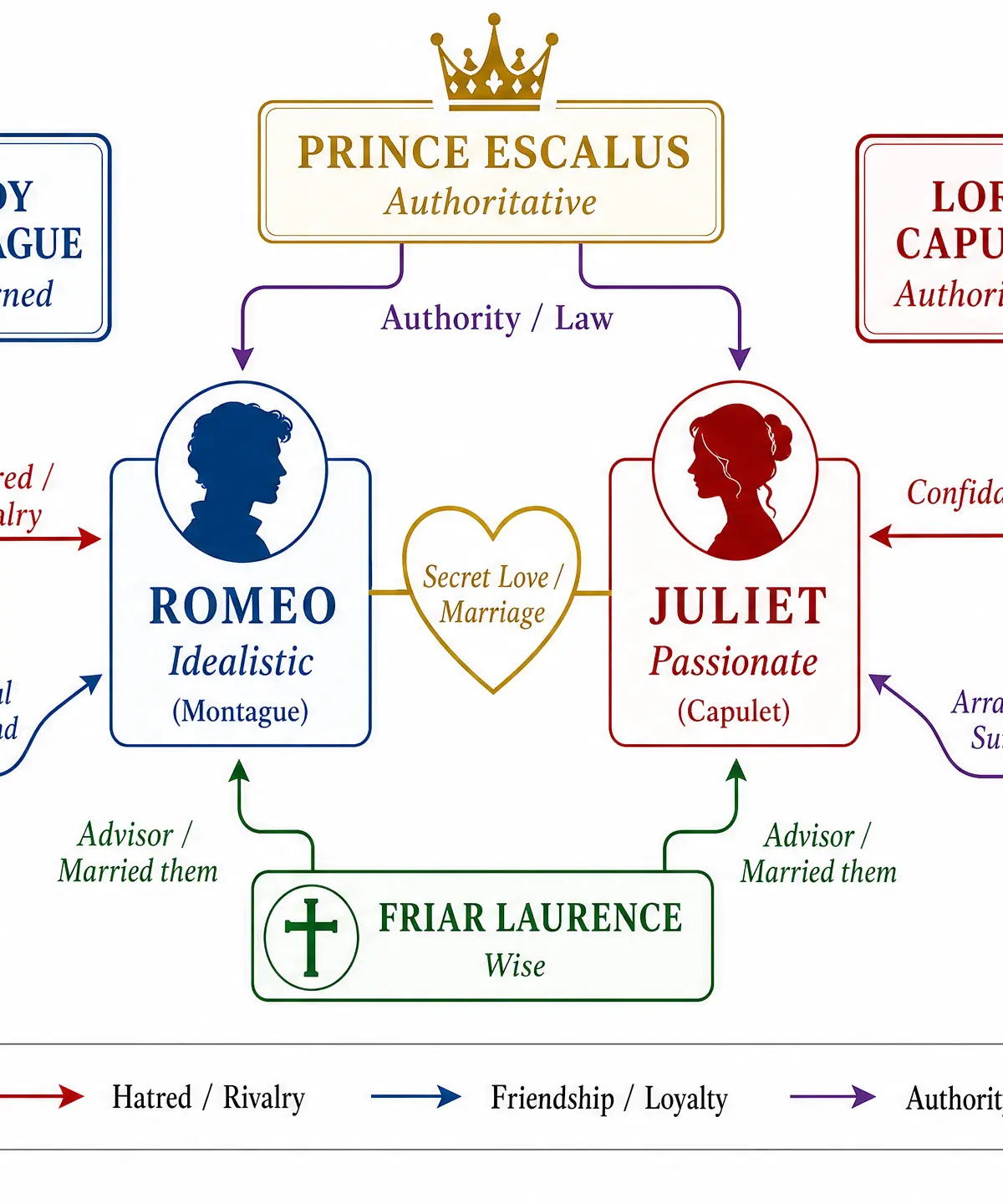
Romeo Montague
Role: The tragic hero whose impulsivity drives the plot forward.
Key Traits: Passionate, impulsive, fatalistic, romantic.
Character Arc: Romeo develops from a melancholic, artificial lover (pining for Rosaline) into a desperate, tragic figure who chooses death over a life without Juliet.
Essential Quotes:
- "Juliet is the sun." (Act 2, Scene 2)
- "Fire-eyed fury be my conduct now!" (Act 3, Scene 1)
Juliet Capulet
Role: The tragic heroine who challenges the patriarchal expectations of her society.
Key Traits: Intelligent, decisive, loyal, courageous.
Character Arc: Juliet transforms from an obedient, sheltered child ("It is an honour that I dream not of") into a fiercely independent young woman willing to fake her own death to defy her father.
Essential Quotes:
- "O Romeo, Romeo! wherefore art thou Romeo?" (Act 2, Scene 2)
- "My dismal scene I needs must act alone." (Act 4, Scene 3)
Lord Capulet
Role: The patriarch who embodies the oppressive control over women in Elizabethan society.
Key Traits: Authoritative, volatile, status-obsessed.
Character Arc: He initially appears protective of Juliet, telling Paris to wait, but becomes violently tyrannical when she disobeys his order to marry.
Essential Quotes:
- "Hang thee, young baggage! disobedient wretch!" (Act 3, Scene 5)
- "My child is yet a stranger in the world." (Act 1, Scene 2)
Writer's Methods
Examiners heavily reward AO2 analysis of Shakespeare's dramatic and linguistic techniques:
Dramatic Irony: Shakespeare frequently gives the audience information the characters lack. We know Juliet is not truly dead in Act 5, which makes Romeo's suicide excruciatingly tense. This technique heightens the tragedy and reinforces the theme of fate.
Form (The Sonnet): The Prologue is a Shakespearean sonnet (14 lines, iambic pentameter, ABAB CDCD EFEF GG rhyme scheme). Sonnets were traditionally used for love poetry, but Shakespeare uses this one to announce death, inextricably linking love and violence from the very first lines.
Light/Dark Imagery: Romeo consistently associates Juliet with light in darkness ("Juliet is the sun", "a rich jewel in an Ethiope's ear"). This highlights her purity and the hope she brings him, but also foreshadows that their love can only exist in the dark, hidden from their feuding families.
Context
To score highly on AO3, you must integrate contextual knowledge into your analysis, not just 'bolt it on':
Patriarchal Society: Elizabethan England was strictly patriarchal. Fathers effectively owned their daughters. Lord Capulet's rage at Juliet's refusal to marry Paris is not just anger; it is a reaction to a profound subversion of the social order. Juliet's agency makes her a radical character.
Astrology and Fate: Elizabethans widely believed that the stars and planets influenced human affairs. When Romeo defies the stars, he is challenging the natural order of the universe.
The Honour Code: Young men in Verona (like Tybalt and Mercutio) operate under a strict code of masculine honour, where any insult must be met with violence. Shakespeare critiques this toxic masculinity, showing how it inevitably leads to tragedy.
Visual Resources
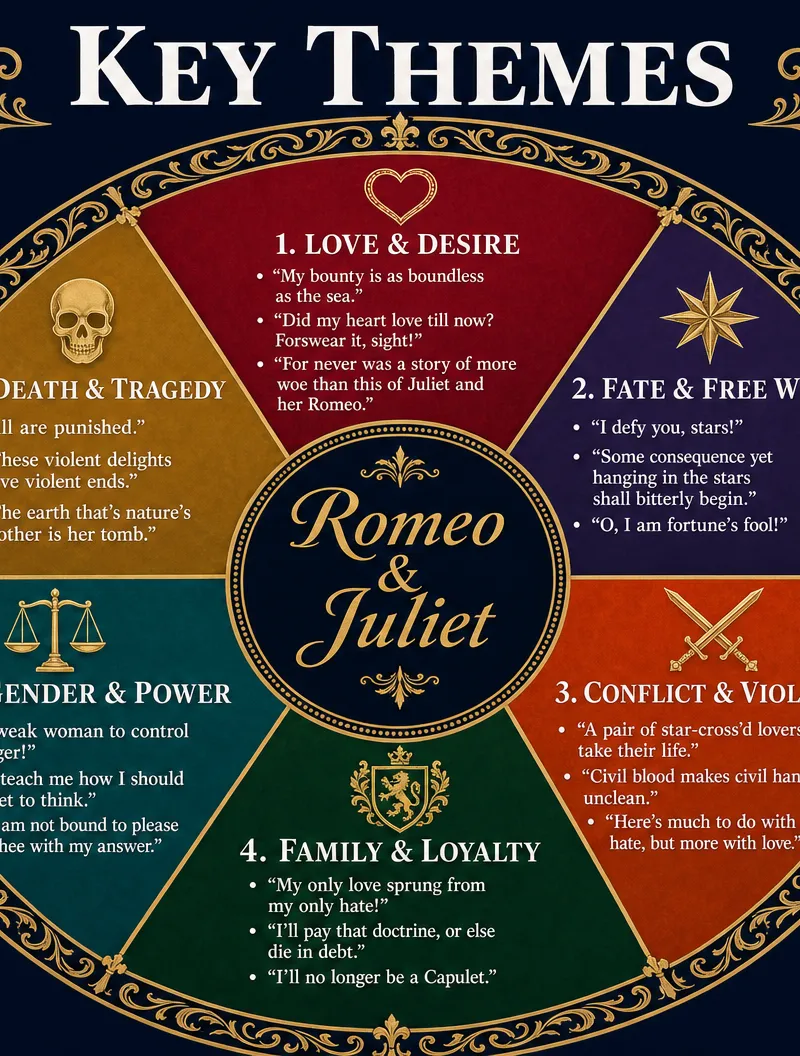
3 diagrams and illustrations
Interactive Diagrams
1 interactive diagram to visualise key concepts
Conceptual Flow Outline
The Tragic Structure of Romeo and Juliet
Worked Examples
2 worked examples — open one to explore the question and available guidance.
Practice Questions
Try the question, then reveal an answer plan or example response
Starting with this extract (Act 1 Scene 5, Romeo: 'O, she doth teach the torches to burn bright!'), explore how Shakespeare presents the power of love. (30 marks)
This prompt needs an extract from your set text. Use the extract provided by your teacher or exam paper; this question card does not include one.
Hint: Contrast this genuine reaction to Juliet with his earlier, artificial poetry about Rosaline. Look at the light/dark imagery.
Explore how Shakespeare presents the character of Tybalt and his attitude to honour. (30 marks)
Hint: Look at Tybalt's first lines in Act 1 Scene 1 and his actions in Act 3 Scene 1. Connect him to Elizabethan ideas of masculinity.
How does Shakespeare present the relationship between parents and children in the play? (30 marks)
Hint: Focus on Lord Capulet and Juliet. Track how his attitude changes from Act 1 to Act 3.
Explore the significance of the Nurse in Romeo and Juliet. (30 marks)
Hint: Contrast her practical, bawdy view of love with Juliet's romantic idealism. Note her ultimate betrayal of Juliet in Act 3.
Exam technique
How to turn what you know into marks
How to approach the question
Deconstruct the prompt: highlight the character/theme, identify the extract focus, and jot down 3 links to the wider play before writing.
How to structure your answer
Use integrated paragraphs: Point → Embedded Quote → Language Analysis (AO2) → Effect on Audience → Link to Context (AO3).
Timing
For a 30+4 mark question, spend 5 minutes planning, 40-45 minutes writing
Common pitfalls
- Retelling the plot instead of analysing how Shakespeare crafts meaning
- Feature spotting (e.g. 'Shakespeare uses a metaphor') without explaining the effect
- Bolting on historical context at the end of a paragraph rather than linking it to character motivation
- Ignoring the wider play in an extract-based question
What the command words want
- Explore
- Look at the theme or character from multiple angles. Show how they change from the beginning to the end of the play.
- Starting with this extract
- Spend 50% of your essay analysing the extract in close detail, then 50% making connections to other specific scenes in the play.
- How does Shakespeare present...
- Focus heavily on AO2. The word 'present' means 'what methods does the writer use'. Talk about structure, form, and specific word choices.
Watch or listen (optional)
Test your understanding of Romeo and Juliet
Active recall beats re-reading. Take an instant quiz now to test what you’ve learned and lock it into long-term memory.
7 days Premium · Then the free plan continues · No card, no charge