AQA · GCSE · English Literature
Course version: 8702 · Version from Sept 2015
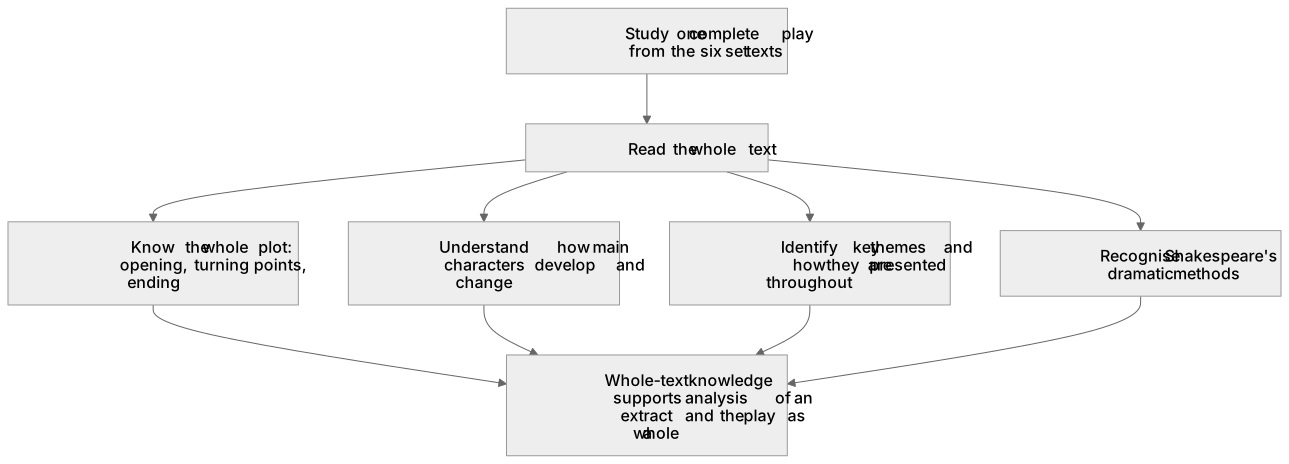
Shakespeare: Students will study one play from the list of six set texts. Students should study the whole text.
Studying the whole text lets you trace how characters, themes and dramatic techniques develop across the play.
- 4 key terms
Study notes
From the checked teaching notes for this specification point.
The idea
Studying the whole text lets you trace how characters, themes and dramatic techniques develop across the play. For example, in Macbeth you can follow Macbeth's change from loyal soldier to tyrant by comparing his early soliloquies with later scenes. You should know the play's plot, main characters, key themes and Shakespeare's methods, and be able to support ideas with brief, accurate references. Assessment asks you to write an essay on an extract and the whole play, so whole-text knowledge is essential for context and argument.
What earns the marks
- Study one complete play from the six set texts, not extracts or adaptations.
- Know the whole plot, including opening, turning points and ending.
- Understand how main characters develop and change across the play.
- Identify and explain key themes and how they are presented throughout.
- Recognise Shakespeare's dramatic methods, such as soliloquy, imagery and dramatic irony.
- Use brief, accurate references from across the whole text to support ideas.
Common mistakes and how to put them right
Revising only key scenes or extracts.
Put it right: Read and revise the whole play so you can place any extract in its wider context.
Retelling the plot without analysing language, form or structure.
Put it right: Use plot knowledge to support analysis of how Shakespeare creates meaning.
Ignoring the extract's position in the play.
Put it right: Link the extract to events before and after it to show whole-text understanding.
Exam tips
- Read the whole play at least once before revising key scenes in detail.
- Create a timeline of major events and character developments to see the play as a whole.
- When analysing an extract, ask how it fits into the play's wider patterns and themes.
- Learn a few short, flexible quotations from different parts of the play.
Try the lesson
The start of the Shakespeare: Students will study one play from the list of six set texts. Students should study the whole text. lesson, made from checked teaching notes for this specification point.
Have a go first
In a Shakespearean play, what is the term for a speech where a character speaks their thoughts aloud while alone on stage, revealing their inner feelings to the audience?
Listen
Studying the whole text lets you trace how characters, themes and dramatic techniques develop across the play. For example, in Macbeth you can follow Macbeth's change from loyal soldier to tyrant by comparing his early soliloquies with later scenes. You should know the play's plot, main characters, key themes and Shakespeare's methods, and be able to support ideas with brief, accurate references. Assessment asks you to write an essay on an extract and the whole play, so whole-text knowledge is essential for context and argument. A strong answer earns marks for these points. Study one complete play from the six set texts, not extracts or adaptations. Know the whole plot, including opening, turning points and ending. Understand how main characters develop and change across the play. Identify and explain key themes and how they are presented throughout. A common slip: revising only key scenes or extracts. Instead, read and revise the whole play so you can place any extract in its wider context. Exam tip: Read the whole play at least once before revising key scenes in detail.
See it
Key words
Say what each word means before you turn the card.
Whole-text study
Try answering aloud or in your head before turning the card.
Character development
Try answering aloud or in your head before turning the card.
Themes and ideas
Try answering aloud or in your head before turning the card.
Shakespeare's dramatic methods
Try answering aloud or in your head before turning the card.
See every definition
- Whole-text study
- Reading and revising the complete play from the six set texts, not extracts or a shortened version.
- Character development
- Understanding how main characters change across the play, such as following a change by comparing early soliloquies with later scenes.
- Themes and ideas
- Identifying and explaining key themes and how they are presented throughout the play.
- Shakespeare's dramatic methods
- Recognising dramatic methods such as soliloquy, imagery and dramatic irony.
Label the diagram
Some boxes have lost their names. Pick the right name for each number.
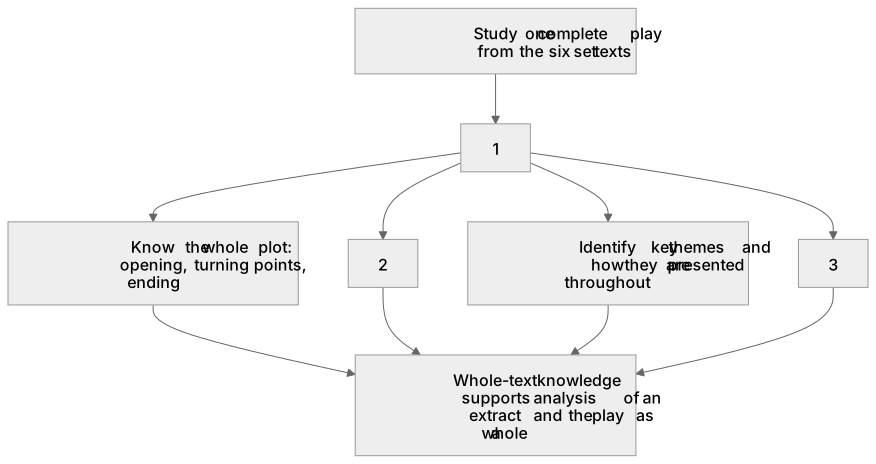
1Box 1
2Box 2
3Box 3
There is more to this lesson
The full lesson goes on to check your understanding and help you earn the marks. Create a free account to carry on, with your progress saved.
A week of Premium from your first lesson · Then the free plan continues · No card, no charge
Test your understanding of Shakespeare: Students will study one play from the list of six set texts. Students should study the whole text.
Active recall beats re-reading. Take an instant quiz now to test what you’ve learned and lock it into long-term memory.
A week of Premium from your first lesson · Then the free plan continues · No card, no charge