AQA · GCSE · English Literature
Course version: 8702 · Version from Sept 2015
Skills - Reading comprehension and reading critically: critical reading: identifying the theme and distinguishing between themes; supporting a point of view by referring to evidence in the text; recognising the possibility of and evaluating different responses to a text; using understanding of writers’ social, historical and cultural contexts to inform evaluation; making an informed personal response that derives from analysis and evaluation of the text
Critical reading means forming and defending your own interpretation.
- 4 key terms
Study notes
From the checked teaching notes for this specification point.
The idea
Critical reading means forming and defending your own interpretation. First, identify a theme, such as social responsibility in An Inspector Calls, and distinguish it from related themes like class or gender. Support your view with precise evidence: quotations, stage directions or structural choices. Recognise that others may read the text differently; evaluate those responses by weighing evidence. Use context—Priestley's 1945 audience and 1912 setting—to inform your evaluation, but avoid claiming the text is simply a history lesson. Finally, craft an informed personal response that grows from your analysis, not a pre-learned opinion.
For example: Argue that the Inspector is a catalyst rather than a character, and justify with his final speech and the play's circular structure.
What earns the marks
- Identifying and distinguishing themes: accurately name a central theme and separate it from other themes, explaining how they differ.
- Supporting a point of view with evidence: select relevant quotations or references and use them to back up an interpretation.
- Recognising and evaluating different responses: acknowledge alternative readings and assess their strengths and weaknesses using textual evidence.
- Using social, historical and cultural contexts: integrate relevant contextual knowledge to deepen evaluation, without letting it overshadow the text.
- Making an informed personal response: develop a coherent, personal interpretation that is clearly derived from analysis and evaluation of the text.
Common mistakes and how to put them right
Listing themes without distinguishing them.
Put it right: For each theme, write a sentence explaining how it differs from another theme, using 'whereas' or 'unlike'.
Using context as a substitute for textual analysis.
Put it right: Link context back to specific words, phrases or structural choices in the text.
Presenting a personal response without evidence.
Put it right: For every opinion, provide a quotation or close reference and explain how it supports your view.
Exam tips
- Plan your response by noting your main argument, two or three supporting quotations, and one alternative interpretation you can evaluate.
- Use evaluative language such as 'effectively', 'convincingly' or 'arguably' to show critical engagement, and always tie evaluation to evidence.
- When using context, ask 'How does this help me understand the writer's choices?' rather than simply stating historical facts.
Try the lesson
The start of the Skills - Reading comprehension and reading critically: critical reading: identifying the theme and distinguishing between themes; supporting a point of view by referring to evidence in the text; recognising the possibility of and evaluating different responses to a text; using understanding of writers’ social, historical and cultural contexts to inform evaluation; making an informed personal response that derives from analysis and evaluation of the text lesson, made from checked teaching notes for this specification point.
Have a go first
A novel follows a poor family who move to a new city and slowly build a better life. Which theme is most clearly explored?
Listen
Critical reading means forming and defending your own interpretation. First, identify a theme, such as social responsibility in An Inspector Calls, and distinguish it from related themes like class or gender. Support your view with precise evidence: quotations, stage directions or structural choices. Recognise that others may read the text differently; evaluate those responses by weighing evidence. Use context—Priestley's 1945 audience and 1912 setting—to inform your evaluation, but avoid claiming the text is simply a history lesson. Finally, craft an informed personal response that grows from your analysis, not a pre-learned opinion. For example, argue that the Inspector is a catalyst rather than a character, and justify with his final speech and the play's circular structure. A strong answer earns marks for these points. Identifying and distinguishing themes: accurately name a central theme and separate it from other themes, explaining how they differ. Supporting a point of view with evidence: select relevant quotations or references and use them to back up an interpretation. Recognising and evaluating different responses: acknowledge alternative readings and assess their strengths and weaknesses using textual evidence. Using social, historical and cultural contexts: integrate relevant contextual knowledge to deepen evaluation, without letting it overshadow the text. A common slip: Listing themes without distinguishing them. Instead, For each theme, write a sentence explaining how it differs from another theme, using 'whereas' or 'unlike'. Exam tip: Plan your response by noting your main argument, two or three supporting quotations, and one alternative interpretation you can evaluate.
See it
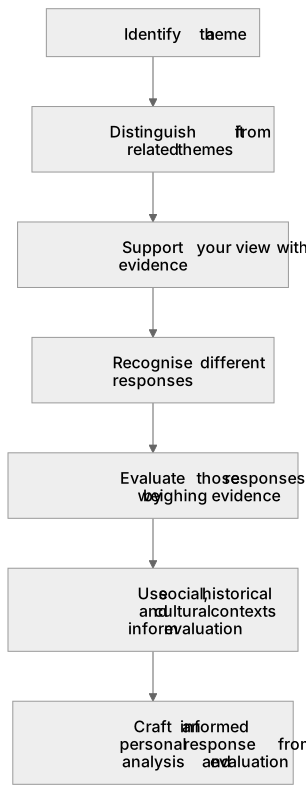
Put it in order
Put these steps in the order they happen.
- 1. Distinguish it from related themes
- 2. Support your view with evidence
- 3. Recognise different responses
- 4. Evaluate those responses by weighing evidence
- 5. Use social, historical and cultural contexts to inform evaluation
- 6. Craft an informed personal response from analysis and evaluation
- 7. Identify a theme
Key words
Say what each word means before you turn the card.
Theme identification and distinction
Try answering aloud or in your head before turning the card.
Evidence-based argument
Try answering aloud or in your head before turning the card.
Multiple interpretations and evaluation
Try answering aloud or in your head before turning the card.
Contextual influence on meaning
Try answering aloud or in your head before turning the card.
See every definition
- Theme identification and distinction
- Accurately naming a central theme and separating it from other themes, explaining how they differ.
- Evidence-based argument
- Supporting a point of view by selecting relevant quotations or references and using them to back up an interpretation.
- Multiple interpretations and evaluation
- Recognising the possibility of different responses to a text and assessing their strengths and weaknesses using textual evidence.
- Contextual influence on meaning
- Using understanding of writers' social, historical and cultural contexts to inform evaluation, without letting it overshadow the text.
Label the diagram
Some boxes have lost their names. Pick the right name for each number.
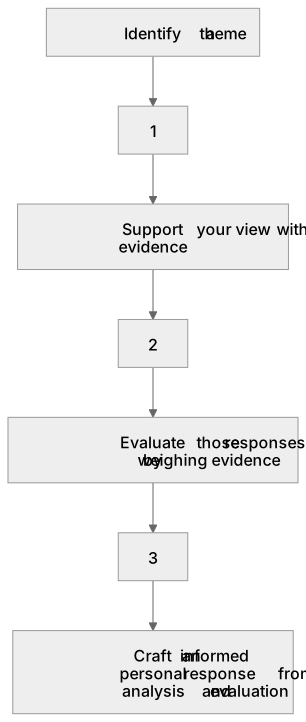
1Box 1
2Box 2
3Box 3
There is more to this lesson
The full lesson goes on to check your understanding and help you earn the marks. Create a free account to carry on, with your progress saved.
A week of Premium from your first lesson · Then the free plan continues · No card, no charge
Test your understanding of Skills - Reading comprehension and reading critically: critical reading: identifying the theme and distinguishing between themes; supporting a point of view by referring to evidence in the text; recognising the possibility of and evaluating different responses to a text; using understanding of writers’ social, historical and cultural contexts to inform evaluation; making an informed personal response that derives from analysis and evaluation of the text
Active recall beats re-reading. Take an instant quiz now to test what you’ve learned and lock it into long-term memory.
A week of Premium from your first lesson · Then the free plan continues · No card, no charge