AQA · GCSE · English Literature
Course version: 8702 · Version from Sept 2015
Skills - Reading comprehension and reading critically: evaluation of a writer’s choice of vocabulary, grammatical and structural features: analysing and evaluating how language, structure, form and presentation contribute to quality and impact; using linguistic and literary terminology for such evaluation
This skill asks you to examine a writer’s deliberate choices—specific words, sentence structures, overall organisation, and presentational devices—and judge how they create quality and impact.
- 4 key terms
Study notes
From the checked teaching notes for this specification point.
The idea
This skill asks you to examine a writer’s deliberate choices—specific words, sentence structures, overall organisation, and presentational devices—and judge how they create quality and impact. For example, in Macbeth a short, abrupt sentence after the murder conveys shock, while repeated phrasing can build tension. Explain why the writer chose that technique and what effect it has. Evaluation goes beyond identification: weigh how effective the choice is and how it shapes meaning. Use accurate linguistic and literary terminology, such as metaphor, caesura or anaphora, to discuss choices precisely. In Literature, ‘presentation’ usually means the writer’s presentational choices—chapter breaks, staging, narrative framing—rather than publisher typography or layout, which belongs more to English Language.
What earns the marks
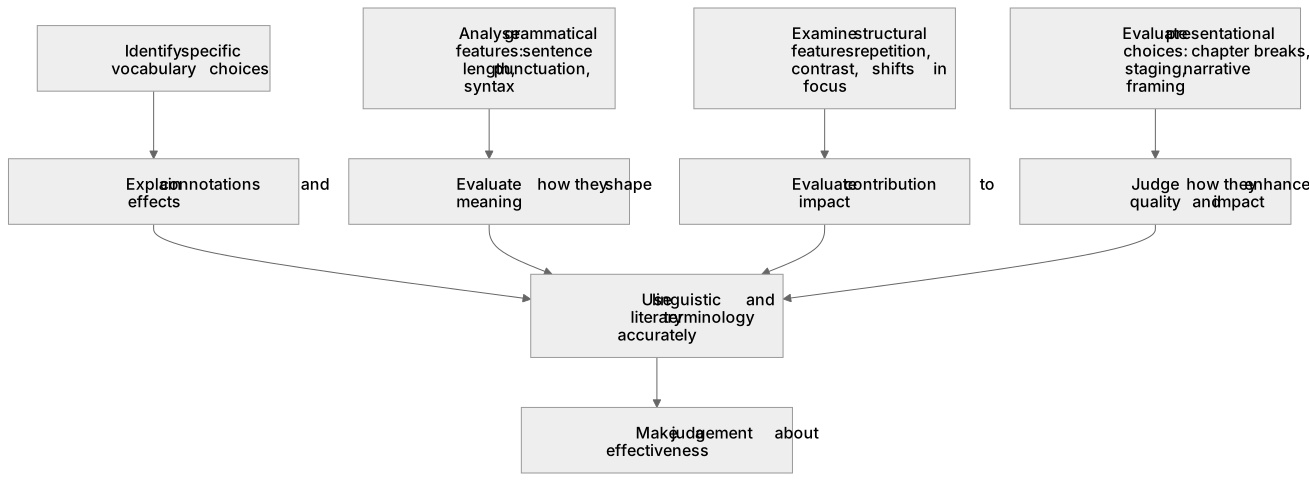
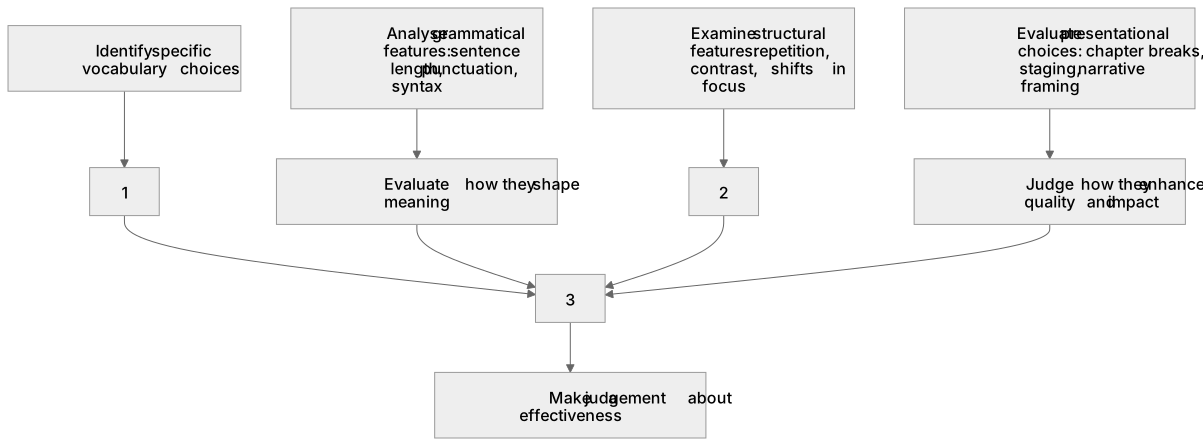
- Identify specific vocabulary choices and explain their connotations and effects, for example how ‘blood’ accumulates guilt-laden meanings across Macbeth.
- Analyse grammatical features such as sentence length, punctuation and syntax, and evaluate how they shape meaning, for example a fragmented sentence after the murder conveying shock.
- Examine structural features like repetition, contrast and shifts in focus, and evaluate their contribution to impact, for example the recurring knocking in Macbeth.
- Evaluate presentational choices in a literary sense—chapter breaks, staging, narrative framing—and how they enhance quality and impact, rather than publisher typography.
- Use linguistic and literary terminology accurately and purposefully to support evaluation, for example ‘caesura’, ‘juxtaposition’ or ‘anaphora’.
- Make a judgement about effectiveness: weigh how far a choice shapes meaning and impact, rather than merely naming the technique.
Common mistakes and how to put them right
Feature spotting without explaining effect.
Put it right: Link the technique to its effect on the reader and the writer’s intention.
Vague terminology: using terms like ‘language’ or ‘structure’ without precision.
Put it right: Use specific terms such as ‘metaphor’, ‘caesura’ or ‘juxtaposition’.
Ignoring form and presentation.
Put it right: Consider how the text’s form (e.g., sonnet, novel, play) and presentational choices (e.g., chapter breaks, staging) contribute to impact.
Confusing Literature presentation with English Language layout or typography.
Put it right: In Literature, discuss the writer’s presentational choices, such as chapter breaks or staging, not publisher design.
Exam tips
- Embed short quotations to support your analysis and evaluation.
- Use the writer’s name and active verbs (e.g., ‘The writer juxtaposes…’) to focus on choices.
- Plan your response by identifying key choices and their effects before writing.
Try the lesson
The start of the Skills - Reading comprehension and reading critically: evaluation of a writer’s choice of vocabulary, grammatical and structural features: analysing and evaluating how language, structure, form and presentation contribute to quality and impact; using linguistic and literary terminology for such evaluation lesson, made from checked teaching notes for this specification point.
Have a go first
Which term describes the repetition of the same grammatical structure in successive clauses or sentences?
Listen
This skill asks you to examine a writer’s deliberate choices—specific words, sentence structures, overall organisation, and presentational devices—and judge how they create quality and impact. For example, in Macbeth a short, abrupt sentence after the murder conveys shock, while repeated phrasing can build tension. Explain why the writer chose that technique and what effect it has. Evaluation goes beyond identification: weigh how effective the choice is and how it shapes meaning. Use accurate linguistic and literary terminology, such as metaphor, caesura or anaphora, to discuss choices precisely. In Literature, ‘presentation’ usually means the writer’s presentational choices—chapter breaks, staging, narrative framing—rather than publisher typography or layout, which belongs more to English Language. A strong answer earns marks for these points. Identify specific vocabulary choices and explain their connotations and effects, for example how ‘blood’ accumulates guilt-laden meanings across Macbeth. Analyse grammatical features such as sentence length, punctuation and syntax, and evaluate how they shape meaning, for example a fragmented sentence after the murder conveying shock. Examine structural features like repetition, contrast and shifts in focus, and evaluate their contribution to impact, for example the recurring knocking in Macbeth. Evaluate presentational choices in a literary sense—chapter breaks, staging, narrative framing—and how they enhance quality and impact, rather than publisher typography. A common slip: Feature spotting without explaining effect: listing techniques without analysing how they create meaning. Instead, link the technique to its effect on the reader and the writer’s intention. Exam tip: Embed short quotations to support your analysis and evaluation.
See it
Key words
Say what each word means before you turn the card.
Language analysis
Try answering aloud or in your head before turning the card.
Structural devices
Try answering aloud or in your head before turning the card.
Evaluation and impact
Try answering aloud or in your head before turning the card.
Writer’s craft
Try answering aloud or in your head before turning the card.
See every definition
- Language analysis
- Examining a writer’s deliberate choices of vocabulary and grammatical features, and judging how they create quality and impact.
- Structural devices
- Features such as repetition, contrast and shifts in focus, whose contribution to impact should be evaluated.
- Evaluation and impact
- Weighing how far a choice shapes meaning and impact, rather than merely naming the technique.
- Writer’s craft
- The deliberate choices a writer makes in words, sentence structures, overall organisation and presentational devices, judged for quality and impact.
Label the diagram
Some boxes have lost their names. Pick the right name for each number.
1Box 1
2Box 2
3Box 3
There is more to this lesson
The full lesson goes on to check your understanding and help you earn the marks. Create a free account to carry on, with your progress saved.
A week of Premium from your first lesson · Then the free plan continues · No card, no charge
Test your understanding of Skills - Reading comprehension and reading critically: evaluation of a writer’s choice of vocabulary, grammatical and structural features: analysing and evaluating how language, structure, form and presentation contribute to quality and impact; using linguistic and literary terminology for such evaluation
Active recall beats re-reading. Take an instant quiz now to test what you’ve learned and lock it into long-term memory.
A week of Premium from your first lesson · Then the free plan continues · No card, no charge