AQA · GCSE · English Literature
Course version: 8702 · Version from Sept 2015
Skills - Reading comprehension and reading critically: literal and inferential comprehension: understanding a word, phrase or sentence in context; exploring aspects of plot, characterisation, events and settings; distinguishing between what is stated explicitly and what is implied; explaining motivation, sequence of events, and the relationship between actions or events
This skill moves from surface meaning to deeper inference.
- 4 key terms
Study notes
From the checked teaching notes for this specification point.
The idea
This skill moves from surface meaning to deeper inference. First, understand the literal meaning of a word, phrase or sentence; then explore what it suggests in context. For example, Mr Birling's statement that 'a man has to mind his own business' literally advocates self-interest, but inferentially reveals a selfish capitalist ideology that Priestley critiques. Analyse plot, characterisation, events and settings, such as how the bleakness of Scrooge's counting house contrasts with the warmth of Fred's home to highlight different values. Distinguish what is stated explicitly from what is implied: Sheila's guilt is explicit ('I know I'm to blame'), whereas Gerald's reaction to the name Daisy Renton implies his connection and discomfort. Explain character motivation and trace the sequence of events, explaining how one action causes another.
What earns the marks
- Literal comprehension: accurately identify explicit information, such as a character's action or a setting detail, without adding interpretation.
- Inferential comprehension: deduce implied meanings from textual clues, such as tone, imagery or a symbolic object, and justify each deduction with a quotation or close reference.
- Exploration of plot, characterisation, events and settings: analyse how these elements develop and interact, for example how the Birling dining room's lighting and props reflect the family's exposed position.
- Explaining motivation, sequence and relationships: trace cause and effect between actions or events, and explain why characters act as they do, such as Lady Macbeth's persuasion leading to Duncan's murder.
Common mistakes and how to put them right
Retelling the plot without inference.
Put it right: For every event, ask 'What does this suggest?' and support the answer with a quotation.
Confusing what is stated with what is implied.
Put it right: Underline explicit facts in one colour and inferred ideas in another when annotating; check whether the character actually says it or if it is suggested by their actions or tone.
Confusing explicit statements with implied attitudes.
Put it right: An explicit statement is directly voiced, like the Inspector's final warning of 'fire and blood and anguish'. An implied attitude is deduced from behaviour or tone, such as Mr Birling's initial dismissiveness implying his arrogance.
Ignoring context when defining a word.
Put it right: Read the whole sentence and paragraph before deciding on meaning, and consider the writer's purpose.
Exam tips
- Read the extract twice: first for literal understanding, then for inference. Annotate briefly with 'L' for literal and 'I' for inferred.
- When answering, use phrases like 'this suggests' or 'this implies' to show inferential thinking, and always link back to the question.
- For motivation and sequence questions, create a quick timeline of key events and note the cause of each action before writing.
Try the lesson
The start of the Skills - Reading comprehension and reading critically: literal and inferential comprehension: understanding a word, phrase or sentence in context; exploring aspects of plot, characterisation, events and settings; distinguishing between what is stated explicitly and what is implied; explaining motivation, sequence of events, and the relationship between actions or events lesson, made from checked teaching notes for this specification point.
Have a go first
In a novel, a character is described as walking home slowly with her eyes fixed on the pavement. What does this description most likely suggest about how she feels?
Listen
This skill moves from surface meaning to deeper inference. First, understand the literal meaning of a word, phrase or sentence; then explore what it suggests in context. For example, Mr Birling's statement that 'a man has to mind his own business' literally advocates self-interest, but inferentially reveals a selfish capitalist ideology that Priestley critiques. Analyse plot, characterisation, events and settings, such as how the bleakness of Scrooge's counting house contrasts with the warmth of Fred's home to highlight different values. Distinguish what is stated explicitly from what is implied: Sheila's guilt is explicit ('I know I'm to blame'), whereas Gerald's reaction to the name Daisy Renton implies his connection and discomfort. Explain character motivation and trace the sequence of events, explaining how one action causes another. A strong answer earns marks for these points. Literal comprehension: accurately identify explicit information, such as a character's action or a setting detail, without adding interpretation. Inferential comprehension: deduce implied meanings from textual clues, such as tone, imagery or a symbolic object, and justify each deduction with a quotation or close reference. Contextual understanding: explain how a word, phrase or sentence gains meaning from its surrounding sentences and the wider text, for example how the word 'blood' in Macbeth shifts from a literal reference to a powerful symbol of guilt. Exploration of plot, characterisation, events and settings: analyse how these elements develop and interact, for example how the Birling dining room's lighting and props reflect the family's exposed position. A common slip: Retelling the plot without inference. Instead, for every event, ask 'What does this suggest?' and support the answer with a quotation. Exam tip: Read the extract twice: first for literal understanding, then for inference. Annotate briefly with 'L' for literal and 'I' for inferred.
See it
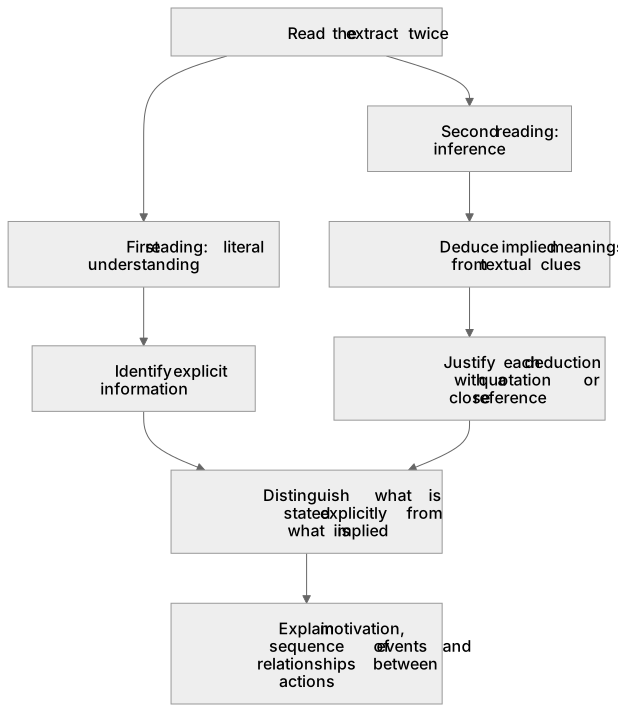
Key words
Say what each word means before you turn the card.
Literal versus inferential meaning
Try answering aloud or in your head before turning the card.
Character motivation and development
Try answering aloud or in your head before turning the card.
Plot structure and cause-effect relationships
Try answering aloud or in your head before turning the card.
The role of setting in shaping meaning
Try answering aloud or in your head before turning the card.
See every definition
- Literal versus inferential meaning
- Understanding a word, phrase or sentence in context, and distinguishing between what is stated explicitly and what is implied.
- Character motivation and development
- Explaining why characters act as they do, and analysing how characterisation develops and interacts with other elements.
- Plot structure and cause-effect relationships
- Tracing the sequence of events and explaining how one action causes another, including the relationship between actions or events.
- The role of setting in shaping meaning
- Exploring aspects of settings and analysing how they develop and interact with plot, characterisation and events to contribute to meaning.
Label the diagram
Some boxes have lost their names. Pick the right name for each number.
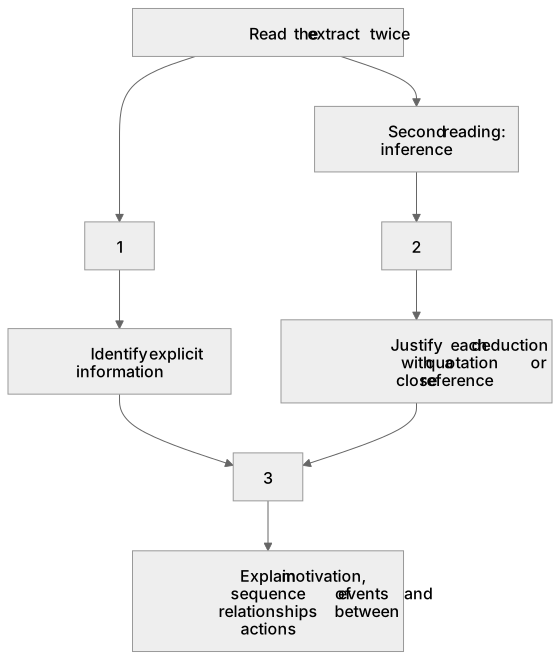
1Box 1
2Box 2
3Box 3
There is more to this lesson
The full lesson goes on to check your understanding and help you earn the marks. Create a free account to carry on, with your progress saved.
A week of Premium from your first lesson · Then the free plan continues · No card, no charge
Test your understanding of Skills - Reading comprehension and reading critically: literal and inferential comprehension: understanding a word, phrase or sentence in context; exploring aspects of plot, characterisation, events and settings; distinguishing between what is stated explicitly and what is implied; explaining motivation, sequence of events, and the relationship between actions or events
Active recall beats re-reading. Take an instant quiz now to test what you’ve learned and lock it into long-term memory.
A week of Premium from your first lesson · Then the free plan continues · No card, no charge