AQA · GCSE · English Literature
Course version: 8702 · Version from Sept 2015
Skills - Writing: accurate Standard English: accurate spelling, punctuation and grammar.
This skill requires accurate Standard English: correct spelling, punctuation and grammar.
- 3 key terms
Study notes
From the checked teaching notes for this specification point.
The idea
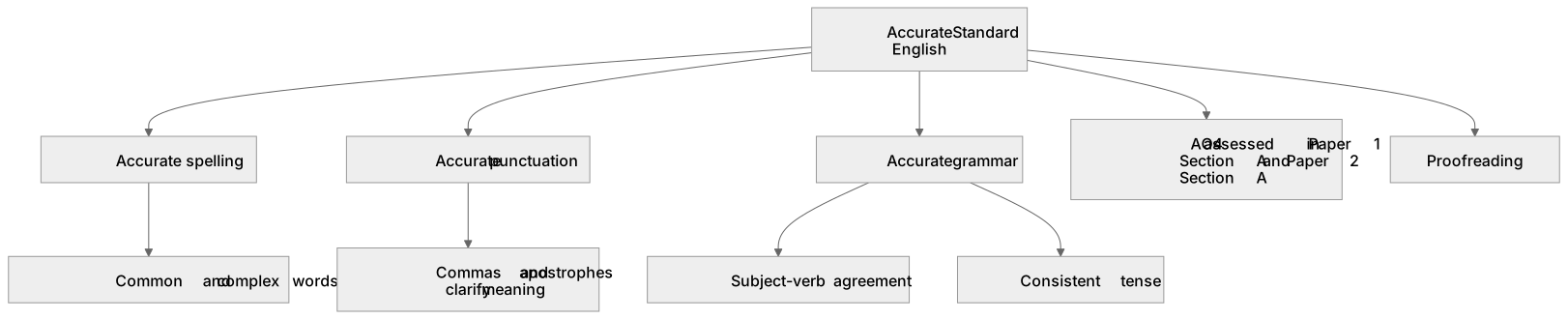
This skill requires accurate Standard English: correct spelling, punctuation and grammar. Spell common and complex words correctly, use punctuation like commas and apostrophes to clarify meaning, and write grammatically sound sentences. For example, distinguish between 'their/there/they're' and use apostrophes for possession, not plurals. Good grammar involves subject-verb agreement and consistent tense. In this specification, these skills (AO4) are assessed for technical accuracy in specific sections: Paper 1 Section A (Shakespeare) and Paper 2 Section A (Modern texts). Marks for technical accuracy are allocated to those sections, not to the 19th-century novel. Frequent errors can obscure your argument, so proofreading is essential to demonstrate control and secure these marks.
What earns the marks
- Accurate spelling includes correctly spelling common words and increasingly complex vocabulary, including subject-specific terms like 'soliloquy' or 'metaphor'.
- Accurate punctuation involves using full stops, commas, question marks, exclamation marks, apostrophes and semicolons correctly to clarify meaning and structure sentences.
- Accurate grammar requires subject-verb agreement, consistent tense, correct pronoun use, and avoidance of sentence fragments or run-on sentences.
- Standard English means avoiding non-standard forms such as double negatives ('I don't know nothing') or incorrect verb forms ('we was').
- Control of writing is demonstrated when errors are rare and do not impede understanding; ambitious vocabulary and varied sentence structures are used accurately.
- AO4 is assessed for technical accuracy in Paper 1 Section A (Shakespeare) and Paper 2 Section A (Modern texts); do not assume it applies to every response.
Common mistakes and how to put them right
Confusing homophones such as 'their', 'there' and 'they're'.
Put it right: Learn the meanings and practise using them in sentences.
Misusing apostrophes for plurals (e.g., 'apple's' instead of 'apples').
Put it right: Apostrophes show possession or omission, not plurals.
Writing comma splices or run-on sentences.
Put it right: Use full stops, semicolons or conjunctions to separate independent clauses.
Inconsistent tense within a sentence or paragraph.
Put it right: Proofread to ensure verbs stay in the same tense unless a shift is intentional.
Assuming AO4 is assessed in every response, including the 19th-century novel.
Put it right: Check the specification; AO4 is assessed in Paper 1 Section A (Shakespeare) and Paper 2 Section A (Modern texts).
Exam tips
- Leave five minutes at the end of the exam to proofread your work, focusing on spelling, punctuation and grammar.
- If unsure about a complex word, choose a simpler word you can spell correctly to maintain accuracy.
- Use a range of punctuation deliberately, such as semicolons to link related clauses or dashes for emphasis, but only if you are confident.
- Read your sentences aloud in your head to check for grammatical errors and clarity.
Try the lesson
The start of the Skills - Writing: accurate Standard English: accurate spelling, punctuation and grammar. lesson, made from checked teaching notes for this specification point.
Have a go first
Which sentence uses Standard English correctly?
Listen
This skill requires accurate Standard English: correct spelling, punctuation and grammar. Spell common and complex words correctly, use punctuation like commas and apostrophes to clarify meaning, and write grammatically sound sentences. For example, distinguish between 'their/there/they're' and use apostrophes for possession, not plurals. Good grammar involves subject-verb agreement and consistent tense. In this specification, these skills (AO4) are assessed for technical accuracy in specific sections: Paper 1 Section A (Shakespeare) and Paper 2 Section A (Modern texts). Marks for technical accuracy are allocated to those sections, not to the 19th-century novel. Frequent errors can obscure your argument, so proofreading is essential to demonstrate control and secure these marks. A strong answer earns marks for these points. Accurate spelling includes correctly spelling common words and increasingly complex vocabulary, including subject-specific terms like 'soliloquy' or 'metaphor'. Accurate punctuation involves using full stops, commas, question marks, exclamation marks, apostrophes and semicolons correctly to clarify meaning and structure sentences. Accurate grammar requires subject-verb agreement, consistent tense, correct pronoun use, and avoidance of sentence fragments or run-on sentences. Standard English means avoiding non-standard forms such as double negatives ('I don't know nothing') or incorrect verb forms ('we was'). A common slip: Confusing homophones such as 'their', 'there' and 'they're'. Instead, learn the meanings and practise using them in sentences. Exam tip: Leave five minutes at the end of the exam to proofread your work, focusing on spelling, punctuation and grammar.
See it
Key words
Say what each word means before you turn the card.
Technical accuracy
Try answering aloud or in your head before turning the card.
Proofreading
Try answering aloud or in your head before turning the card.
Accurate grammar
Try answering aloud or in your head before turning the card.
See every definition
- Technical accuracy
- Accurate spelling, punctuation and grammar, assessed in Paper 1 Section A (Shakespeare) and Paper 2 Section A (Modern texts).
- Proofreading
- Checking your work to demonstrate control and secure marks, since frequent errors can obscure your argument.
- Accurate grammar
- Subject-verb agreement, consistent tense, correct pronoun use, and avoidance of sentence fragments or run-on sentences.
Label the diagram
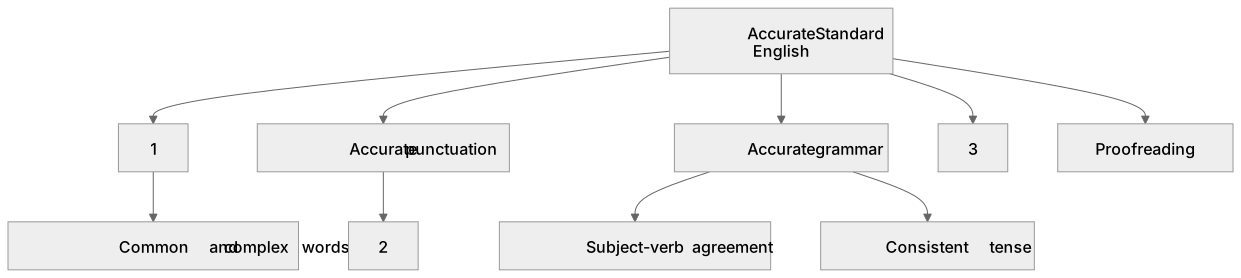
Some boxes have lost their names. Pick the right name for each number.
1Box 1
2Box 2
3Box 3
There is more to this lesson
The full lesson goes on to check your understanding and help you earn the marks. Create a free account to carry on, with your progress saved.
A week of Premium from your first lesson · Then the free plan continues · No card, no charge
Test your understanding of Skills - Writing: accurate Standard English: accurate spelling, punctuation and grammar.
Active recall beats re-reading. Take an instant quiz now to test what you’ve learned and lock it into long-term memory.
A week of Premium from your first lesson · Then the free plan continues · No card, no charge