AQA · GCSE · English Literature
Course version: 8702 · Version from Sept 2015
Skills - Writing: producing clear and coherent text: writing effectively about literature for a range of purposes such as: to describe, explain, summarise, argue, analyse and evaluate; discussing and maintaining a point of view; selecting and emphasising key points; using relevant quotation and using detailed textual references
This skill is about writing clearly and coherently when you respond to literature.
- 4 key terms
Study notes
From the checked teaching notes for this specification point.
The idea
This skill is about writing clearly and coherently when you respond to literature. Exam questions typically use command words such as 'How does...', 'Explore how...', 'Compare...' or 'To what extent...'. You must maintain a point of view, select and emphasise key points, and support ideas with relevant quotation and detailed textual references. For example, if asked how Shakespeare presents Macbeth's ambition, you might argue it is destructive, select Macbeth's Act 1 Scene 7 soliloquy, and embed 'vaulting ambition' before analysing the metaphor. Coherence means each paragraph builds logically on the last and links back to your argument.
What earns the marks
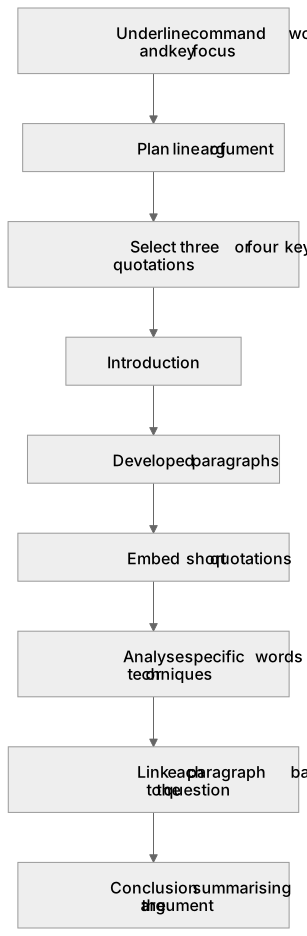
- Clear and coherent writing is organised logically, with an introduction, developed paragraphs and a conclusion that follow a planned line of thought.
- Writing for different purposes means adapting tone and structure: describing uses vivid detail, arguing uses persuasive language, analysing breaks down methods, and evaluating weighs up effects.
- Maintaining a point of view involves consistently referring back to your central argument throughout the response, avoiding drifting into unrelated points.
- Selecting and emphasising key points requires choosing the most relevant moments or quotations rather than listing everything you know about the text.
- Using relevant quotation means embedding short, precise quotations that directly support your point; detailed textual references include specific acts, scenes, chapters or lines.
- Coherence is strengthened by using discourse markers (e.g. 'furthermore', 'in contrast') and by linking each paragraph back to the question.
- Distinguish writing purposes from exam command words: 'describe' and 'summarise' are purposes you may use, while 'How does...' and 'Explore how...' are typical command words that direct your response.
Common mistakes and how to put them right
Retelling the plot instead of arguing a point.
Put it right: Focus on answering the question with analysis, using plot only as brief context.
Using long, unembedded quotations that disrupt the flow.
Put it right: Embed short quotations into your own sentences to maintain coherence.
Losing sight of the point of view by including irrelevant points.
Put it right: Plan your response and check each paragraph links back to your central argument.
Treating 'describe', 'explain', 'summarise', 'argue', 'analyse' and 'evaluate' as exam command words.
Put it right: These are writing purposes from the specification; exam command words are typically 'How does...', 'Explore how...', 'Compare...' or 'To what extent...'.
Exam tips
- Underline the command word and key focus of the question before planning, so you know whether to explore, compare or evaluate.
- Spend five minutes planning your line of argument and selecting three or four key quotations that you can analyse in detail.
- Use short, embedded quotations and always follow them with analysis of specific words or techniques, linking back to your point of view.
- Write a brief conclusion that summarises your argument and evaluates the text's overall effect, if the question asks for evaluation.
Try the lesson
The start of the Skills - Writing: producing clear and coherent text: writing effectively about literature for a range of purposes such as: to describe, explain, summarise, argue, analyse and evaluate; discussing and maintaining a point of view; selecting and emphasising key points; using relevant quotation and using detailed textual references lesson, made from checked teaching notes for this specification point.
Have a go first
Which of the following is the best way to use a quotation when writing about a character in a novel?
Listen
This skill is about writing clearly and coherently when you respond to literature. Exam questions typically use command words such as 'How does...', 'Explore how...', 'Compare... or 'To what extent... You must maintain a point of view, select and emphasise key points, and support ideas with relevant quotation and detailed textual references. For example, if asked how Shakespeare presents Macbeth's ambition, you might argue it is destructive, select Macbeth's Act 1 Scene 7 soliloquy, and embed 'vaulting ambition' before analysing the metaphor. Coherence means each paragraph builds logically on the last and links back to your argument. A strong answer earns marks for these points. Clear and coherent writing is organised logically, with an introduction, developed paragraphs and a conclusion that follow a planned line of thought. Writing for different purposes means adapting tone and structure: describing uses vivid detail, arguing uses persuasive language, analysing breaks down methods, and evaluating weighs up effects. Maintaining a point of view involves consistently referring back to your central argument throughout the response, avoiding drifting into unrelated points. Selecting and emphasising key points requires choosing the most relevant moments or quotations rather than listing everything you know about the text. A common slip: Retelling the plot instead of arguing a point. Instead, focus on answering the question with analysis, using plot only as brief context. Exam tip: Underline the command word and key focus of the question before planning, so you know whether to explore, compare or evaluate.
See it
Key words
Say what each word means before you turn the card.
Clear and coherent written communication
Try answering aloud or in your head before turning the card.
Adapting writing for different purposes
Try answering aloud or in your head before turning the card.
Sustaining a critical point of view
Try answering aloud or in your head before turning the card.
Selecting and using textual evidence effectively
Try answering aloud or in your head before turning the card.
See every definition
- Clear and coherent written communication
- Writing that is organised logically, with an introduction, developed paragraphs and a conclusion that follow a planned line of thought.
- Adapting writing for different purposes
- Adapting tone and structure so that describing uses vivid detail, arguing uses persuasive language, analysing breaks down methods, and evaluating weighs up effects.
- Sustaining a critical point of view
- Consistently referring back to your central argument throughout the response, avoiding drifting into unrelated points.
- Selecting and using textual evidence effectively
- Choosing the most relevant moments or quotations rather than listing everything you know, and embedding short, precise quotations that directly support your point.
Label the diagram
Some boxes have lost their names. Pick the right name for each number.
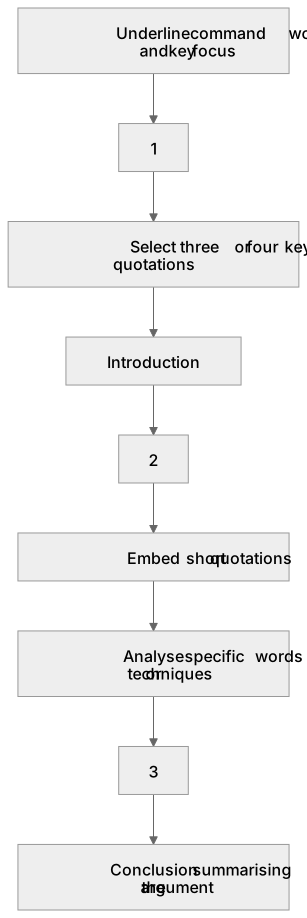
1Box 1
2Box 2
3Box 3
There is more to this lesson
The full lesson goes on to check your understanding and help you earn the marks. Create a free account to carry on, with your progress saved.
A week of Premium from your first lesson · Then the free plan continues · No card, no charge
Test your understanding of Skills - Writing: producing clear and coherent text: writing effectively about literature for a range of purposes such as: to describe, explain, summarise, argue, analyse and evaluate; discussing and maintaining a point of view; selecting and emphasising key points; using relevant quotation and using detailed textual references
Active recall beats re-reading. Take an instant quiz now to test what you’ve learned and lock it into long-term memory.
A week of Premium from your first lesson · Then the free plan continues · No card, no charge