AQA · GCSE · English Literature
Course version: 8702 · Version from Sept 2015
Storm on the Island
'Storm on the Island' is a powerful exploration of human vulnerability in the face of nature's relentless force. It rewards candidates who can unpick its political undertones and masterful use of structure, making it a brilliant text for demonstrating perceptive, critical analysis.
- 6 min read
- 1 worked example
- 4 practice questions
- 8 key terms
Check what you remember
Read the wording for your board, then hide it and explain Dramatic Monologue in your own words. Rough notes are fine. This is a self-check, with no mark or grade.
Reference: AQA
A poem in the form of a speech or narrative by an imagined person, in which the speaker inadvertently reveals aspects of their character.
Study Notes
Overview
'Storm on the Island' by Seamus Heaney is a dramatic monologue that explores the conflict between a seemingly secure island community and the formidable, unpredictable power of nature. Published in 1966, before the outbreak of 'The Troubles' in Northern Ireland, the poem operates on two levels: a literal description of a storm, and a metaphorical exploration of political violence and existential threat. Examiners look for candidates who can seamlessly integrate these contextual layers while providing detailed, word-level analysis of Heaney's military lexis and structural choices.
Listen to the audio guide here:
Content Overview
The poem follows a clear chronological progression, shifting from confident preparation to terrifying exposure. The speaker begins by detailing the community's defensive measures against the harsh weather: building squat houses, sinking walls into rock, and securing roofs with slate. However, as the storm hits, the landscape itself turns against them. The sea, usually a companion, becomes a weapon, and the wind attacks the island like a fighter plane. By the end, the speaker is left contemplating the terrifying reality that the source of their profound fear is invisible and intangible.
Themes
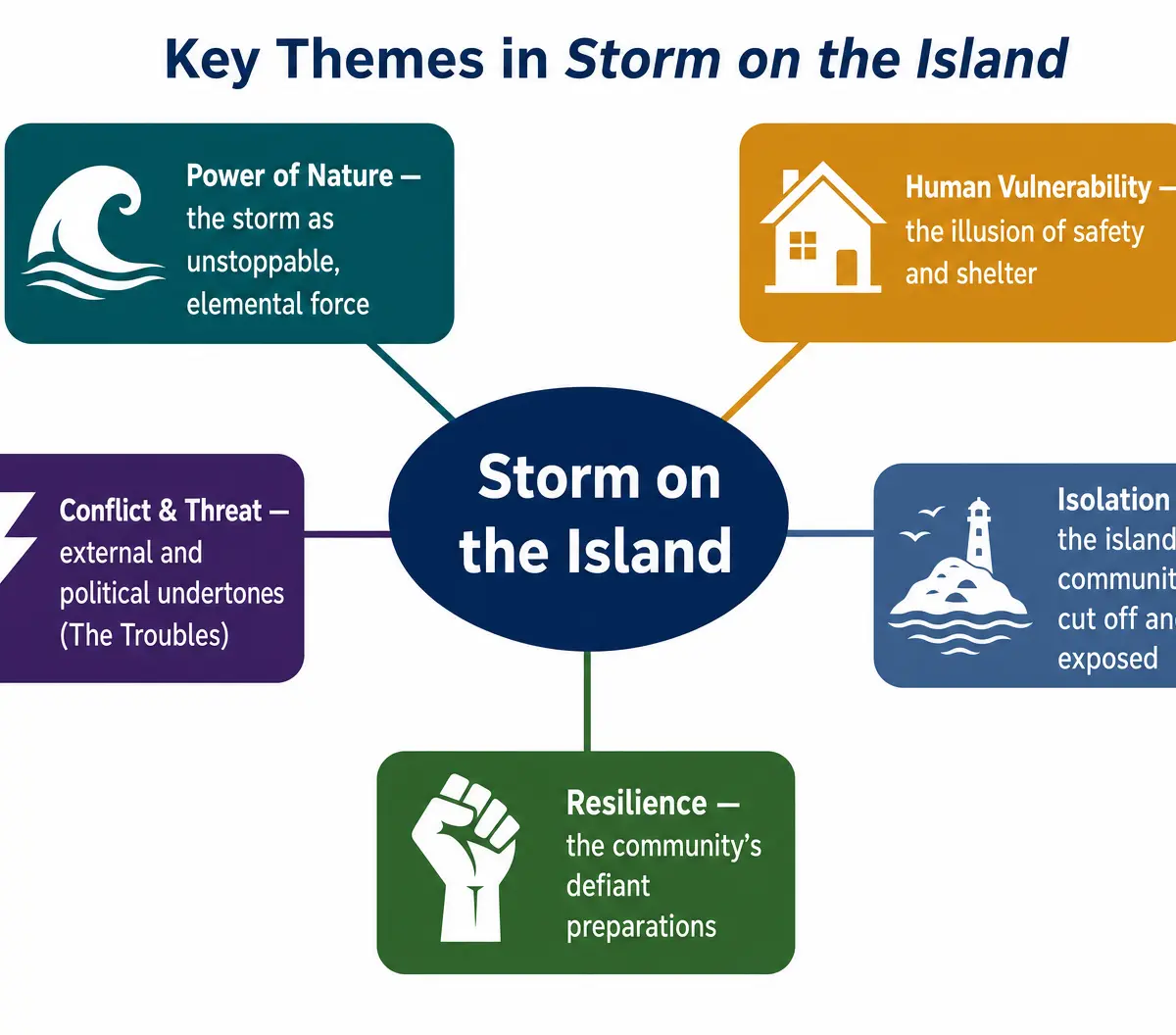
Theme 1: The Power of Nature
Heaney presents nature not as a nurturing force, but as an aggressive, unstoppable adversary. The storm is personified as a military attacker, highlighting its destructive capability and the complete lack of control humanity has over it.
Key Quotes:
- "Spits like a tame cat / Turned savage" - The simile suggests that nature can seem domesticated and familiar (the sea), but can suddenly turn wild and dangerous. The sibilance of 'spits' and 'savage' creates a hissing, menacing tone.
- "We are bombarded by the empty air" - The military verb 'bombarded' transforms the wind into artillery fire, emphasising the violent, relentless nature of the assault.
Theme 2: Human Vulnerability and Isolation
The poem exposes the illusion of human safety. Despite their careful preparations, the islanders are ultimately powerless. Their isolation on the island amplifies their vulnerability, as they have no shelter and no escape.
Key Quotes:
- "We are prepared: we build our houses squat" - The collective pronoun 'we' establishes a sense of community solidarity, while the confident, declarative opening sentence suggests a false sense of security that is dismantled as the poem progresses.
- "No trees, no natural shelter" - The repetition of 'no' emphasises the bleakness and complete exposure of the landscape, stripping away any comfort.
Theme 3: Conflict and Threat (Political Metaphor)
Many critics read the poem as an allegory for the political tensions in Northern Ireland (The Troubles). The storm represents the threat of violence that hangs over the community, an invisible but terrifying presence.
Key Quotes:
- "Space is a salvo" - 'Salvo' is a simultaneous discharge of artillery. By equating empty space with weaponry, Heaney suggests that the threat is everywhere and nowhere, much like guerrilla warfare or political tension.
- "Strange, it is a huge nothing that we fear." - The concluding paradox highlights the existential dread of the islanders. The threat is invisible (the wind/political tension), making it impossible to fight, which is deeply unsettling.
Writer's Methods
Form
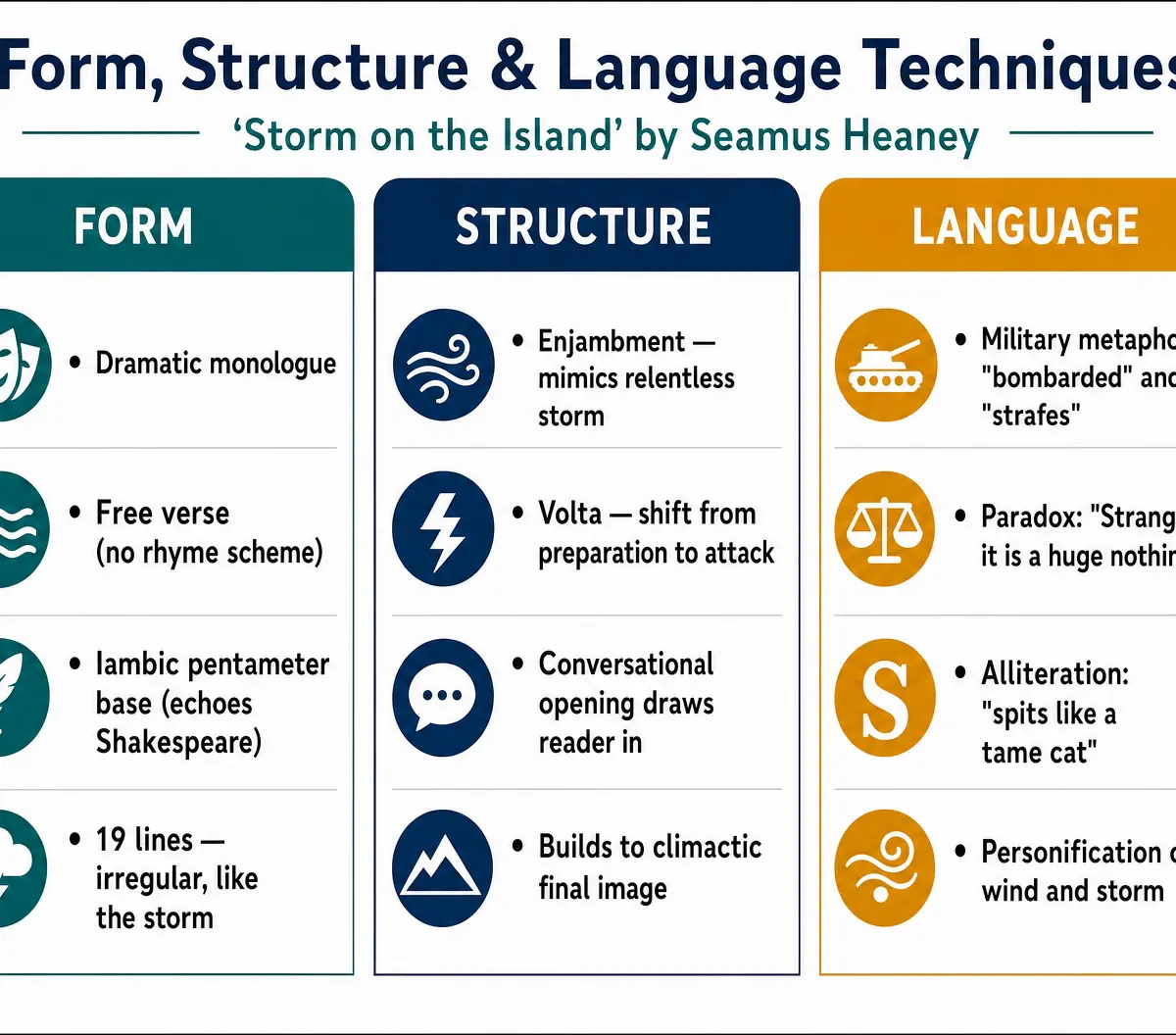
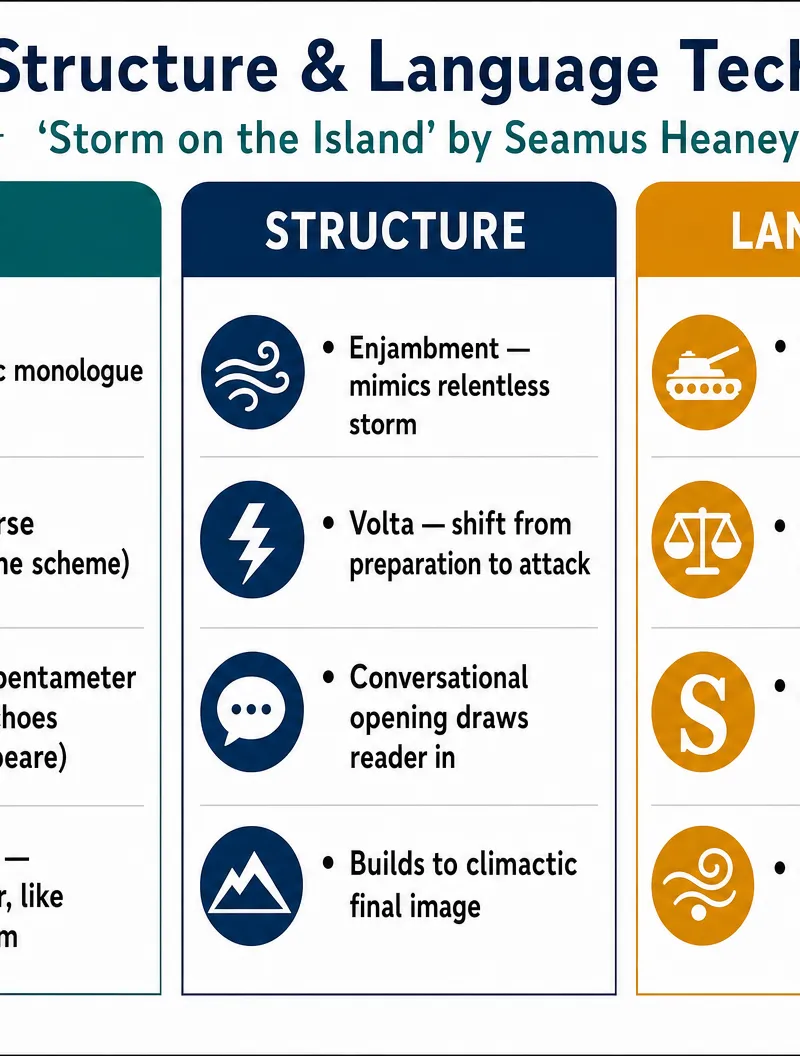
The poem is written as a dramatic monologue in free verse, with a loose iambic pentameter base. The lack of a regular rhyme scheme mirrors the unpredictable, chaotic nature of the storm. The single stanza of 19 lines visually represents the relentless, unbroken assault of the weather.
Structure
Heaney makes masterful use of enjambment. Lines frequently spill over into the next without punctuation (e.g., "when it begins, / The flung spray hits"). This creates a fast, uncontrollable pace, mimicking the breathless, overwhelming experience of being caught in the storm. The poem also features a clear volta (turning point) around line 14 ("But there are no trees"), where the tone shifts from confident preparation to fearful realisation.
Language
The most striking linguistic feature is the extended military metaphor. Words like "strafes", "salvo", and "bombarded" compare the storm to an aerial bombardment. This lexical field of warfare elevates the storm from a natural event to a hostile, deliberate attack. Additionally, the personification of the earth and sea ("the earth has never troubled us", "spits like a tame cat") gives the landscape agency and hostility.
Context
Seamus Heaney was born in County Derry, Northern Ireland, in 1939. 'Storm on the Island' was published in 1966 in his collection Death of a Naturalist. This was a period of rising tension in Northern Ireland, leading up to 'The Troubles' (a conflict primarily between Unionists/Loyalists and Nationalists/Republicans).
Examiner Expectation: Top-tier candidates (Level 5/6) will not simply state "Heaney was Irish." Instead, they will integrate this context to enrich their analysis, suggesting that the poem's military language and themes of invisible threat reflect the anxiety and looming violence of the political situation in Northern Ireland. Interestingly, the first eight letters of the poem's title spell 'Stormont', the name of the Northern Ireland parliament building, further supporting this political reading.
Visual Resources
2 diagrams and illustrations
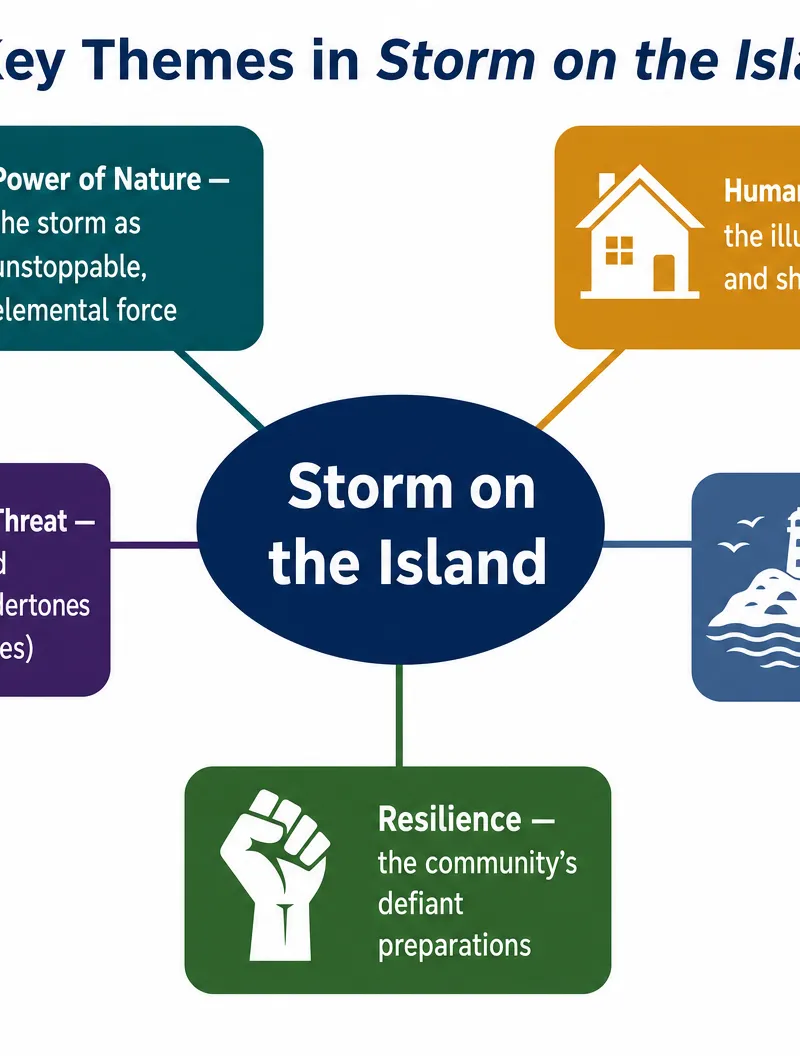
Interactive Diagrams
1 interactive diagram to visualise key concepts
Conceptual Flow Outline
The structural progression of fear in 'Storm on the Island'
Worked Examples
1 worked example — open one to explore the question and available guidance.
Practice Questions
Try the question, then reveal an answer plan or example response
Compare how poets present the power of nature in 'Storm on the Island' and one other poem from your anthology. (30 marks)
Hint: Consider 'Exposure' or 'Bayonet Charge' for contrast, or 'Ozymandias' for a similar theme of human powerlessness.
How does Heaney use language and structure to create a sense of fear in 'Storm on the Island'? (15 marks)
Hint: Look at the shift from 'we are prepared' to 'a huge nothing that we fear'. Discuss the military lexis.
Explore the significance of the poem's title, 'Storm on the Island'.
Hint: Think about the literal meaning, the isolation of an island, and the hidden political meaning (Stormont).
Compare how poets present human vulnerability in 'Storm on the Island' and 'London'. (30 marks)
Hint: Compare the external threat of nature in Heaney to the internal, societal threat in Blake.
Exam technique
How to turn what you know into marks
How to approach the question
Deconstruct the question to find the core theme (e.g., 'power of nature'). Choose a comparison poem that offers both similarities and differences in how that theme is presented.
How to structure your answer
Use integrated comparative paragraphs. Discuss Poem A, then use a connective ('Similarly', 'Conversely') to discuss Poem B in the same paragraph, comparing their methods directly.
Timing
For a 30 mark poetry comparison, spend 5 minutes planning, 40 minutes writing.
Common pitfalls
- Writing about one poem entirely, then the other (failing to integrate comparison).
- Feature spotting (e.g., 'Heaney uses enjambment') without explaining the effect.
- Bolting on context (e.g., 'Heaney was Irish') without linking it to the language of the poem.
What the command words want
- Compare
- Focus heavily on AO2 (methods). How do both poets use language/structure to present the theme? What is similar? What is different?
- How does... present
- Focus on the writer's choices. Use phrases like 'Heaney constructs...', 'The poet utilises...', 'This suggests...'
Watch or listen (optional)
Test your understanding of Storm on the Island
Active recall beats re-reading. Take an instant quiz now to test what you’ve learned and lock it into long-term memory.
7 days Premium · Then the free plan continues · No card, no charge