AQA · GCSE · English Literature
Course version: 8702 · Version from Sept 2015
The Tempest
Dive into the magic, power struggles, and colonial tensions of Shakespeare's final solo masterpiece, The Tempest. This guide will help you master character complexities, untangle the theme of power, and weave Jacobean context into your essays to secure top marks.
- 6 min read
- 2 worked examples
- 4 practice questions
- 4 key terms
Try the lesson
The start of the The Tempest lesson, made from checked teaching notes for this specification point.
Have a go first
In The Tempest, who is the rightful Duke of Milan that lives in exile on the island?
Listen
The Tempest is a Shakespeare set text for AQA GCSE English Literature. You study the whole play, exploring how Shakespeare presents power, colonisation, magic, revenge, forgiveness and the relationship between nature and nurture. Assessment is by a closed-book exam: you respond to one question, analysing a printed extract and then the play as a whole. You need detailed knowledge of plot, characters, themes and Shakespeare's dramatic methods, including masque, spectacle, song and the island setting. A useful method is to map the play's movement from storm and plotting to reconciliation, tracking how Prospero's control of magic and language shapes events and how different characters respond to freedom and servitude. A strong answer earns marks for these points. Trace how Prospero's magic drives the main plot, from the initial storm he conjures to the harpy masque Ariel performs to induce remorse in his enemies. Explain Caliban's desire for freedom by analysing his alliance with Stephano and Trinculo, showing how their drunken plot to kill Prospero is comically thwarted. Describe the play's resolution in Act 5, focusing on Prospero's forgiveness of his enemies, his freeing of Ariel, and his direct address to the audience in the Epilogue. Analyse how Ariel's song uses rhyme and haunting imagery to transform Alonso's supposed death into art, blurring grief and illusion. A common slip: Treating Caliban or Ariel as simple stereotypes without analysing how Shakespeare uses their language and status. Instead, examine their speech and role in relation to power and freedom. Exam tip: Identify the question's focus, such as power, forgiveness or discovery, and keep returning to it throughout the essay.
See it
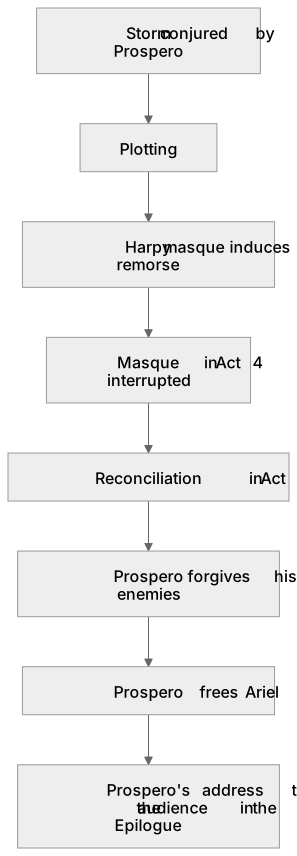
Put it in order
Put these steps in the order they happen.
- 1. Plotting
- 2. Harpy masque induces remorse
- 3. Masque in Act 4 interrupted
- 4. Reconciliation in Act 5
- 5. Prospero forgives his enemies
- 6. Prospero frees Ariel
- 7. Prospero's address to the audience in the Epilogue
- 8. Storm conjured by Prospero
Key words
Say what each word means before you turn the card.
Power and control
Try answering aloud or in your head before turning the card.
Colonisation and otherness
Try answering aloud or in your head before turning the card.
Magic, art and illusion
Try answering aloud or in your head before turning the card.
Forgiveness and reconciliation
Try answering aloud or in your head before turning the card.
See every definition
- Power and control
- Shakespeare presents this through Prospero's control of magic and language, which shapes events and drives the main plot.
- Colonisation and otherness
- Contextual ideas about exploration and colonialism connect to Caliban's claim to the island and debates about the rights of indigenous peoples.
- Magic, art and illusion
- Prospero's magic, derived from his books, and his creation of the masque link to Renaissance interest in magic and learning.
- Forgiveness and reconciliation
- The play's movement from revenge to forgiveness fits the genre of Shakespeare's late romances, while noting the uneasy reconciliation.
Label the diagram
Some boxes have lost their names. Pick the right name for each number.
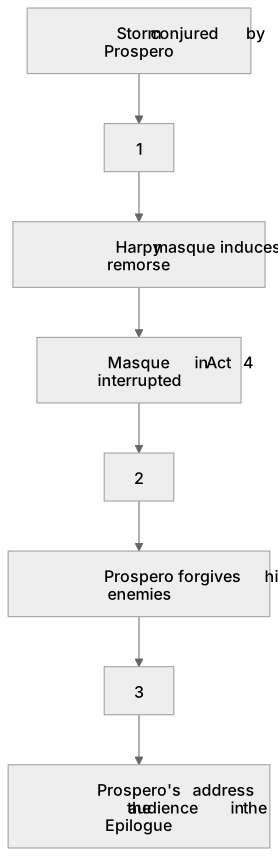
1Box 1
2Box 2
3Box 3
There is more to this lesson
The full lesson goes on to check your understanding and help you earn the marks. Create a free account to carry on, with your progress saved.
A week of Premium from your first lesson · Then the free plan continues · No card, no charge
Study Notes
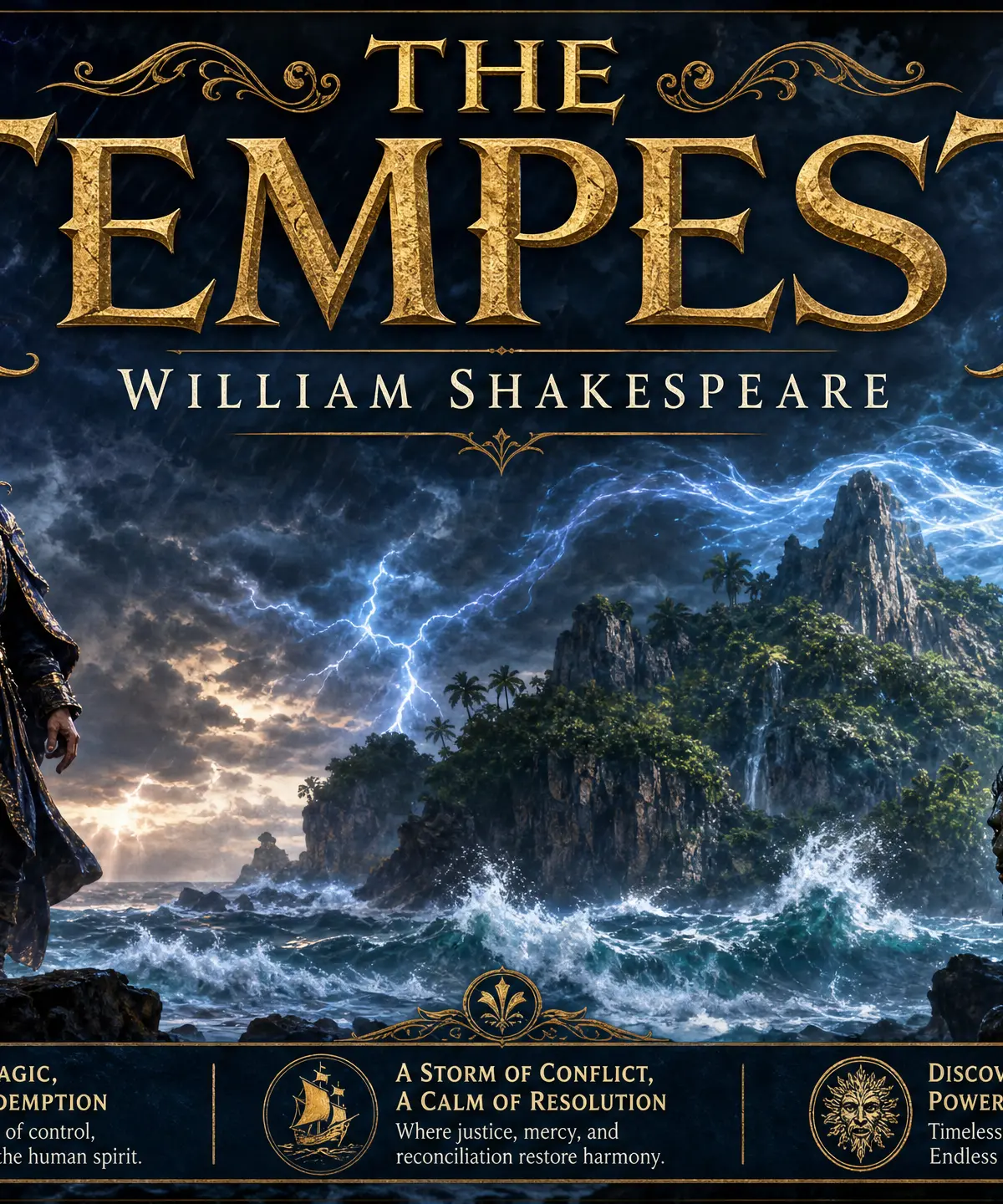
Overview
'The Tempest', written around 1610-1611, is a late romance play by William Shakespeare. It explores themes of power, colonialism, magic, and forgiveness on a mysterious island. Examiners look for a nuanced understanding of characters like Prospero and Caliban, rather than simplistic readings. They reward candidates who can integrate contextual knowledge—such as Jacobean exploration and beliefs about magic—seamlessly into their analysis of Shakespeare's dramatic methods. This guide will help you move beyond basic plot retelling to achieve the critical, perceptive analysis required for Levels 5 and 6.
Plot/Content Overview
Act 1: A violent storm (the tempest) wrecks a ship carrying King Alonso of Naples and his court. We learn the storm was conjured by Prospero, the usurped Duke of Milan, who lives on the island with his daughter Miranda. Prospero commands the spirit Ariel and has enslaved the native Caliban. Ferdinand, Alonso's son, meets Miranda and they fall in love.
Act 2: The shipwrecked royals wander the island. Prospero's treacherous brother Antonio convinces Sebastian to plot to kill King Alonso. Meanwhile, Caliban meets the drunken sailors Trinculo and Stephano and plots to overthrow Prospero.
Act 3: Ferdinand labours for Prospero to win Miranda. The royals are confronted by Ariel in the form of a harpy, who accuses them of their past crimes against Prospero.
Act 4: Prospero blesses Ferdinand and Miranda's betrothal with a magical masque. He suddenly remembers Caliban's plot and abruptly ends the revels, delivering his famous "our revels now are ended" speech.
Act 5: Prospero's enemies are entirely in his power. Moved by Ariel's pity, Prospero chooses forgiveness over revenge. He reveals his identity, reclaims his dukedom, frees Ariel, and renounces his magic. In the Epilogue, he asks the audience for applause to set him free.
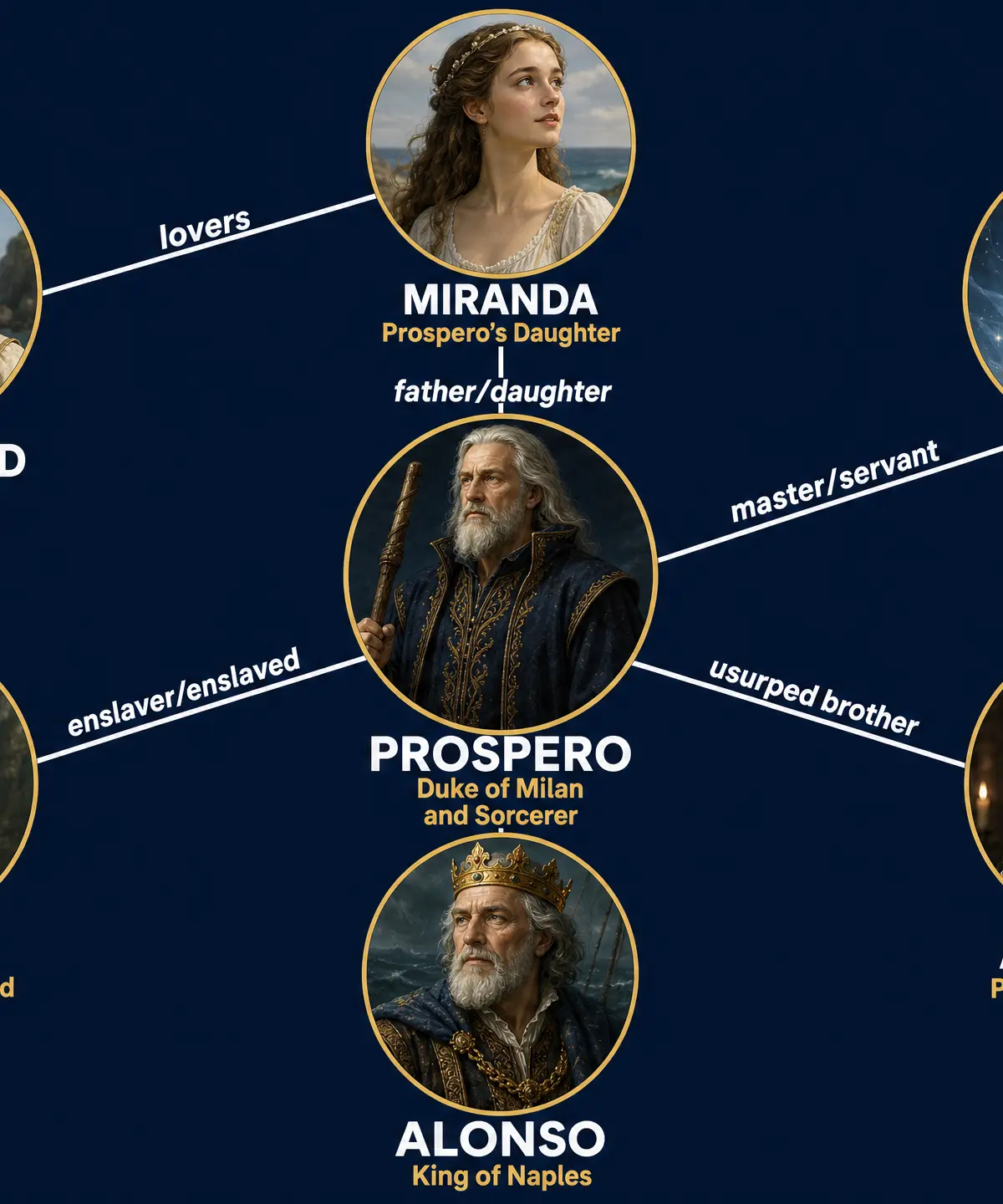
Themes
Theme 1: Power and Control
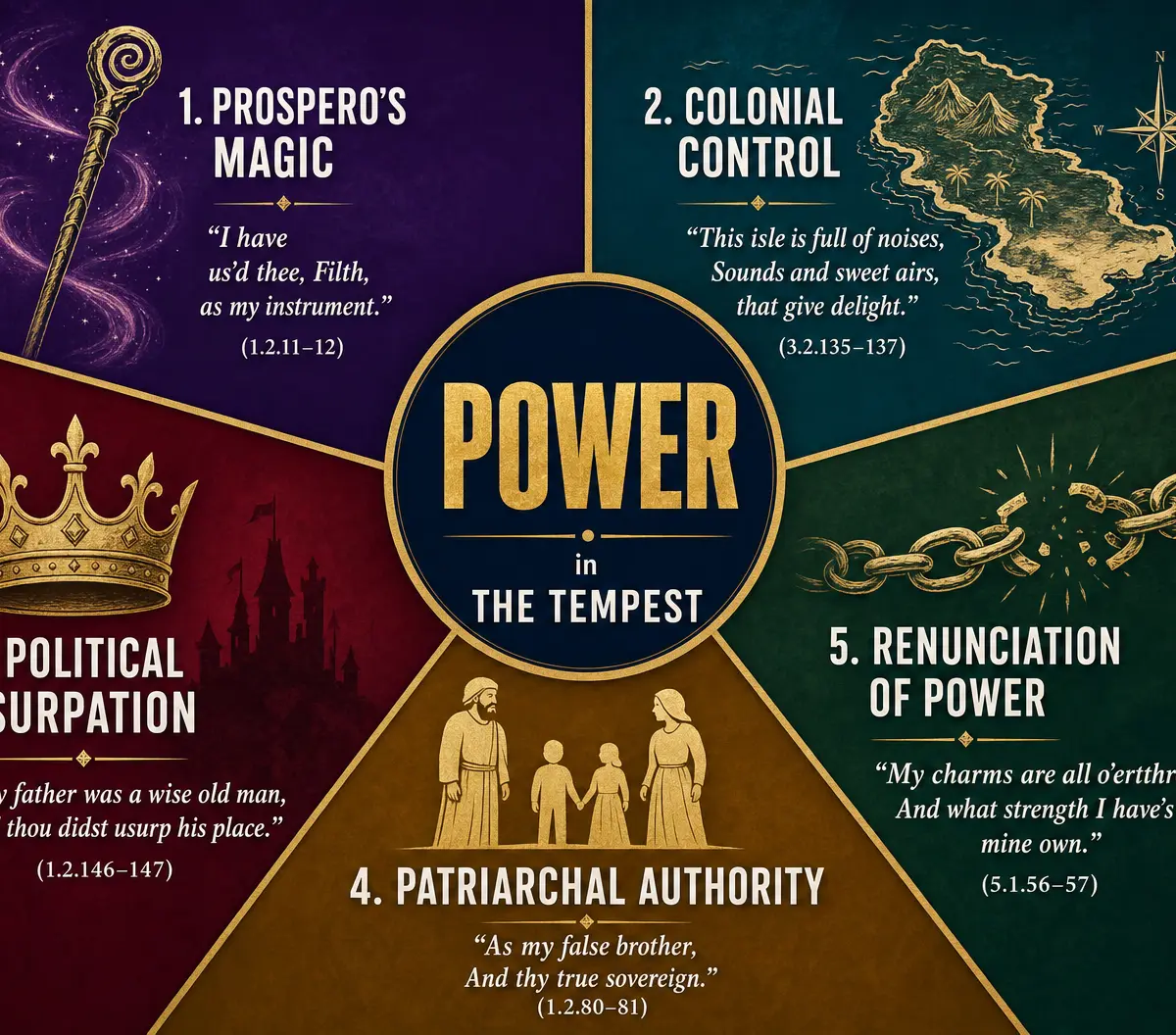
Power is the central engine of the play. Shakespeare explores political usurpation (Antonio stealing Prospero's dukedom), colonial control (Prospero enslaving Caliban), and patriarchal authority (Prospero arranging Miranda's marriage). The play asks whether power inevitably corrupts and what it takes to relinquish it.
Key Quotes:
- "I have used thee, Filth as thou art, with humane care" (1.2) - Prospero's justification of his power over Caliban, highlighting the coloniser's mindset.
- "My charms I'll break, their senses I'll restore" (5.1) - The moment Prospero chooses to relinquish his magical power, suggesting that true strength lies in restraint.
Theme 2: Colonialism and 'The Other'
The play reflects Jacobean anxieties and fascinations with the New World. Caliban represents the colonised subject—initially nurtured, then enslaved and dispossessed. The play interrogates the morality of empire.
Key Quotes:
- "This island's mine, by Sycorax my mother, Which thou tak'st from me." (1.2) - Caliban's assertion of sovereignty and the injustice of colonial dispossession.
- "You taught me language, and my profit on't Is, I know how to curse." (1.2) - Highlights how the coloniser's 'gift' becomes a tool of resistance.
Theme 3: Magic, Illusion, and Art
Magic in the play is both a literal force and a metaphor for theatrical art. Prospero acts as a playwright, directing the action and creating illusions. His renunciation of magic is often read as Shakespeare's farewell to the theatre.
Key Quotes:
- "We are such stuff As dreams are made on, and our little life Is rounded with a sleep." (4.1) - Prospero's meta-theatrical reflection on the fleeting nature of life and art.
- "But this rough magic I here abjure" (5.1) - Prospero's decision to abandon his art and return to the real world.
Character Analysis
Prospero
Role: The protagonist, usurped Duke of Milan, and master of the island.
Key Traits: Controlling, protective, vengeful yet ultimately merciful, authoritative.
Character Arc: He moves from a desire for absolute control and revenge to an acceptance of human limitation and the necessity of forgiveness.
Essential Quotes:
- "The rarer action is in virtue than in vengeance." (5.1)
- "I'll break my staff... I'll drown my book." (5.1)
Caliban
Role: The native inhabitant of the island, enslaved by Prospero.
Key Traits: Resentful, eloquent, earthy, morally complex.
Character Arc: He moves from rebellion to a grudging acceptance of authority, vowing to "be wise hereafter, And seek for grace."
Essential Quotes:
- "The isle is full of noises, Sounds and sweet airs, that give delight and hurt not." (3.2)
- "I must obey. His art is of such power." (1.2)
Ariel
Role: A spirit of the air, bound to serve Prospero.
Key Traits: Ethereal, obedient but longing for freedom, devoid of human emotion but capable of prompting it in others.
Character Arc: Ariel faithfully executes Prospero's commands until finally granted the long-promised freedom.
Essential Quotes:
- "All hail, great master! grave sir, hail! I come To answer thy best pleasure." (1.2)
- "Mine would, sir, were I human." (5.1)
Writer's Methods
Shakespeare uses a variety of dramatic and linguistic methods to shape meaning. The play observes the classical unities of time and place—the action unfolds in real-time on a single island, intensifying the pressure. He contrasts the blank verse (unrhymed iambic pentameter) of noble characters like Prospero with the prose of lower-class characters like Stephano, though notably, Caliban speaks in beautiful verse, elevating his status. The use of spectacle—the storm, the harpy, the masque—reinforces the theme of illusion.
Context
Examiners expect candidates to integrate context. Key areas include:
- Age of Discovery: The 1609 wreck of the Sea Venture in Bermuda heavily influenced the play's colonial themes.
- The Great Chain of Being: Jacobean belief in a strict hierarchy; Antonio's usurpation disrupts this, causing chaos.
- Magic and Witchcraft: King James I was fascinated by (and fearful of) witchcraft. Prospero's 'white' magic (theurgy) is contrasted with Sycorax's 'black' magic (goety).
- Divine Right of Kings: The belief that monarchs are appointed by God, making usurpation a sin against heaven.
Listen to our comprehensive podcast episode for a deeper dive into these themes and characters, along with a quick-fire revision quiz!
Worked Examples
2 worked examples — open one to explore the question and available guidance.
Practice Questions
Try the question, then reveal an answer plan or example response
Starting with this extract (Act 4, Scene 1: "Our revels now are ended"), explore how Shakespeare presents the theme of illusion and reality. (30 marks + 4 AO4)
This prompt needs an extract from your set text. Use the extract provided by your teacher or exam paper; this question card does not include one.
Hint: Consider how the masque functions as a play-within-a-play, and connect Prospero's magic to Shakespeare's own theatrical art.
Explore how Shakespeare presents Antonio as a Machiavellian villain. (30 marks + 4 AO4)
Hint: Look at his past actions (usurping Prospero) and his present actions on the island (manipulating Sebastian).
How does Shakespeare present the island setting in The Tempest? (30 marks + 4 AO4)
Hint: The island is not just a location; it is a blank canvas where characters project their own desires and fears.
Explore how Shakespeare presents the relationship between Miranda and Ferdinand. (30 marks + 4 AO4)
Hint: Consider whether their love is genuinely pure, or if it is manipulated by Prospero for political gain.
Exam technique
How to turn what you know into marks
How to approach the question
Underline the focus (character or theme). Identify 3-4 key moments in the play that address this focus. Select 2 short quotes for each moment. Decide on your overarching thesis statement before you start writing.
How to structure your answer
Use integrated paragraphs: Make a conceptual Point → Embed short Evidence → Analyse the Method (language/structure) → Explore the Effect on the audience → Seamlessly weave in relevant Context (AO3).
Timing
For a 30+4 mark question, spend 5 minutes planning, 40-45 minutes writing.
Common pitfalls
- Feature spotting without analysing the effect on the audience.
- Bolting on context at the end of a paragraph rather than linking it to the quote.
- Retelling the plot instead of analysing the writer's choices.
- Treating Caliban only as a victim without acknowledging his complex, sometimes violent nature.
What the command words want
- Explore
- Look at the topic from multiple angles. E.g., if exploring power, look at political, magical, and colonial power.
- Evaluate
- Make judgements based on evidence. Consider alternative interpretations (e.g., 'While a postcolonial reading suggests... a different perspective might argue...').
- How does... present
- Focus heavily on AO2 (methods). Use phrases like 'Shakespeare constructs...', 'Through the use of...', 'The writer employs...'
- Starting with this extract
- Maintain a strict 50/50 balance between analysing the printed extract and referencing the wider play.
Test your understanding of The Tempest
Active recall beats re-reading. Take an instant quiz now to test what you’ve learned and lock it into long-term memory.
A week of Premium from your first lesson · Then the free plan continues · No card, no charge