AQA · GCSE · English Literature
Course version: 8702 · Version from Sept 2015
Tissue
Imtiaz Dharker's 'Tissue' is a profound and delicate exploration of the fragility of human power. By using the extended metaphor of paper, the poem challenges us to rethink the permanence of the borders, buildings, and beliefs that shape our world."
- 5 min read
- 1 worked example
- 1 practice question
Study Notes
Overview
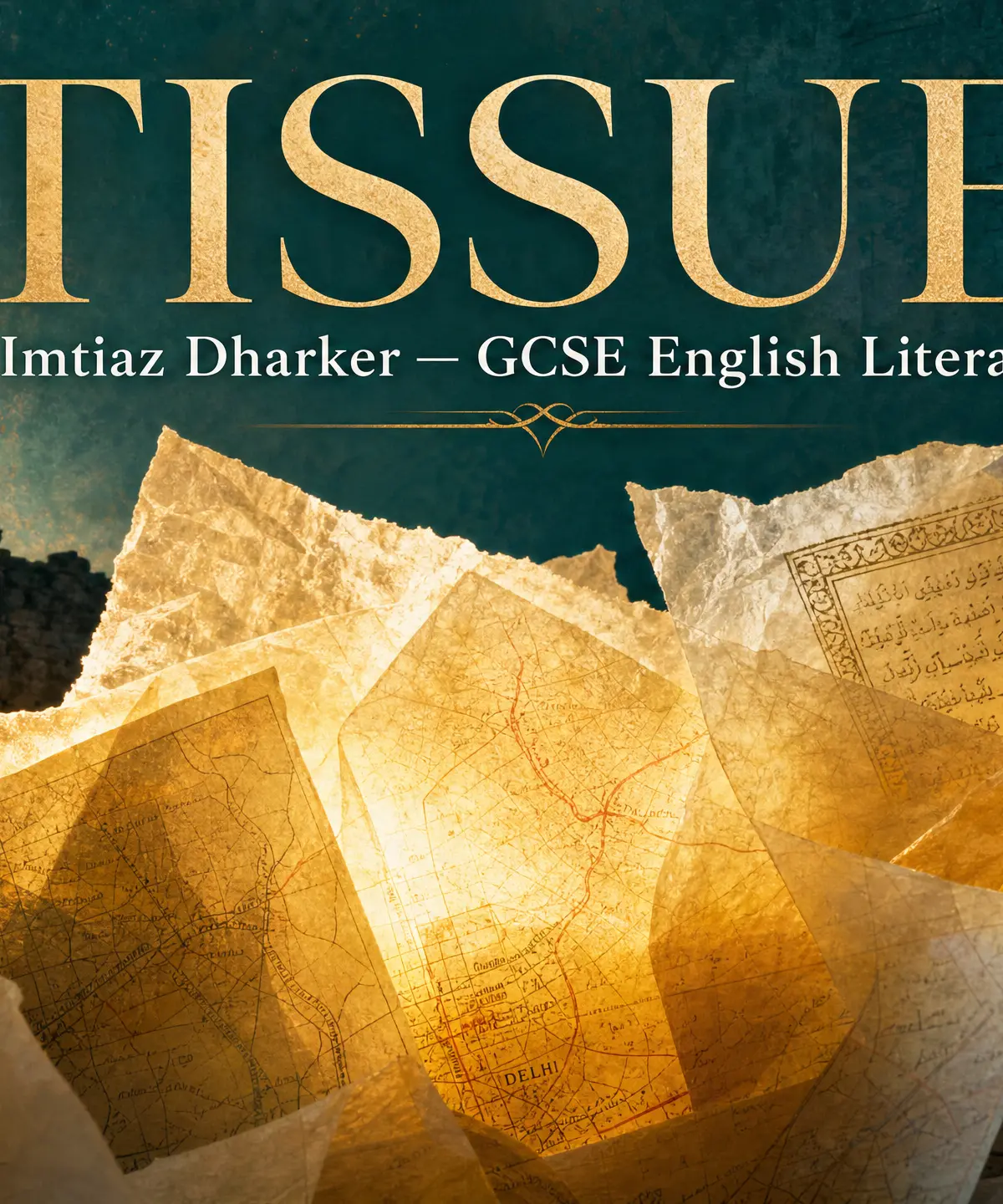
Imtiaz Dharker's 'Tissue' is a deeply philosophical poem that uses the extended metaphor of paper to explore the fragility and transience of human power. Unlike other poems in the anthology that depict conflict through violence or dramatic downfall, Dharker contrasts the solid, imposing nature of buildings and borders with the delicate, light-permeable nature of tissue paper. The poem suggests that true strength lies in softness, adaptability, and the transcendent power of light. Examiners look for candidates who can confidently navigate this extended metaphor, moving beyond a literal interpretation of paper to discuss what it represents: human identity, rigid societal structures, and the inevitable decay of human constructs.
Podcast Revision
Listen to this 10-minute revision podcast covering the core concepts, exam tips, and a quick-fire recall quiz.
Thematic Overview
Theme 1: Power and Fragility
Dharker presents human power as inherently fragile, contrasting the arrogance of permanent structures with the delicate reality of existence. The poem suggests that the rigid things humans build—both physical (buildings) and conceptual (borders)—are ultimately as vulnerable as tissue paper.
Key Quotes:
- "paper thinned by age or touching" (Stanza 1) - The verb 'touching' implies that human contact and the passage of time gently erode power. It is not dramatic conflict that destroys, but the persistent reality of life.
- "the sun shines through / their borderlines" (Stanza 5) - Light, a natural and transcendent force, easily penetrates the artificial borders humans draw on maps. This highlights the arbitrary and fragile nature of human division.
Theme 2: Transience and Impermanence
Everything humans create is temporary. Dharker uses the imagery of paper records—receipts, maps, and architectural plans—to show how we attempt to make things permanent, yet these very records are delicate and easily destroyed.
Key Quotes:
- "fine slips from grocery shops" (Stanza 4) - These slips represent the power of money and commerce, yet they "fly our lives like paper kites." This simile suggests that we are controlled by money, but also that this control is flimsy and subject to the wind.
- "raise a structure / never meant to last" (Stanza 9) - This explicit statement acknowledges the impermanence of human creation, suggesting an acceptance of our transient nature.
Theme 3: Light and Transparency
Light acts as a symbol of truth, knowledge, and perhaps a spiritual or transcendent force that exists beyond human constructs. It exposes the fragility of paper and, by extension, the fragility of human power.
Key Quotes:
- "Paper that lets the light / shine through, this / is what could alter things." (Stanza 1) - The enjambment here allows the line to flow, mimicking the passage of light. The light represents an alternative, softer power that can bring about change.
- "let the daylight break / through capitals and monoliths" (Stanza 8) - 'Capitals' and 'monoliths' represent human arrogance and entrenched power. The daylight breaking through them suggests nature or truth overcoming human constructs.
Writer's Methods
Form and Structure
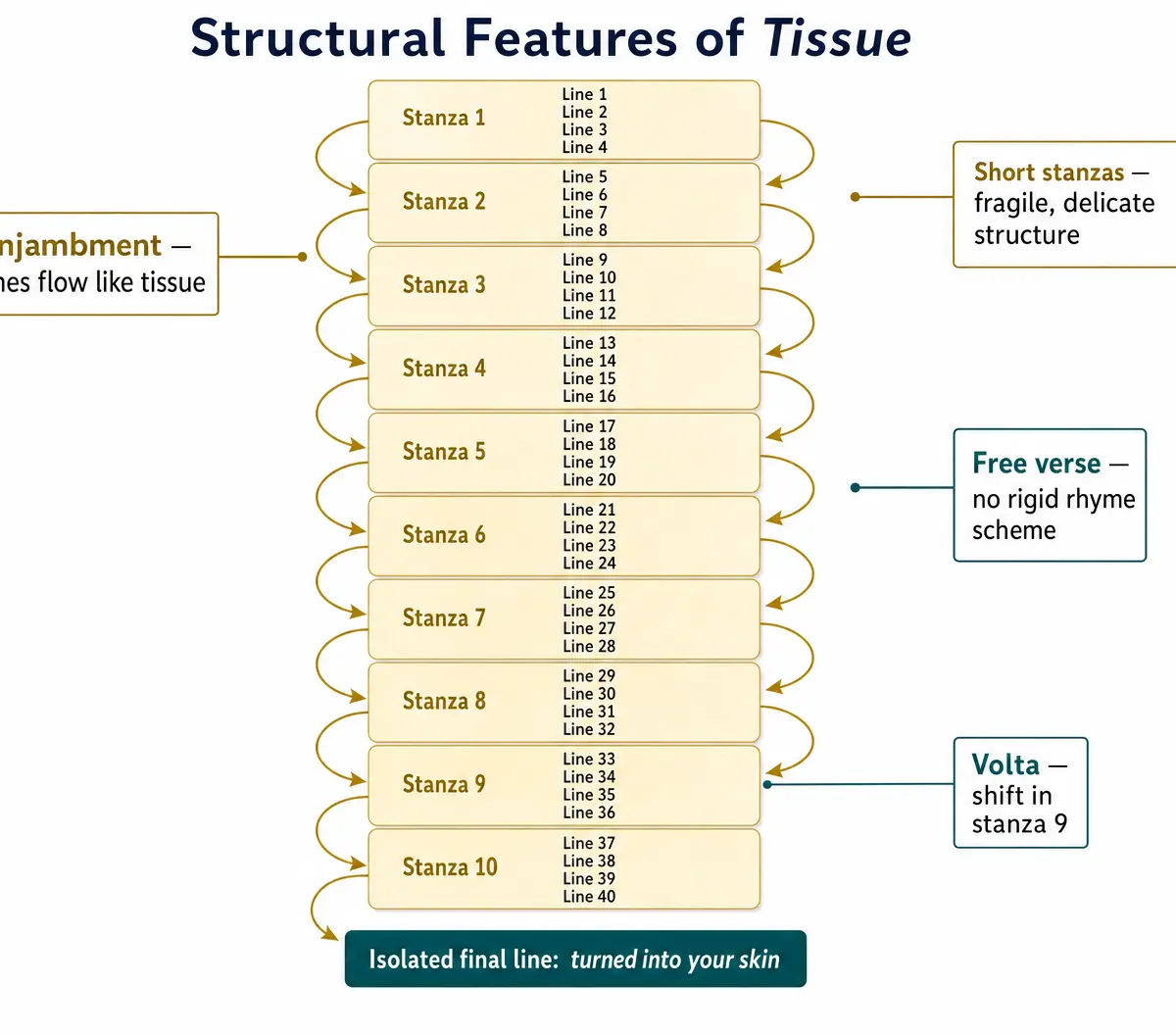
- Continuous Enjambment: Almost every line and stanza flows into the next without a full stop. This structural choice mimics the fluidity and fragility of tissue paper, suggesting that human boundaries cannot be rigidly contained.
- Short Stanzas: The poem is composed of ten quatrains (four-line stanzas), which visually look like small, delicate blocks of text—like slips of paper.
- The Final Isolated Line: "turned into your skin" (Stanza 10). After nine and a half stanzas of four lines, the poem ends on a single, isolated line. This abrupt shift collapses the extended metaphor, directly addressing the reader and linking the fragility of paper to human mortality.
Language and Imagery
- Semantic Field of Light: Words like 'shines', 'luminous', 'daylight', and 'transparent' create a sense of hope and spiritual clarity, contrasting with the solid, oppressive words like 'monoliths' and 'brick'.
- Extended Metaphor: The entire poem hinges on the comparison between paper and human life/power. Paper is used to record history (the Quran), geography (maps), and commerce (receipts), showing how human civilization relies on something so easily torn.
Context
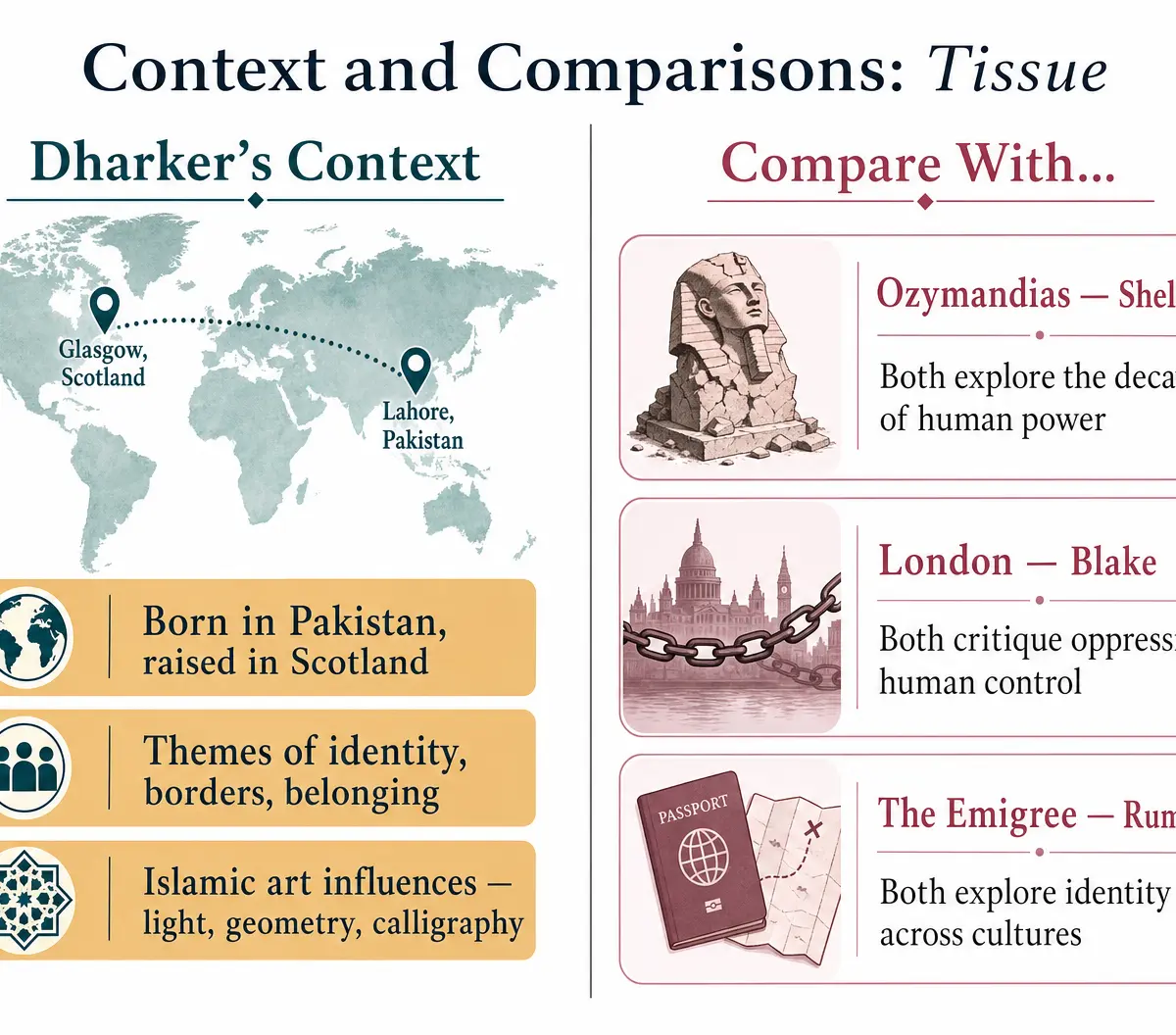
Imtiaz Dharker was born in Lahore, Pakistan, and raised in Glasgow, Scotland. She describes herself as a "Scottish Muslim Calvinist." This multicultural background heavily influences 'Tissue'. Her awareness of different cultures and the often arbitrary nature of national borders informs the poem's critique of human division. Furthermore, the poem's imagery draws on Islamic art and architecture, which often values light, geometry, and calligraphy over solid, figurative representation. Understanding this context helps candidates appreciate the poem's nuanced approach to identity and belonging."
Worked Examples
1 worked example — open one to explore the question and available guidance.
Practice Questions
Try the question, then reveal an answer plan or example response
Compare how poets present the effects of human conflict and division in 'Tissue' and one other poem from the cluster. (30 marks)
Hint: Consider comparing with 'The Emigree' or 'London'. Focus on how borders and societal structures cause division.
Watch or listen (optional)
Test your understanding of Tissue
Active recall beats re-reading. Take an instant quiz now to test what you’ve learned and lock it into long-term memory.
7 days Premium · Then the free plan continues · No card, no charge