Conflict Poetry Anthology
Master the GCSE English Literature Conflict Poetry Anthology with this comprehensive guide. Explore how poets use language, form, and structure to present the profound physical and psychological impacts of conflict, from the trenches of WWI to the domestic front line, and learn the examiner-approved techniques to secure top marks in your comparative essay.
Study Notes
Overview
The Conflict Poetry Anthology is a cornerstone of the GCSE English Literature specification, demanding that candidates engage critically with a diverse range of poetic voices spanning over a century. Examiners look for perceptive analysis of how poets construct meaning, exploring not just what is said about conflict, but how it is expressed through deliberate choices in language, structure, and form. To achieve the highest bands (Levels 5 and 6), candidates must move beyond simple feature-spotting and demonstrate a conceptualised understanding of the overarching themes—power, loss, identity, memory, and protest—while seamlessly integrating relevant contextual factors. This guide provides the analytical depth and structural frameworks required to excel in the comparative poetry essay.
Podcast: The Conflict Poetry Masterclass
Listen to this 12-minute audio masterclass covering core concepts, exam techniques, and a quick-fire recall quiz.
Themes
Theme 1: Power and Control
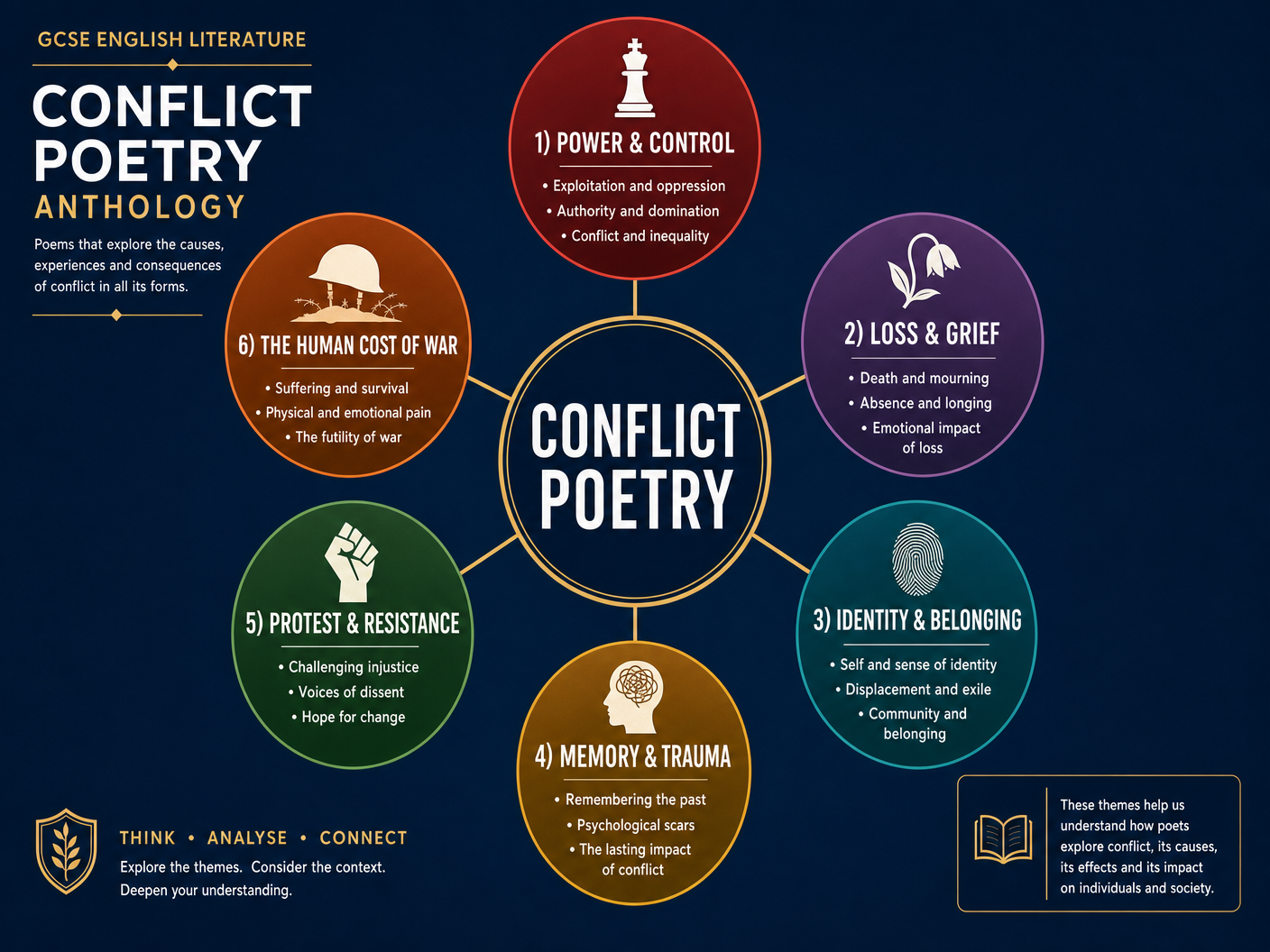
This theme explores the mechanisms of authority and the profound effects of power imbalances. Poets often present power not as an absolute, but as something fragile, corruptible, or ultimately transient in the face of nature or time. The conflict arises from the tension between those who wield power (governments, military leaders, societal structures) and those subjected to it.
Key Quotes:
- "sneer of cold command" (Ozymandias) - The alliteration and harsh 'c' sounds emphasize the arrogant, dismissive nature of tyrannical power, yet the poem's structure reveals its ultimate futility against the vastness of time.
- "mind-forg'd manacles" (London) - Blake's powerful metaphor suggests that the oppression of the poor is not just physical, but psychological; the citizens are trapped by the societal structures they have internalised.
- "might fly our lives like paper kites" (Tissue) - Dharker uses a simile to contrast the rigid structures of human power (documents, borders) with the fragility and transience of human life, suggesting that power is ultimately an illusion.
Theme 2: The Human Cost of War (Physical and Psychological)
Many poems in the anthology strip away the glorification of conflict to expose its brutal reality. This encompasses both the immediate physical devastation on the battlefield and the enduring psychological trauma (PTSD) that haunts survivors. Examiners reward candidates who can distinguish between these two types of suffering and compare how different poets articulate them.
Key Quotes:
- "bent double, like old beggars under sacks" (Dulce et Decorum Est) - Owen's simile degrades the soldiers, stripping them of heroic identity and forcing the reader to confront the physical degradation that propaganda conceals.
- "his blood-shadow stays on the street" (Remains) - Armitage uses a visceral metaphor to represent the indelible nature of trauma; the physical stain becomes a permanent psychological scar for the speaker.
- "a hundred agonies in black-and-white" (War Photographer) - Duffy's juxtaposition of immense suffering ("agonies") with the neat, ordered medium of photography ("black-and-white") critiques the sanitised way conflict is consumed by the public.
Theme 3: Identity, Belonging, and Displacement
Conflict invariably fractures identity. For soldiers, it can mean the loss of their civilian self; for civilians, it can mean displacement from their homeland or a struggle to reconcile their personal grief with public narratives of heroism. This theme is often explored through the lens of memory and nostalgia.
Key Quotes:
- "my memory of it is sunlight-clear" (The Emigrée) - Rumens uses light imagery to represent the speaker's idealized, unshakeable connection to her lost city, contrasting with the dark reality of its current state.
- "spasms of paper red, disrupting a blockade / of yellow bias binding" (Poppies) - Weir uses military semantic fields ("spasms", "blockade") to describe domestic, maternal actions, highlighting how the conflict has infiltrated and redefined the mother's identity and her relationship with her son.
- "Strange, it is a huge nothing that we fear" (Storm on the Island) - Heaney's ambiguous conclusion suggests that the community's identity, built on opposition to an external threat (the storm/political conflict), is ultimately hollow or based on an intangible fear.
Assessment Objectives Framework
Writer's Methods (AO2 Focus)
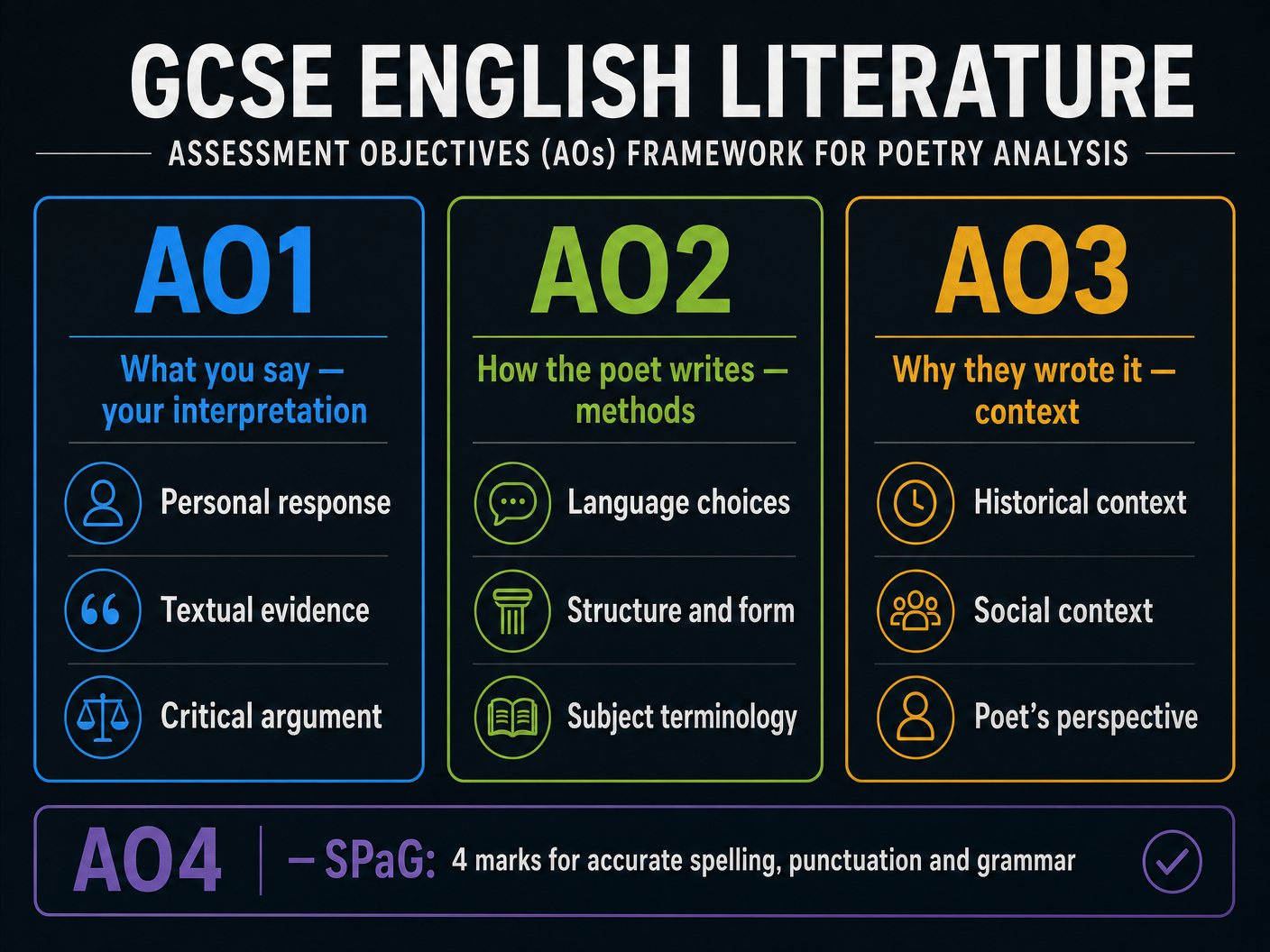
To secure marks for AO2, candidates must analyse how meaning is constructed. This involves moving from word-level analysis to structural and formal choices.
- Form: Consider the overarching shape of the poem. Is it a sonnet (traditionally associated with love, perhaps used ironically, as in Ozymandias)? A dramatic monologue (allowing a singular, often biased perspective, as in My Last Duchess)? Free verse (reflecting chaos, natural speech, or lack of control)?
- Structure: Look at the progression of ideas. Enjambment can create a sense of breathlessness, urgency, or the uncontrollable flow of memory. Caesura can force a pause, representing a fracture, a moment of realization, or a physical break. Stanza lengths matter: regular stanzas might imply control or the relentless march of an army, while irregular stanzas might reflect emotional instability or the chaos of battle.
- Language: Move beyond simply identifying metaphors and similes. Analyse semantic fields (groups of related words) and the specific connotations of verbs and adjectives. For example, explore how violent verbs are used to describe natural elements, blurring the line between human conflict and the natural world.
Context (AO3 Focus)
Context must be integrated, not bolted on. It is the 'why' behind the poem.
- Biographical Context: How did the poet's own experiences shape their perspective? (e.g., Owen's frontline experience vs. Tennyson's role as Poet Laureate writing from afar).
- Historical Context: What specific events are being referenced? (e.g., The Charge of the Light Brigade during the Crimean War, or the Troubles in Northern Ireland for Heaney).
- Literary Context: Is the poet writing within or against a specific tradition? (e.g., Romantic poets like Blake and Shelley challenging establishment power, compared to modern poets like Armitage exploring contemporary psychological trauma).
Worked Examples
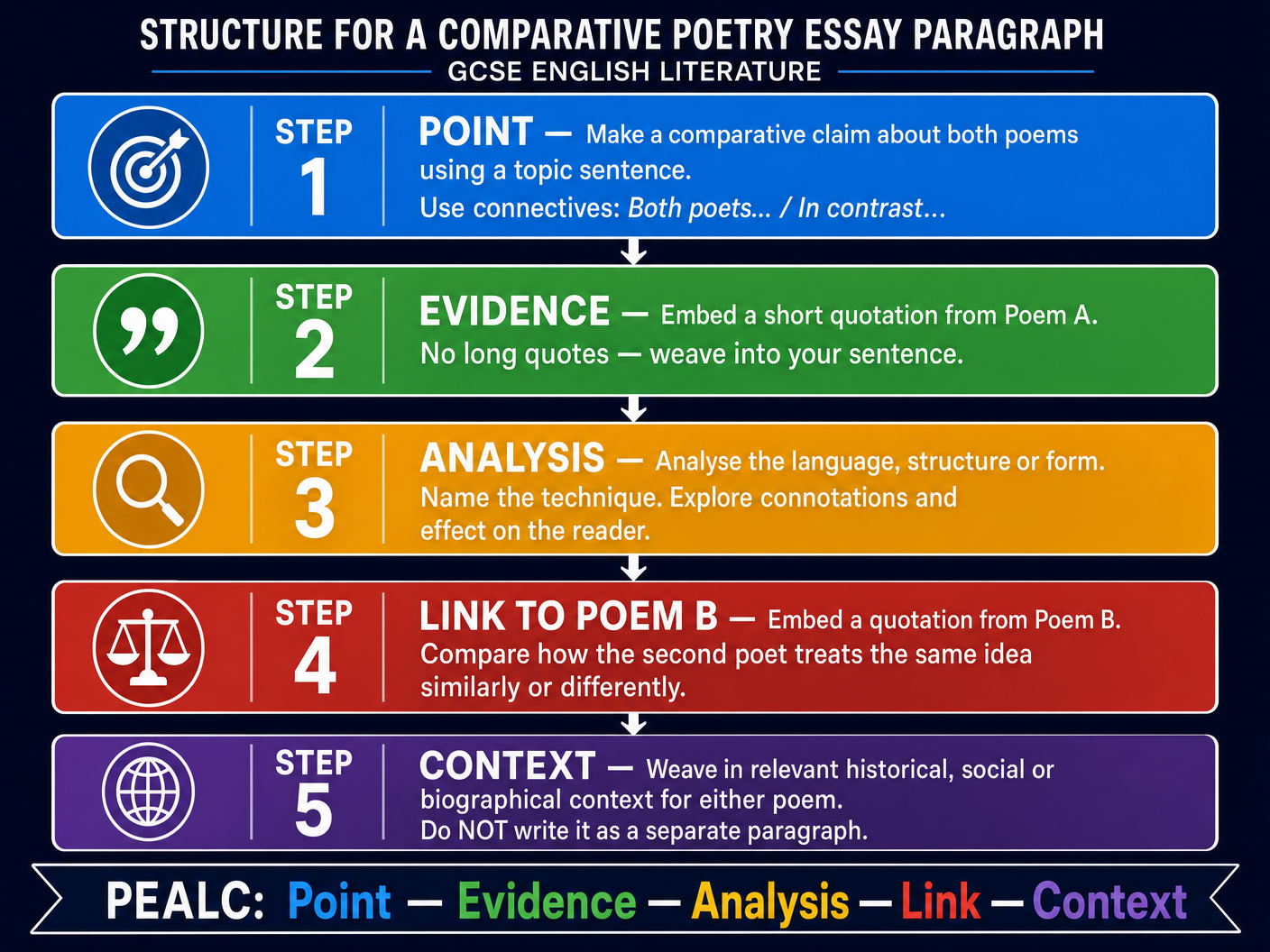
1 detailed example with solutions and examiner commentary
Practice Questions
Test your understanding — click to reveal model answers
Compare how poets present the power of nature in 'Storm on the Island' and one other poem from the anthology. (30 marks)
Hint: Consider comparing with 'Ozymandias' (nature outlasting human power) or 'Exposure' (nature as a deadly enemy).
Compare how poets explore the loss of identity in 'Poppies' and one other poem. (30 marks)
Hint: Compare with 'The Emigrée' (loss of national/cultural identity) or 'Remains' (loss of civilian identity to trauma).
Compare how poets present the effects of conflict on civilians in 'War Photographer' and one other poem. (30 marks)
Hint: Compare with 'London' (systemic oppression of civilians) or 'The Emigrée' (civilian displacement).
Compare how poets use form to convey powerful emotions in 'My Last Duchess' and one other poem. (30 marks)
Hint: Focus heavily on AO2. Compare the dramatic monologue of 'My Last Duchess' with the first-person narrative of 'Remains' or the sonnet form of 'Ozymandias'.