Frankenstein
Frankenstein is a foundational Gothic text that explores the devastating consequences of unchecked ambition and the moral responsibilities of creation. Studying this novel rewards candidates who can analyse its complex narrative structure and connect its themes to Romantic-era anxieties about science, nature, and human isolation.
Study Notes
Overview
Mary Shelley's Frankenstein (1818) is a seminal text for GCSE Literature, blending Gothic horror with Romantic philosophy. Examiners reward candidates who move beyond plot summary to analyse Shelley's complex narrative structure—the "Russian doll" framing of Walton, Frankenstein, and the Creature. Top-band responses consistently explore how Shelley uses these competing voices to question the limits of scientific ambition, the nature of humanity, and the devastating impact of rejection. To succeed, you must embed precise quotations, analyse the effects of Shelley's language choices (especially her use of the sublime and pathetic fallacy), and seamlessly integrate context regarding Romanticism and the Prometheus myth.
Plot/Content Overview
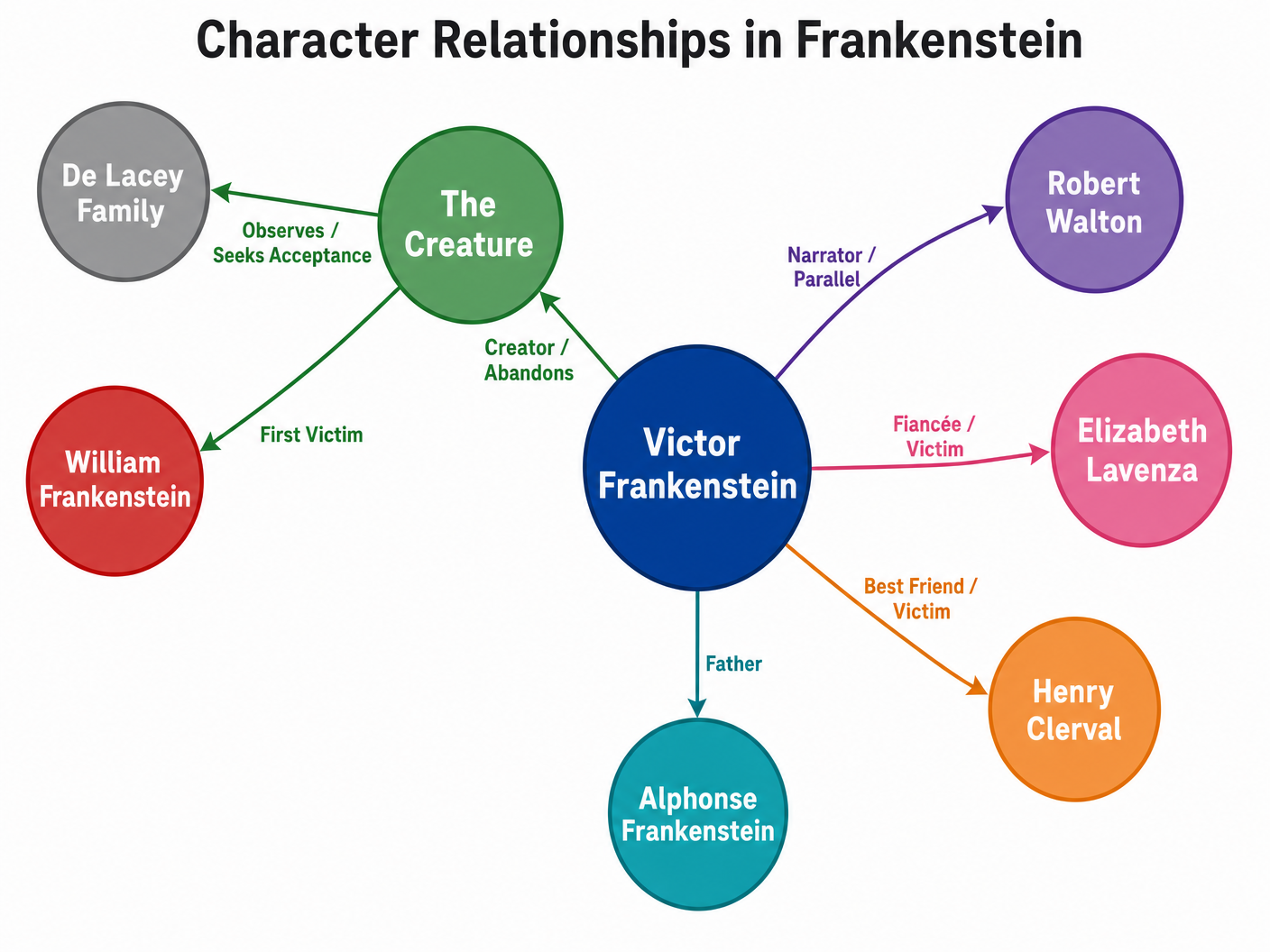
- Walton's Letters: Arctic explorer Robert Walton writes to his sister, describing his dangerous quest for the North Pole. His ship becomes trapped in ice, and the crew rescues a nearly frozen man: Victor Frankenstein.
- Victor's Youth & Ambition: Victor narrates his privileged childhood in Geneva, his friendship with Henry Clerval, and his "more than sister" Elizabeth. At university in Ingolstadt, his fascination with natural philosophy becomes an obsession with creating life.
- The Creation & Abandonment: Victor successfully animates a creature compiled from body parts but is immediately horrified by its appearance. He flees, abandoning his creation.
- Tragedy Strikes: Victor learns his youngest brother, William, has been murdered. The innocent servant Justine is executed for the crime, though Victor knows the Creature is responsible.
- The Encounter on the Glacier: Victor confronts the Creature in the Alps. The Creature demands to be heard, shifting the narrative perspective.
- The Creature's Tale: The Creature recounts his early days of confusion, his rejection by society, and his time secretly observing the De Lacey family. After they too reject him in terror, his heartbreak turns to a desire for revenge against his creator.
- The Demand: The Creature demands Victor make him a female companion. Victor initially agrees, travels to Scotland to begin the work, but destroys it in a fit of paranoia.
- The Vengeance: Enraged, the Creature vows to be with Victor on his wedding night. He murders Henry Clerval, and later, Elizabeth. Victor's father dies of grief.
- The Pursuit: Victor dedicates the rest of his life to hunting the Creature across the globe, eventually leading to the Arctic where he meets Walton.
- Conclusion: Victor dies aboard Walton's ship. The Creature appears, expresses profound remorse over Victor's death, and departs into the ice to end his own life. Walton, learning from Victor's hubris, turns his ship back towards home.
Themes
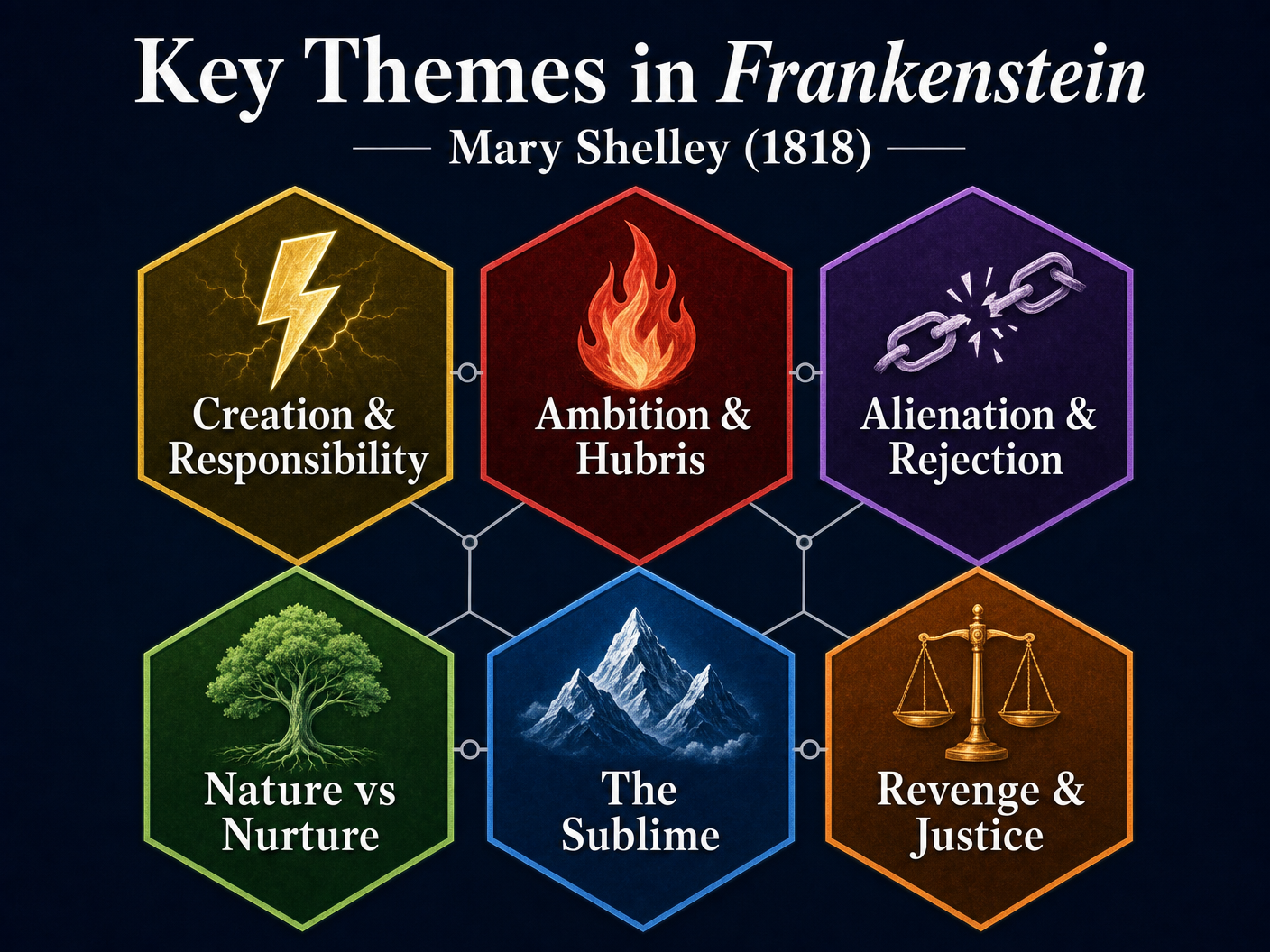
Theme 1: Creation and Responsibility
Shelley interrogates the moral duty creators owe to their creations. Victor's tragedy is not just that he creates life, but that he fails to nurture it. This reflects Romantic anxieties about science overstepping its bounds without ethical constraints.
Key Quotes:
- "I had desired it with an ardour that far exceeded moderation; but now that I had finished, the beauty of the dream vanished, and breathless horror and disgust filled my heart." (Chapter 5) - Victor's language reveals that his ambition was aesthetic and egotistical; the reality of responsibility immediately repels him.
- "I ought to be thy Adam, but I am rather the fallen angel, whom thou drivest from joy for no misdeed." (Chapter 10) - The Creature uses biblical intertextuality to highlight Victor's failure as a "creator/God" figure, positioning himself as unjustly punished.
Theme 2: Alienation and Rejection
Isolation is presented as deeply destructive. The Creature is born benevolent but is corrupted by society's superficial rejection of his appearance. Victor, conversely, actively chooses isolation to pursue his unnatural science, leading to his own ruin.
Key Quotes:
- "Everywhere I see bliss, from which I alone am irrevocably excluded." (Chapter 10) - The adverb "irrevocably" emphasizes the absolute and permanent nature of the Creature's exclusion from human society.
- "Am I not shunned and hated by all mankind?" (Chapter 17) - A rhetorical question that underlines the Creature's fundamental tragedy: he is a social being denied society.
Theme 3: Ambition and Hubris
Victor and Walton represent the dangers of unchecked ambition. Shelley critiques the masculine desire to conquer nature and "penetrate her secrets," contrasting it with the domestic, nurturing spheres of Elizabeth and the De Laceys.
Key Quotes:
- "Learn from me, if not by my precepts, at least by my example, how dangerous is the acquirement of knowledge..." (Chapter 4) - Victor's explicit warning to Walton serves as the moral thesis of the novel.
- "Life and death appeared to me ideal bounds, which I should first break through, and pour a torrent of light into our dark world." (Chapter 4) - The metaphor "torrent of light" exposes Victor's hubristic belief that he is a savior bringing enlightenment, masking his dangerous transgression.
Character Analysis
Victor Frankenstein
Role: The protagonist and primary narrator; the ambitious scientist who creates and abandons the Creature.
Key Traits: Ambitious, self-absorbed, guilt-ridden, evasive of responsibility.
Character Arc: Moves from a passionate, idealistic student to an obsessive creator, then to a paranoid, guilt-ravaged man consumed by a desire for revenge.
Essential Quotes:
- "I was seized by remorse and the sense of guilt, which hurried me away to a hell of intense tortures, such as no language can describe."
- "A new species would bless me as its creator and source."
The Creature
Role: The creation of Victor; the novel's most complex and articulate voice.
Key Traits: Articulate, deeply emotional, physically powerful, lonely, vengeful.
Character Arc: Begins as an innocent "blank slate" (tabula rasa), seeks connection and knowledge, suffers violent rejection, and transforms into a bitter, calculating murderer out of profound despair.
Essential Quotes:
- "I, the miserable and the abandoned, am an abortion, to be spurned at, and kicked, and trampled on."
- "I was benevolent and good; misery made me a fiend."
Robert Walton
Role: The outer narrator whose letters frame the story; Victor's parallel.
Key Traits: Ambitious, lonely, empathetic, capable of learning.
Character Arc: Starts with reckless ambition mirroring Victor's, but ultimately chooses to abandon his dangerous quest to save his crew, showing he has learned the novel's moral lesson.
Essential Quotes:
- "I have no friend, Margaret: when I am glowing with the enthusiasm of success, there will be none to participate my joy."
- "One man's life or death were but a small price to pay for the acquirement of the knowledge which I sought."
Writer's Methods
Narrative Structure: Shelley uses an epistolary (letter-based) frame narrative. This "Russian doll" structure (Walton → Victor → Creature) creates multiple layers of unreliable narration. It forces the reader to evaluate who to trust and emphasizes the isolation of the characters, as they are all desperate to have their stories heard.
The Sublime: Shelley frequently uses the Romantic concept of the sublime—landscapes that are simultaneously awe-inspiring and terrifying (e.g., the Alps, the Arctic). These settings dwarf human ambition and reflect the intense, turbulent emotions of the characters.
Pathetic Fallacy: Weather constantly mirrors psychological states. The Creature is brought to life on a "dreary night of November" with rain pattering "dismally," establishing an immediate atmosphere of unnatural horror and foreboding.
Intertextuality: Shelley heavily references Milton's Paradise Lost. The Creature reads it as factual history, comparing himself to both Adam (created but abandoned) and Satan (cast out and vengeful). This elevates the text from a horror story to a profound theological and moral debate.
Context
The Romantic Movement: Romanticism celebrated emotion, individual genius, and the awe-inspiring power of nature. Shelley critiques the extreme end of Romantic individualism through Victor, suggesting that unchecked passion and isolation lead to destruction.
The Prometheus Myth: The novel's subtitle is "The Modern Prometheus." In Greek myth, Prometheus stole fire from the gods to give to humanity and was eternally punished. Victor similarly steals the divine power of creation and suffers eternal torment as a result.
Galvanism and Science: In the early 19th century, scientists like Luigi Galvani experimented with electricity to stimulate muscle movement in dead animals. Shelley taps into contemporary fears about science overstepping ethical boundaries and "playing God."
Listen to our comprehensive 10-minute audio guide covering themes, context, and exam strategies.
Visual Resources
2 diagrams and illustrations
Interactive Diagrams
2 interactive diagrams to visualise key concepts
Conceptual Flow Outline
The Tragic Arc: Victor's hubris and its consequences across the novel
Conceptual Flow Outline
The Frame Narrative Structure: Three nested layers of storytelling
Worked Examples
2 detailed examples with solutions and examiner commentary
Practice Questions
Test your understanding — click to reveal model answers
Starting with this extract (the Creature observing the De Laceys), explore how Shelley presents the Creature's desire for connection. (30 marks)
Hint: Focus on the Creature's empathy in the extract, then contrast it with how he is treated by Victor and society in the wider novel.
Explore the significance of the settings in Frankenstein. (30 marks)
Hint: Think about the contrast between the claustrophobic laboratory, the domestic warmth of Geneva, and the vast, icy sublime of the Alps/Arctic.
How does Shelley present women in Frankenstein? (30 marks)
Hint: Look at Elizabeth, Justine, and the female creature. Consider how they are passive victims of male ambition.
Explore how Shelley presents the relationship between Victor and the Creature. (30 marks)
Hint: Focus on the shifting power dynamic. Victor starts as the powerful creator, but the Creature eventually becomes the master.