Much Ado About Nothing
Much Ado About Nothing is Shakespeare's sparkling comedy of love, deception, and honour. It rewards study because its dual plots — the witty 'merry war' of Beatrice and Benedick versus the near-tragic shaming of Hero — offer rich opportunities for high-level analysis of Elizabethan society and dramatic structure.
Study Notes
Overview
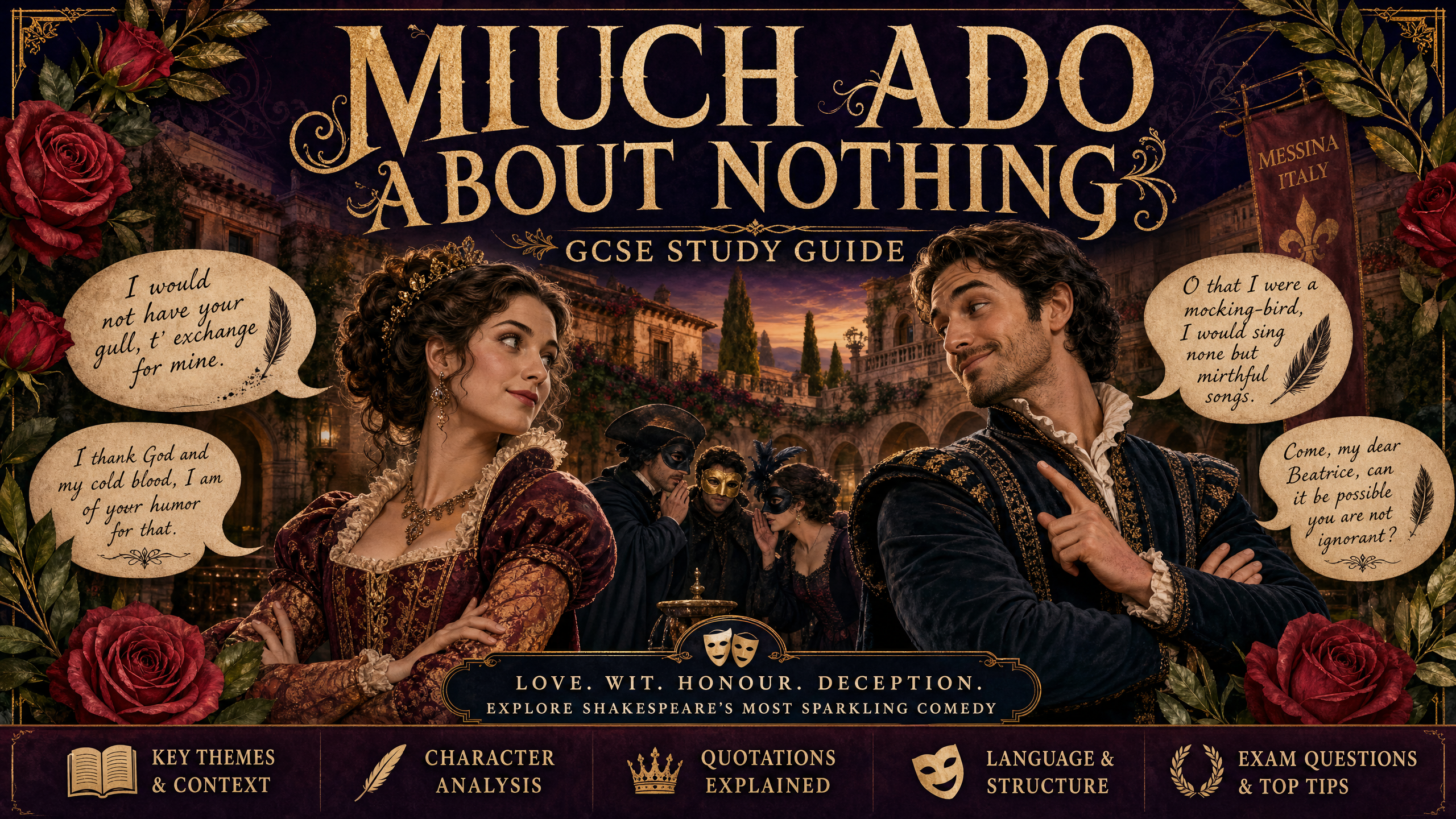
Written around 1598-1599, Much Ado About Nothing is a brilliant comedy that explores the complexities of love, the power of language, and the destructive nature of Elizabethan honour codes. Examiners look for candidates who can analyse the contrast between the two central couples: the witty, independent Beatrice and Benedick, and the conventional, easily manipulated Hero and Claudio. Top-tier responses will explore how Shakespeare uses both benign and malicious deception to drive the plot, and how he critiques the patriarchal society of Messina.
Listen to the 10-minute expert tutor podcast below for a deep dive into the core themes and exam strategies:
Plot/Content Overview
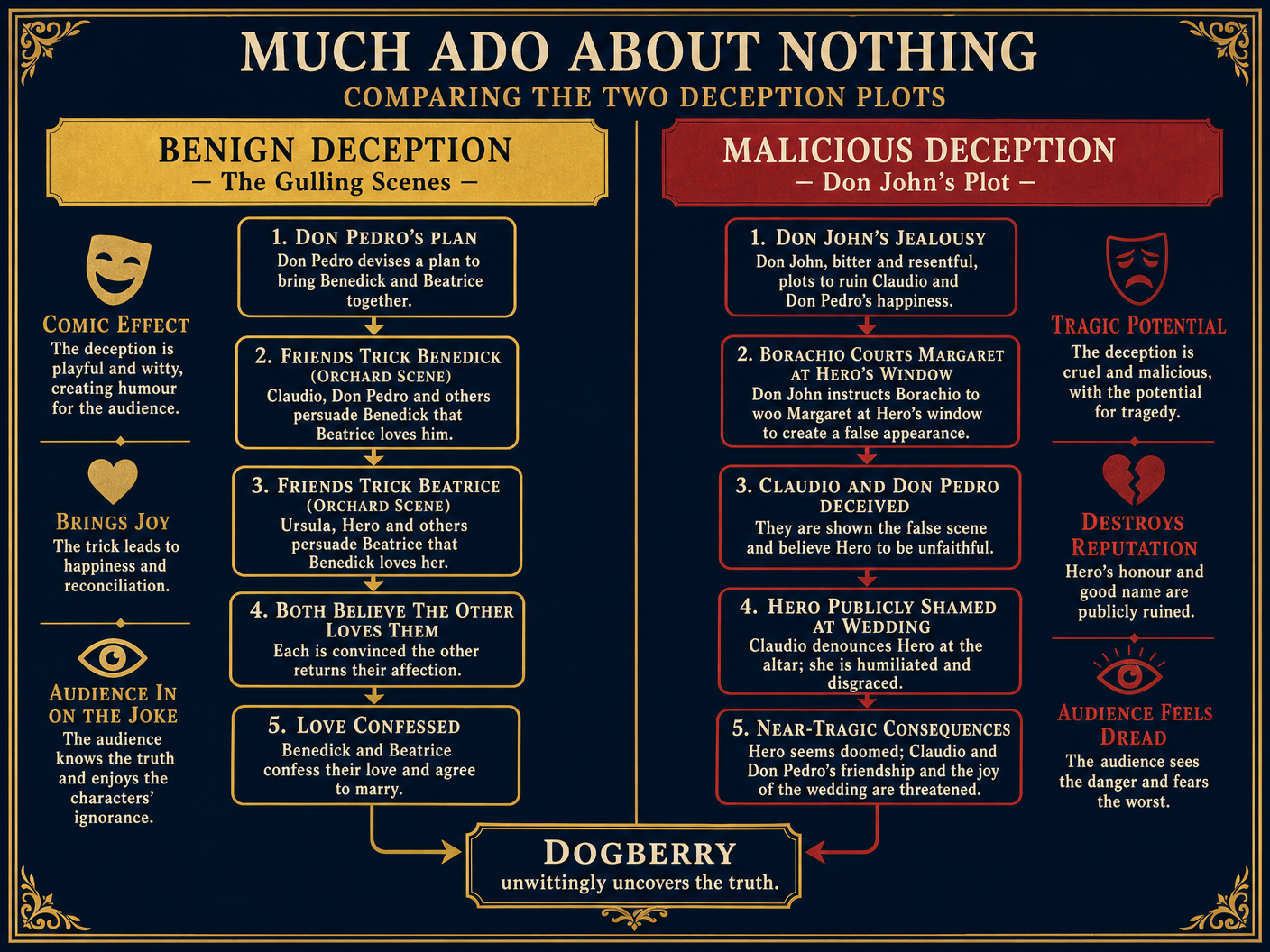
Act 1: Don Pedro, his brother Don John, Claudio, and Benedick arrive in Messina. Claudio falls in love with Hero. Beatrice and Benedick resume their "merry war" of wits. Don Pedro offers to woo Hero on Claudio's behalf.
Act 2: At a masked ball, Don John tricks Claudio into thinking Don Pedro is wooing Hero for himself, but the misunderstanding is quickly resolved. Don Pedro proposes a plan to trick Beatrice and Benedick into falling in love. Don John plots to ruin Claudio and Hero's marriage.
Act 3: The "gulling scenes" occur: Benedick overhears that Beatrice loves him, and Beatrice overhears that Benedick loves her. Both are deceived into love. Meanwhile, Don John shows Claudio and Don Pedro a false scene of Hero being unfaithful (it is actually Margaret). Dogberry and the Watch inadvertently arrest Don John's men, Borachio and Conrade.
Act 4: Claudio publicly shames and rejects Hero at the altar. The Friar advises Leonato to pretend Hero has died of grief. Beatrice demands that Benedick "Kill Claudio" to prove his love and avenge Hero's honour.
Act 5: Dogberry's men reveal Don John's plot. A repentant Claudio agrees to marry Leonato's "niece" as penance, who is revealed to be Hero. Beatrice and Benedick publicly declare their love. The play ends with a double wedding and a dance.
Themes
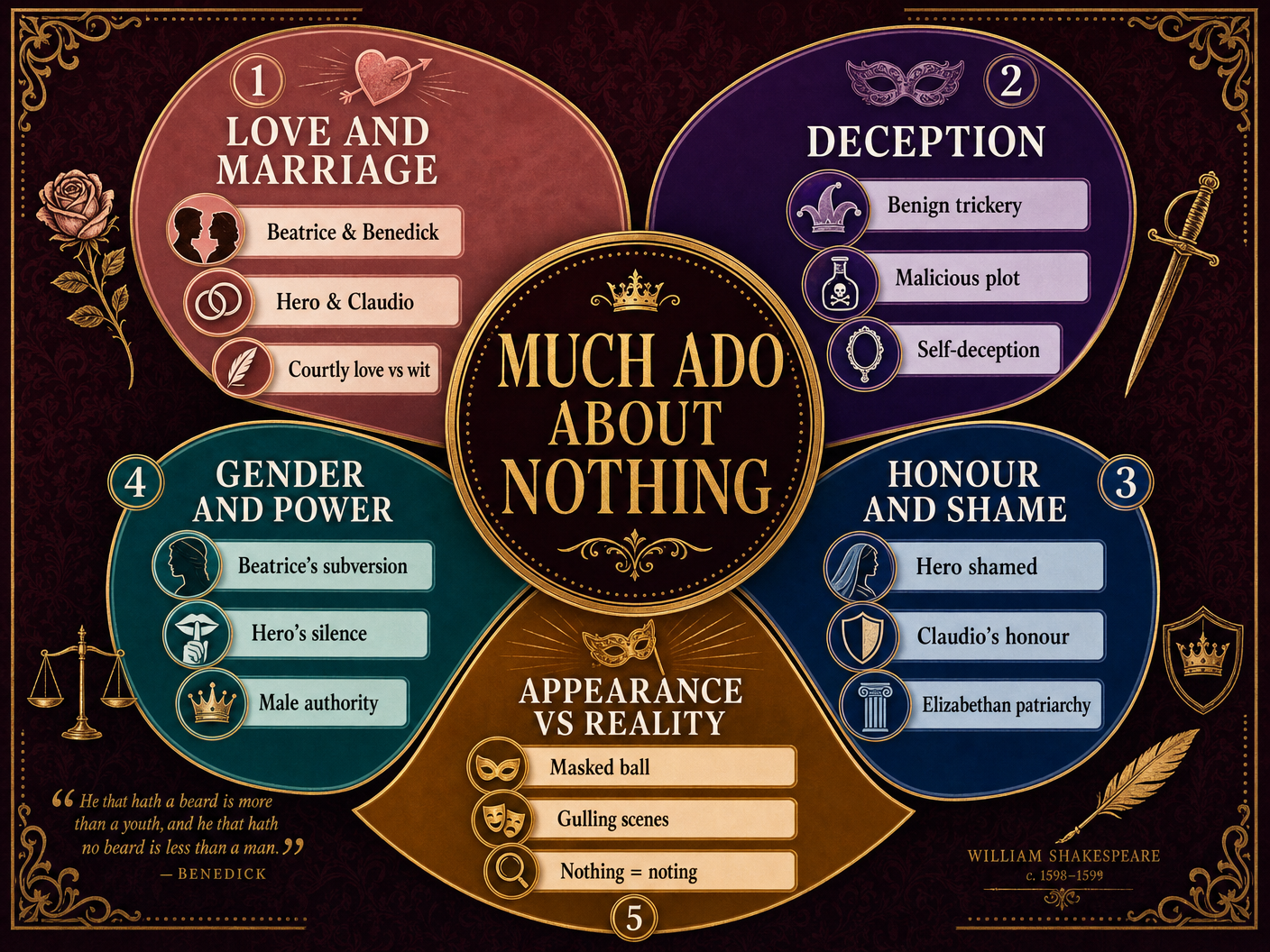
Theme 1: Deception and Noting
Deception is the engine of the play, taking two distinct forms: the benign trickery that unites Beatrice and Benedick, and the malicious plot that nearly destroys Hero and Claudio. The play plays on the Elizabethan pronunciation of "nothing" as "noting" (observing/eavesdropping), highlighting how characters misinterpret what they see and hear.
Key Quotes:
- "Note this before my notes; / There's not a note of mine that's worth the noting." (Act 2, Scene 3) - Balthasar's pun establishes the theme of observation and misinterpretation.
- "I will so trust, trust me, and you shall see / That I will have her" (Act 1, Scene 1) - Don Pedro's plan relies on deception for a good cause.
- "Any bar, any cross, any impediment will be medicinable to me." (Act 2, Scene 2) - Don John's malicious intent to use deception to cause pain.
Theme 2: Honour and Reputation
In the patriarchal society of Messina, a man's honour is based on military valour and male camaraderie, while a woman's honour is based entirely on her chastity. Hero's public shaming demonstrates the fragility of female reputation and the severe consequences of its loss.
Key Quotes:
- "Give not this rotten orange to your friend" (Act 4, Scene 1) - Claudio's metaphor reduces Hero to a spoiled commodity, reflecting the transactional nature of their marriage.
- "O, she is fallen / Into a pit of ink, that the wide sea / Hath drops too few to wash her clean again" (Act 4, Scene 1) - Leonato's hyperbolic language shows how a woman's lost honour taints the entire family.
Theme 3: Gender and Patriarchy
Shakespeare contrasts the silent, submissive Hero with the vocal, independent Beatrice. However, both are ultimately constrained by the patriarchal society. Beatrice's frustration at her inability to challenge Claudio directly highlights the limitations placed on women.
Key Quotes:
- "O God, that I were a man! I would eat his heart in the market-place." (Act 4, Scene 1) - Beatrice's raw fury exposes her powerlessness as a woman in a male-dominated world.
- "I cannot be a man with wishing, therefore I will die a woman with grieving." (Act 4, Scene 1) - Beatrice acknowledges the fatalistic reality of her gender.
Character Analysis
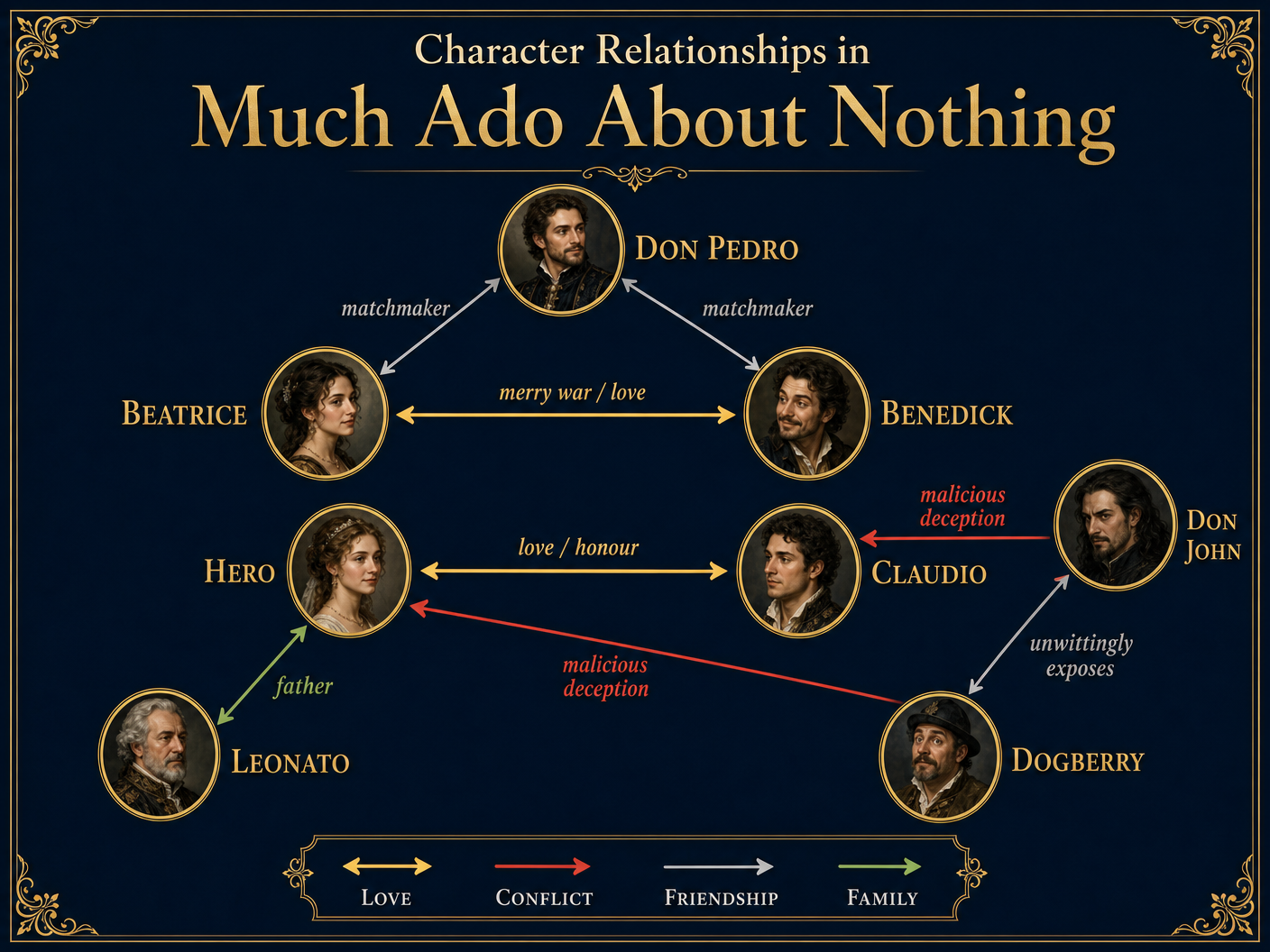
Beatrice
Role: The witty, unconventional heroine who challenges gender norms.
Key Traits: Sharp-tongued, fiercely independent, emotionally intelligent, loyal.
Character Arc: Moves from a defensive, cynical view of love to a vulnerable acceptance of it, though she maintains her wit and independence.
Essential Quotes:
- "I had rather hear my dog bark at a crow than a man swear he loves me." (Act 1, Scene 1)
- "Stand I condemn'd for pride and scorn so much? / Contempt, farewell! and maiden pride, adieu!" (Act 3, Scene 1)
Benedick
Role: The boastful bachelor whose journey mirrors Beatrice's.
Key Traits: Arrogant, witty, ultimately honourable and brave.
Character Arc: Transitions from a mocking critic of marriage to a devoted lover who chooses Beatrice's honour over his loyalty to his male friends.
Essential Quotes:
- "I will live a bachelor." (Act 1, Scene 1)
- "When I said I would die a bachelor, I did not think I should live till I were married." (Act 2, Scene 3)
- "Enough, I am engaged; I will challenge him." (Act 4, Scene 1) - His decisive shift from comedy to serious action.
Claudio
Role: The conventional romantic lead, representing the flaws of Elizabethan courtly love.
Key Traits: Gullible, concerned with outward appearances, quick to anger.
Character Arc: Falls in love quickly, is easily deceived into jealousy, repents when the truth is revealed, and is rewarded with Hero.
Essential Quotes:
- "Can the world buy such a jewel?" (Act 1, Scene 1) - Views Hero as a valuable object.
- "Farewell, / Thou pure impiety and impious purity!" (Act 4, Scene 1) - His use of oxymoron highlights his confusion over appearance vs reality.
Writer's Methods
Prose vs. Verse: Shakespeare uses prose for the witty, intellectual banter of Beatrice and Benedick, creating a fast-paced, naturalistic feel. He uses blank verse (iambic pentameter) for moments of high emotion, nobility, or seriousness (e.g., the wedding scene). When Benedick shifts from prose to verse, it signals his emotional maturation.
Dramatic Irony: Used extensively in the "gulling scenes" where the audience knows the trick being played on Beatrice and Benedick. This creates comedy and aligns the audience with the tricksters.
Malapropism: Dogberry's misuse of words (e.g., "comprehend" for "apprehend") provides comic relief while subtly mocking the incompetence of authority figures. Ironically, the foolish Watch uncovers the truth that the "wise" nobles miss.
Context
Elizabethan Patriarchy: Women were legally and socially subordinate to men. A father owned his daughter until he passed ownership to her husband. Hero's silence and obedience reflect the ideal Elizabethan woman.
Honour Code: Male honour was tied to public reputation and military prowess. Female honour was inextricably linked to chastity. A woman's perceived impurity was a source of profound shame for her entire family.
Cuckoldry: The fear of being a "cuckold" (a man whose wife is unfaithful, traditionally depicted with horns) was a pervasive anxiety in Elizabethan society, frequently joked about by Benedick to mask his fear of vulnerability.
Visual Resources
3 diagrams and illustrations
Interactive Diagrams
1 interactive diagram to visualise key concepts
Conceptual Flow Outline
Structural Narrative Arc of Much Ado About Nothing
Worked Examples
2 detailed examples with solutions and examiner commentary
Practice Questions
Test your understanding — click to reveal model answers
Starting with this extract (Act 2 Scene 1, Don Pedro: 'I will in the interim undertake one of Hercules' labours...'), explore how Shakespeare presents the attitudes of male characters towards love and marriage.
Hint: Consider how love is viewed as a game, a conquest, or a threat to male camaraderie. Contrast Don Pedro's meddling with Benedick's fear of cuckoldry.
Explore how Shakespeare presents the character of Hero and her significance in the play.
Hint: Don't just say she is quiet. Explore *why* she is quiet (societal expectations) and how her silence makes her vulnerable to the malicious deception.
How does Shakespeare use comedy to explore serious issues in Much Ado About Nothing?
Hint: Look at the 'merry war', Dogberry's malapropisms, and the gulling scenes. What darker truths do they reveal about society, justice, and human pride?
Explore the significance of the title Much Ado About Nothing in relation to the events of the play.
Hint: Remember the pun on 'nothing' and 'noting'. How does making a 'fuss' over 'observation/eavesdropping' drive both plots?