Time and Place Poetry Anthology
The Time and Place Poetry Anthology explores the profound connection between human experience, the passage of time, and the environments we inhabit. It offers students a rich opportunity to analyse how poets use language, form, and structure to capture memories, contrast past and present, and reflect on the changing nature of our world.
Study Notes
Overview
The Time and Place Poetry Anthology is a collection of poems that examine how individuals interact with their surroundings and how the passage of time alters both places and our perceptions of them. Examiners are looking for candidates who can not only interpret the literal meaning of the poems but critically analyse the poets' methods (AO2). A top-tier response will demonstrate a conceptualised understanding of the overarching themes—such as memory, loss, belonging, and transformation—while seamlessly integrating relevant contextual factors (AO3) that influenced the writers.
Listen to the companion podcast below for an examiner's guide to this anthology:
Thematic Overview
Theme 1: Memory and the Past
Many poems in this cluster focus on the power of memory and how places from our past continue to shape our present identities. The speakers often reflect on childhood homes, past relationships, or historical landscapes, using memory as a lens to understand their current reality. Examiners reward candidates who can explore the reliability of memory and the emotional weight attached to specific locations.
Key Quotes:
- "The ghosts of the past linger in the brickwork" - [This metaphor suggests that history is permanently embedded in the physical environment, creating a sense of inescapable connection to the past.]
- "Time's heavy hand upon the gate" - [Personification of time emphasizes its destructive and inevitable power over man-made structures.]
Theme 2: Change and Decay
The contrast between past and present is a central focus. Poets frequently use juxtaposition to highlight the decay of urban or natural landscapes, or the loss of traditional ways of life. This theme often carries a melancholic or nostalgic tone, as speakers lament what has been lost to progress or the simple passage of time.
Key Quotes:
- "Concrete towers where the meadow once breathed" - [Juxtaposition between the brutalist 'concrete' and the personified, living 'meadow' highlights the destructive nature of urbanisation.]
- "Fading echoes in the empty hall" - [Sensory imagery creates a haunting atmosphere, emphasizing absence and the passage of time.]
Theme 3: Identity and Belonging
Our relationship with place is inextricably linked to our sense of self. Several poems explore the feeling of displacement—being caught between two cultures, or returning to a place that no longer feels like home. This theme requires careful analysis of the speaker's tone and the use of pronouns (e.g., 'we' vs 'they') to establish inclusion or alienation.
Key Quotes:
- "A stranger in the streets I used to own" - [The paradox of feeling alienated in a familiar place highlights the psychological impact of change and time.]
- "Rooted deep in the foreign soil" - [The imagery of roots suggests a complex, hard-won sense of belonging in a new environment.]
Writer's Methods
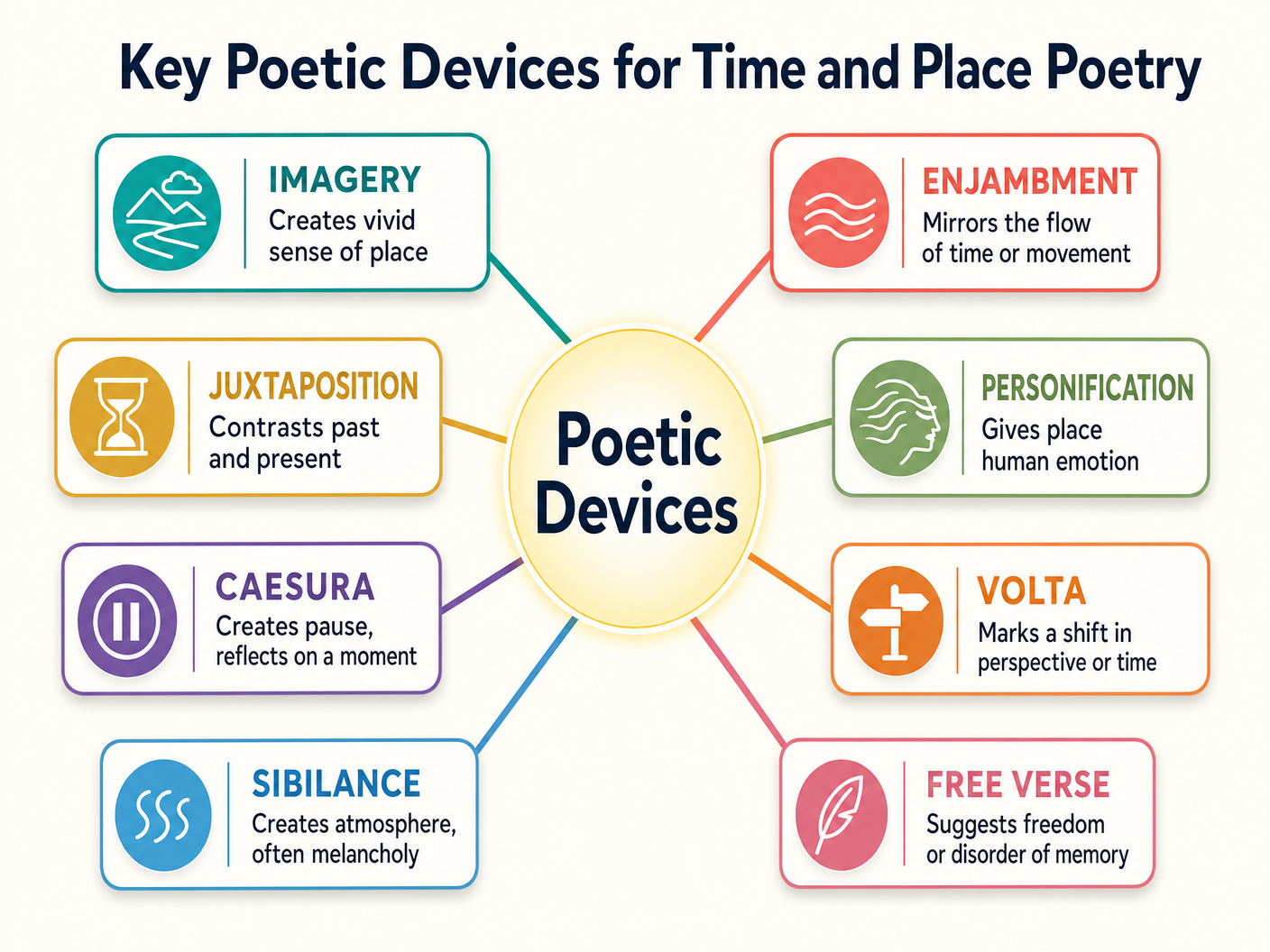
Poets in this anthology use a range of methods to convey their ideas about time and place.
Imagery: Sensory language is crucial for creating a vivid sense of place. Look for how poets use visual, auditory, and tactile imagery to make the reader experience the environment. For example, harsh, industrial imagery might contrast with soft, natural descriptions.
Structure and Form: The shape of the poem often reflects its meaning. Enjambment can mimic the unstoppable flow of time or the rush of memory. Conversely, a caesura (a deliberate pause) often marks a moment of reflection, hesitation, or a sudden shift in perspective (a volta).
Contrast and Juxtaposition: These are the engines of comparison in this anthology. Poets frequently place opposing ideas side by side—past/present, nature/city, youth/age—to highlight the impact of time.
Context
Context (AO3) must be integrated into your analysis, not bolted on. Consider the historical period in which the poem was written. Does it respond to the Industrial Revolution, post-war societal changes, or modern globalization? How does the poet's own background (e.g., migration, childhood experiences) influence their perspective on the place described? Examiners reward candidates who show how context shapes the meaning of the poem.
Visual Resources
2 diagrams and illustrations
Interactive Diagrams
1 interactive diagram to visualise key concepts
Conceptual Flow Outline
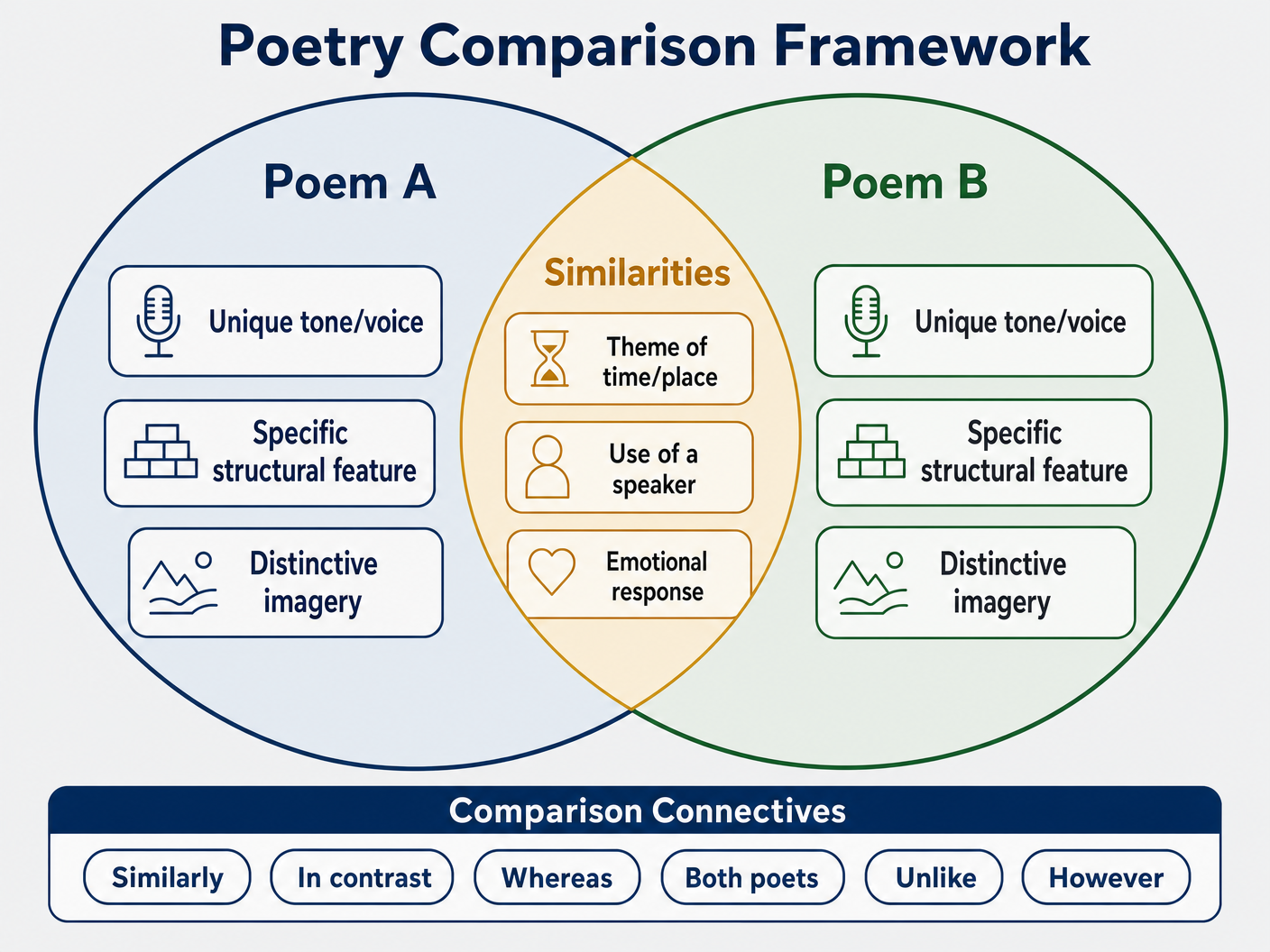
Workflow for planning a Poetry Comparison Essay
Worked Examples
2 detailed examples with solutions and examiner commentary
Practice Questions
Test your understanding — click to reveal model answers
Compare how poets present the loss of a familiar place in Poem D and one other poem from the anthology. (30 marks)
Hint: Consider the different reasons for the loss (e.g., the passage of time, urban development, forced migration) and how the poets use tone to convey the emotional impact.
Compare how poets present the relationship between humanity and nature in Poem E and one other poem. (30 marks)
Hint: Look for juxtaposition between the natural and the man-made. Does nature conquer man, or does man destroy nature?
Compare how poets use structure and form to present the passing of time in Poem F and one other poem. (30 marks)
Hint: This question specifically targets AO2 structure. Focus heavily on enjambment, caesura, stanza length, rhyme scheme, and volta.
Compare how poets present the concept of 'home' in Poem G and one other poem. (30 marks)
Hint: Is 'home' a physical place, a memory, or a feeling? How do the poets use sensory imagery to create a sense of belonging or alienation?