A View from the Bridge Revision Notes

    Introduction

    Comprehensive revision notes for Edexcel IGCSE.

    Summary & Overview

    A View from the Bridge is a gripping, fast-paced modern tragedy that explores honour, jealousy, and betrayal in 1950s Brooklyn. Studying this play rewards candidates who can unpick Arthur Miller's precise stage directions, understand the suffocating power of community codes, and track the inevitable downfall of its flawed protagonist, Eddie Carbone.

    Study Material

    ![Header image for A View from the Bridge](https://xnnrgnazirrqvdgfhvou.supabase.co/storage/v1/object/public/study-guide-assets/guide_9917fb99-26fb-497b-b91c-fb604a166176/header_image.png) ## Overview Arthur Miller's *A View from the Bridge* is a masterclass in modern tragedy, set against the backdrop of the Brooklyn docks in the 1950s. It explores the fatal consequences of unchecked desire, the clash between community honour codes and formal law, and the destructive nature of rigid masculinity. For the Edexcel IGCSE Literature exam, examiners are looking for perceptive, critical engagement (AO1) combined with a detailed analysis of Miller's dramatic methods (AO2). The strongest candidates do not merely recount the plot; they analyse *how* Miller constructs tension, *why* he uses Alfieri as a chorus, and the specific effects of his precise stage directions. Context (AO3) is also crucial, but it must be seamlessly woven into your argument—showing how the McCarthy era and Sicilian immigrant experiences shape the characters' decisions. ![A View from the Bridge Revision Podcast](https://xnnrgnazirrqvdgfhvou.supabase.co/storage/v1/object/public/study-guide-assets/guide_9917fb99-26fb-497b-b91c-fb604a166176/a_view_from_the_bridge_podcast.mp3) ## Plot/Content Overview **Act One**: The play opens with Alfieri, a lawyer, introducing the Italian-American community of Red Hook. We meet Eddie Carbone, a longshoreman, his wife Beatrice, and his orphaned niece Catherine, whom he has raised. Eddie is fiercely overprotective of Catherine, who has just been offered a job as a stenographer. The household dynamic is disrupted by the arrival of Beatrice's cousins, Marco and Rodolfo, who have entered the country illegally from Sicily to find work. Catherine and the young, vibrant Rodolfo quickly fall in love. Eddie's possessiveness turns into intense jealousy. He tries to undermine Rodolfo, claiming he is unmasculine and only wants to marry Catherine for American citizenship. The act culminates in a tense scene where Eddie 'teaches' Rodolfo to box, striking him, which prompts Marco to lift a heavy chair above Eddie's head as a silent, menacing warning. **Act Two**: Time has passed, and Catherine and Rodolfo are planning to marry. Eddie, increasingly desperate and unable to control his feelings, visits Alfieri, who tells him the law cannot stop the marriage. In a fatal moment of hubris, Eddie breaks the ultimate community taboo: he calls the Immigration Bureau to report Marco and Rodolfo. Immigration officers arrive and arrest the brothers, along with two other immigrants staying upstairs. The community turns its back on Eddie for being an informer. Marco, furious at the betrayal, spits in Eddie's face and accuses him in front of the neighbourhood. Out on bail, Marco returns to confront Eddie. Eddie demands his "name" (his reputation) back, drawing a knife. In the ensuing struggle, Eddie is killed with his own blade, dying in Beatrice's arms. Alfieri delivers a final, mournful reflection on the inevitability of the tragedy. ## Themes ![Key Themes in A View from the Bridge](https://xnnrgnazirrqvdgfhvou.supabase.co/storage/v1/object/public/study-guide-assets/guide_9917fb99-26fb-497b-b91c-fb604a166176/themes_diagram.png) ### Theme 1: Honour, Reputation and the Code of Silence In the Red Hook community, honour is more important than the formal law. The "code of silence" dictates that you never inform on your own people to the authorities. Eddie's betrayal of Marco and Rodolfo destroys his reputation, leading to his ultimate downfall. Miller explores how the desperate need to maintain one's "name" can drive a person to self-destruction. **Key Quotes**: - "I want my name!" (Act Two) - Eddie's final, desperate demand reveals that his identity is entirely bound up in his community reputation. Without it, he has nothing. - "You can quicker get back a million dollars that was stole than a word that you gave away." (Act One) - Alfieri's warning to Eddie foreshadows the irreversible nature of Eddie's betrayal. ### Theme 2: Justice and the Law Miller sets up a conflict between the formal American legal system (represented by Alfieri) and the informal, tribal justice of the Sicilian immigrants. Alfieri notes that the law is not always just, and justice is not always legal. Eddie seeks legal help to stop Rodolfo, but the law cannot intervene in matters of the heart, leading Eddie to use the law as a weapon of betrayal. **Key Quotes**: - "Now we settle for half, and I like it better." (Act One) - Alfieri explains that the American legal system requires compromise, unlike the absolute, bloody justice of Sicily. - "The law is nature. The law is only a word for what has a right to happen." (Act Two) - Alfieri tries to explain to Marco that personal revenge has no place in the formal legal system. ### Theme 3: Love, Obsession and Jealousy Eddie's unspoken, inappropriate desire for his niece Catherine drives the tragic plot. His protective uncle role masks a deep, destructive jealousy. Because Eddie cannot admit his true feelings, even to himself, they manifest as irrational hatred toward Rodolfo. **Key Quotes**: - "You want somethin' else, Eddie, and you can never have her!" (Act Two) - Beatrice finally forces the unspoken truth into the open, shattering Eddie's self-deception. - "He's a rat! He belongs in the sewer!" (Act Two) - Eddie's extreme, visceral reaction to Rodolfo stems from intense jealousy rather than any actual wrongdoing by Rodolfo. ### Theme 4: Masculinity and Gender Roles Eddie holds rigid, traditional views of masculinity, believing a man should be a strong provider and unquestioned head of the household. He feels emasculated by Rodolfo, who can sing, cook, and make dresses—skills Eddie associates with femininity. Eddie's tragic flaw is partly his inability to adapt to a changing world and different expressions of manhood. **Key Quotes**: - "The guy ain't right." (Act One) - Eddie repeatedly uses this phrase to suggest Rodolfo is homosexual or unmanly, attempting to undermine him. - "I don't understand this. He's not a man." (Act One) - Eddie's narrow definition of masculinity blinds him to Rodolfo's genuine qualities. ## Character Analysis ![Character Relationships in A View from the Bridge](https://xnnrgnazirrqvdgfhvou.supabase.co/storage/v1/object/public/study-guide-assets/guide_9917fb99-26fb-497b-b91c-fb604a166176/character_relationships.png) ### Eddie Carbone **Role**: The tragic protagonist; a Brooklyn longshoreman. **Key Traits**: Protective, traditional, stubborn, self-deceiving, deeply flawed. **Character Arc**: Eddie begins as a respected, hardworking family man. His inability to let go of Catherine and his refusal to acknowledge his inappropriate feelings lead him to break the community's most sacred rule, resulting in his isolation and death. **Essential Quotes**: - "I ain't no punk." (Act One) - "I want my respect!" (Act Two) ### Alfieri **Role**: The narrator and lawyer; functions as a Greek chorus. **Key Traits**: Educated, objective, helpless, reflective. **Character Arc**: Alfieri watches the tragedy unfold, fully aware of where it is heading, but is powerless to stop it. He bridges the gap between the audience and the characters, and between the law and the community. **Essential Quotes**: - "I could see every step coming, step after step, like a dark figure walking down a hall toward a certain door." (Act One) - "I mourn him—I admit it—with a certain... alarm." (Act Two) ### Catherine **Role**: Eddie's niece; the catalyst for the conflict. **Key Traits**: Innocent, eager to please, increasingly independent. **Character Arc**: Catherine transitions from a naive, compliant girl who seeks Eddie's approval to a young woman who asserts her independence and ultimately condemns Eddie's actions. **Essential Quotes**: - "Here! I'll light it for you!" (Act One - showing her subservience to Eddie) - "He's a rat! He belongs in the sewer!" (Act Two - her final, furious rejection of Eddie) ### Beatrice **Role**: Eddie's wife; Catherine's aunt. **Key Traits**: Perceptive, patient, frustrated, ultimately loyal. **Character Arc**: Beatrice sees the truth of Eddie's feelings long before anyone else. She tries to mediate and save her marriage, ultimately confronting Eddie with the truth. Despite his betrayal, she stays with him at the end. **Essential Quotes**: - "When am I gonna be a wife again, Eddie?" (Act One) - "You want somethin' else, Eddie, and you can never have her!" (Act Two) ### Marco **Role**: Beatrice's cousin; Rodolfo's protective older brother. **Key Traits**: Strong, silent, honourable, driven by duty. **Character Arc**: Marco arrives grateful to Eddie but becomes his nemesis. He represents the old Sicilian code of absolute justice and honour, ultimately enacting revenge when the American law fails him. **Essential Quotes**: - "He degraded my brother. My blood. He robbed my children, he mocks my work." (Act Two) - "Animal! You go on your knees to me!" (Act Two) ## Writer's Methods **Stage Directions**: Miller's stage directions are highly prescriptive and act as a crucial narrative tool. For example, when Marco lifts the chair, the direction reads: *"Marco is face to face with Eddie, a strained tension gripping his eyes and jaw, his neck stiff, the chair raised like a weapon over Eddie's head."* This creates immense visual tension and foreshadows the final conflict. **The Greek Chorus**: By using Alfieri as a narrator, Miller elevates a domestic drama to the level of classical tragedy. Alfieri breaks the fourth wall, speaking directly to the audience. This creates dramatic irony—we know the ending is inevitable, shifting the tension from *what* will happen to *how* it will happen. **Colloquial Language**: Miller captures the rhythms of working-class Brooklyn speech. Eddie's language is limited and repetitive (e.g., "He ain't right"), reflecting his inability to articulate complex emotions. This linguistic limitation is a key part of his tragedy; he acts out physically because he cannot express himself verbally. **Symbolism**: The Brooklyn Bridge symbolises the connection and the divide between the insular immigrant community and wider American society. High heels and short skirts symbolise Catherine's burgeoning sexuality and independence. The knife symbolises phallic power, violence, and ultimate destruction. ## Context **McCarthyism and the Red Scare**: Written in 1955, the play reflects the paranoia of the McCarthy era, where Americans were encouraged to inform on suspected communists. Miller despised the House Un-American Activities Committee (HUAC). Eddie's act of informing on the immigrants mirrors the betrayals of the Red Scare, highlighting the moral repugnance of the 'informer'. **Greek Tragedy**: Miller consciously modelled the play on Greek tragedy. He believed the tragic mode was not just for kings and queens, but for the common man (as outlined in his essay *Tragedy and the Common Man*). Eddie's 'hubris' (fatal pride) and his inevitable march toward a predestined doom are classic tragic elements. **Immigration and the American Dream**: The play highlights the struggles of Italian immigrants in mid-20th century America. Marco and Rodolfo represent the desperate pursuit of the American Dream, willing to risk everything for a better life. The Red Hook community operates on its own Old World codes, isolated from the mainstream society that surrounds it.

    A View from the Bridge

    Edexcel
    IGCSE
    English Literature

    A View from the Bridge is a gripping, fast-paced modern tragedy that explores honour, jealousy, and betrayal in 1950s Brooklyn. Studying this play rewards candidates who can unpick Arthur Miller's precise stage directions, understand the suffocating power of community codes, and track the inevitable downfall of its flawed protagonist, Eddie Carbone.

    10
    Min Read
    2
    Examples
    4
    Questions
    8
    Key Terms
    🎙 Podcast Episode
    A View from the Bridge
    0:00-0:00

    Study Notes

    Header image for A View from the Bridge

    Overview

    Arthur Miller's A View from the Bridge is a masterclass in modern tragedy, set against the backdrop of the Brooklyn docks in the 1950s. It explores the fatal consequences of unchecked desire, the clash between community honour codes and formal law, and the destructive nature of rigid masculinity. For the Edexcel IGCSE Literature exam, examiners are looking for perceptive, critical engagement (AO1) combined with a detailed analysis of Miller's dramatic methods (AO2). The strongest candidates do not merely recount the plot; they analyse how Miller constructs tension, why he uses Alfieri as a chorus, and the specific effects of his precise stage directions. Context (AO3) is also crucial, but it must be seamlessly woven into your argument—showing how the McCarthy era and Sicilian immigrant experiences shape the characters' decisions.

    A View from the Bridge Revision Podcast

    Plot/Content Overview

    Act One: The play opens with Alfieri, a lawyer, introducing the Italian-American community of Red Hook. We meet Eddie Carbone, a longshoreman, his wife Beatrice, and his orphaned niece Catherine, whom he has raised. Eddie is fiercely overprotective of Catherine, who has just been offered a job as a stenographer. The household dynamic is disrupted by the arrival of Beatrice's cousins, Marco and Rodolfo, who have entered the country illegally from Sicily to find work. Catherine and the young, vibrant Rodolfo quickly fall in love. Eddie's possessiveness turns into intense jealousy. He tries to undermine Rodolfo, claiming he is unmasculine and only wants to marry Catherine for American citizenship. The act culminates in a tense scene where Eddie 'teaches' Rodolfo to box, striking him, which prompts Marco to lift a heavy chair above Eddie's head as a silent, menacing warning.

    Act Two: Time has passed, and Catherine and Rodolfo are planning to marry. Eddie, increasingly desperate and unable to control his feelings, visits Alfieri, who tells him the law cannot stop the marriage. In a fatal moment of hubris, Eddie breaks the ultimate community taboo: he calls the Immigration Bureau to report Marco and Rodolfo. Immigration officers arrive and arrest the brothers, along with two other immigrants staying upstairs. The community turns its back on Eddie for being an informer. Marco, furious at the betrayal, spits in Eddie's face and accuses him in front of the neighbourhood. Out on bail, Marco returns to confront Eddie. Eddie demands his "name" (his reputation) back, drawing a knife. In the ensuing struggle, Eddie is killed with his own blade, dying in Beatrice's arms. Alfieri delivers a final, mournful reflection on the inevitability of the tragedy.

    Themes
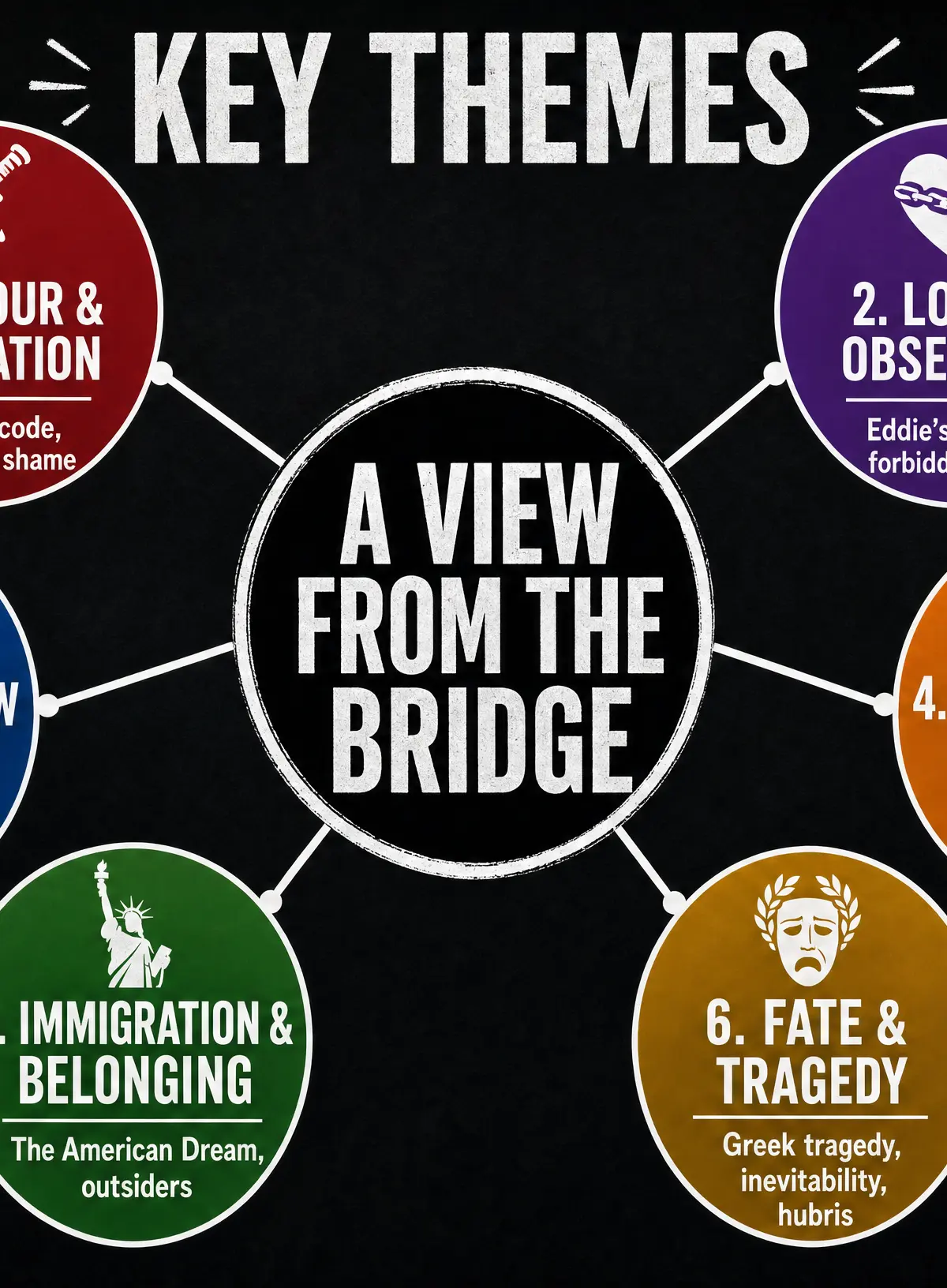
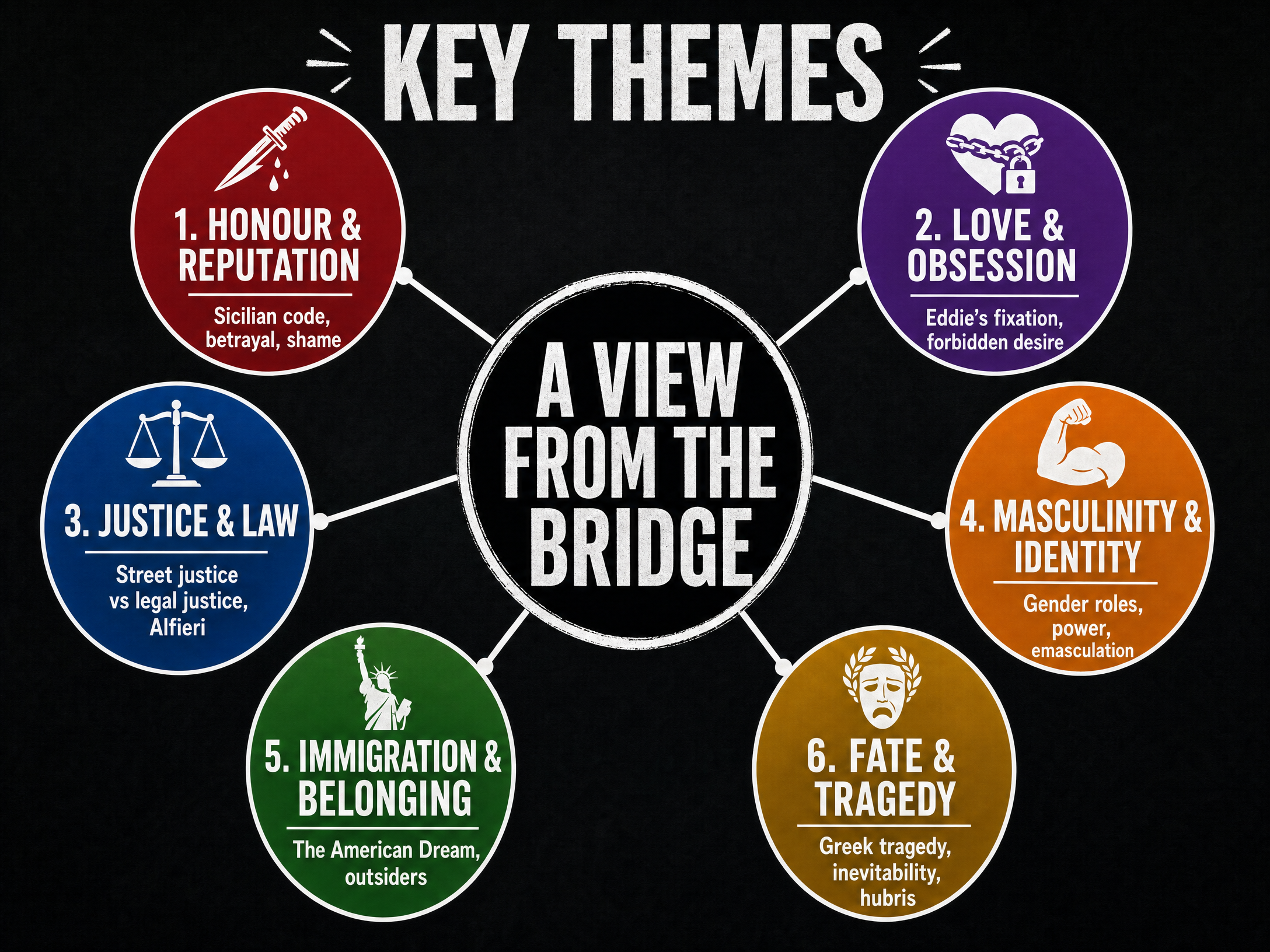
    Key Themes in A View from the Bridge

    Theme 1: Honour, Reputation and the Code of Silence

    In the Red Hook community, honour is more important than the formal law. The "code of silence" dictates that you never inform on your own people to the authorities. Eddie's betrayal of Marco and Rodolfo destroys his reputation, leading to his ultimate downfall. Miller explores how the desperate need to maintain one's "name" can drive a person to self-destruction.

    Key Quotes:

    • "I want my name!" (Act Two) - Eddie's final, desperate demand reveals that his identity is entirely bound up in his community reputation. Without it, he has nothing.
    • "You can quicker get back a million dollars that was stole than a word that you gave away." (Act One) - Alfieri's warning to Eddie foreshadows the irreversible nature of Eddie's betrayal.

    Theme 2: Justice and the Law

    Miller sets up a conflict between the formal American legal system (represented by Alfieri) and the informal, tribal justice of the Sicilian immigrants. Alfieri notes that the law is not always just, and justice is not always legal. Eddie seeks legal help to stop Rodolfo, but the law cannot intervene in matters of the heart, leading Eddie to use the law as a weapon of betrayal.

    Key Quotes:

    • "Now we settle for half, and I like it better." (Act One) - Alfieri explains that the American legal system requires compromise, unlike the absolute, bloody justice of Sicily.
    • "The law is nature. The law is only a word for what has a right to happen." (Act Two) - Alfieri tries to explain to Marco that personal revenge has no place in the formal legal system.

    Theme 3: Love, Obsession and Jealousy

    Eddie's unspoken, inappropriate desire for his niece Catherine drives the tragic plot. His protective uncle role masks a deep, destructive jealousy. Because Eddie cannot admit his true feelings, even to himself, they manifest as irrational hatred toward Rodolfo.

    Key Quotes:

    • "You want somethin' else, Eddie, and you can never have her!" (Act Two) - Beatrice finally forces the unspoken truth into the open, shattering Eddie's self-deception.
    • "He's a rat! He belongs in the sewer!" (Act Two) - Eddie's extreme, visceral reaction to Rodolfo stems from intense jealousy rather than any actual wrongdoing by Rodolfo.

    Theme 4: Masculinity and Gender Roles

    Eddie holds rigid, traditional views of masculinity, believing a man should be a strong provider and unquestioned head of the household. He feels emasculated by Rodolfo, who can sing, cook, and make dresses—skills Eddie associates with femininity. Eddie's tragic flaw is partly his inability to adapt to a changing world and different expressions of manhood.

    Key Quotes:

    • "The guy ain't right." (Act One) - Eddie repeatedly uses this phrase to suggest Rodolfo is homosexual or unmanly, attempting to undermine him.
    • "I don't understand this. He's not a man." (Act One) - Eddie's narrow definition of masculinity blinds him to Rodolfo's genuine qualities.

    Character Analysis
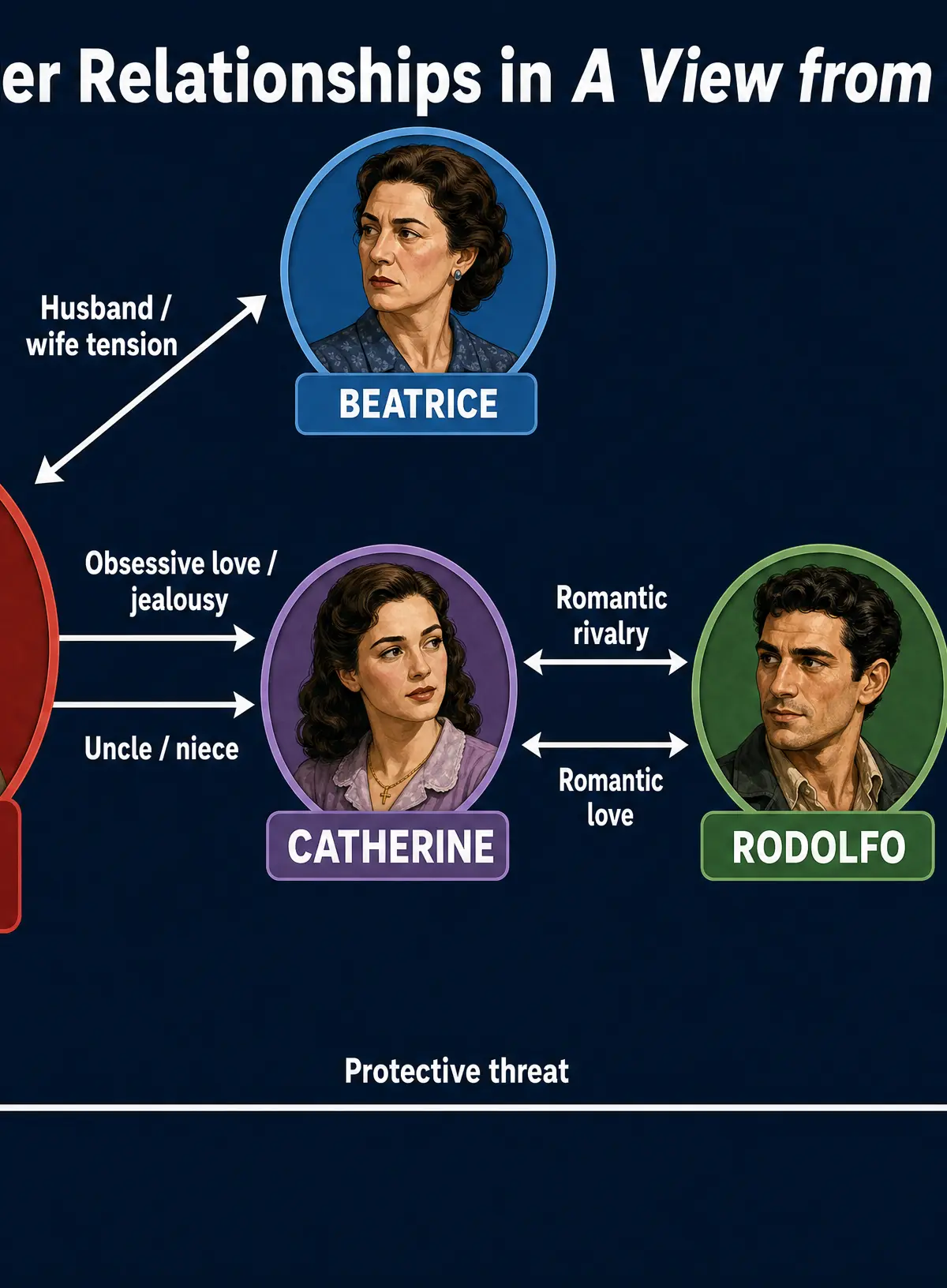
    Character Relationships in A View from the Bridge

    Eddie Carbone

    Role: The tragic protagonist; a Brooklyn longshoreman.

    Key Traits: Protective, traditional, stubborn, self-deceiving, deeply flawed.

    Character Arc: Eddie begins as a respected, hardworking family man. His inability to let go of Catherine and his refusal to acknowledge his inappropriate feelings lead him to break the community's most sacred rule, resulting in his isolation and death.

    Essential Quotes:

    • "I ain't no punk." (Act One)
    • "I want my respect!" (Act Two)

    Alfieri

    Role: The narrator and lawyer; functions as a Greek chorus.

    Key Traits: Educated, objective, helpless, reflective.

    Character Arc: Alfieri watches the tragedy unfold, fully aware of where it is heading, but is powerless to stop it. He bridges the gap between the audience and the characters, and between the law and the community.

    Essential Quotes:

    • "I could see every step coming, step after step, like a dark figure walking down a hall toward a certain door." (Act One)
    • "I mourn him—I admit it—with a certain... alarm." (Act Two)

    Catherine

    Role: Eddie's niece; the catalyst for the conflict.

    Key Traits: Innocent, eager to please, increasingly independent.

    Character Arc: Catherine transitions from a naive, compliant girl who seeks Eddie's approval to a young woman who asserts her independence and ultimately condemns Eddie's actions.

    Essential Quotes:

    • "Here! I'll light it for you!" (Act One - showing her subservience to Eddie)
    • "He's a rat! He belongs in the sewer!" (Act Two - her final, furious rejection of Eddie)

    Beatrice

    Role: Eddie's wife; Catherine's aunt.

    Key Traits: Perceptive, patient, frustrated, ultimately loyal.

    Character Arc: Beatrice sees the truth of Eddie's feelings long before anyone else. She tries to mediate and save her marriage, ultimately confronting Eddie with the truth. Despite his betrayal, she stays with him at the end.

    Essential Quotes:

    • "When am I gonna be a wife again, Eddie?" (Act One)
    • "You want somethin' else, Eddie, and you can never have her!" (Act Two)

    Marco

    Role: Beatrice's cousin; Rodolfo's protective older brother.

    Key Traits: Strong, silent, honourable, driven by duty.

    Character Arc: Marco arrives grateful to Eddie but becomes his nemesis. He represents the old Sicilian code of absolute justice and honour, ultimately enacting revenge when the American law fails him.

    Essential Quotes:

    • "He degraded my brother. My blood. He robbed my children, he mocks my work." (Act Two)
    • "Animal! You go on your knees to me!" (Act Two)

    Writer's Methods

    Stage Directions: Miller's stage directions are highly prescriptive and act as a crucial narrative tool. For example, when Marco lifts the chair, the direction reads: "Marco is face to face with Eddie, a strained tension gripping his eyes and jaw, his neck stiff, the chair raised like a weapon over Eddie's head." This creates immense visual tension and foreshadows the final conflict.

    The Greek Chorus: By using Alfieri as a narrator, Miller elevates a domestic drama to the level of classical tragedy. Alfieri breaks the fourth wall, speaking directly to the audience. This creates dramatic irony—we know the ending is inevitable, shifting the tension from what will happen to how it will happen.

    Colloquial Language: Miller captures the rhythms of working-class Brooklyn speech. Eddie's language is limited and repetitive (e.g., "He ain't right"), reflecting his inability to articulate complex emotions. This linguistic limitation is a key part of his tragedy; he acts out physically because he cannot express himself verbally.

    Symbolism: The Brooklyn Bridge symbolises the connection and the divide between the insular immigrant community and wider American society. High heels and short skirts symbolise Catherine's burgeoning sexuality and independence. The knife symbolises phallic power, violence, and ultimate destruction.

    Context

    McCarthyism and the Red Scare: Written in 1955, the play reflects the paranoia of the McCarthy era, where Americans were encouraged to inform on suspected communists. Miller despised the House Un-American Activities Committee (HUAC). Eddie's act of informing on the immigrants mirrors the betrayals of the Red Scare, highlighting the moral repugnance of the 'informer'.

    Greek Tragedy: Miller consciously modelled the play on Greek tragedy. He believed the tragic mode was not just for kings and queens, but for the common man (as outlined in his essay Tragedy and the Common Man). Eddie's 'hubris' (fatal pride) and his inevitable march toward a predestined doom are classic tragic elements.

    Immigration and the American Dream: The play highlights the struggles of Italian immigrants in mid-20th century America. Marco and Rodolfo represent the desperate pursuit of the American Dream, willing to risk everything for a better life. The Red Hook community operates on its own Old World codes, isolated from the mainstream society that surrounds it.

    Visual Resources

    2 diagrams and illustrations
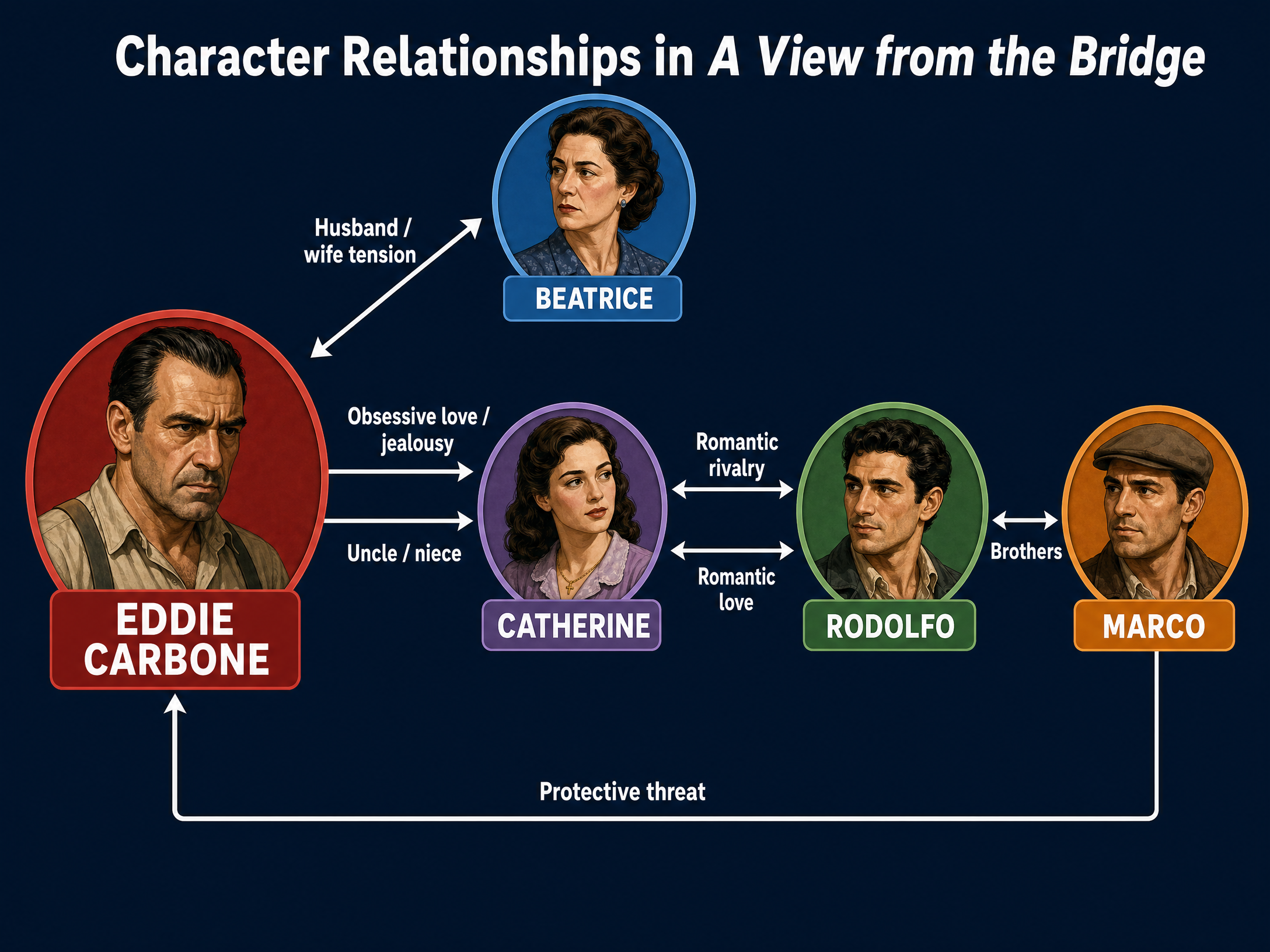
    Character Relationships in A View from the Bridge
    Character Relationships in A View from the Bridge
    Key Themes in A View from the Bridge
    Key Themes in A View from the Bridge

    Interactive Diagrams

    1 interactive diagram to visualise key concepts

    Eddie Carbone's Tragic Arc

    Worked Examples

    2 detailed examples with solutions and examiner commentary

    Practice Questions

    Test your understanding — click to reveal model answers

    Q1

    Explore how Miller presents the theme of betrayal in the play. You must consider the context of the play in your answer. (30 marks + 4 AO4)

    34 marks
    standard

    Hint: Think about the story of Vinny Bolzano in Act 1, Eddie's phone call in Act 2, and how betrayal links to the McCarthy era context.

    Q2

    Starting with the extract where Eddie kisses Catherine and Rodolfo, explore how Miller presents Eddie's loss of control. (30 marks + 4 AO4)

    34 marks
    high

    Hint: Look closely at the stage directions in the extract. How does physical action replace dialogue? Link this to his later loss of control when he calls Immigration.

    Q3

    How does Miller present the character of Catherine and her development in the play? (30 marks + 4 AO4)

    34 marks
    standard

    Hint: Track her journey from subservient child (lighting Eddie's cigar) to independent woman (calling him a rat).

    Q4

    Explore the significance of the setting (Red Hook, Brooklyn) in A View from the Bridge. (30 marks + 4 AO4)

    34 marks
    high

    Hint: Think about the bridge itself, the claustrophobic apartment, and the contrast between the community and the outside world.

    Key Terms

    Essential vocabulary to know